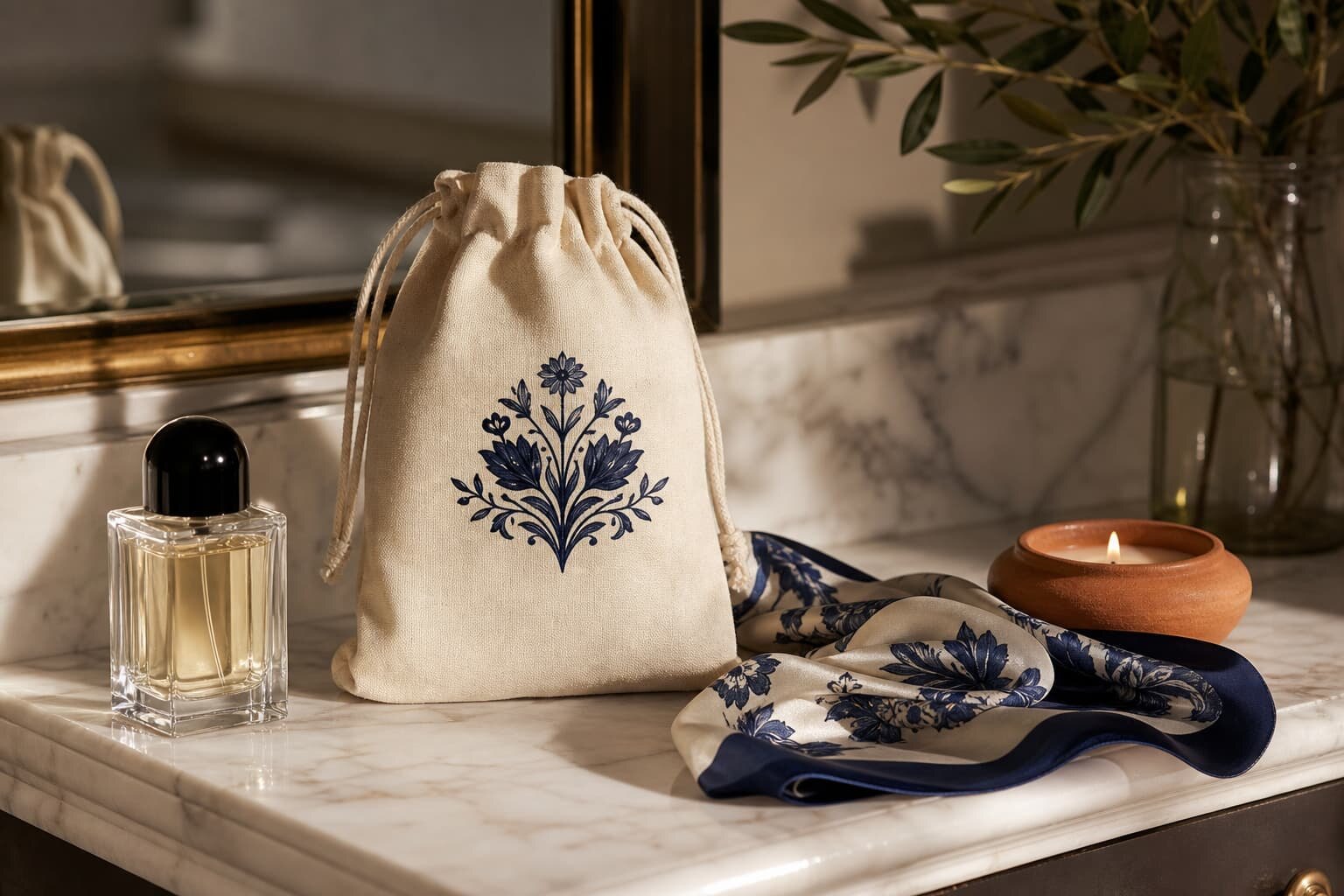
Why a Logo Placement Memo Matters
A drawstring pouch looks simple, but logo placement is one of the most common reasons for sample delays and bulk production arguments. The buyer may approve a digital artwork centered on a rectangle, while the factory is working with fabric that will be folded, sewn, pulled by a cord, filled with product, pressed, and packed. If the approval record only says "logo centered," both sides may be correct in their own way and still produce a pouch the brand cannot use.
A logo placement approval memo solves this by turning visual preference into measurable production instructions. It records the finished pouch size, print size, distance from finished edges, allowable tolerance, artwork file version, sample approval status, and packing method. For procurement teams, it becomes a practical control document attached to the RFQ, PO, pre-production sample, and final inspection plan.
- Use the memo before bulk cutting or printing starts, not after the sales sample is already accepted casually.
- Write measurements in millimeters because they reduce confusion between overseas suppliers, designers, and inspectors.
- Approve placement on a physical sample whenever possible; if not, require a photo with ruler and finished pouch edges visible.
- Keep the memo with the sealed sample so the inspector checks the same placement the buyer approved.
Define the Finished Pouch Before Placing the Logo
Logo placement should always start from the finished pouch size, not the fabric cutting size. A 10 x 15 cm drawstring pouch may require extra fabric for side seams, bottom seam, top hem fold, and drawcord channel. If the designer centers artwork on the cut panel, the finished logo may sit too high, too low, or too close to the cord opening after sewing.
Fabric weight also changes the final look. A 120 GSM cotton pouch folds softly and may collapse around the product, while a 220 GSM cotton canvas pouch has a stronger panel and supports a cleaner front logo. Jute and heavy canvas have rougher surfaces, so small lettering and thin lines need extra caution. The memo should state fabric composition and GSM because the same logo can look different on different material weights.
- Common light cotton pouch: 120-140 GSM for jewelry, tea, small gifts, and giveaways.
- Common mid-weight cotton pouch: 160-180 GSM for cosmetics, accessories, candles, and retail packaging.
- Common canvas pouch: 220-280 GSM when the buyer wants better structure and longer reuse.
- Jute pouch: often selected for natural texture, but fine logo detail is harder to keep clean.
Choose Reference Points That Production Can Measure
A useful approval memo does not say "place the logo in the middle" unless it also defines what middle means. Drawstring pouches have a top folded edge, side seams, bottom seam, cord channel, and sometimes rounded or boxed bottom corners. Production workers and inspectors need reference points that remain visible on the finished product.
For most front logo approvals, measure from the finished top edge to the top of the logo, from the left finished side seam to the left edge of the logo, and confirm the logo width and height. For lower logo placement, also measure from the bottom seam to the bottom of the logo. If the pouch is gusseted or boxed, specify whether the measurement is taken while flat, filled, or standing.
- Top reference: finished folded top edge, not the cut fabric edge before hemming.
- Side reference: visible stitched side seam or finished side edge after turning.
- Bottom reference: bottom seam line or finished bottom edge, depending on pouch construction.
- Centered reference: equal visible margin from left and right side seams after sewing.
Match Logo Placement to Print Method
Screen printing is usually the most practical method for cotton drawstring pouches when the artwork has solid colors and the order quantity supports screen setup. It works well on 120-220 GSM cotton, but placement control depends on whether printing is done before sewing or on finished pouches. Printing before sewing gives a flatter surface, but the factory must control sewing alignment. Printing after sewing confirms the finished panel position, but seams and cords may interfere with the printing jig.
Heat transfer can handle gradients, small details, or multi-color logos at lower quantities, but the buyer should check hand feel, edge film, wash resistance, and whether the transfer mark is acceptable on natural fabric. Embroidery is less common on small pouches because it can pucker light cotton and may feel bulky. Woven side labels are useful for a premium minimal look, but they add label MOQ, lead time, and a separate placement approval.
- Screen print: best for clean one-color or two-color logos on cotton and canvas.
- Heat transfer: useful for detailed or multi-color artwork, but check film edge and heat mark.
- Embroidery: better on heavier canvas than on thin 120 GSM cotton.
- Woven label: good for repeat programs, but confirm label MOQ and sewing direction.
- Patch or debossed component: suitable for premium pouches, but quote the component separately.
Set Practical Tolerances Before Bulk Production
A factory cannot hold zero tolerance on cut-and-sew textile goods. Cotton fabric moves during cutting, printing, sewing, pressing, and packing. A professional memo should define an acceptable tolerance before inspection. For small drawstring pouches, +/-2 mm may be realistic for logo size and placement if the factory uses good jigs and the fabric is stable. For larger pouches or rougher fabric, +/-3 mm to +/-5 mm may be more practical.
Tolerance should be connected to the visual risk. A logo 2 mm off center on a 30 x 40 cm laundry pouch may not matter. The same 2 mm shift on a 7 x 9 cm jewelry pouch can look obvious. If the logo must align with a product window, retail insert, or folded packing face, the buyer should specify a tighter acceptance rule and expect more sampling time.
- Small pouch under 12 cm wide: inspect logo position more strictly because small shifts are visible.
- Medium pouch 13-25 cm wide: +/-2 mm to +/-3 mm is often workable for standard front logos.
- Large pouch over 25 cm wide: allow practical tolerance unless the logo aligns with another component.
- Rough fabric such as jute: expect more edge variation and avoid tiny text.
- Washed cotton: confirm shrinkage before locking placement.
Use the Memo to Compare Supplier Quotes
Many drawstring pouch quotes look cheaper because they leave out details that affect logo placement and approval. One supplier may quote 140 GSM cotton with one-color screen print after sewing. Another may quote 180 GSM cotton, print before sewing, include pre-production samples, and pack each pouch flat with tissue protection. The unit price comparison is not meaningful until the logo method, sample process, material weight, and packing method are aligned.
Your RFQ should ask factories to separate the pouch body cost, logo setup cost, sample cost, custom cord or label cost, packing cost, and estimated wastage for special placement. MOQ logic should also be clear. A factory may accept 500 pieces for a plain cotton pouch but require 1,000 pieces for custom dyed fabric, 2,000 pieces for custom woven labels, or a screen charge for each color. The approval memo helps reveal these cost drivers early.
- Ask whether screen setup is charged once per artwork, per color, per size, or per repeat order.
- Confirm whether the quoted fabric is greige, bleached, natural, dyed, organic, recycled, or custom color.
- Check if custom drawcord color has a separate MOQ from the pouch body.
- Ask if the quoted price includes pre-production sample correction after the first sample is rejected.
- Require carton dimensions, gross weight estimate, and packing quantity per carton for landed cost planning.
Approve Samples With Real Use Conditions
A flat sample on a desk is not enough for logo placement approval if the pouch will be filled with product. A pouch for a bottle, candle, cosmetic jar, hotel amenity kit, cable set, or jewelry box changes shape after filling. The front panel may curve, the bottom may bulge, and the drawcord may pull the top inward. The memo should state whether placement approval is based on flat empty condition, filled condition, or both.
The sample review should include measurements, photos, and handling checks. Ask the factory to send close-up photos with a ruler showing logo width, logo height, top distance, side distance, and bottom distance. Also check drawcord length, knot location, top hem height, side seam straightness, and whether the printed area wrinkles after tightening. If the sample will be sealed, write the seal number or approved sample date into the memo.
- Check the logo while the pouch is flat, lightly filled, and fully tightened.
- Confirm whether the logo remains visible when the drawcord is pulled closed.
- Inspect ink edges for bleeding on natural cotton and rough canvas.
- Rub the printed area after curing to check obvious ink transfer.
- Photograph the approved sample with a ruler and artwork sheet in the same frame.
Prevent Common Placement Mistakes
The most common mistake is approving artwork on a digital rectangle that does not show the top hem fold. On drawstring pouches, the cord channel can consume a significant portion of the upper panel. If the logo is placed too close to the top, the drawcord knot, gathered fabric, or fold shadow may cover the brand mark when the pouch is closed. This is especially risky on small jewelry and cosmetic pouches.
Another frequent problem is ignoring print distortion after sewing and packing. If the factory prints panels first, sewing variation can shift the logo left or right. If the factory prints finished pouches, the print platen may not sit evenly because of side seams and drawcord bulk. Tight packing can crease the logo, especially if pouches are bundled before ink is fully cured. The memo should define sequence, drying time, and packing protection when the logo is sensitive.
- Do not place small text across heavy weave, jute slubs, or seam areas.
- Avoid printing too close to the bottom seam if the pouch will stand filled.
- Do not approve logo position without knowing the final top hem height.
- Avoid judging white ink coverage on dark fabric only from supplier photos.
- Do not let a sales sample become the approval standard if it was made with different fabric GSM.
Connect Packing to Logo Protection
Packing is part of logo quality control, not just a shipping detail. A good print can arrive with pressure marks, scratches, ink transfer, or deep creases if pouches are packed too soon, folded across the logo, or compressed in cartons. For retail buyers, a front logo crease may create the same rejection risk as a print defect. The memo should state how the logo face is protected during folding, bundling, and carton packing.
For basic wholesale orders, flat bulk packing by 50 or 100 pieces per polybag may be acceptable. For premium retail packaging, individual paper bands, tissue sheets, or specific fold lines may be required. If the pouch is packed inside another product kit, confirm whether the logo must face outward, be visible through a window, or remain uncreased after insertion. These details affect labor time, carton size, and quote accuracy.
- State whether pouches are packed flat, folded once, rolled, or inserted into retail packaging.
- Avoid fold lines crossing the logo unless the buyer approves the final packed appearance.
- Require curing time before packing for screen print or heat transfer decoration.
- Ask for carton loading photos when the order has a high-value printed front panel.
- Include packing method in final inspection because it can change the appearance at arrival.
Build the Approval Memo Into the Sourcing Workflow
The memo should not be a separate document that only the designer sees. It belongs in the sourcing workflow from RFQ to shipment. At RFQ stage, it tells suppliers how to quote the correct fabric, print method, setup cost, sample cost, MOQ, tolerance, and packing labor. At sampling stage, it records what has been approved and what must be corrected. At production stage, it becomes the instruction for the printing and sewing line.
At inspection stage, the memo becomes the acceptance standard. The inspector should not rely on memory, email screenshots, or a low-resolution mockup. They should compare bulk goods against the approved sample and the memo dimensions. If a claim occurs, the buyer and factory can review the same written standard instead of debating subjective placement. This is especially important for distributors managing multiple brand versions under one pouch size.
- Attach the memo to the RFQ so every supplier quotes the same placement requirement.
- Update the memo after sample correction and remove outdated artwork versions.
- Send the final memo with PO, artwork, packing instructions, and inspection checklist.
- Require factory confirmation before bulk printing begins.
- Use the same memo for reorder control, especially if the factory changes material batch or print line.
Specification comparison for buyers
| Spec decision | Recommended option | When it fits | Buyer risk to check |
|---|---|---|---|
| Front center logo on 10 x 15 cm cotton pouch | Keep print within 55 x 65 mm and at least 35 mm below top edge | Jewelry, cosmetics, amenity kits, small gift packaging | Logo drifting into the drawcord channel after hemming or appearing too high when filled |
| Logo on lower front panel | Place baseline 25-35 mm above bottom seam allowance | Retail packaging where the pouch is displayed standing or filled | Bottom seam curve and filled shape may hide the lower part of the artwork |
| Side label instead of front print | Woven or printed label sewn into side seam, usually 15-25 mm visible width | Premium gifting, minimalist branding, multi-market SKUs | Label orientation, wash shrinkage, and MOQ for custom woven labels |
| Large all-over logo or pattern | Panel print before sewing with registration tolerance written in memo | Fashion, promotional launches, subscription packaging | Higher wastage, print alignment issues across seams, and higher sampling cost |
| Logo near drawstring opening | Use only if artwork is small and not blocked by cord knot | Small brand mark, batch icon, refillable pouch program | Cord movement, top hem fold, and knot position can cover the logo |
| Debossed or embossed logo on non-woven or PU patch | Attach patch after confirming stitch margin and patch thickness | Higher perceived value or reusable accessory pouch | Extra component MOQ, patch color variation, and sewing distortion on light fabric |
Buyer checklist before sampling
- Confirm final pouch size after sewing, not only flat fabric panel size before hemming.
- Approve logo position from finished edges: top folded edge, left seam, right seam, and bottom seam.
- State artwork size in millimeters and include acceptable tolerance, usually +/-2 mm for small pouches and +/-3 mm for larger fabric bags.
- Check whether print is applied before sewing or after sewing, because the placement method changes registration risk.
- Match print method to fabric weight: screen print for most cotton pouches, heat transfer for small detailed color work, woven label for premium low-ink branding.
- Review a filled sample as well as a flat sample, especially for pouches used for bottles, cosmetics, cables, jewelry, or irregular kits.
- Approve logo color against a fabric swatch under normal light and avoid judging only from a digital artwork file.
- Mark whether drawcord color, knot length, stopper, bead, or metal tip can visually interfere with the logo.
- Require pre-production sample photos with ruler, front view, side view, top hem close-up, and packing fold method.
- Attach the signed memo to the PO, artwork file, sample seal record, and final inspection checklist.
Factory quote questions to send
- What is the finished pouch size tolerance after cutting, sewing, washing if applicable, and pressing?
- Will the logo be printed before sewing or on finished pouches, and what placement tolerance can the factory hold in bulk?
- What fabric weight is quoted, such as 120 GSM, 140 GSM, 180 GSM, 220 GSM cotton, canvas, jute, or recycled blend?
- Which print method is included in the quote, and is the screen setup, film, plate, digital file handling, or label tooling charged separately?
- What is the MOQ for the pouch body, custom cord color, custom woven label, and each logo color?
- How many pre-production samples are included, and are courier fees, artwork revisions, and re-sampling costs excluded?
- What is the estimated lead time after artwork approval, material approval, deposit, and final sample signoff?
- How will pouches be packed: flat, folded, bundled, individual polybag, paper band, master carton, or retail-ready inner box?
- What inspection standard will be used for logo placement, print defects, fabric stains, seam strength, and carton labeling?
- Can the factory provide bulk production photos from cutting, printing, sewing, trimming, pressing, and packing before shipment?
Quality-control points to confirm
- Measure logo position from finished pouch edges, not from a loose fabric panel or digital mockup.
- Check top hem fold width and drawcord channel height because they directly affect the visible front panel.
- Inspect the first 30-50 printed pieces before mass sewing or before continuing finished-pouch printing.
- Confirm ink coverage on textured cotton, canvas, jute, and dyed fabric because rough weave can break fine lines.
- Compare printed logo color to the approved sample under daylight-equivalent lighting and normal office lighting.
- Test rub resistance after drying or curing, especially for dark ink on natural cotton and white ink on dyed fabric.
- Check logo skew against both side seams because a pouch may look straight when flat but twist after drawcord tightening.
- Review packing pressure because tight bundles can crease fresh prints, transfer ink, or distort the logo panel.