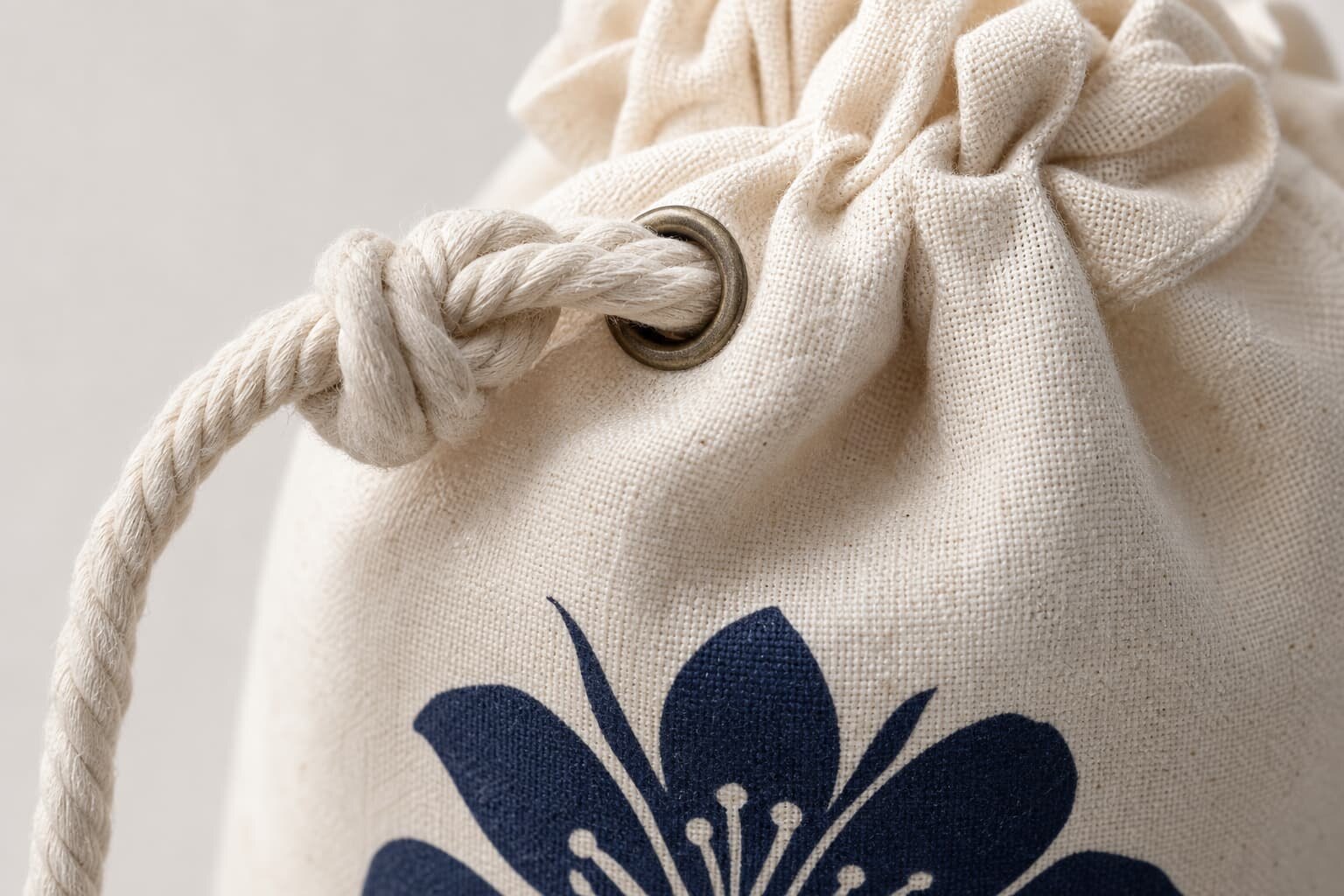
Start with the failure mode, not the decoration
A drawstring pouch with a handle seam should be treated as a load-bearing product, not just a printed giveaway bag. Once the handle becomes part of the carry function, the seam is no longer a cosmetic detail. It has to survive folding, carton pressure, and repeat handling from the factory floor to the warehouse. Many buyer disputes start because the supplier quoted a decorative pouch while the buyer expected a usable carry item.
The first RFQ decision is simple: define what the pouch must survive. Will it be carried by hand, used as a retail gift bag, packed into a larger shipper, or tucked into another product as an insert? That answer changes the fabric weight, seam build, and packing method. For a soft promotional pouch, 120-140 GSM cotton can be acceptable. For a reusable retail pouch, 140-160 GSM is a safer base, and heavier canvas may be more appropriate when the handle will take real daily use.
- State the load case before asking for a unit price.
- Tell the factory whether the handle is decorative or carry-rated.
- Ask for a packing sketch that matches the final use, not a display sample.
Build the pouch so the seam survives carton pressure
The handle attachment style is the biggest technical choice in this product. If the handle is sewn into the top binding, the seam has to share load with the drawstring tunnel. If it is attached into the side seam, the handle can pull the panel out of shape unless the factory adds bartacks or a reinforcement patch. A separate folded loop with reinforced ends is usually more stable than a quick one-line attachment, especially when the pouch is packed tightly.
Ask the supplier to specify seam allowance, stitch density, thread type, and reinforcement placement on the approval sheet. A 3-4 mm stitch length and 8-12 mm seam allowance are common starting points for cotton and canvas pouches, but the right setup depends on the fabric and the load. More stitches are not always better. Too many stitches can perforate lighter fabric and create a tear line right where the handle enters the seam.
- Use bartacks or a reinforcement patch at every load point.
- Avoid putting the highest stitch density on thin fabric without testing.
- Make the factory mark the exact handle entry point on the sample.
Choose fabric and print specs that do not weaken the seam
Fabric weight affects both seam strength and how the pouch behaves in packing. A 100-120 GSM cotton pouch is light and economical, but the handle seam may twist or wrinkle under stacked cartons. A 140-160 GSM cotton or light canvas construction is often the practical middle ground for brand buyers because it balances cost, appearance, and fold recovery. If the pouch is premium, carry-oriented, or expected to survive repeat use, 200-280 GSM canvas gives better body and hides minor sewing variation more effectively.
Decoration can also weaken the seam area if it is not planned around the fold line. One-color screen print is usually the safest and most cost-effective option when the artwork stays clear of the stitch path. Heat transfer can sit across a wider area, but it may crack if the pouch is folded sharply in packing. Embroidery gives a premium finish, but it adds bulk and stiffness near the handle. If the logo sits close to the seam, test it in the actual packed fold, not only on a flat artwork proof.
- Keep print out of the seam allowance whenever possible.
- Check how the logo looks after the pouch is folded, not only on a flat sample.
- Use heavier cloth if the print, label, and handle all sit in one crowded area.
Set the packing method before the factory cuts fabric
Packing is where many handle seam problems appear for the first time. A pouch can look perfect on the sewing table and still fail once it is folded, stacked, and carton-packed. The fold should protect the handle exit and keep the seam flat. It should not force the handle backward against the stitch line or create a hard crease where the logo sits. If the supplier only gives a verbal description, ask for a simple folded packing drawing with finished dimensions and orientation notes.
Compare bulk pack, individual polybag, and retail-style inner packing by how they affect seam memory, dust protection, and carton density. Bulk pack is cheaper and often better for B2B inserts or warehouse use, but it can crush the handle area. Individual polybags protect print and keep the pouch clean, but they can trap residual moisture if the goods are packed too soon after sewing or printing. If the pouch must look retail-ready, request a low-gauge polybag or a paper insert so the handle seam stays visible without being crushed.
- Fix the fold direction before the cutting order is released.
- Define carton count and max carton weight in the RFQ.
- Ask whether the supplier will use a vented bag or a dry pack step if humidity is a concern.
Check samples like a shipment, not a showroom piece
A flat sample is not enough for this product. The approval sample should be checked in the same fold, count, and carton style that will be used in mass production. Buyers often approve a clean open sample, then discover that the handle seam opens after the factory packs 300 pieces per carton. That is why the sample review must include handle pull, fold recovery after 24 hours, and visual inspection of the print and stitching on the crease line.
A practical approval flow uses three stages. The pre-production sample confirms the build. The packing sample confirms carton fit and fold direction. The golden sample becomes the line reference for sewing, packing, and final release. If the pouch includes a woven side label or a small CTM or CottonToMaker mark, check it after folding and tucking, because a label that looks centered on the table may shift once the handle and drawstring are packed into the pouch body.
- Approve a pre-production sample, a packing sample, and a golden sample when the order matters.
- Inspect the sample after it has sat packed for at least one day.
- Check the logo and side label after folding, not before.
Ask for quote data that lets you compare apples to apples
A useful quote for a drawstring pouch with a handle seam should list the full build, not just a unit price. Ask for fabric composition, GSM, pouch dimensions, handle construction, print method, packing method, carton size, gross weight, and any extra charges for labels, plates, setup, or special folding. If one supplier looks cheaper, it may simply mean the seam reinforcement, print setup, or packing detail was left out of the quote. That creates false savings and usually causes a correction later.
MOQ should follow production logic. A simple one-size, one-fabric, one-color print pouch may have a lower MOQ because the line can run with fewer interruptions. Add multiple sizes, multiple logo colors, woven labels, and custom inserts, and the MOQ rises because the supplier has to cut, sort, print, sew, and pack more variables. Ask for MOQ by size, color, and decoration method so you can see exactly what is driving the minimum.
- Request a line-item quote, not a single all-in number.
- Ask the supplier to separate sewing, printing, packing, and setup charges.
- Compare MOQ by variable so you know what can be simplified if needed.
Use a simple cost breakdown to spot hidden seam risk
The real cost of this pouch is usually buried in the details around the seam. Handle reinforcement adds labor. A wider seam allowance may reduce cutting efficiency. A tighter packing style can require a second folding step. Even a small change in label placement can add time if the worker has to align the label after the handle is inserted. That is why a low unit price is not automatically a good quote if the factory has not accounted for the actual build.
Review the quote in five buckets: material, decoration, sewing, packing, and freight-facing details. Material should include the GSM and waste rate. Decoration should include print setup or label application. Sewing should include handle reinforcement and bartacks. Packing should include inner pack, carton count, and master carton print if any. Freight-facing details should include carton dimensions and gross weight because those affect shipping cost and warehouse handling. If the supplier cannot explain where the cost sits, the process is probably not stable enough for a clean order.
- Do not judge the quote by fabric cost alone.
- Separate sewing labor from decoration labor.
- Use carton size and gross weight as part of the sourcing comparison.
Lock acceptance criteria before mass production
Good acceptance criteria are measurable and tied to the failure you want to avoid. For a drawstring pouch with a handle seam, define what counts as acceptable stitch skip, loose thread length, seam slippage, handle pull resistance, logo cracking on the fold, and carton compression marks. Do not leave the standard at good quality or factory standard. Those phrases are too vague to help a merchandiser reject a bad pack or defend a claim later.
Add checkpoints at three moments: after sewing, after packing, and before shipment release. The line inspection should catch incorrect handle length, missing bartacks, off-center labels, and wrong fold direction. The packing audit should confirm that the sample carton load is consistent with the approved sketch. The final release should verify that the carton count, master mark, and packed appearance all match the signed-off version. A small correction at the sewing station is inexpensive; a carton return is not.
- Set a clear pull test or handling test for the handle area.
- Require the final packed sample to match the approved fold and carton count.
- Reject vague quality language in the PO or specification sheet.
Turn the checklist into a release process
The cleanest way to manage this product is to treat the seam and packing spec as a release document. Once the sample is approved, the factory should not change fold direction, carton count, thread color, or label position without written buyer approval. That matters because many seam issues are introduced late, when the production team tries to save time or improve carton loading. The change may look minor on the floor, but it can affect every shipping carton.
A strong release process also keeps version control. Save the approved sample photo, the fold sketch, the quote version, and the carton pack image in the same file set. If a claim happens, those records show whether the issue came from sewing, packing, or transport compression. For repeat orders, the record shortens the next RFQ because the buyer can quote from a proven version instead of rebuilding the spec from memory.
- Freeze the approved spec once samples are signed off.
- Keep photos of the packed sample and the carton label together with the PO.
- Use the same release file for reorders so the factory cannot drift on construction.
Specification comparison for buyers
| Spec decision | Recommended option | When it fits | Buyer risk to check |
|---|---|---|---|
| Handle attachment | Separate handle loop with bartacks and clear reinforcement | Reusable retail pouches, sample kits, and any bag that will be carried often | Weak turn points if the handle is sewn into a light side seam without reinforcement |
| Fabric weight | 140-160 GSM cotton as a practical base, 200+ GSM for premium or heavier use | Most promotional and retail orders that need a stable fold and decent hand feel | Underweight fabric can collapse in carton and distort the handle seam |
| Print method near seam | One-color screen print placed away from the stitch path | Simple logo work where cost control and sharp edges matter | Print cracking or distortion if artwork crosses the fold or seam allowance |
| Packing format | Packed to a fixed fold sketch, with bulk pack or low-gauge polybag selected by channel | Bulk ship, e-commerce insert, or retail-ready presentation depending on destination | Carton crush, moisture trapping, or logo shift if the fold is left to the factory |
| Sample stage | Packed pre-production sample approved in the actual fold and carton count | Any order where the handle seam is part of the carry function | A flat display sample can look fine and still fail once packed for shipment |
Buyer checklist before sampling
- Confirm the pouch use case: giveaway, retail, sample kit, or insert pack, because that changes load and packing risk.
- Lock the fabric composition and GSM before you discuss price, not after the factory has already quoted a lower grade cloth.
- State exactly where the handle sits, how it is attached, and whether bartacks or reinforcement patches are required.
- Approve the print method, color count, and logo position relative to the seam and fold line.
- Ask for a fold sketch that shows the handle exit, drawstring tuck, and packed carton orientation.
- Request a pre-production sample packed the same way the shipment will be packed.
- Check carton count, carton size, gross weight, and whether the pack needs a vent or moisture protection.
- Compare MOQ by size, color, and decoration method instead of accepting one vague minimum.
- Freeze the approved spec with photos so the factory cannot change fold direction, label position, or thread color later.
- Ask which line items are excluded from the quote, including setup, plates, labels, and special packing materials.
Factory quote questions to send
- What exact fabric composition and GSM are included in the quote, and is the same material used for the handle area?
- Where is the handle sewn, what reinforcement is used, and are bartacks included in the unit price?
- What stitch length, seam allowance, and thread type will be used on the handle seam and drawstring channel?
- What print method is quoted, how many colors are included, and does any artwork cross a fold or seam line?
- What is the MOQ by size, color, and decoration method, and what changes increase it?
- Is the pre-production sample fee separate, and is it credited back after order confirmation?
- What fold method and carton pack count are included in the standard quote?
- What are the carton dimensions, net weight, gross weight, and estimated packing volume?
- How long is the sample lead time and the mass production lead time after sample approval?
- Which items are excluded from the unit price, such as labels, polybags, master carton print, or extra inspection?
Quality-control points to confirm
- Fabric GSM and hand feel match the approved sample within the agreed tolerance.
- Handle placement, seam allowance, and bartack location match the signed-off drawing.
- Stitch density is consistent, with no skipped stitches, loose thread tails, or seam puckering.
- Handle pull area shows no seam creep, splitting, or distortion after a basic pull check.
- Logo placement stays correct after the pouch is folded into the approved packing position.
- Printed areas near the fold line do not crack, smear, or blister after folding and refolding.
- Carton count, pack method, and carton label details match the approved packing sheet.
- Finished cartons show no excessive compression marks, moisture damage, or crushed handle corners.