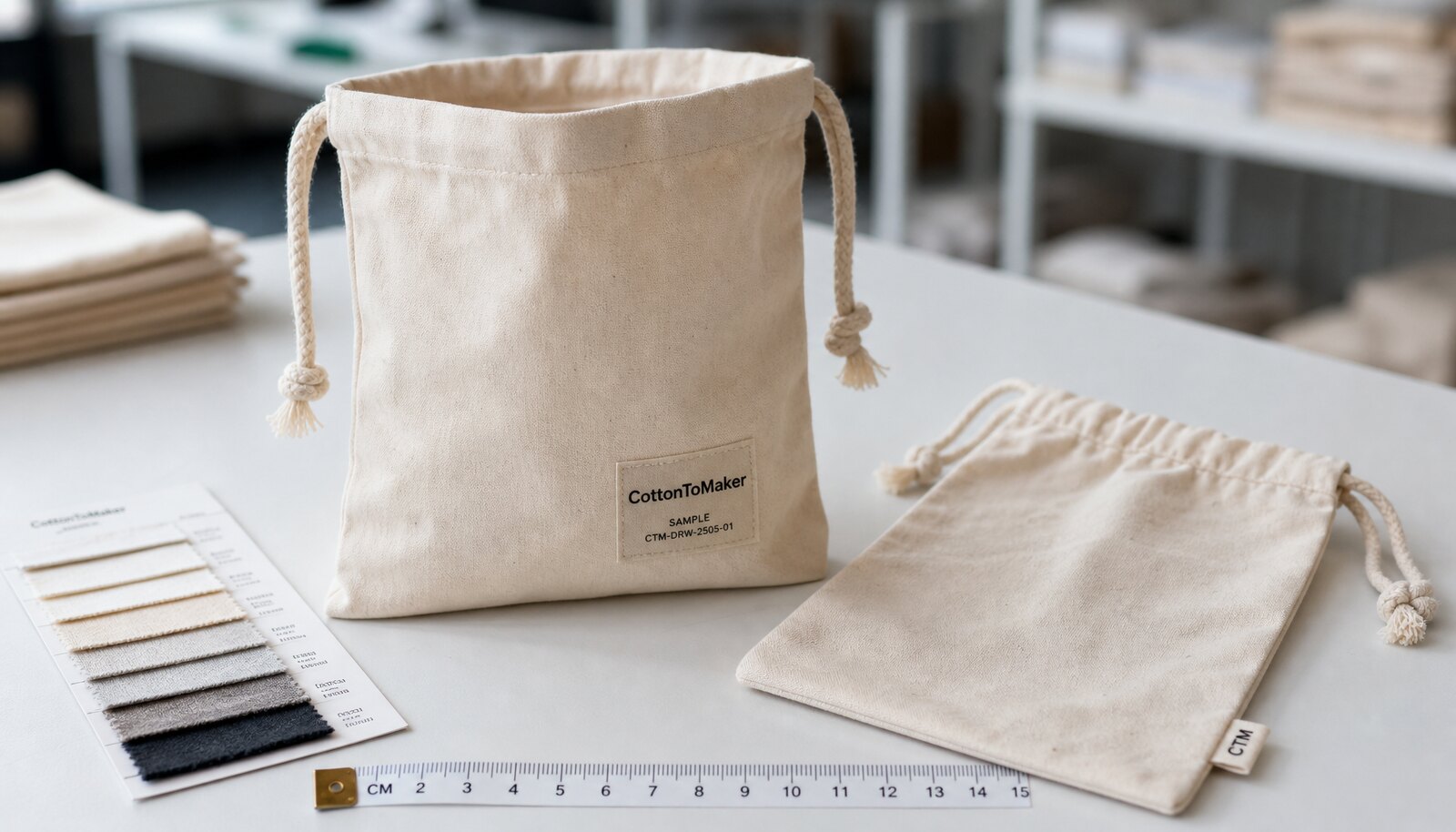
Why Shrinkage Needs Its Own Buyer Memo
A drawstring pouch looks simple until it has to fit a product exactly. A 10 mm height loss may not matter for a loose jewelry pouch, but it can make a cosmetic bottle, candle jar, tea tin, charger set, or hotel amenity kit difficult to insert. The problem is usually not discovered at fabric quotation stage because many RFQs only say cotton pouch, logo print, and finished size. The factory then prices normal fabric, cuts according to its own allowance, prints after sewing, and ships within ordinary tolerance.
A drawstring pouch fabric shrinkage memo is a short technical attachment to the RFQ and purchase order. It defines how the fabric will be tested, how the finished size will be measured, and which shrinkage result controls bulk cutting. It also helps buyers compare quotes fairly. A supplier using untreated 140 GSM cotton can look cheaper than a supplier using pre-shrunk 200 GSM cotton, but those two quotations are not commercially equal if your product must fit after printing, steaming, or consumer washing.
- Use the memo when pouch fit, logo position, retail presentation, or repeat-order consistency matters.
- Attach it before sampling, not after bulk fabric is purchased.
- Treat shrinkage as a costing and quality item, not only a lab-test item.
- Ask for measured evidence instead of accepting broad comments such as normal cotton shrinkage.
Define the Size That Actually Matters
The first mistake is unclear size language. A pouch quoted as 15 x 20 cm can mean cut panel size, finished sewn size, approximate flat size before cord insertion, or final delivered size after ironing and packing. For buying teams, the most useful size is the final usable pouch size: the internal width and height available to hold the product after the channel, seams, and any bottom fold are deducted.
For a drawstring pouch, height is not the same as usable height. If the total pouch height is 200 mm and the drawstring channel consumes 25 mm, the usable height may be about 170-175 mm depending on seam allowance and closure behavior. When shrinkage is uncontrolled, the total height may still seem acceptable, while the usable cavity becomes too short. Your memo should therefore include both external finished size and usable internal size.
- State total finished width and height after all finishing steps.
- State usable inner height below the drawstring channel.
- Define width measurement at mouth and base because side seams can skew.
- Show logo position from bottom edge and side seam after shrinkage.
- Add product-fit requirement, for example: must hold a 90 x 155 x 28 mm box without forcing.
Fabric Weight, Weave, and Finishing Choices
Fabric shrinkage depends on fiber, yarn, weave, finishing, and moisture history. Lightweight muslin at 90-120 GSM can shrink and wrinkle more visibly than a stable twill or canvas. Medium cotton fabric at 140-180 GSM is common for promotional pouches, while 200-240 GSM cotton canvas or twill is better when the pouch must feel retail-ready and keep shape. For heavier drawstring bags, 280 GSM and above can be used, but cost, sewing bulk, and channel flexibility must be checked.
Do not only compare GSM. Ask whether the GSM is measured before or after finishing. Greige cotton may shrink significantly when washed or steamed. Dyed fabric may have already experienced some relaxation during dyeing, but that does not guarantee low shrinkage in the final pouch. Pre-shrunk, sanforized, or washed fabric usually costs more, yet it reduces cutting risk and repeat-order disputes.
- 90-120 GSM cotton muslin: low cost, light gift use, higher wrinkle and shrinkage sensitivity.
- 140-180 GSM cotton or recycled cotton: common for promotions, moderate structure, needs shrink test.
- 180-240 GSM cotton canvas or twill: better for retail, cosmetics, accessories, and repeated handling.
- 250-320 GSM canvas: premium feel, but check drawstring channel thickness and carton weight.
- Jute, linen, and blended fabrics need separate testing because shrinkage and seam behavior differ from cotton.
How Shrinkage Changes Cost and MOQ
Shrinkage control is not free. The factory may need to buy finished fabric instead of stock greige fabric, add fabric testing time, cut larger panels, or reject rolls that fail the agreed rate. If the pouch is washed after sewing, labor, water, drying, ironing, wastage, and packing recovery time all affect the quote. A very low unit price often means the supplier has assumed no special shrinkage control.
MOQ is also tied to fabric lot control. For small orders, a factory may use available stock fabric from multiple rolls or lots. That can be acceptable for loose promotional use, but it is risky for size-critical pouches. For larger orders, ask the supplier at what quantity they can reserve one fabric lot and test it before cutting. If your order is below that level, the memo should specify that every mixed roll needs its own shrinkage record.
- Expect higher cost for pre-shrunk or washed fabric versus untreated stock cotton.
- Ask whether cutting allowance increases fabric consumption by 2%, 5%, or more.
- Clarify whether shrinkage testing is included in the unit price or charged as a sample/lab fee.
- For low MOQ orders, confirm whether stock roll mixing is allowed.
- For repeat orders, require the new lot to be tested again; do not rely on last order data.
Sample Checks Before Bulk Approval
A photo sample is not enough for shrinkage approval. The supplier should provide a pre-production sample made with the proposed bulk fabric, actual seam allowance, actual cord, and actual print method. If the factory sends a clean blank sample but plans to print bulk goods later, the sample does not confirm heat curing, ink hand feel, logo movement, or final packed size.
The shrinkage memo should include a simple measurement sequence. Measure the fabric swatch before and after wash or steam. Measure the sewn blank pouch. Measure after print curing. If washing is part of the process, measure after wash and drying. Finally measure after the pouch has rested flat for a defined time, such as 12 to 24 hours, before final packing approval. The exact time can vary by factory workflow, but the sequence must be consistent.
- Keep one sealed approved sample with date, fabric lot note, and measured dimensions.
- Photograph the sample with ruler placement at the same points used in the memo.
- Check cord length and closure after shrink test, not only body size.
- Confirm whether ironing or pressing is allowed before measurement.
- Reject sample approval language that says size is approximate without a tolerance table.
Print Method and Heat Curing Risks
Printing can create shrinkage disputes even when the fabric itself was acceptable. Water-based screen print, pigment print, discharge print, heat transfer, and digital print all use different temperature and drying conditions. Water-based screen printing is common for cotton drawstring pouches because it gives a softer hand feel, but it still needs curing. Heat transfer may give sharp logo edges, yet the press temperature and pressure can mark fabric or change panel dimensions if not tested.
Logo placement should be measured after all heat exposure. If the fabric shrinks more in height than width, a logo printed too close to the bottom fold may look lower than expected or become uneven across the batch. For pouches with two-side printing, the buyer should also check alignment after sewing and curing, because panel skew becomes more visible when the logo has straight horizontal lines.
- For water-based screen print, ask for curing temperature, dwell time, and post-cure wash or rub test if relevant.
- For heat transfer, test press marks, edge lifting, and fabric relaxation after pressing.
- For digital print, confirm pre-treatment and drying conditions on the exact fabric.
- For foil or metallic effects, check cracking after cord closure and light folding.
- Set minimum logo distance from seam, bottom fold, and channel after shrinkage, not before.
Cutting Allowance and Sewing Tolerance
The factory should not guess cutting allowance from experience alone when the pouch is size-critical. If fabric shrinkage is 4% in warp and 2% in weft, the cut panel cannot be the same as a fabric with 1% shrinkage in both directions. The memo should require the supplier to calculate cutting size from tested shrinkage plus sewing allowance. This is especially important when the pouch has a gusset, rounded bottom, lining, or boxed base.
Sewing tolerance must be realistic. Small pouches may require +/-3 mm to +/-5 mm depending on construction, while larger cotton pouches may accept +/-5 mm to +/-10 mm. However, tolerance should not be used to hide a systematic shrinkage miss. If every pouch is near the low limit, the buyer may still have a product-fit issue. Use average size plus range, and inspect several cartons rather than only the top samples.
- Ask for calculated cut size for panel width, panel height, channel fold, and seam allowance.
- Check whether the pouch uses single fold, double fold, French seam, overlock, or bound seam.
- Verify that channel width remains wide enough for smooth cord movement after shrinkage.
- Use tighter tolerance for pouches holding rigid products than for loose gift packaging.
- Do not approve bulk cutting until the tested allowance is written into the production file.
Packing and Lead Time Effects
Packing can change how a drawstring pouch looks and measures when it reaches the importer. Warm printed fabric packed too soon may retain pressure marks. Washed pouches packed before full moisture recovery can develop odor, mildew risk, or carton deformation. Heavy compression can flatten cords and crease the channel. These issues are not always visible in the factory’s first inspection photos.
Lead time should include fabric testing and recovery time. A standard lead time may cover fabric purchase, cutting, printing, sewing, inspection, and export packing, but shrinkage-controlled orders need an extra approval gate before cutting. If fabric fails the agreed shrinkage range, the supplier needs time to replace, re-finish, or re-test. Buyers should ask for a timeline that separates sample approval, fabric lot test, bulk cutting, printing, sewing, final inspection, and carton packing.
- Require pouches to cool after curing before tight carton packing.
- For washed pouches, confirm drying method and moisture check before sealing cartons.
- Specify flat pack, bundle pack, or individual polybag only after checking creasing risk.
- Ask carton quantity and carton weight because heavier GSM changes freight and handling.
- Build a decision point into the schedule: fabric test approved before bulk cutting starts.
What Quote Data Buyers Should Compare
A useful quote for drawstring pouches should show more than unit price. It should identify fabric composition, GSM tolerance, finishing method, print method, cord type, size basis, packing method, carton data, sample cost, production lead time, and shrinkage test responsibility. Without this data, the cheapest quote may simply be the least controlled quote.
When comparing suppliers, mark whether each quotation includes the same commercial assumptions. One factory may include pre-production sample revision, shrink test photos, and one fabric lot reservation. Another may charge less but assume stock fabric, approximate sizing, and no post-cure measurement. The price difference is then not a saving; it is a transfer of risk to the buyer.
- Fabric: composition, weave, GSM before/after finishing, color method, lot control.
- Size: target finished size, usable size, tolerance, measurement stage.
- Decoration: print method, ink type, curing process, logo placement tolerance.
- Construction: seam type, channel height, cord diameter, stopper or bead if used.
- Packing: pieces per inner pack, carton quantity, carton size, gross weight, moisture control.
- Terms: MOQ, sample lead time, bulk lead time, retest procedure, acceptance standard.
Acceptance Criteria for the Shrinkage Memo
The memo should end with clear acceptance criteria. Avoid vague wording such as shrinkage must be acceptable. A better standard is to define the test method, maximum shrinkage rate, finished size tolerance, usable size requirement, logo placement tolerance, and what happens if bulk fabric exceeds the limit. The criteria should be strict enough to protect product fit, but practical enough for textile production.
For example, a buyer may require that the finished pouch remains 150 x 200 mm +/-5 mm after print curing and 24-hour flat recovery, with usable inner height not less than 170 mm and logo center position within +/-3 mm of the approved sample. This is only an example, not a universal standard. The correct numbers depend on fabric, pouch size, product fit, and retail presentation.
- Define maximum fabric shrinkage in warp and weft, such as no more than the agreed tested percentage.
- Define delivered finished size and usable internal size after all production steps.
- Define inspection sample size by carton or by AQL plan if your company uses one.
- Define whether out-of-tolerance goods can be reworked, sorted, discounted, or rejected.
- Require supplier signature or written confirmation before bulk fabric purchase.
Specification comparison for buyers
| Spec decision | Recommended option | When it fits | Buyer risk to check |
|---|---|---|---|
| Fabric construction for shrink control | Pre-shrunk cotton canvas or twill, 180-240 GSM for medium gift and retail pouches | Brands that need stable finished size after steam, light wash, or consumer handling | Supplier may quote lower GSM greige fabric without preshrink treatment, causing finished pouch to run small after production or wash |
| Allowance between cut size and finished size | State target finished size plus permitted tolerance, then require factory cutting allowance based on tested shrinkage | RFQs where pouch must hold a fixed product box, jar, bottle, cable set, or apparel item | Buyer approves a flat sample but does not lock post-shrink dimensions; bulk pouches may fail packing fit |
| Print method on shrink-prone fabric | Water-based screen print with curing temperature and dwell time stated; test after heat exposure | Cotton, organic cotton, recycled cotton, and muslin pouches with simple logos | Heat curing can add relaxation shrinkage or distort the logo if fabric was not relaxed before printing |
| Cord and channel behavior | Use matching cotton cord or polyester cord selected after shrink test; verify channel width after wash/steam | Pouches with frequent opening, jewelry packaging, cosmetics, hotel amenities, or reusable gift use | Body fabric shrinks but cord does not, creating puckering, tight draw closure, or uneven mouth opening |
| Sample approval standard | Approve pre-production sample with measured before-and-after shrinkage memo attached | Importers comparing several factories or moving from sample to repeat order | A good-looking sample without measurements gives no protection when bulk fabric lot changes |
| Packing method | Flat pack after cooling and moisture recovery; avoid compressing warm printed pouches immediately after curing | Bulk export cartons, retail replenishment, promotional programs, and distributor stock | Warm fabric compressed too early can hold creases, skew panels, or trap moisture that changes dimensions in carton |
Buyer checklist before sampling
- Define whether the quoted size is cut size, sewn size, washed size, or final delivered size.
- State fabric type, weave, GSM, color, and whether pre-shrunk, washed, sanforized, enzyme washed, or untreated greige fabric is required.
- Ask the supplier to record fabric shrinkage in warp and weft before cutting bulk material.
- Require a finished pouch measurement table before and after steam, wash, or heat curing if the pouch will be printed.
- Confirm the test method: water temperature, wash time, drying method, ironing or no ironing, and measurement points.
- Set tolerance by size, not only by percentage; small pouches need tighter millimeter-level control.
- Check whether cord, label, lining, zipper, bead, stopper, or metal eyelet reacts differently from the body fabric.
- Approve the print only after shrink and curing checks, not from an untreated blank pouch.
- Request packing recovery time after printing or washing before final carton packing.
- Keep one approved shrinkage memo, one sealed pre-production sample, and one fabric swatch from the bulk lot.
Factory quote questions to send
- What is the quoted fabric GSM before and after finishing, and what tolerance do you apply to GSM in bulk?
- Is the fabric pre-shrunk, washed, sanforized, calendared, enzyme washed, or supplied in an untreated state?
- What are the tested shrinkage rates in warp and weft for the exact fabric lot proposed for this pouch?
- Are you quoting the finished pouch size after sewing only, or after washing, steam, curing, and packing recovery?
- What cutting allowance will you add to reach our required delivered size?
- How will heat curing for screen print or transfer print affect pouch size and logo placement?
- Can you provide a pre-production sample measured before wash, after wash, after print curing, and after packing?
- At what MOQ can you purchase one controlled fabric lot instead of mixing rolls from different dye or finishing lots?
- What is the lead time impact if bulk fabric fails shrinkage testing and must be replaced or re-finished?
- Which shrinkage result will be used as the commercial acceptance standard for shipment release?
Quality-control points to confirm
- Measure fabric roll width, GSM, and shrinkage before cutting; do not wait until finished pouch inspection.
- Record warp and weft shrinkage separately because drawstring pouches usually fail by height loss or mouth width distortion.
- Check sample size at five points: total height, usable inner height below channel, width at mouth, width at base, and logo position from edge.
- Test printed panels after curing because heat can relax untreated cotton and move the logo closer to the seam or bottom fold.
- Inspect channel opening and cord movement after shrink testing; a pouch can meet size tolerance but still close poorly.
- Compare bulk pouches from the first, middle, and last cartons to catch fabric roll mixing or operator cutting drift.
- Check moisture content and odor before carton sealing if the pouch was washed, steamed, or packed soon after printing.
- Keep signed measurement photos with ruler placement, not only a typed result table.