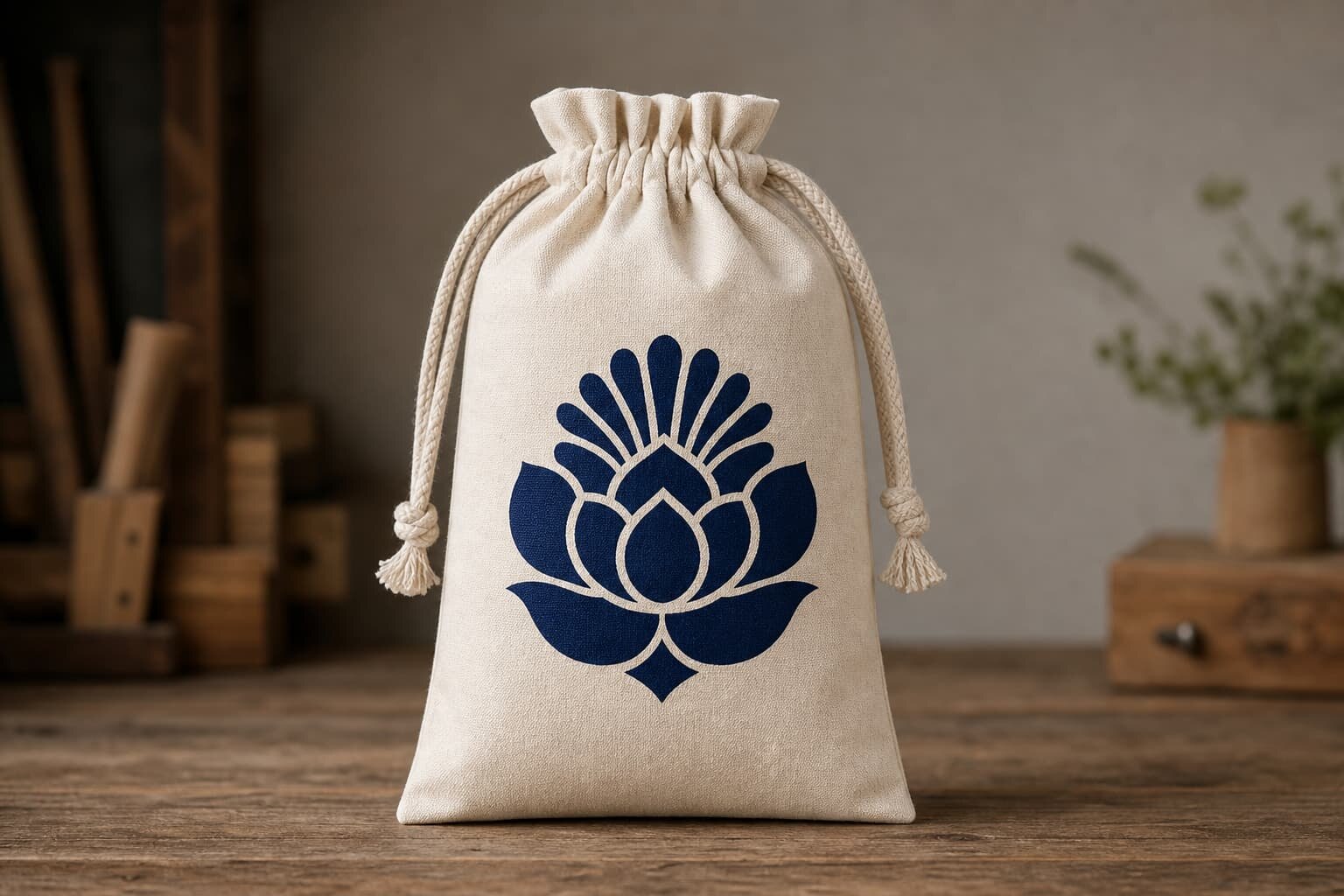
Why shade approval fails so often on drawstring pouches
Drawstring pouches look simple, but shade control is harder on a small soft good than many buyers expect. The front panel, back panel, seam line, cord channel, and any label all sit close together, so even a minor shift in fabric color becomes visible once the pouch is sewn and packed. A color that looks acceptable on a loose swatch can read darker, warmer, or duller once the fabric is stitched into a three-dimensional bag.
The most common mistake is approving a color from a digital image or a loose fabric strip and assuming the finished pouch will match automatically. It will not. Fabric lot, dye method, finishing, and even packing compression can change the visual result. For procurement teams, the right standard is the finished pouch under a defined light source, with one agreed reference sample and one written reject limit.
- Approve the actual pouch format, not only a flat swatch.
- Use one light source for all comparisons, then document it.
- Treat cord, label, and print as part of the color decision, not separate afterthoughts.
Lock the color target before you request pricing
A useful RFQ starts with a clear fabric and shade target. Say whether the pouch body is cotton canvas, plain weave cotton, recycled cotton, poly-cotton, or jute blend, then add the GSM. For many drawstring pouches, 90-120 GSM fits lightweight gift or promo programs, 140-180 GSM is more common for midweight retail goods, and 200 GSM plus is usually used when the buyer wants a denser, more premium hand feel. The same color code can look very different across those weights.
Your quote request should also state whether you want stock natural cotton, optical white, dyed beige, black, or a custom shade matched to a sample. If the target is custom, tell the factory whether it must match a physical reference, a Pantone callout, or both. The clearer this is before pricing, the less chance a supplier uses a near-match fabric to win the order and then pushes the shade variance into production.
- Write the fabric composition, weave, GSM, and finish in the RFQ.
- State whether the target is stock shade or custom dyed.
- Attach the reference sample and the viewing standard when possible.
Fabric weight, weave, and finish change how the shade reads
Buyers often focus on dye color and forget that the fabric itself changes the way the color appears. A plain weave cotton at 120 GSM can reflect more light and look slightly lighter than a 180 GSM canvas in the same dye bath. Twill, canvas, brushed surfaces, mercerized cotton, enzyme-washed cotton, and recycled blends all present color differently because the yarn structure and surface texture control how light is absorbed and reflected.
That is why a factory quote should always be tied to the same fabric lot and the same finish. If one supplier quotes from bleached stock and another quotes from piece-dyed canvas, the shade will never compare fairly. Ask whether the color approval is made before washing, after washing, or after final pressing. If the factory approves a prewash swatch but delivers a postwash pouch, shrinkage and finish can move the color enough to create a dispute at inspection.
- Compare like-for-like GSM before judging shade.
- Confirm whether the approval sample is prewash or postwash.
- Check if the finish is mercerized, washed, brushed, or raw, because that changes the visual tone.
Print method can make the approved shade look wrong
If the drawstring pouch carries a logo, print method matters as much as the base fabric. Screen printing usually gives stronger opacity and can make the area feel flatter or slightly warmer. Water-based ink tends to sink into cotton and can soften the appearance of the fabric around the print. Heat transfer, embroidery, woven labels, and stitched patches all change the way the pouch is perceived in the hand and under light. A large white underbase can make the fabric look brighter than the actual bulk lot, while heavy ink coverage can make the front panel seem darker than the back panel.
For buyer approval, the print sample must be done on the final pouch construction, not only on a cut panel. Ask the factory to use the same ink system, the same cure temperature, and the same coverage percentage that will be used in bulk. If the logo covers a large share of the front panel, the print strike-off needs a separate sign-off from the fabric shade approval. Otherwise the supplier may say the print passed even when the final pouch looks visually off once the logo is added.
- Approve print strike-offs on the final pouch size.
- Confirm print coverage percentage and ink system in the quote.
- Check both printed and unprinted sides so the pouch still looks balanced.
Use a sample ladder the factory can actually repeat
For custom shade work, the safest sequence is sample first, finished pouch sample second, then bulk release. A lab dip or dye strike-off gives the first color direction, but it is not enough on its own for a drawstring pouch. Once the fabric is cut, sewn, and drawcord inserted, the color can read differently because of seam tension, panel shape, and the interaction with labels or print. The buyer should therefore approve the finished pouch sample and not stop at the loose fabric stage.
Keep the system simple enough that the factory can repeat it. Retain one sealed master sample with the date, fabric lot, and color code. Keep one buyer sample and one factory sample. Review them under the same light source each time, and if your team can measure color, use an instrument standard in addition to the visual check. If you cannot measure, define an accepted visual band and keep it narrow enough that a different mill lot will not create a surprise on arrival.
- Use lab dip for color direction, then approve a finished pouch sample.
- Keep sealed reference samples on both sides.
- Document the approved light source and the approval date.
MOQ logic matters when shade approval requires a custom dye lot
MOQ is not only about how many pouches you need; it is also about how the fabric is sourced. A pouch made from stock dyed fabric usually has a lower MOQ and faster approval cycle than a pouch that requires a custom dye bath. If the color must be matched to a specific sample, the factory may need a minimum fabric quantity to run the mill efficiently. That minimum can be driven by the fabric mill rather than by the sewing line.
Ask the supplier to separate MOQ by color, size, and fabric lot. That matters when you order multiple pouch sizes in one color or several shades in one program. A low quoted MOQ may look attractive, but if the factory has to split the order across several dye lots, the risk of shade drift goes up and the scrap cost can appear later as a rush fee or a rework charge. It is better to know the real batch logic at quote stage than to discover it after the first approval sample passes.
- Ask whether MOQ is per color, per size, or per fabric lot.
- Confirm who owns leftover fabric if the dye batch exceeds the finished order.
- Request any color-change or re-dye surcharge before you place the PO.
Ask for itemized quote data, not a single price per pouch
A flat pouch price hides too much. For shade-sensitive orders, you need to see how the supplier priced the fabric, dyeing or printing, cutting, sewing, cord, stopper, label, inspection, and packing. Two quotes can look similar on paper while using very different fabric weights, dye methods, or quality controls. A procurement team cannot compare suppliers properly if one factory includes a custom dye lot and another assumes stock fabric that only looks close at sample stage.
The quote should also state what is included in sampling. Some suppliers include one lab dip and one strike-off, while others charge for every round. Ask whether a revision of the color sample resets the lead time or only the sample fee. Then ask what happens if the first bulk fabric lot misses the approved shade. A good quote answers whether the factory will adjust, re-dye, or remake, and who pays for the delay if the error comes from their side.
- Request a line-by-line breakdown: fabric, print, sewing, trim, QC, and packing.
- Compare sample fees and re-sample fees across suppliers.
- Ask for the corrective action if the first bulk lot misses the approved shade.
Packing and lead time can change how shade looks on arrival
Shade approval does not end when the factory signs the sample. Packing affects what the buyer sees when the cartons arrive. Tight folding can create crease lines that make one part of the pouch appear lighter. High humidity can make some natural fabrics look dull or slightly yellowed. If the cartons sit too long in a hot warehouse or container, the visual impression can shift even if the production lot was approved correctly at the factory. That is why the packing spec should be part of the shade discussion, not just the shipping discussion.
Keep the lead time broken into sample time, bulk production time, and packing time. In many programs, a lab dip may take 3-7 working days, a print strike-off or sewn sample may take 5-10 working days, and bulk production may take 20-35 days after approval, depending on fabric availability and factory load. Those figures are only examples, but they show why approval timing matters. If a buyer asks for a fast ship date without locking color early, the factory will either rush the batch or quietly fall back to stock fabric.
- Ask for packing photos and carton markings before shipment.
- Specify polybag count, carton lining, and desiccant use if needed.
- Separate sample lead time from bulk lead time in the PO.
Write acceptance criteria that a QC team can enforce
The best shade approval documents do three things: they name the reference, define the viewing condition, and state the reject condition. If the criteria only say "color should match sample," the factory and the buyer will each use their own standard when the shipment is inspected. For a drawstring pouch, the acceptance rule should consider the front panel, back panel, side seam, drawcord, label, and any print or embroidery, because a mismatch in one part can make the whole product look off.
Common mistakes are easy to prevent once the criteria are written. Do not approve under office LEDs only. Do not compare a fresh bulk sample to an old swatch that has faded in storage. Do not allow mixed lots in the same carton unless the buyer explicitly allows it. If the team can measure color, a Delta E target can help, but the visual rule still needs to be written because many shipment disputes are about appearance, not just numbers. The goal is not perfect lab science; it is a repeatable commercial standard that protects the PO.
- Define the reference sample and the light source in writing.
- State whether mixed lots are allowed inside one carton or not.
- Write a clear reject condition for visible panel-to-panel mismatch.
Use a simple RFQ-to-PO workflow to prevent shade disputes
A clean sourcing workflow keeps everyone honest. Start with a specification sheet that names the fabric, GSM, size, color target, print method, label type, and packing format. Then request a quote that matches that spec exactly, not a softer version of it. After the quote, approve the lab dip or strike-off, then the finished pouch sample, then the first bulk fabric lot if the order is large enough to justify it. Only after those steps should the supplier release full production and carton packing.
If the bulk sample drifts from the approved standard, stop at the earliest practical point. Isolate the roll, compare it to the sealed master, and ask for a written root-cause note before more cutting happens. It is much cheaper to reject one fabric roll than to sort thousands of finished pouches. Procurement teams that follow this sequence usually spend less time arguing about shade and more time controlling repeat orders, because the supplier knows the approval path is real and documented.
- Use one spec sheet for every supplier quote.
- Approve in stages: sample, finished pouch, bulk fabric, then production.
- Hold any questionable roll before cutting if the shade starts to drift.
Specification comparison for buyers
| Spec decision | Recommended option | When it fits | Buyer risk to check |
|---|---|---|---|
| Digital mockup vs physical reference | Approve against a physical fabric swatch on the exact pouch material | Any custom color or repeat order where shade matters | Digital files hide weave, finish, and dye depth |
| Lab dip only vs finished pouch sample | Approve the finished pouch, not just loose fabric | Solid-dyed pouches and repeat SKUs | Sewing tension and finishing can change how the shade reads |
| Strike-off only vs sewn strike-off | Use a sewn strike-off on the final pouch construction | Printed pouches, logo-heavy orders, or all-over graphics | Ink coverage can make the base fabric look darker or warmer |
| One sample vs shade band | Document an accepted shade band with a retained master sample | Multi-lot production or orders split across mills | No written reject limit leads to disputes at inspection |
| Stock fabric vs custom dyed fabric | Quote both options separately if the shade is not standard | Private label launches and retail programs | A lower quote may hide a fabric color that is only close, not matched |
Buyer checklist before sampling
- Confirm the exact pouch fabric, weave, GSM, and finish before asking for color matching.
- State the target shade with a physical reference, Pantone if relevant, and the viewing light source.
- Approve the finished pouch sample, not only loose fabric, if sewing or printing is part of the order.
- Ask whether the quoted shade comes from stock fabric, custom dyeing, or a printed surface.
- Require lot numbers for fabric, cord, label, and print ink if color consistency matters.
- Write the acceptable shade range and the reject condition into the RFQ or PO.
- Separate sample lead time from bulk production lead time so approval delay is visible.
- Keep one sealed buyer-retained sample from the approved lot for future reorders.
Factory quote questions to send
- What exact fabric composition, weave, and GSM are you quoting for the pouch body?
- Is the shade based on stock fabric, a custom dye lot, or a printed surface finish?
- How many lab dips or strike-offs are included in the sample stage?
- What is the MOQ per color, per size, and per fabric dye lot?
- Are the cord, stopper, label, and print included in the same shade approval process?
- What light source and tolerance do you use when judging shade approval at the factory?
- If the bulk fabric drifts from the approved sample, do you re-dye, re-cut, or remake?
- What are the separate lead times for sampling, bulk production, and final packing?
Quality-control points to confirm
- Check fabric shade against the approved master sample under the same light source.
- Inspect front panel, back panel, and gusset together so seam tension does not hide mismatch.
- Verify that drawcord, stopper, and label colors do not clash with the approved fabric shade.
- Confirm print opacity and cure quality do not change the perceived base color.
- Reject mixed shade lots in the same carton unless the buyer has signed off in writing.
- Check shrinkage or wash response if the pouch will be laundered, steamed, or pressed.
- Keep one sealed reference sample from the approved bulk shipment.
- Record fabric lot, print lot, and packing date on the inspection report.