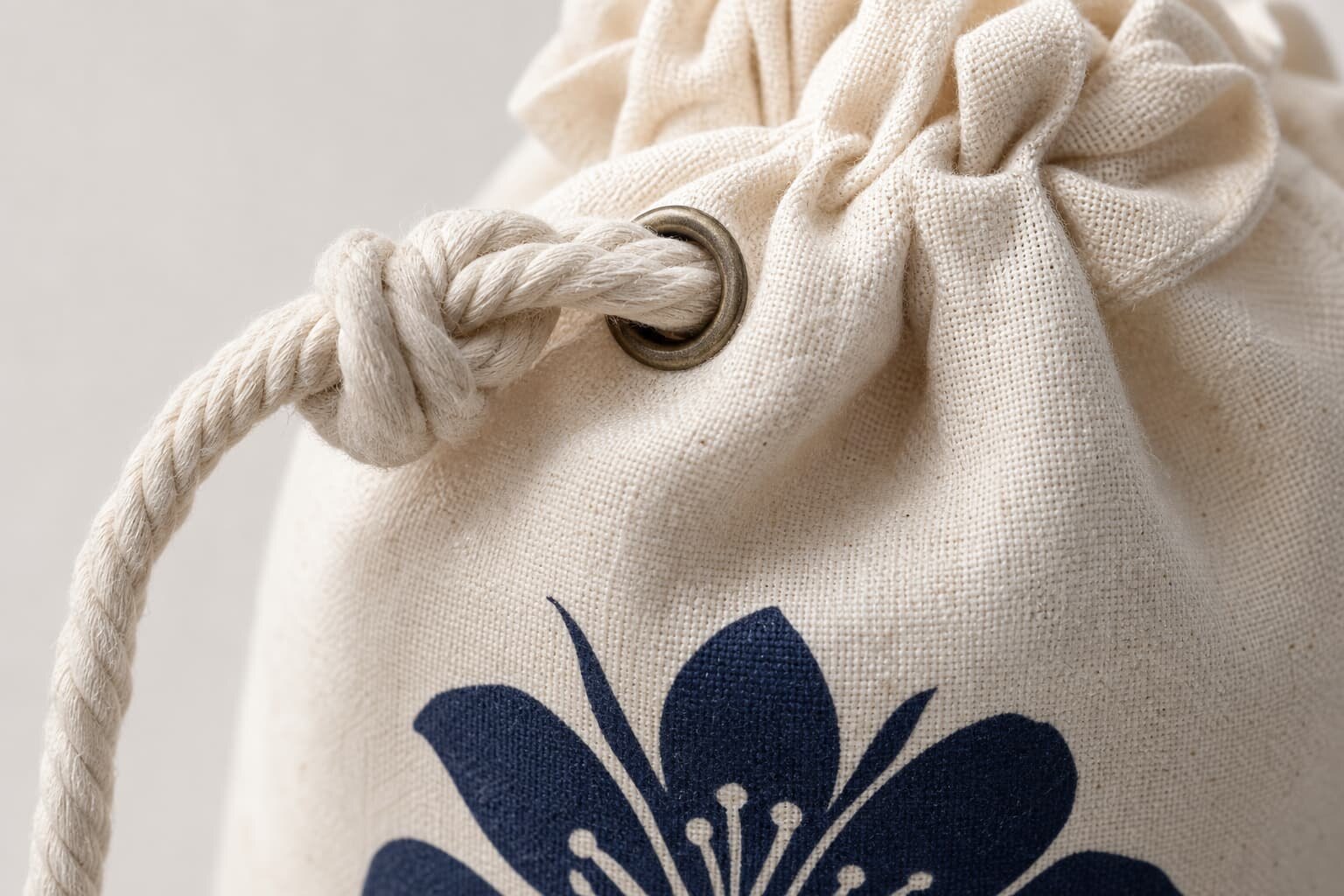
Why the cord pull report matters for pouch buyers
A drawstring pouch cord pull test report matters because the closure is the part buyers and end users touch first. A pouch can look clean on the table and still fail once the cord, hem, and side seam are loaded together. When that happens, the defect is expensive: rework, return risk, delayed launch, and a quote dispute over whether the factory tested the same build you approved.
For procurement, the report is not just a lab record. It is the fastest way to compare whether two factories are quoting the same pouch. One may use 140 GSM cotton with a thin twisted cord and one row of stitching; another may use 220 GSM canvas, a braided cord, and a bartacked exit. Both can say pass. Only a report tied to the exact construction tells you which quote is safer for retail, gifting, or repeated daily use.
- Use the report to spot hidden changes in fabric, cord, and stitch build.
- Treat the report as a quote-comparison tool, not just compliance paperwork.
- Match the test severity to the real use case of the pouch.
- Focus on failure mode, not only the pass/fail result.
What a useful report must document
A useful report should read like a build sheet plus a test record. At minimum it should show pouch size, body fabric and GSM, cord material and diameter, stopper type if used, print method, label type, stitch pattern, sample count, test force or load, hold time or cycle count, failure definition, date, operator, and photos of both the intact sample and the failure point. Without those items, you cannot compare lots or reorder with confidence.
The report should also state whether the sample was finished with final artwork, final labels, and final packing. If the supplier tested a blank pouch and then added a woven label or heat transfer later, the result is not the same product. Ask for traceability back to fabric roll, cord lot, and production batch so the report can be used again at reorder time.
- Sample ID tied to the approved order or pre-production sample.
- Fabric GSM, cord diameter, and decoration method listed clearly.
- Test force, hold time, cycle count, and pass/fail definition recorded.
- Failure photos included on the same report page or in the same file.
- Lot traceability shown for fabric, cord, and production batch.
Material choices that change pull performance
Fabric weight drives how the top hem responds to pull. Light cotton pouches in the 140-180 GSM range are common for cosmetics, jewelry, and event gifts, but the fabric can elongate or pucker if the cord channel is narrow. Heavier 200-240 GSM cotton or 8-10 oz canvas gives more structure, hides stitch tension better, and usually tolerates a more demanding closure test. That extra stability can be worth more than a small material cost difference if the pouch goes into retail.
Cord choice matters just as much. Braided polyester cord is usually more consistent in diameter and less likely to fuzz, while cotton cord gives a softer natural look but can vary more from lot to lot. Print method also changes the risk profile. Screen print is simple on flat areas but can crack if the fabric folds sharply during the pull. Embroidery and woven labels add stiffness; a side label near the closure can help branding but must be kept clear of the load path.
- Light GSM fabrics often need a gentler pull target or a stronger hem build.
- Heavier canvas can hide stitching variation but usually costs more to cut and sew.
- Braided polyester cord is more stable lot to lot than many cotton cords.
- Custom dyed cord, woven labels, and multi-color print usually lift MOQ.
- Keep decoration away from the bend line if you want cleaner pull test results.
Set a repeatable test method before quoting
A pull test only helps if every factory runs it the same way. Start by defining the sample set: one pouch size or each size, one color or each color, and one sample from the actual production lot rather than a hand-made prototype. Then lock the force, hold time, cycle count, and failure definition. If the buyer does not set those variables, the factory will fill in a convenient method and the report will look better than the bulk result.
For many buyers, the easiest internal method is a controlled pull on the closed pouch with the cord path and hem under load, repeated for several cycles. The exact force should match the use case: a light accessory pouch does not need the same load as a heavy gift bag. What matters is not copying a standard from another product; it is freezing a test that reflects how the pouch will actually be opened, closed, shipped, and handled on shelf.
- Test the real production sample, not a hand-built sample with hidden shortcuts.
- Define force, hold time, and cycle count before the quote is accepted.
- Use the same method for every supplier so the reports can be compared.
- Keep photo evidence of the setup and the failure point.
How to read pass, fail, and borderline results
When you read the results, do not stop at pass or fail. Look at how the pouch failed. A clean fail on the cord knot tells you the cord itself is the weak point. A tear at the hem says the stitch density, seam allowance, or fabric weight is too low. If the cord slips but the fabric stays intact, the stopper, knot, or cord finish is the problem. Those failure modes guide the corrective action and help you decide whether the quote needs a material change or just a sewing adjustment.
Set acceptance criteria in buyer language, not factory language. Instead of asking for good quality, require no seam opening beyond your tolerance, no visible rupture at the cord exit, no stopper migration if a stopper is used, no print damage in the flex area, and no label detachment. If you need a numeric limit, write the number into the RFQ and keep it tied to the finished size, not just to the fabric type.
- A pass with the wrong failure mode is still a warning sign.
- Borderline results should trigger a sample review, not silent approval.
- Write your acceptance limits into the RFQ so the factory cannot improvise.
- Use separate criteria for different sizes or load categories.
Build the RFQ so quotes are comparable
The report becomes commercially useful when it sits next to a quote sheet. Ask every factory to break out fabric, cord, stitch labor, print, label, testing, packing, and carton costs. That makes the hidden tradeoffs visible. A lower unit price may simply mean a thinner cord, a lighter GSM fabric, or a test performed on an unfinished sample. A better supplier is not always the cheapest supplier, but the cheapest quote only matters if it is built to the same spec and tested the same way.
MOQ logic should follow setup complexity. Standard cotton fabric, one-color screen print, and stock cord color usually support a lower MOQ. Custom dyed cord, woven label, multiple print colors, or mixed sizes normally raise MOQ because the supplier has more setup and waste. Typical sample lead times for a standard build are often 5-10 working days, with bulk lead times in the 25-40 day range depending on print, label, and packing complexity. Treat those as planning ranges, not promises, and confirm them in writing.
- Request a line-by-line quote so you can compare real cost drivers.
- Ask whether the quoted price includes testing, retest, and report issuance.
- Separate standard stock materials from custom materials in the RFQ.
- Force the supplier to state MOQ by size, color, and decoration method.
- Confirm sample and bulk lead times in writing before approval.
Sample approval checks before bulk starts
A sample should be approved only after it matches the final bulk recipe. Check the final fabric GSM, cord diameter, cord color, stopper, print method, label placement, and the exact pouch dimensions. If the sample has hand-tied cords or a temporary label, do not treat it as production evidence. Ask the factory to send a pre-production sample made from the same materials and machine settings that will be used on the line.
The sample pack should also be tested in a realistic way. If the pouch will arrive retail-ready, inspect the folded shape, count, and carton layout. If it will be shipped as a set, confirm that the pouch still closes correctly after packing insert cards, tissue, or inner polybags are added. The goal is not a perfect display sample; the goal is a sample that matches how the product will leave the factory and survive transit.
- Match the sample to the final fabric roll and cord lot.
- Confirm print and label placement on the actual production sample.
- Check the sample after packing, not only before packing.
- Ask for a signed approval file that includes the tested sample photo.
- Treat any material substitution as a new approval step.
Common failure modes and the fixes that actually work
The most common failure is a weak top hem. It usually comes from a narrow fold, low stitch density, or fabric that is too light for the chosen cord. The second common failure is cord fray or knot pull-through, which often appears when the cord end is poorly sealed or the exit hole is too large. A third issue is print cracking near the closure because the artwork was placed where the pouch bends every time it is opened. These are not cosmetic defects; they are cost and return defects.
Most fixes are simple when caught early. Increase hem width, add a second row of stitching, move bartacks closer to the cord exit, switch to a more stable cord construction, or move the print away from the bend line. If the pouch is branded with a woven side label, make sure the label edge does not rub against the cord path. The best factories will tell you which correction is lowest risk before they change the price, because some fixes add labor while others change the BOM.
- Weak hem: widen the fold and increase stitch support.
- Cord fray: improve cord end sealing or switch to a cleaner braid.
- Stopper slip: tighten the stopper spec or change the cord diameter.
- Print cracking: move artwork away from the flex zone.
- Label abrasion: reposition the label or change the attachment method.
Packing and shipment controls that protect the result
Packing can hide or create quality problems. A pouch that passes pull testing can still arrive creased, crushed, or contaminated if the carton spec is wrong. For cotton and canvas pouches, confirm whether they are polybagged, bundled, or packed loose, and whether moisture protection is needed for sea freight. The report should be archived with the shipment lot so that if a buyer finds a problem on arrival, the factory can trace the exact test sample and production batch.
Carton compression matters more than many buyers expect. Overpacked cartons can flatten the drawstring channel and make the pouch look weak even when the stitching is fine. They can also rub printed areas and labels. Ask for carton quantity, net and gross weight targets, inner pack count, and a packing photo before shipment. If the pouch is part of a gift set, the packing plan should be tested with the full set, not just the empty pouch.
- Keep the pull report linked to the shipment lot for traceability.
- Use packing photos to spot compression, rubbing, and count errors.
- Confirm whether moisture protection is required for your route.
- Test the full gift set if the pouch ships with inserts or accessories.
Turn the report into a buying decision
The best buying decision is the one that links the report to the exact commercial offer. If two quotes differ by only a small amount, the safer choice is usually the one that gives you clearer test data, better traceability, and fewer hidden assumptions. That is especially true for retail launches, premium gifting, and recurring replenishment, where a small closure failure can affect the whole program.
Keep one baseline report, one approved sample, and one spec sheet for each size and decoration variant. Use them on every reorder. If the factory changes the cord, fabric roll, stitch program, or packing method, ask for a new report before release. That habit turns a simple cord pull test into a sourcing control tool, which is exactly what a procurement team needs when multiple suppliers are quoting similar-looking pouches.
- Approve only after the test method, sample build, and quote are aligned.
- Request a new report whenever the factory changes a material or process.
- Keep one baseline file for each size, color, and decoration variant.
- Use the report to prevent reorders from drifting away from the approved spec.
Specification comparison for buyers
| Spec decision | Recommended option | When it fits | Buyer risk to check |
|---|---|---|---|
| Body fabric weight | 140-180 GSM cotton for light retail pouches; 200-240 GSM or 8 oz canvas for heavier gifting | Cosmetics, jewelry, event pouches, and premium gift sets | Thin fabric can pass a weak pull test but deform in bulk |
| Cord material | Braided polyester for consistency; cotton cord for a natural look; avoid mixed lots | When your brand wants either durability or a softer natural hand feel | Check diameter tolerance, fuzzing, dye bleed, and knot slip |
| Closure build | Double drawcord with folded hem and bartack at the cord exit | Higher-value SKUs or pouches that are opened many times | Single-row stitching may pass a light sample test but fail after repeated use |
| Decoration method | Screen print for flat graphics; woven label or side label when the pull zone is close to artwork | Brand graphics that must survive handling and testing | Print cracking or label detachment can happen if the closure area flexes |
| Test plan | 3-5 samples per size/color/lot with defined force, hold time, and failure criteria | Any reorder, multi-factory comparison, or retail launch | One pass/fail photo is not enough to compare suppliers |
| Packing spec | Flat packed with count and lot traceability; avoid over-compression | When pouches ship with labels, inserts, or retailer barcodes | Compressed cartons can hide seam issues and distort opening shape |
Buyer checklist before sampling
- Confirm pouch size, body fabric GSM, cord type, and decoration method in one spec sheet.
- Require a test report with sample ID, lot numbers, force, hold time, cycle count, and failure photos.
- Compare every quote on the same basis: fabric, cord, print, label, packing, retest, and MOQ.
- Ask for a pre-production sample made from final materials, not a hand-built prototype.
- Verify that print area and label placement do not sit on the load path of the cord pull.
- Check whether carton pack and moisture protection fit the shipping lane you will use.
- Keep an approved gold sample and baseline report for each size and decoration variant.
- Confirm lead time by sample, bulk, and rework stage, not just one overall date.
- Ask which changes trigger a new pull test before release.
- Archive the reorder spec by size, color, and lot so future quotes stay comparable.
Factory quote questions to send
- What exact pull force, cycle count, and failure criteria did you use for this report?
- How many samples per size, color, and lot were tested?
- What are the fabric GSM and cord diameter of the tested sample?
- Is the test sample identical to bulk for print, label, stopper, and seam build?
- What stitch pattern and seam allowance do you use at the cord exit?
- What is MOQ by size, color, print method, and label method?
- What are sample and bulk lead times under current capacity?
- What packing method, inner count, and carton count are quoted?
- Can you share photos or video of the test setup and the failure point?
- What happens to price and timing if we change cord construction or fabric weight?
Quality-control points to confirm
- Incoming fabric GSM check against the approved spec.
- Cord diameter and finish check across the production lot.
- Stitch density and bartack placement at the cord exit.
- Top hem width and fold consistency on every size.
- Print position kept away from the fold line and pull zone.
- Label attachment strength and abrasion check.
- Finished size, opening width, and closure smoothness check.
- Packing count, carton weight, and lot traceability review.