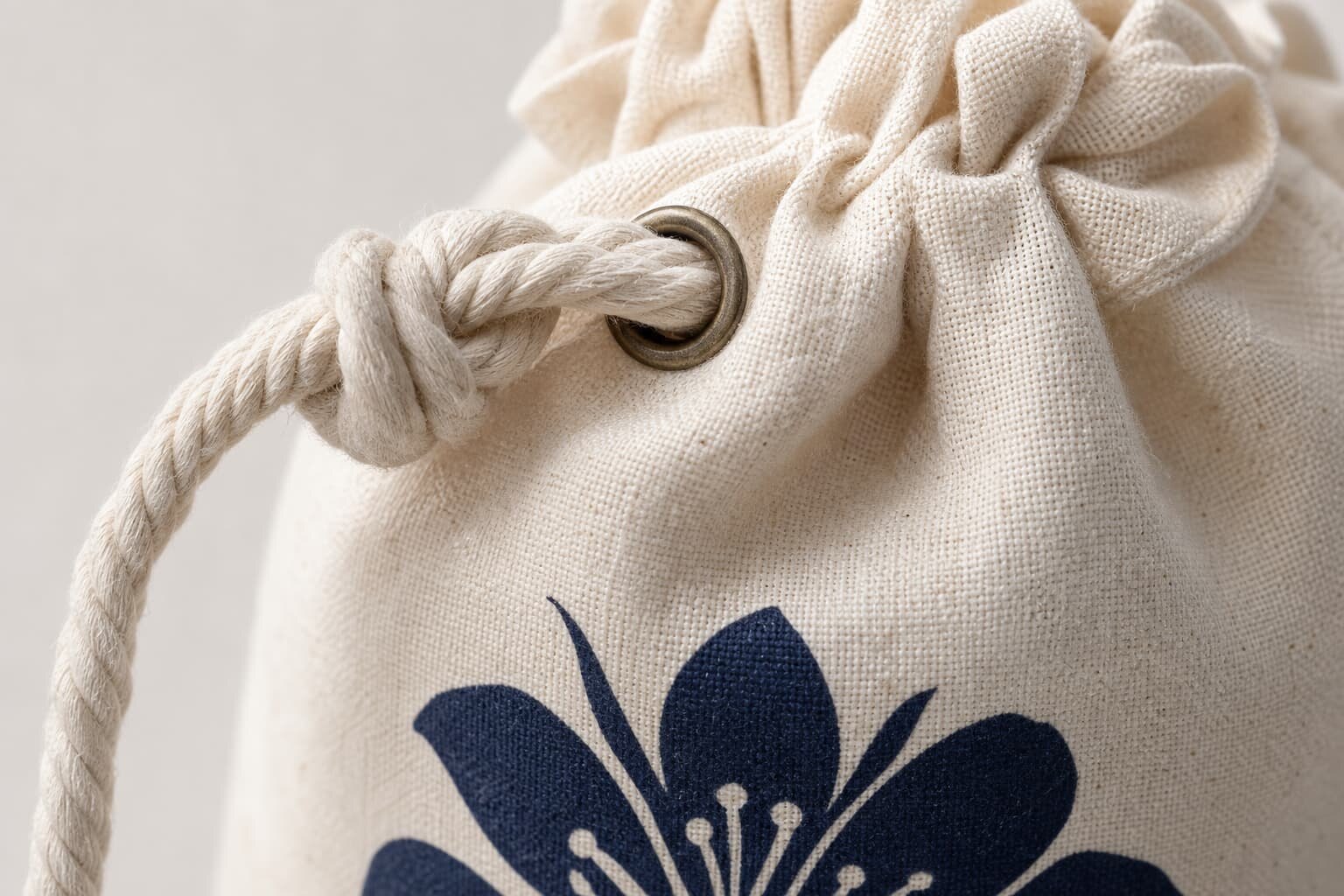
Why Cord Knot Inspection Deserves Its Own Sheet
A drawstring pouch can look acceptable in a flat product photo but fail in use because the cord knots are too small, uneven, loose, or poorly matched to the channel. For buyers, this is not a cosmetic detail. A missing or weak knot can let the cord disappear into the hem during packing, retail handling, or the first customer use. Once that happens, the pouch becomes difficult to close and the complaint is usually blamed on the brand, not the factory.
The inspection sheet should separate cord and knot checks from general sewing inspection. A normal checklist may record fabric, print, size, and packing, but cord function needs its own acceptance criteria. Procurement teams should ask the factory to measure cord length, knot diameter, knot tail length, channel clearance, and pull performance before final packing. This makes quote comparison easier because each supplier is pricing the same construction, not guessing based on a sample photo.
- Use a cord knot inspection sheet when the pouch will be opened and closed repeatedly.
- Treat missing knots, loose knots, and blocked cord channels as functional defects, not minor appearance issues.
- Ask for inspection photos before shipment when the order includes multiple pouch sizes or cord colors.
- Keep a sealed approved sample so the warehouse team can compare knot size and cord length on arrival.
Define the Pouch Construction Before Discussing Knot Standards
Cord knot quality depends on the pouch construction. A small 8 x 10 cm jewelry pouch in 4 oz cotton behaves differently from a 30 x 40 cm canvas product pouch in 10 oz fabric. If the channel is narrow, a thick cord or bulky knot may jam. If the fabric is too light, repeated pulling can tear the side seam or cord exit. This is why the RFQ should state finished pouch size, fabric weight, channel style, and cord type together.
For most branded drawstring pouches, buyers use cotton between 5 oz/170 GSM and 8 oz/270 GSM. Lightweight 4 oz/130 GSM can work for dust bags or low-load promotional packaging, but the top hem needs careful sewing because the fabric can distort. Heavier 10 oz/340 GSM canvas is stronger but may require a wider channel and a stronger cord. If the factory quotes only by size and fabric name, ask them to add GSM and finished construction details before comparing prices.
- State finished size, such as 20 x 30 cm after sewing, not only cutting size.
- Specify fabric as 100% cotton, recycled cotton blend, canvas, muslin, velvet, jute, or polyester, with GSM.
- Confirm whether the pouch has one cord, two cords, or a drawstring backpack style closure.
- Define whether side seams are overlocked, lockstitched, French seamed, or bound for heavier contents.
Cord Material, Diameter, and Knot Size Must Match
The cord should be chosen by use, not by the cheapest quote line. Cotton cord gives a natural retail appearance and works well with cotton or canvas pouches, but it can shed fibers if low grade. Polyester cord is smoother and stronger, but it may look less natural and can slip more easily if the knot is too small. Jute cord fits rustic packaging, yet it is rougher and can fray at the ends. For many pouch orders, 3 mm to 5 mm cord is the practical range.
A useful inspection sheet should include knot diameter and knot tail length. If the knot is too small, it can pass through the side opening into the channel. If it is too large, it creates a lump that damages carton packing or prevents the pouch mouth from closing neatly. For cotton cord, a double overhand knot is usually more secure than a single loose knot. The factory should tie and trim consistently, not leave long random tails that make retail presentation look unfinished.
- For small pouches, use 2.5-3 mm cord and a compact knot that cannot enter the channel.
- For medium cosmetic or gift pouches, use 3-4 mm cotton cord with a clear knot tail tolerance.
- For heavier canvas pouches, consider 5 mm cord and a wider top channel.
- Avoid mixing cord batches unless the factory can control color shade and diameter consistency.
Set Practical Acceptance Criteria for Cord Knots
The inspection sheet should use clear pass or fail language. Do not write only 'cord must be good quality.' A warehouse inspector or third-party QC team needs measurable points: cord length after knotting, knot tightness, knot position, tail length, and whether the knot can pass through the channel opening. These checks are fast, but they prevent a high percentage of drawstring pouch complaints.
Buyers can set tolerances based on pouch size and retail standard. For example, cord length after knotting may be allowed within plus or minus 10 mm for small pouches and plus or minus 20 mm for larger pouches. Knot tail length might be 5-12 mm if the brand wants a clean look. The exact numbers can change by design, but the principle is the same: the approved sample becomes the reference, and bulk must follow it.
- Missing cord knot: critical or major defect depending on end use.
- Loose knot that opens under hand pull: major defect.
- Cord end fraying beyond approved sample: major defect for retail pouches.
- Left and right cord length visibly uneven: major defect if it affects closing or shelf appearance.
- Knot larger than approved sample and causing packing dents: minor or major depending on severity.
Sample Review: What Buyers Should Test Before Approval
A sample can pass appearance review but still fail functional testing. Before approving a drawstring pouch sample, open and close it at least 20 times. Pull both cord ends firmly but not violently. Check whether the knot moves, loosens, or slips into the channel. Then lay the pouch flat and compare the two cord sides. If the sample already shows imbalance, bulk production will usually be worse unless the factory changes the process.
Also check the relationship between the print and the gathered mouth. Screen printing is the common choice for simple logos, brand marks, and one to three solid colors. Heat transfer can reproduce fine artwork but may feel less integrated with cotton fabric. Embroidery or woven labels can work for premium pouches, but they add cost and may affect MOQ. Whatever method is used, the artwork should not sit so close to the cord channel that it becomes distorted every time the pouch is closed.
- Measure finished pouch width and height after sewing and after closing the drawstring.
- Check cord channel width with the cord installed, not only on an empty fabric piece.
- Rub the cord ends lightly to see whether fibers shed or unravel.
- Close the pouch fully and confirm the logo remains visually acceptable.
- Put the intended product inside the sample if possible, especially candles, cosmetics, jewelry boxes, or bottles.
MOQ Logic: Why Cord and Knot Details Affect the Quote
MOQ is not only about pouch quantity. It is also affected by fabric dyeing, cord color, print setup, cutting efficiency, and packing requirements. A factory may accept a low MOQ for natural cotton with stock beige cord, but require a higher MOQ for custom dyed fabric, custom cord color, or multiple logo versions. If each SKU needs a different cord shade and knot style, the factory must manage more material inventory and more sewing-line changeovers.
For RFQs, buyers should ask suppliers to quote by specification blocks. One quote can cover stock natural cotton fabric with stock cord, while another covers custom dyed fabric and matched cord. This prevents a misleading low quote that later changes after artwork and cord selection. If the project has many distributors or retail colors, consider standardizing cord diameter and knot finish across SKUs to reduce inspection complexity.
- Lower MOQ is more realistic with stock natural cotton, stock black cord, or stock white cord.
- Higher MOQ is likely when cord color must match Pantone fabric or printed artwork.
- Multiple pouch sizes can share one cord material, but cord length must be separately controlled.
- Retail barcode labeling, individual bags, or paper bands can raise packing labor and MOQ discussions.
Print Method and Cord Placement Need Joint Approval
A common production mistake is approving artwork without checking how the pouch looks after the drawstring is pulled. If the print is high on the bag, the gathered fabric may crease through the logo. If the logo is too wide, side seam distortion may make the print look off-center. This is especially visible on lightweight cotton and muslin pouches, where the mouth gathers deeply when closed.
Screen printing is usually the most stable option for solid brand logos on cotton drawstring pouches. It offers good cost control and repeatability when the artwork has clean lines. Digital print may be useful for small runs or multi-color artwork, but buyers should confirm wash resistance, hand feel, and color consistency. Heat transfer can look sharp at sampling stage, yet buyers should test cracking and edge lifting if the pouch will be folded, squeezed, or packed tightly.
- Keep important logo details away from the top channel and side seams.
- Request one sample photo fully open and one photo fully closed.
- Ask whether print curing time is included before packing to avoid ink offset.
- For dark fabric, confirm whether underbase printing affects hand feel and cost.
- For natural cotton, accept that small seed flecks may show through light ink unless the fabric is bleached.
Packing Controls That Protect Cord Knots in Transit
Cord knots can be damaged during packing even when sewing is correct. If workers compress pouches tightly, large knots may leave pressure marks on light fabric. If cords are loose in bulk cartons, they can tangle and slow down warehouse receiving. If mixed sizes are packed without clear labels, distributors may discover the problem only when fulfilling orders. Packing should therefore be part of the cord knot inspection sheet, not a separate afterthought.
For simple bulk packing, pouches can be stacked flat in inner bags or paper bands, with cords tucked inside the pouch or aligned to one side. For retail programs, individual polybags, recycled paper sleeves, barcode labels, or hang tags may be required. The buyer should state whether knots can be visible in the retail pack and whether the pouch must arrive wrinkle-controlled. Carton strength and moisture protection matter for sea freight, especially with cotton, jute, and canvas materials.
- Confirm inner pack quantity so inspectors can count without disturbing every pouch.
- Avoid over-compression if knots are thick or fabric is light-colored.
- Separate colors and sizes by carton or by clearly marked inner packs.
- Add desiccant only when suitable for the destination and packing material.
- Request carton photos showing label, SKU, quantity, and packing layout before shipment.
Lead Time Risks Linked to Cord, Fabric, and Inspection
Lead time for drawstring pouches is often underestimated because the pouch shape looks simple. In reality, delays can come from fabric procurement, dye approval, cord availability, print proofing, sample revision, and packing material confirmation. A natural cotton pouch with stock cord and one-color screen print may move quickly. A custom dyed canvas pouch with matched cord, woven label, retail barcode, and export carton marks needs more approval steps.
Procurement teams should separate sample lead time from bulk production lead time. Sample timing starts after artwork, size, fabric, and cord instructions are complete. Bulk timing starts after the buyer approves the pre-production sample and the factory has received required order confirmation. If the order is seasonal, add buffer for material booking and final inspection. Rushing the factory often leads to skipped cord checks, uneven knot trimming, and mixed packing.
- Ask for a production calendar with material arrival, cutting, printing, sewing, inspection, and packing dates.
- Require inline checking after first 200-500 pieces if the order is large or has multiple SKUs.
- Do not approve bulk cutting until fabric GSM and shrinkage are confirmed.
- Plan extra time for custom cord dyeing or Pantone-matched print ink.
- Reserve time for rework if knot security or cord length fails inspection.
How to Use the Inspection Sheet During Supplier Comparison
The best time to use a drawstring pouch cord knot inspection sheet is before placing the purchase order. Send the same sheet to each factory and ask them to confirm what is included in the quote. One supplier may quote a thinner cord, narrower channel, lighter fabric, or bulk packing without individual sorting. Another may include stronger cord, better trimming, and inline QC. Without the sheet, both quotes may look similar on the surface.
When comparing offers, do not focus only on unit price. Review fabric GSM, cord diameter, print method, sample policy, packing detail, MOQ by SKU, inspection support, and defect handling. A slightly lower unit price can become expensive if the buyer must pay for rework, air shipment, repacking, or retailer chargebacks. A well-written RFQ gives the factory less room to make assumptions and gives procurement a clearer basis for negotiation.
- Attach drawings or photos marking cord exit, knot style, logo area, and channel width.
- Request a quote line for any upgrade, such as thicker cord, individual packing, or woven label.
- Ask factories to declare substitutions instead of making quiet changes during production.
- Compare sample quality against the written quote, not only against product photos.
- Keep the inspection sheet in the PO file so QC and receiving teams use the same standard.
Specification comparison for buyers
| Spec decision | Recommended option | When it fits | Buyer risk to check |
|---|---|---|---|
| Cord material | Cotton cord, 3-5 mm diameter, pre-shrunk if washing is required | Natural cotton, organic-look, gift, cosmetics, tea, jewelry, and retail pouch programs | Loose fiber shedding, inconsistent diameter, dye migration on colored cord, and cord shrinkage after steam or wash test |
| Cord end finish | Double overhand knot or heat-free wrapped cotton end for natural fiber cord | Most cotton and canvas drawstring pouches where the cord should not slide out during retail handling | Knots too small for the channel, uneven knot tail length, cord unraveling, or bulky knots deforming the pouch mouth |
| Fabric weight | 5 oz/170 GSM to 8 oz/270 GSM cotton depending on pouch size and product weight | Small jewelry pouches, cosmetic pouches, candle bags, accessory packaging, and reusable retail packing | Light fabric tearing at cord exit, heavy fabric making the mouth hard to close, and GSM substitution without approval |
| Drawstring channel | Folded top hem with 8-12 mm clear channel allowance after stitching | Standard single or double drawstring cotton pouches | Cord drag, skipped stitches inside the channel, narrow channel blocking the knot, and poor corner turning |
| Print method | Screen print for solid logos; heat transfer only when fine gradient artwork is unavoidable | Brand logo, care mark, promotional artwork, or retail front panel print | Ink cracking near the gathered mouth, print distortion after closing, and print placed too close to the cord channel |
| Inspection sampling | AQL-style random pull plus 100% check on cord insertion for small premium orders | Bulk import orders where cord function affects customer complaints | Factory only checking appearance, not pull strength, knot security, or paired cord length |
| Packing method | Flat pack by size and color, inner polybag or paper band, cord ends tucked but not compressed | Retail, ecommerce, and distributor stock programs | Knots pressed into visible dents, mixed sizes in cartons, cord tangling, and humidity damage during sea freight |
Buyer checklist before sampling
- Confirm pouch size after sewing, not just cutting size, with tolerance stated in millimeters.
- Specify fabric composition and weight, such as 100% cotton 5 oz/170 GSM or 8 oz/270 GSM canvas.
- Define cord material, diameter, color, end finish, knot type, and acceptable knot tail length.
- Request a top-channel measurement and a functional closing test on approved sample and bulk inspection.
- Check whether the pouch uses single drawstring, double drawstring, or backpack-style pull direction.
- Approve print method, print size, print position, and distance from cord channel before bulk fabric cutting.
- Ask factory to test cord pull force on both sides after the pouch is fully closed and opened repeatedly.
- Set an acceptable defect list for missing knots, loose knots, mismatched cord length, frayed cord, and blocked channels.
- Require carton marking by SKU, color, size, fabric GSM, and quantity to avoid mixed warehouse stock.
- Keep one signed pre-production sample and one shipment sample for comparison during incoming inspection.
Factory quote questions to send
- What fabric GSM and yarn construction are included in the quote, and is shrinkage controlled before cutting?
- What cord material, diameter, and color fastness level are included in the unit price?
- Which knot style will be used, and what knot tail length tolerance will your QC team inspect?
- Is the pouch quoted with single drawstring or double drawstring, and is cord length measured before or after knotting?
- What is your minimum order quantity by size, fabric color, print color, and cord color?
- How many pre-production samples are included, and what is the sample lead time after artwork approval?
- Which print method is quoted, and does the price include screen setup, ink matching, or print position proofing?
- What packing method is included: bulk carton, individual polybag, paper band, retail barcode label, or master carton only?
- What production lead time applies after sample approval and deposit, and what can delay it during peak season?
- Can you provide an inline inspection photo set showing cord channel stitching, knot finish, print position, and carton packing?
Quality-control points to confirm
- Cord knots must not pass back through the cord channel during normal opening and closing.
- Left and right cord lengths should be visually balanced when the pouch is laid flat and fully opened.
- Cord should run smoothly through the channel without skipped stitches, fabric jams, or tight corners.
- Knot tails should be consistent, trimmed cleanly, and free from unraveling or loose fiber bundles.
- Top hem stitching must not cut into the cord path or leave open gaps at side seams.
- Print should remain outside the gathered distortion zone unless the buyer has approved that appearance.
- Fabric at the cord exit should not tear after repeated pull testing on a representative bulk sample.
- Packed pouches should not arrive with crushed knots, tangled cords, moisture smell, or mixed SKU quantities.