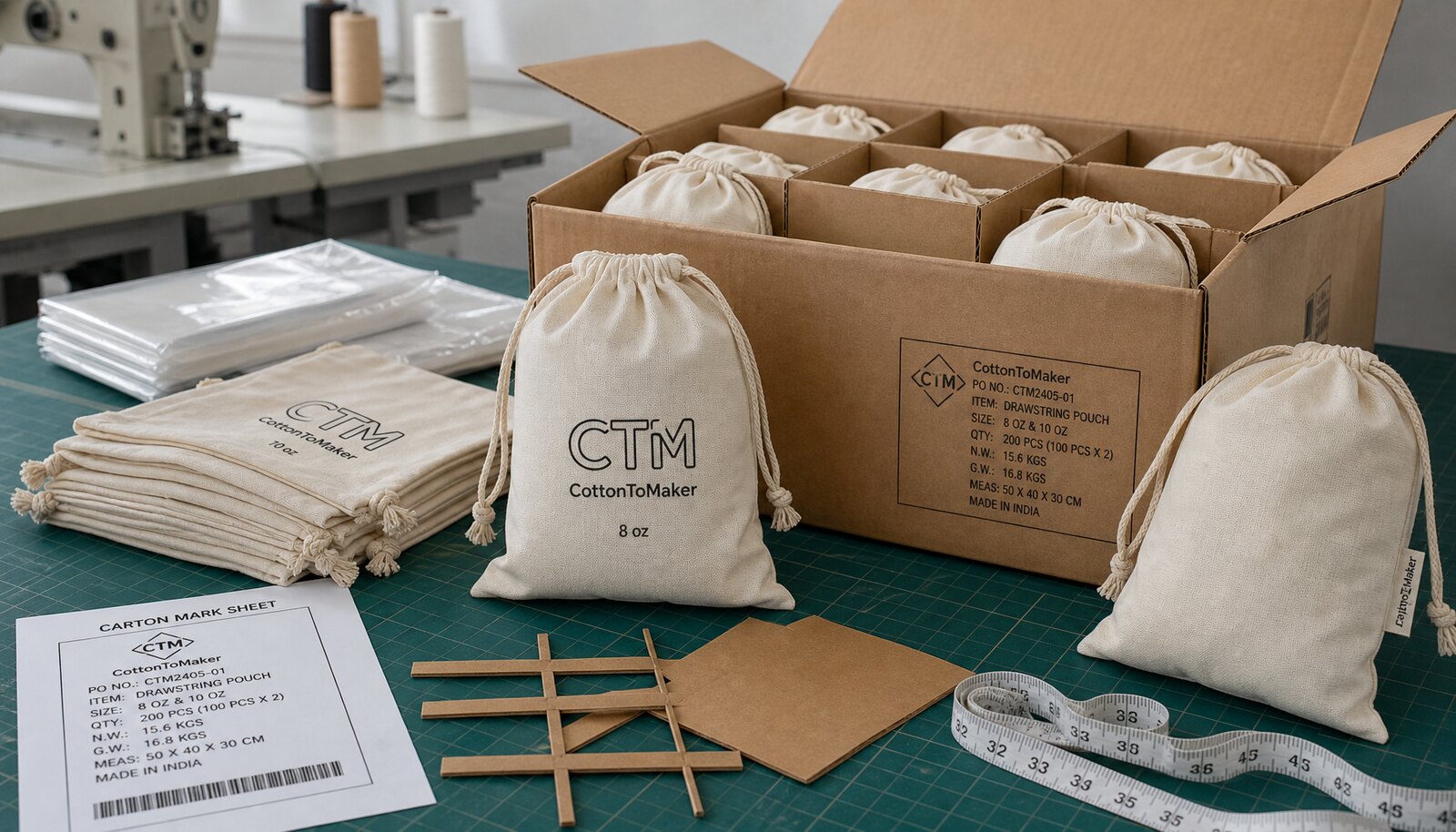
Why Carton Packing Must Be Specified Before Production
Drawstring pouch buyers often spend time on fabric color, logo size, and unit price, then leave carton packing as a supplier default. That is risky. Carton packing affects freight CBM, warehouse receiving, print condition, carton breakage, and even the final landed cost. A pouch order can pass sewing inspection but still create problems if cartons are too heavy, quantities are inconsistent, or mixed SKUs are not labeled clearly.
For procurement teams, carton packing should be part of the RFQ, not a final detail after production. The factory needs to know the packing method before confirming cost and lead time because individual polybags, inner bags, barcode labels, carton marks, and carton strength all add labor and material. The more SKUs, colors, and sizes in the order, the more important the packing plan becomes.
- A clear packing specification helps suppliers quote the same scope, instead of one quote including inner bags and another quote assuming loose bulk packing.
- Carton dimension and gross weight help freight forwarders estimate shipping cost before the order is finished.
- SKU-separated cartons reduce receiving errors for distributors and retail warehouses.
- Defined packing rules reduce disputes when the order arrives with crushed cartons, wrong counts, or mixed colors.
Start With the Pouch Specification, Not the Carton
The correct carton quantity depends on the pouch itself. A 10 x 15 cm cotton jewelry pouch in 5 oz fabric packs very differently from a 30 x 40 cm 12 oz canvas pouch with a thick braided cord. Even if both are called drawstring pouches, their carton volume, carton weight, and compression behavior are not comparable. This is why a factory cannot give a reliable carton plan from quantity alone.
In your RFQ, state the finished pouch size, fabric type, fabric weight, drawcord type, decoration method, and whether the pouch must remain flat and retail-presentable. Cotton pouches in 5 oz to 8 oz are flexible and can be compressed. Heavier canvas pouches in 10 oz to 12 oz need more space and may show creasing if overpacked. Jute and laminated materials also need looser packing because sharp folding can leave marks.
- Light cotton pouch: usually easier to bulk pack and suitable for higher pieces per carton.
- Canvas pouch: stronger retail feel but higher carton weight and lower carton quantity.
- Jute pouch: more rigid, less suitable for heavy compression, often needs careful stacking.
- Thick cotton cord or rope drawcord: increases bulk and can distort pouch shape when overpacked.
- Flat drawstring tape: packs cleaner but may need alignment if retail presentation matters.
Fabric GSM Changes Carton Weight and Freight Cost
Fabric weight is not only a hand-feel decision. It directly changes carton gross weight and total CBM. For example, upgrading from a light 5 oz cotton to a 10 oz canvas can make the pouch feel more premium, but the same carton may hold fewer pieces or become too heavy for safe handling. If the carton exceeds a practical warehouse handling weight, the factory may need to reduce pieces per carton, increasing the total carton count.
For most drawstring pouch orders, buyers should ask the supplier to calculate packing based on the approved fabric GSM and final sample, not on an early estimate. Cotton fabric can vary by weave, finishing, and shrinkage. A brushed or washed cotton may be bulkier than a plain greige cotton at similar GSM. If freight budget is tight, ask for estimated CBM at both the target GSM and an alternative GSM before confirming the order.
- 5 oz to 6 oz cotton: common for lightweight gift, jewelry, and promotional pouch programs.
- 8 oz cotton: a balanced option when the buyer wants better opacity and hand feel without excessive weight.
- 10 oz canvas: suitable for premium kits, shoe bags, and heavier retail accessories.
- 12 oz canvas: strong but bulky; check carton weight and creasing risk carefully.
- Jute or blended fabrics: confirm both GSM and material thickness because stiffness affects packing volume.
Choose Inner Packing Based on How the Goods Will Be Received
There is no single best inner packing method. The right choice depends on whether the pouches go to a repacking center, promotional distributor, retail warehouse, ecommerce fulfillment center, or directly into a gift kit assembly line. Loose bulk packing is cheaper and uses less plastic, but it can slow counting and may expose printed surfaces to rubbing. Inner polybags improve counting and cleanliness, but they add cost, packing time, and sometimes compliance requirements.
A common practical option is 10, 25, or 50 pouches per inner bag, then several inner bags per export carton. Small pouches can often be packed in larger inner quantities. Larger canvas pouches may need smaller bundles to avoid heavy handling and deep creases. If the pouch has a fresh screen print or heat transfer print, the factory should avoid pressing printed faces directly against rough carton surfaces or sharp cord knots.
- Loose bulk packing: best when the buyer will repack the pouches after import and wants the lowest packing cost.
- Inner bags of 10 pcs: useful for distributor picking, retail allocation, or sample kit assembly.
- Inner bags of 25 or 50 pcs: efficient for bulk warehouse counting while controlling dust and mixing.
- Individual polybag: suitable for retail or ecommerce, but confirm label, warning, and recycling requirements.
- Paper band or tissue wrap: may fit plastic-reduction programs but needs testing for transport durability.
Print Method Affects Drying, Stacking, and Protection
Decoration is one of the most common reasons packed pouches fail inspection. Screen print, heat transfer, embroidery, woven labels, and embossing all behave differently during packing. A simple one-color screen print on cotton is usually stable after proper curing, but if pouches are stacked too soon, ink can transfer or block. Heat transfer can show pressure marks if hot or freshly applied items are compressed too quickly.
Buyers should connect the printing specification with the packing specification. If the logo is large and centered, printed panels may need to face the same direction with paper separation for the first trial carton. If the logo uses metallic ink, puff ink, rubberized transfer, or high-opacity ink, ask the factory how long they wait before packing. For woven labels, confirm the label does not fold inside the carton in a way that makes the retail presentation look poor.
- Screen print: confirm curing time, rub resistance, and whether stacked print faces need protection.
- Heat transfer: check edge adhesion after compression and after pouch opening and closing.
- Embroidery: check backing material, thread trimming, and whether raised stitching leaves pressure marks.
- Woven label: confirm label position, stitch security, and whether labels remain visible or flat after packing.
- Foil or specialty print: request a packed sample test because surface damage is easier during transport.
Set Carton Quantity With Handling Limits, Not Guesswork
A supplier may suggest a high quantity per carton to reduce carton count and CBM, but that is not always the safest choice. Overpacked cartons can bulge, burst at corners, or arrive with compressed pouches that require steaming or repacking. Underpacked cartons can collapse when stacked. The target is a carton that is full enough to protect the goods but not so heavy or compressed that warehouse handling becomes difficult.
For many pouch orders, the practical carton gross weight should be discussed before the final packing plan is approved. A carton that looks efficient on paper may not be acceptable for a retail warehouse if it is too heavy for manual lifting. Ask the factory to provide a first packed carton weight and dimension before mass packing. If the order uses multiple pouch sizes, each size should have its own carton quantity and carton measurement.
- Small cotton pouches may pack several hundred to 1,000 pcs per carton depending on size and inner packing.
- Medium cotton or canvas pouches may need 200 to 500 pcs per carton depending on GSM and decoration.
- Large shoe, bottle, or accessory pouches may need much lower carton quantities.
- Heavy cartons should use stronger board and may need strapping if the logistics route is rough.
- Mixed-size cartons should be avoided unless the warehouse has approved the carton content format.
Carton Marks and Packing Lists Prevent Receiving Disputes
Carton marks are not just labels for the factory floor. They are part of the receiving process for the importer, distributor, or retail warehouse. If carton marks are unclear, the warehouse may need to open cartons one by one to identify SKUs, causing labor cost, delay, and sometimes chargebacks. For repeat orders, carton mark consistency also helps compare shortages, carton damage, or SKU errors across shipments.
At minimum, carton marks should match the purchase order and packing list. For multi-SKU programs, use item code, pouch size, color, print version, carton number, total carton count, quantity per carton, net weight, gross weight, and destination information where needed. If the buyer has a 3PL or retailer routing guide, send it before production starts. Do not wait until shipment booking to add warehouse label rules.
- Use one SKU per carton when possible for easier receiving and inventory control.
- If mixed cartons are required, mark the exact content breakdown on the carton and packing list.
- Confirm whether carton marks should be printed, stickered, or both.
- Ask for carton mark photos before shipment, especially for first orders.
- Make sure country of origin wording follows the buyer market requirement.
How Packing Requirements Affect MOQ and Lead Time
MOQ is not only a fabric purchasing issue. Packing can also create MOQ pressure. If a buyer requests many sizes, many colors, individual polybags, barcode labels, or special carton labels, the factory must separate materials, sewing batches, inspection, and packing lines. A total order of 5,000 pouches can be efficient if it is one size and one color, but inefficient if split into 20 small SKU lines with different packing rules.
Lead time also changes when packing is complex. Bulk sewing may finish on schedule, but printing, curing, trimming, folding, inner packing, barcode labeling, carton marking, and final inspection all take time. Buyers should reserve packing time in the purchase order timeline, especially before seasonal launches or fixed vessel bookings. A realistic lead time discussion includes sample approval, material purchasing, production, printing, packing, inspection, and shipment handover.
- Ask whether MOQ is calculated by total order, fabric color, pouch size, print artwork, or packing format.
- Confirm if barcode labels or individual polybags require extra setup time.
- Allow time for printed pouches to dry or cure before compression in cartons.
- For multi-SKU orders, request a packing schedule by SKU instead of one general ship date.
- Build in inspection time after cartons are packed, not only after sewing is completed.
Sample Checks Should Include One Packed Carton Reference
Many buyers approve a loose pre-production sample and assume bulk packing will follow common sense. That leaves too much room for variation. A better method is to approve a packed-carton reference at the beginning of bulk packing. The factory can prepare one trial carton using the approved pouch, inner bag quantity, carton mark, folding method, and sealing method. The buyer or inspector can then confirm whether the packing is acceptable before thousands of cartons are completed.
The packed carton sample does not always need to be shipped to the buyer. Clear photos and measurements are often enough for approval, especially for repeat programs. Ask for photos showing the open carton, inner packing arrangement, carton mark, carton dimensions, gross weight, and sealing. If the product is retail-sensitive, request photos after opening the carton to see whether the pouches remain flat and clean.
- Check folded or stacked pouch appearance after removing from the carton.
- Confirm printed panels are not sticking, scratching, or transferring color.
- Verify inner bag quantity by opening and counting at least one inner bag.
- Compare actual carton weight with the quoted packing data.
- Keep the approved packing photos for future reorders and inspections.
Common Packing Mistakes and How Buyers Can Avoid Them
The most expensive packing mistakes are usually simple: wrong carton quantity, mixed colors without clear marking, weak cartons, heavy cartons, missing barcode labels, and prints damaged by stacking too soon. These problems are avoidable if the RFQ includes specific packing data and if the buyer checks one packed carton before mass packing. Do not rely on the phrase export standard packing without defining what it means for your order.
When comparing supplier quotes, check whether the packing scope is equal. One factory may include 5-ply cartons, inner bags, carton marks, and barcode labels. Another may quote a lower unit price based on loose packing in standard cartons. The cheaper quote may become more expensive after packing changes, repacking labor, or freight adjustment. A good quote should make packing visible, measurable, and inspectable.
- Avoid approving a quote without carton dimensions, gross weight, and CBM.
- Avoid mixing SKUs in one carton unless the receiving warehouse agrees in writing.
- Avoid packing fresh prints under pressure without curing or protection checks.
- Avoid cartons that are too heavy for manual warehouse handling.
- Avoid vague instructions such as standard packing, normal carton, or as usual.
Specification comparison for buyers
| Spec decision | Recommended option | When it fits | Buyer risk to check |
|---|---|---|---|
| Pouch fabric weight | 5 oz to 8 oz cotton for light gifts; 10 oz to 12 oz canvas for heavier retail kits | Cosmetics, jewelry, candles, accessories, premium promotional packs | Heavier GSM increases carton weight and may reduce pieces per carton; confirm gross weight before freight booking |
| Print method before packing | Screen print for simple logos; heat transfer for gradients; woven label for repeated retail programs | Screen print fits high-volume single-color orders; transfer fits detailed artwork; labels fit brand consistency | Fresh prints can mark off if packed too soon; require curing or drying time before bulk packing |
| Individual packing | Loose bulk packing or 10 to 50 pcs per inner polybag depending on distribution method | Loose packing fits repacking centers; inner bags fit retail warehouse counting and cleaner handling | Too many pouches per inner bag makes counting slow and can crease printed panels |
| Carton quantity | Usually 200 to 1,000 pcs per carton depending on pouch size, fabric GSM, drawcord, and decoration | Small jewelry pouches can pack high quantity; canvas shoe or bottle pouches need lower quantity | Do not approve carton quantity without checking carton dimension, gross weight, and compression risk |
| Carton strength | 5-ply export carton for heavy canvas, long shipment, or stacked warehouse storage | Sea freight, mixed container loading, or cartons above roughly 15 kg gross weight | Thin cartons can burst at corners when cotton fabric expands after compression |
| Carton marks | SKU, PO number, item size, color, quantity, net weight, gross weight, carton number, country of origin if required | Multi-SKU retail orders, distributor receiving, Amazon or 3PL inbound sorting | Missing carton marks create receiving delays and chargebacks even when product quality is acceptable |
| MOQ and packing split | Set MOQ by fabric color, pouch size, print setup, and packing method, not only total units | Orders with several pouch sizes, logo colors, or retail pack formats | A low total MOQ may still be inefficient if every variant needs separate cutting, printing, and packing control |
| Pre-shipment check | Inspect packed cartons as well as loose pouches: count, carton mark, inner bag quantity, weight, sealing, and drop resistance | Any export order where cartons go directly to warehouse or retail distribution | Checking only loose pouches misses the most common import receiving problems |
Buyer checklist before sampling
- Confirm pouch size, finished tolerance, fabric GSM, drawcord type, color, and shrinkage allowance before discussing carton quantity.
- State whether pouches should be bulk packed loose, packed by inner polybag quantity, or packed as retail-ready sets.
- Define the exact quantity per inner bag and per export carton for each SKU, not only one general packing instruction.
- Ask for carton dimensions, net weight, gross weight, and estimated CBM before approving the final quote.
- Check whether the print, heat transfer, label, or embroidery needs extra drying, curing, or protection before packing.
- Require a packing photo from the pre-production sample or first bulk carton, including inner bag, carton mark, and carton sealing.
- Set acceptance criteria for carton damage, incorrect quantity, mixed colors, mixed sizes, and wrong carton marks.
- Make sure the packing list format matches your warehouse receiving system, including SKU, PO, color, size, and carton sequence.
- For retail or distributor orders, confirm barcode label position, suffocation warning language, recycling mark, and country of origin rules if applicable.
- Before shipment, compare actual packed carton weight and CBM against the original quote to catch freight cost changes early.
Factory quote questions to send
- For this drawstring pouch size and fabric GSM, how many pieces do you recommend per inner bag and per export carton?
- What are the proposed carton dimensions, net weight, gross weight, and total CBM for the full order quantity?
- Will you use 3-ply or 5-ply export cartons, and what gross weight limit do you apply per carton?
- Can you pack by SKU, color, size, or PO line separately, and will each carton contain only one SKU unless we approve mixed packing?
- If the pouch has screen print, heat transfer, embroidery, or a woven label, how do you prevent print transfer, creasing, or label deformation during packing?
- What is the MOQ impact if we require 10 pcs per inner bag, individual polybags, barcode labels, or retail-ready packing?
- Can you provide photos of one packed carton before mass packing starts, including the carton mark and inner packing arrangement?
- How many days should be reserved for final packing, carton marking, weighing, and inspection after bulk sewing and printing are finished?
- Will the packing list show carton-by-carton quantity, or only the total order quantity?
- What carton sealing method will you use: tape only, tape plus straps, or reinforced corner protection for heavy cartons?
Quality-control points to confirm
- Check finished pouch dimensions after sewing and after normal handling; do not measure only flat cut panels.
- Confirm fabric GSM with approved swatch or sample reference, especially when cotton, canvas, jute, or blended fabric is quoted.
- Inspect drawcord length, knot security, cord color, channel stitching, and whether the pouch closes smoothly without fabric bunching.
- Verify print position, print size, color, curing, adhesion, and whether printed surfaces are protected inside the carton.
- Open random cartons to confirm inner bag quantity, carton quantity, SKU separation, and packing direction.
- Compare actual carton dimensions and gross weight with the supplier packing list and freight booking data.
- Check carton marks against the purchase order, item code, destination requirement, and buyer warehouse label rules.
- Inspect carton sealing, corner strength, moisture condition, odor, and any signs of crushing before shipment release.
- For mixed-size programs, confirm the carton sequence and packing list allow the warehouse to receive without opening every carton.
- Keep one approved packed-carton photo set as the reference for repeat orders.