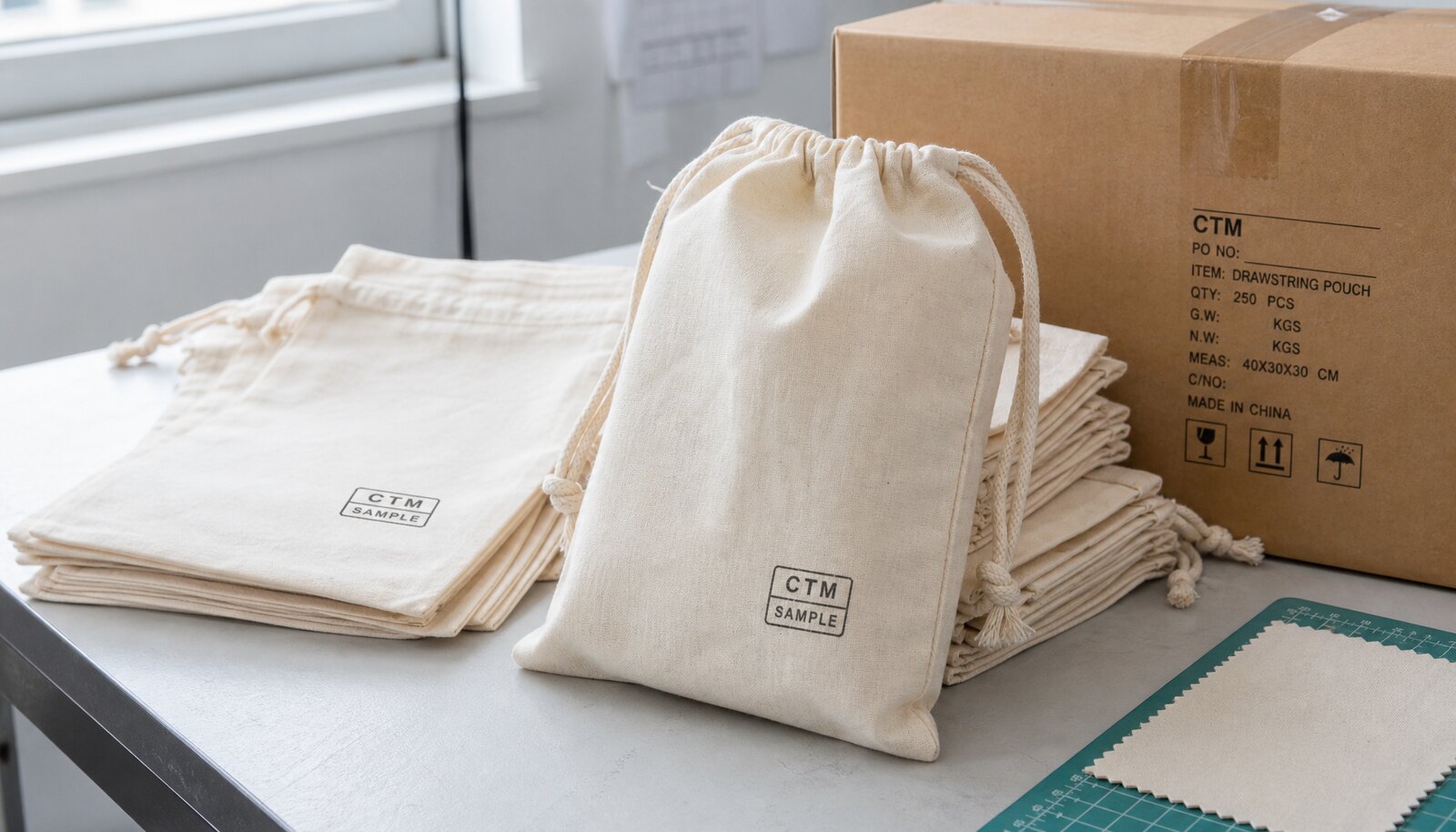
Why Carton Freight Belongs in the Pouch RFQ
Drawstring pouches look simple, but freight mistakes often start before the first fabric is cut. A buyer may compare two quotes for the same cotton pouch and focus only on the unit price. One supplier then packs 1,000 pieces per carton, another packs 400 pieces per carton, and a third uses large soft cartons that cube out the shipment. The landed cost changes even when the product specification looks similar.
A drawstring pouch carton freight checklist helps procurement teams control the part of the order that is easy to ignore: how the goods are folded, bundled, counted, weighed, labeled, and measured for shipping. If you import for retail, promotional kits, cosmetics, jewelry, wine accessories, hotel amenities, or ecommerce packaging, the carton plan should be approved with the product sample, not discovered when the packing list arrives.
- Use carton data to compare supplier quotes on landed cost, not only FOB unit price.
- Ask for carton dimensions early enough to plan pallet loading and warehouse receiving.
- Check packing method before approving production because changing it later can affect labor, carton count, and lead time.
- Treat carton weight and CBM as commercial data, not only logistics data.
Define the Pouch Before You Define the Carton
Carton planning starts with the pouch specification. A 10 x 15 cm cotton jewelry pouch in 120 GSM fabric and a 30 x 40 cm 10 oz canvas pouch are both drawstring pouches, but they behave very differently in packing. One can be bundled tightly with low carton weight. The other holds air, resists compression, and can wrinkle if forced into a small carton. If the RFQ is vague, the factory may quote the easiest packing method rather than the best method for your supply chain.
Your RFQ should state the finished size, fabric weight, drawcord type, print area, and packing requirement together. Finished size means the usable pouch size after sewing, not the fabric panel size before seam allowance. For drawstring pouches, the channel depth and seam allowance reduce usable space. If the pouch must hold a candle, soap bar, bottle, garment accessory, or gift set, provide the product dimensions and required fit, not just a flat pouch size.
- Small light pouch: 100-140 GSM cotton is common when the pouch is mainly protective packaging.
- Retail gift pouch: 140-180 GSM cotton gives better opacity and print stability.
- Premium reusable pouch: 200-280 GSM canvas or twill gives stronger structure but increases volume.
- Heavy canvas pouch: confirm sewing capability, drawcord channel thickness, and carton weight before order.
GSM, Fabric Hand-Feel, and Freight Volume
Fabric GSM affects more than touch and durability. It affects carton compression, carton weight, sewing output, and sometimes print finish. A low GSM natural cotton pouch can be packed flatter, but it may show contents through the fabric and may not hold a premium brand position. A heavier canvas pouch looks stronger, but a carton can reach warehouse weight limits before it reaches the piece count the buyer expected.
Buyers should ask the factory to quote the same pouch in one or two realistic GSM options when the specification is still open. Do not request too many options, because the quote becomes hard to compare. A practical comparison is usually enough: for example, 140 GSM cotton for a simple promotional pouch and 220 GSM canvas for a reusable retail pouch. Ask for the estimated carton quantity and CBM for both. That shows the freight effect of the material decision.
- Confirm actual GSM tolerance, because fabric may vary by mill batch.
- Ask whether dyed fabric will feel stiffer or softer than natural cotton after finishing.
- Check whether the pouch is pressed before packing, because pressing can improve carton consistency.
- Do not approve fabric by photo only; GSM and hand-feel need a physical swatch or sample.
Print Method Choices That Affect Packing
Printing is often treated as a branding issue, but it also affects packing. Screen print with heavy ink coverage may need proper drying and curing time before bulk packing. Heat transfer can create a smooth logo but may show pressure marks if hot or heavy cartons are stacked too soon. Embroidery is less common for small pouches because it can pucker light fabric and increase labor, but it may be suitable for heavier canvas gift pouches.
For most drawstring pouch programs, screen print is the practical choice for solid logos and one to three spot colors. Heat transfer fits gradients or detailed artwork when the buyer accepts the hand-feel. Woven labels or side labels work well when the brand wants a cleaner front panel or expects multiple artwork changes. The important point is to approve the print method together with the packing method. A perfect logo on the table can still arrive scuffed if pouches rub inside a loose carton.
- Request logo placement tolerance, such as plus or minus 3-5 mm depending on pouch size.
- Check print adhesion with light rub testing after curing, not immediately after printing.
- Avoid placing large prints too close to the drawcord channel where fabric gathers.
- For dark dyed fabric, confirm whether underbase printing is included in the quote.
MOQ Logic: Fabric, Print, Cord, and Carton Efficiency
A realistic MOQ is not only a sales number. It comes from fabric sourcing, dyeing, drawcord availability, print setup, label production, and cutting efficiency. A factory may accept a low MOQ for stock natural cotton fabric but require a higher MOQ for custom dyed cotton, color-matched cords, woven labels, or special carton packing. If procurement pushes the MOQ too low without understanding the reason, the unit cost can rise or the order may be produced with leftover material that is not stable across replenishment.
For quote comparison, ask the supplier to separate MOQ drivers. If the fabric is stock, the MOQ may be mainly print setup and sewing line scheduling. If the fabric is custom dyed, the dye lot and shrinkage control become more important. If the carton plan requires exact retail inner packs or barcode labeling, packing labor may become a bigger cost item than expected. This is especially true for small pouches, where the unit sewing cost is low but handling time is high.
- Ask for MOQ by fabric color, not only by total order quantity.
- Confirm whether multiple pouch sizes can share the same fabric order.
- Check whether logo versions can be combined under one print setup or require separate screens.
- Ask whether carton quantity changes if the order is below the standard packing volume.
Build the Carton Freight Checklist
A good carton freight checklist is short enough for daily use but specific enough to prevent disputes. It should tell the factory what packing data must be confirmed before production and what data must appear on the final packing list. The checklist should also connect product decisions with logistics decisions. For example, if pouches are individually polybagged, the carton volume increases. If they are bundled without polybags, print abrasion and moisture protection need more attention.
The key data points are pieces per carton, carton dimensions, gross weight, net weight, total carton count, and total CBM. These numbers should be requested at quotation stage, checked again after pre-production packing, and confirmed at final packing. For larger orders, ask for carton photos showing the bundle method, carton liner, and sealed carton marks. This gives your freight forwarder and receiving warehouse reliable information before the goods move.
- Pieces per carton: confirm the exact count and whether every carton is the same.
- Carton dimensions: request length, width, and height in centimeters for export quote comparison.
- Gross and net weight: check manual handling limits and forwarder data accuracy.
- Total CBM: use this to compare sea freight, air freight, and consolidation options.
- Carton marks: confirm SKU, PO, quantity, country of origin if required, and barcode labels if needed.
Packing Method: Flat, Folded, Bundled, or Polybagged
The cheapest packing method is not always the best packing method. Flat bundling is efficient for many cotton drawstring pouches and keeps the front panel smoother. Folding can reduce carton footprint for some sizes but may create crease lines through the logo. Individual polybags protect each pouch from dust and mixed handling, but they add labor, plastic, carton volume, and sometimes retailer compliance concerns. Bulk loose packing is risky because it can change count accuracy and cause print rubbing.
Procurement teams should specify how the pouch will be handled after arrival. If the distributor will repack into gift kits, bundled bulk packing may be enough. If the product goes directly to retail stores or ecommerce fulfillment, individual barcode bags or inner packs may be required. If the pouch is part of a premium unboxing experience, creasing and cord tangling become quality issues, not just packing preferences.
- Flat bundles of 25, 50, or 100 pieces are practical for many wholesale programs.
- Individual polybags should be quoted separately so the buyer can see cost and volume impact.
- Inner cartons can help SKU control but increase material cost and total CBM.
- Carton liners help reduce moisture and dust exposure during long transit.
Sample Checks Before Approving Bulk Packing
A product sample without packing is only half a sample. Before mass production, request a pre-production sample and a packing reference. For many orders, a full carton sample is not necessary, but the factory should provide a packing trial with the proposed fold, bundle count, carton size, and estimated carton weight. For high-value retail programs, approving a fully packed carton is worth the time because warehouse problems are expensive after arrival.
Check the sample the same way your receiving team will experience it. Open the carton, count the bundles, inspect print surfaces, pull the cord, check stitching at the channel, and measure finished size. If the pouch has a printed logo, look for ink transfer between pieces. If it uses a woven label, check label direction and seam capture. If it uses dyed fabric, compare shade in several pieces, not only the top sample.
- Measure finished size after the pouch is relaxed, not stretched.
- Pull the drawcord several times to check channel friction and knot security.
- Check whether the print cracks or distorts when the pouch is closed.
- Confirm bundle count and carton packing count match the quote.
- Keep the approved sample sealed and identified by PO, date, and version.
Lead Time and Quote Data Buyers Should Request
Lead time should be broken into steps. A single statement such as 25 days after deposit may hide fabric waiting time, artwork approval, print screen preparation, curing time, sewing output, inspection, packing, and export booking. Drawstring pouches can be fast when fabric and cord are in stock, but custom dyed fabric, special labels, or complex retail packing can change the schedule.
Quote data should also be complete enough for finance and logistics to calculate landed cost. The RFQ should request unit price, fabric specification, print cost, setup cost, packing cost if separate, carton data, sample cost if applicable, production lead time, and quote validity. If the supplier only gives a unit price, the buyer cannot compare freight or identify hidden assumptions. A slightly higher unit price with accurate carton data may be the safer commercial choice.
- Ask for fabric preparation days separately from sewing days.
- Confirm whether sample approval time is included or excluded from production lead time.
- Request quote validity because cotton, carton, and freight-related costs can move.
- Ask for estimated ready date and shipping document timing, not only production completion date.
Common Mistakes That Increase Landed Cost
The most common mistake is approving the pouch and ignoring the carton until the goods are packed. At that stage, the buyer may discover that the cartons are too large, too heavy, poorly marked, or inconsistent in count. Changing cartons after packing wastes time and may damage products during repacking. The second mistake is comparing supplier quotes without normalizing carton data. A lower FOB price can disappear if the shipment uses more CBM.
Another frequent problem is unclear responsibility for retail labels, barcode stickers, country of origin marks, and inner packing. These details look small during sourcing but create delays when the forwarder, warehouse, or retailer requires them. For drawstring pouches used as packaging components, timing is also critical. If the pouches arrive late, the buyer may delay the main product packing line. The carton checklist reduces this risk by forcing the supplier to confirm data before production.
- Do not accept carton dimensions listed as estimated if the order is already packed.
- Do not let the factory choose carton marks without buyer approval.
- Do not approve a print sample without checking how printed pieces touch in packing.
- Do not ignore carton gross weight if your warehouse has manual lifting restrictions.
- Do not assume replenishment orders will match the first order unless packing specs are documented.
Specification comparison for buyers
| Spec decision | Recommended option | When it fits | Buyer risk to check |
|---|---|---|---|
| Fabric weight for standard retail pouch | 120-180 GSM cotton or canvas, depending on pouch size | Small gift, cosmetic, jewelry, candle, or accessory pouch where shape and print clarity matter | Too light can look transparent; too heavy increases carton volume and freight cost without adding retail value |
| Fabric weight for premium reusable pouch | 200-280 GSM canvas or twill | Higher-value kits, bottle accessories, electronic accessories, or reuse-focused packaging | Thicker fabric may require larger carton allowance and slower sewing output |
| Print method | Screen print for solid logos; heat transfer for gradients; woven label for premium minimal branding | Buyer has approved artwork and needs repeatable brand color across replenishment orders | Ink hand-feel, print cracking after drawcord tension, and color tolerance must be checked on pre-production sample |
| Unit packing | Flat packed in bundles of 25, 50, or 100 pieces with carton liner | Most wholesale and retail distribution orders where barcode polybags are not required | Loose packing can change carton count and cause wrinkling or print abrasion during ocean freight |
| Carton strength | 5-ply export carton for heavy canvas pouches or long transit; 3-ply only for light small pouches | Mixed road, sea, and warehouse handling with stacking risk | Weak cartons deform, causing customer claims even when pouch quality is acceptable |
| Carton size | Keep cartons liftable and dimensionally efficient, commonly under 18-22 kg gross weight | Importer wants predictable handling, pallet planning, and freight quote comparison | Oversized cartons may be charged by volume and rejected by some warehouse receiving teams |
| MOQ logic | Base MOQ on fabric availability, dyeing, print setup, and carton packing efficiency | Custom size, dyed fabric, private label, or special drawcord order | A low quoted MOQ may hide higher unit cost, shared fabric risk, or weak production control |
| Shipment quote data | Ask for pieces per carton, carton dimensions, gross/net weight, total CBM, and carton count | Any RFQ where freight, warehouse handling, or landed cost matters | Comparing unit price without carton data can make the cheaper supplier more expensive landed |
Buyer checklist before sampling
- Confirm pouch size measured as finished inside usable size, not only cut panel size.
- State fabric composition and GSM, such as 100% cotton 140 GSM, 10 oz canvas, jute-cotton blend, or recycled cotton blend.
- Confirm whether fabric is natural, bleached, dyed, washed, or unwashed because this affects shrinkage, shade, and carton compression.
- Specify drawcord material, diameter, color, knot style, and whether the cord must pass a pull test.
- Define print method, logo size, print position, ink color reference, and acceptable placement tolerance.
- Request a packed sample or packing photo, not only an unpacked product sample.
- Approve pieces per inner bundle, pieces per carton, carton dimensions, gross weight, net weight, and total CBM before production packing.
- Check whether pouches are folded, laid flat, nested, or compressed because this changes wrinkles and freight volume.
- Require carton marks, SKU labels, purchase order number, country of origin marking if needed, and barcode labels where applicable.
- Ask the factory to confirm carton drop resistance, tape method, carton liner, and moisture protection for sea shipment.
Factory quote questions to send
- What fabric GSM and fabric construction are included in this quote, and is the material greige, bleached, dyed, or stock natural cotton?
- Is the quoted size the finished pouch size after sewing, or the cut fabric size before seam allowance?
- What is the recommended carton quantity for this pouch size and fabric weight, and why?
- What are the carton dimensions, gross weight, net weight, and total CBM for the quoted quantity?
- Will the pouches be flat packed, folded, bundled, individually polybagged, or packed in retail-ready sets?
- What print method is quoted, and what setup cost or screen charge applies for each color or artwork version?
- What logo placement tolerance can the factory maintain on bulk production?
- What MOQ applies to the fabric, drawcord, print process, label, and carton packing method separately?
- Can you provide a pre-production sample packed in the proposed carton method before mass cutting?
- How many days are needed for fabric preparation, print approval, sewing, packing, and export documents?
Quality-control points to confirm
- Finished pouch size tolerance after sewing and pressing.
- Fabric GSM, fabric hand-feel, weave density, and visible slub level against approved sample.
- Drawcord length, cord diameter, knot security, and smooth opening and closing.
- Seam allowance, stitch density, lockstitch consistency, and loose thread removal.
- Print color, print position, print adhesion, edge sharpness, and rub resistance.
- Logo distortion near drawcord channel or side seam.
- Side label position, label folding direction, and label stitching if private label is used.
- Bundle count, carton count, pieces per carton, and carton gross/net weight.
- Carton compression condition, tape strength, liner use, and moisture control.
- Carton marks, SKU labels, PO numbers, barcodes, and packing list consistency.