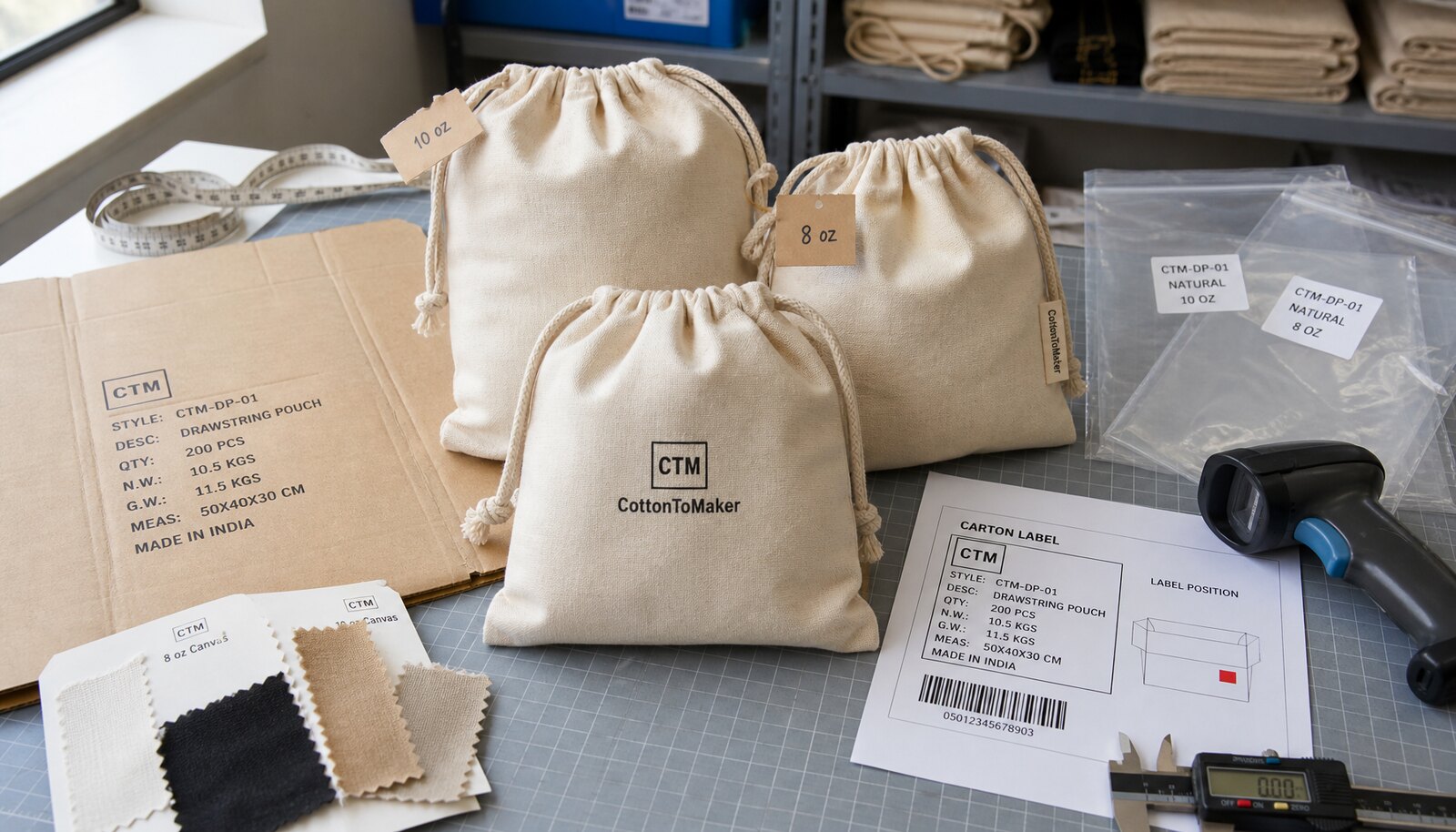
Why carton barcode proofing matters for drawstring pouches
A drawstring pouch is a simple product, but the carton data around it is often where avoidable shipment problems start. Many importers check fabric, logo, and stitching carefully, then approve a carton label as a small administrative detail. That is risky when the order goes to a retail distribution center, 3PL, marketplace prep warehouse, or distributor with automated receiving. A carton barcode that scans incorrectly can delay unloading, trigger manual receiving charges, or force relabeling after the goods have already arrived.
The purpose of a drawstring pouch carton barcode proof worksheet is to connect the physical pouch specification with the carton identification data before mass packing. It is not only a label artwork approval. It should confirm what is inside the carton, how many pieces are packed, which SKU the carton represents, and whether the barcode will scan under real warehouse conditions. For procurement teams, this worksheet becomes a control document between the buyer, merchandiser, factory packing line, inspection company, and receiving warehouse.
- Use the worksheet before carton labels are printed or cartons are packed.
- Treat each pouch SKU and carton pack quantity as a separate approval line.
- Do not rely only on the final packing list to catch barcode mistakes.
- Include the worksheet in the RFQ if the buyer has retailer or 3PL label rules.
Define the pouch SKU before approving any carton barcode
The barcode proof should never float separately from the product specification. For drawstring pouches, similar-looking items can have different commercial meanings: 5 oz cotton versus 10 oz canvas, natural cotton versus dyed black, cotton rope drawcord versus polyester cord, one-color screen print versus heat transfer, or a side seam label versus direct logo print. If those differences are not written into the worksheet, the packing team may label the carton correctly but fill it with the wrong version.
A practical worksheet starts with a locked SKU description. Include pouch dimensions, fabric composition, fabric weight, color, drawcord material, print method, print position, and packing count. For example, a 150 x 200 mm natural cotton drawstring pouch in 5 oz fabric may pack very differently from a 300 x 400 mm 10 oz canvas pouch with thick cotton rope. Carton quantity, carton size, gross weight, and even label placement can change. If the SKU definition changes after sampling, the barcode proof must be updated before production packing.
- Record finished pouch size with tolerance, such as 200 x 300 mm plus or minus 5 mm.
- State fabric weight clearly, such as 140 gsm cotton, 180 gsm cotton, 8 oz canvas, or 10 oz canvas.
- Identify drawcord type, diameter, color, and whether knots, metal tips, or sewn ends are required.
- Link the carton barcode to the exact print method, such as screen print, heat transfer, digital print, embroidery, woven label, or debossed patch.
Choose barcode format based on the receiving channel
Different buyers use different barcode systems. A distributor may only need a Code 128 carton ID for internal receiving. A retail chain may require GS1-128 with application identifiers. A marketplace or fulfillment warehouse may require a specific FNSKU, carton content label, or routing label. The factory should not guess the format from a previous order or create a barcode from the SKU text unless the buyer has confirmed it.
When you send an RFQ, separate the unit barcode requirement from the carton barcode requirement. A pouch sold as a retail item may need a UPC or EAN on the unit polybag or hangtag, while the export carton may need a different barcode for carton receiving. If the pouch is used as a packaging component, such as jewelry pouches or amenity pouches, unit barcodes may not be needed, but carton identification still matters. The worksheet should show both levels so the factory does not print a unit barcode on the carton by mistake.
- Use GS1-128 when the retailer specifies carton content data, lot data, or shipment identifiers.
- Use Code 128 when a buyer warehouse needs a scannable internal carton reference.
- Use EAN-13 or UPC mainly for retail unit packaging, not as a default master carton code.
- Confirm whether barcode numbers come from the buyer, brand owner, distributor, or factory system.
Build the worksheet around carton packing reality
The most common barcode proof mistake is approving the number while ignoring the pack. For drawstring pouches, carton quantity depends on pouch size, fabric thickness, logo treatment, and packing method. Small 100 x 140 mm cotton jewelry pouches may pack in hundreds or thousands per carton when bulk packed. Larger 12 oz canvas drawstring bags with individual polybags may require fewer pieces because the fabric and drawcord create more volume. A barcode tied to 500 pieces per carton becomes wrong if production later changes to 400 pieces due to carton weight or compression.
A good worksheet forces the supplier to confirm carton count before labels are printed. It should include pieces per inner bag or bundle, bundles per carton, total pieces per carton, carton dimensions, net weight, gross weight, and carton sequence. If the order has mixed colors, avoid mixed cartons unless receiving can handle them. If mixed cartons are approved, the barcode label must identify the mix ratio clearly, and the packing list must repeat the same information.
- Confirm whether pouches are bulk packed, bundled, individually polybagged, or packed with retail insert cards.
- Set a maximum gross weight per carton if workers or the destination warehouse have handling limits.
- Avoid last-minute carton quantity changes after barcode approval.
- Require the carton label to show mixed color content only when mixed cartons are approved in writing.
Connect fabric weight, print method, and packing volume
Fabric weight affects more than product feel. It changes folding thickness, carton compression, carton cube, and sometimes the risk of print transfer inside packed cartons. A 5 oz cotton pouch is often used for lightweight promotional packaging. It is easier to compress, but it can wrinkle more visibly. An 8 oz or 10 oz canvas pouch has stronger hand feel and better perceived value, but it takes more carton space. Jute and heavy cotton blends can have rougher surfaces that affect label and logo presentation, especially if the pouch is also individually packed.
Print method also changes packing decisions. Screen printed pouches may need curing time before tight packing. Heat transfer prints can be sensitive to pressure and heat if packed too soon or stored in hot conditions. Digital print may require color control and surface consistency. Embroidery adds thickness and can create pressure marks when pouches are packed tightly. If these production details change the number of pouches per carton, the carton barcode proof and packing worksheet must change together.
- For light cotton pouches, check shrinkage and finished size before setting the carton quantity.
- For canvas pouches, confirm whether folding creates bulky corners that reduce carton capacity.
- For screen print, confirm curing and anti-transfer packing before final carton closing.
- For embroidered or patched pouches, check whether stacking pressure damages the logo area.
Set sample checks before barcode proof approval
The best time to catch barcode and packing issues is after pre-production sample approval but before mass packing. Ask the factory to prepare a packing sample using the approved pouch, agreed inner packing, and proposed carton label. The carton does not need to contain the full production quantity for the first proof photo, but the final packing trial should confirm that the quantity, carton dimensions, and gross weight are realistic.
Your sample check should cover both product and label. The pouch should match approved fabric GSM, size, drawcord, stitching, color, logo position, and print quality. The carton label should match the buyer data, scan cleanly, and sit flat on the carton. If your receiving warehouse has strict requirements, send the proof there before approving mass packing. A merchandiser can confirm whether the label looks correct, but the receiving system confirms whether the barcode data is usable.
- Scan the barcode from the printed label, not only from a PDF on screen.
- Check that human-readable digits under the barcode match the worksheet exactly.
- Ask for photos of the label on the carton from straight-on and angled views.
- Open one packed trial carton to confirm the inside count matches the label.
Avoid the most expensive carton barcode mistakes
Most barcode mistakes are small at the artwork stage and expensive after shipment. A missing digit, wrong check digit, small quiet zone, low print contrast, or label placed over a carton seam can turn a normal receiving process into manual handling. If the shipment includes multiple similar pouch SKUs, the risk increases. Warehouses often receive cartons quickly. They may scan the code and put the carton into stock without opening it, so an incorrect label can hide the problem until order picking or retail replenishment.
Another frequent mistake is reusing an old barcode proof for a reorder after changing carton quantity. Procurement teams often reorder the same pouch with a new logo color, new fabric GSM, or changed pack count to reduce freight cube. If the old carton barcode is still linked to the previous quantity or SKU attributes, inventory records become unreliable. The worksheet should include a revision date and change reason so the buyer and factory can see whether the label belongs to the current order.
- Do not approve barcode artwork without the final carton quantity.
- Do not allow one barcode to cover several pouch colors unless the buyer system treats them as one SKU.
- Do not place barcode labels under stretch wrap, over tape, or near crushed carton corners.
- Do not use low-resolution barcode images copied from email screenshots.
Use MOQ logic to control label cost and error risk
MOQ is not only about sewing quantity. Carton labels, printed unit labels, hangtags, color drawcords, custom dyed fabric, and logo screens all have setup logic. For barcode labels, the unit cost may be small, but the error risk grows when there are too many SKU splits at low quantities. A 3,000 piece order split into six pouch colors, two sizes, and two packing methods can create many carton label versions. Each version needs separate proofing, printing, storage, and packing line control.
When you request a quote, ask the factory to show the MOQ impact of each option. A simple natural cotton pouch with one-color screen print and one carton barcode version is easier to control. A multi-SKU retail order with unit UPC labels, carton GS1 labels, color-specific cartons, and pallet labels requires more administration. The right supplier will not only quote the pouch price; they will explain how many barcode and packing versions are included and what happens if the buyer changes data after label printing.
- Keep carton label versions as few as possible without sacrificing SKU accuracy.
- Group similar pouches only when the receiving system allows the same SKU and same carton quantity.
- Ask whether label printing setup is included or charged separately for small runs.
- Confirm cut-off date for final barcode data before label production begins.
Quote data buyers should request with the worksheet
A useful drawstring pouch quote should include more than unit price and lead time. The quote should show material, fabric weight, finished size, logo method, print colors, drawcord details, inner packing, carton packing, carton size, estimated gross weight, sample cost if any, mass production lead time, and barcode label responsibility. Without those details, two supplier quotes may look similar while one has excluded important packing work.
For a carton barcode proof worksheet, ask the supplier to quote the product and the compliance work together. If the factory must print adhesive carton labels, scan labels during packing, separate mixed SKUs, or prepare retailer-specific shipping marks, those tasks require labor. A cheaper quote may assume generic export markings only. A better quote may include proofing, label application, scan checking, carton numbering, and packing list alignment. Procurement should compare these quote lines before choosing the supplier.
- Request fabric price basis, such as 140 gsm cotton, 180 gsm cotton, 8 oz canvas, or custom dyed fabric.
- Request logo cost by method, screen charge, color count, print size, and whether both sides are printed.
- Request packing cost for individual polybag, paper band, hangtag, insert card, or bulk bundle.
- Request carton label cost and whether the factory can follow buyer or retailer label templates.
Approval workflow before mass packing and shipment
The cleanest workflow is to approve the pouch sample first, then approve the packing method, then approve the carton barcode proof, and only then allow mass packing. If those approvals happen out of order, the factory may print labels before the carton quantity is final, or pack cartons before the receiving data is confirmed. The worksheet should show approval dates and responsible people from both buyer and supplier sides.
During final inspection, the inspector should open selected cartons, count the pouches, check the product against the approved sample, and scan or visually verify the carton barcode. For larger orders, the inspection plan should include more than one carton label version. If there are five SKUs, checking only one barcode version is not enough. Before shipment release, the packing list should match carton sequence, barcode number, SKU, color, quantity, carton dimensions, and gross weight.
- Approve final product sample and artwork before locking carton label data.
- Approve one actual carton label photo before bulk label application.
- Inspect at least one carton from each SKU or barcode version during pre-shipment inspection.
- Keep the final worksheet with the commercial invoice, packing list, and inspection report.
Specification comparison for buyers
| Spec decision | Recommended option | When it fits | Buyer risk to check |
|---|---|---|---|
| Carton barcode format | GS1-128 or Code 128 for carton ID, EAN-13 or UPC only when retailer requests it | Retail distribution centers, marketplace FBA prep, or buyer warehouse receiving | Wrong symbology can scan in the factory but fail at the destination warehouse |
| Carton label placement | Two adjacent carton sides, same height, flat panel area away from tape seams | Mixed pallet receiving, warehouse conveyors, and manual scan at unloading | Labels across corrugation folds, corner crush zones, or tape edges often become unreadable |
| Unit packing inside carton | One pouch per opp bag or bulk stacked by agreed count, with inner carton divider only if required | Promotional pouches, retail gift pouches, amenity kits, and ecommerce kitting | Barcode proof can be correct while inner quantity or color mix is wrong |
| Fabric and print confirmation | Attach pouch spec line to barcode proof: fabric GSM, size, color, print method, and logo position | Orders with multiple SKUs sharing similar carton sizes | Warehouse may accept the carton barcode, but the carton may contain the wrong pouch version |
| Proof approval method | PDF proof plus one photographed printed carton label on actual carton surface before mass packing | Any order shipping to retail DCs, 3PLs, Amazon prep, or distributor warehouses | Flat artwork proof does not reveal print density, label curl, or carton surface scanning problems |
| Reorder control | Lock one barcode worksheet per SKU, per carton pack, per destination rule | Repeat seasonal orders, private label pouches, multi-market distribution | Reusing a previous barcode after changing carton quantity or pouch size creates inventory mismatch |
Buyer checklist before sampling
- Confirm the barcode number, symbology, human-readable digits, and check digit against the buyer system before carton printing or label production.
- Match each barcode proof to one SKU only, including pouch size, fabric GSM, drawcord type, print method, pouch color, carton quantity, gross weight, and destination.
- Ask the factory to photograph a finished carton label on an actual packed carton, not only send a PDF label layout.
- Check that carton label size, quiet zone, print contrast, and placement are suitable for the final carton surface and tape position.
- Verify inner packing: pieces per polybag, pieces per inner bundle, color ratio, size ratio, and whether retail unit barcodes are also required.
- Record carton dimensions, net weight, gross weight, and carton count in the same worksheet used for barcode approval.
- For mixed SKU shipments, require carton sequence numbers such as 1 of 120 and separate packing lists by SKU.
- Do not approve mass packing until one sample carton label has been scanned by phone app and warehouse-grade scanner if available.
- Keep the approved barcode proof with the purchase order, final packing list, and pre-shipment inspection file.
- For reorders, compare the new carton quantity and pouch specs against the last approved worksheet before reusing the old label.
Factory quote questions to send
- Which barcode format will you print or apply on the master carton, and can you match our GS1 or retailer label requirement exactly?
- Will carton labels be printed directly on the carton, thermal printed on adhesive labels, or laser printed and applied manually?
- What label size, paper type, adhesive type, and print resolution will be used for export cartons?
- Can you provide a PDF barcode proof and a photo of the actual label applied to a packed carton before bulk packing starts?
- How will you separate carton labels for similar drawstring pouch SKUs with different GSM, color, drawcord, print method, or carton quantity?
- What is the standard carton quantity for this pouch size and fabric weight, and what carton dimensions and gross weight do you estimate?
- Will each pouch be individually packed, bundled, or bulk packed, and does that change the carton barcode or shipping mark?
- Who checks the barcode scan result during packing, and how many cartons are scanned during in-line and final inspection?
- If a barcode label is wrong after packing, what is the relabeling process, cost responsibility, and schedule impact?
- Can the final packing list include carton number ranges by SKU, barcode number, color, and quantity?
Quality-control points to confirm
- Barcode number and human-readable digits match the approved worksheet and purchase order.
- Barcode quiet zones are not cut off by label trimming, carton edge, tape, or shipping mark artwork.
- Printed bars have enough contrast and are not blurred, stretched, wrinkled, or faded.
- Carton label is placed on a flat, clean surface and repeated on the required carton sides.
- Carton quantity matches the label, packing list, and physical count during random carton opening.
- Pouch inside the carton matches approved sample for fabric GSM, size tolerance, drawcord, stitching, color, and print method.
- Mixed cartons are only used when approved, and color or SKU ratios are clearly shown on the worksheet.
- Gross weight and carton dimensions are within agreed tolerance so the warehouse does not flag the shipment.
- Final carton sequence numbers and pallet labels, if used, match the packing list.
- A scan test record is kept before shipment release, including date, inspector, scanner method, and failed label corrections.