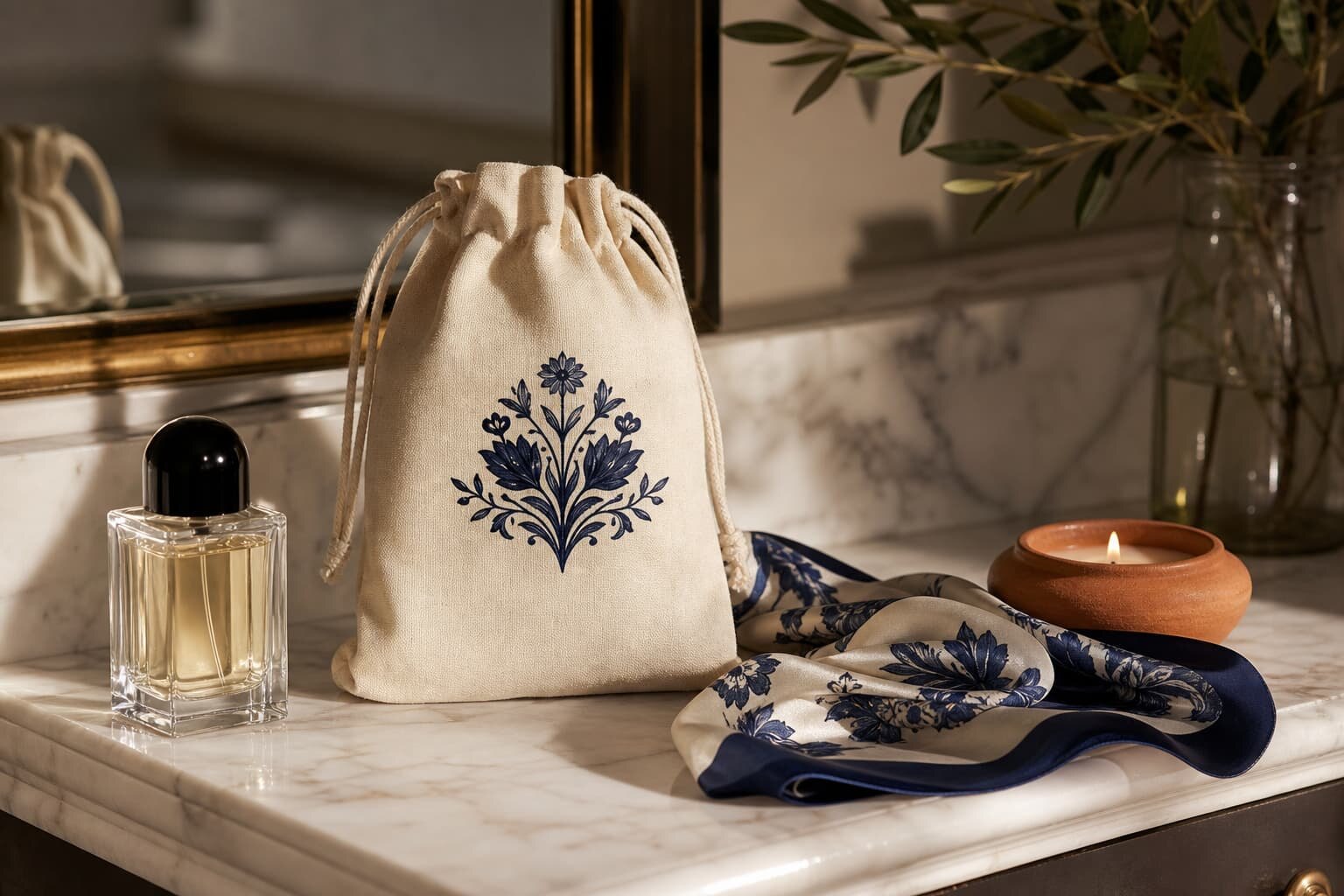
Why care label and packaging details belong in the pouch RFQ
Drawstring pouches look simple, so buyers often send an RFQ with size, fabric, logo, and quantity only. That is enough for a rough unit price, but not enough for a reliable landed-cost comparison. Care labels, hangtags, retail stickers, polybags, carton marks, and packing ratios can change the supplier's cost, MOQ, sample timing, and inspection workload. If those items are added after the pouch price is confirmed, the revised quote may no longer match your budget or launch schedule.
For procurement teams, the main buying problem is not whether a pouch can be made. It is whether every supplier is quoting the same commercial scope. A 5 oz cotton pouch bulk packed in a master carton is not the same as a 5 oz cotton pouch with a sewn bilingual care label, individual recyclable polybag, barcode sticker, inner carton, and warehouse carton label. Put the label and packing requirements into the first RFQ, and you will reduce re-quoting, sample revisions, and receiving disputes.
- Ask suppliers to separate pouch cost, label cost, packaging cost, and carton marking cost.
- State whether the pouch is a retail item, gift packaging, promotional packaging, or reusable consumer product.
- Request photos of similar care label placements on the same pouch size range.
- Treat packaging as part of the product specification, not as a last-minute shipping detail.
Match the care label to fabric weight and end use
Care instructions should start with the actual material, not a copied template. A lightweight 4 oz cotton muslin pouch used for jewelry packaging behaves differently from a 10 oz canvas pouch used for reusable retail kits. Cotton can shrink, canvas may crease heavily, dyed fabric may need colorfastness control, and jute should normally avoid machine washing. If the pouch has a polyester satin drawcord, metallic print, embroidery, lining, or decorative patch, the safest care instruction may be driven by the weakest component rather than the main fabric.
For many drawstring pouch programs, buyers do not need complicated label engineering, but they do need accurate basic data. Ask the factory to confirm fabric composition, GSM or ounce weight, fabric finish, dyed color, washing test experience, and expected shrinkage. If your importer or retailer requires fiber content and country-of-origin wording, provide the exact format rather than asking the factory to decide. The supplier can advise practical production limits, but the buyer remains responsible for market labeling requirements.
- 3-4 oz cotton: light gift or dust bag use; label can be small, but seam puckering risk is higher.
- 5-6 oz cotton: common for cosmetics, accessories, and promotional packaging; sewn label usually works well.
- 8-10 oz canvas: better for reusable retail packaging; thicker seam and drawcord details need sample checking.
- Jute or linen blend: avoid generic machine-wash wording unless testing supports it.
- Polyester or satin pouch: heat sensitivity and print durability may drive care wording.
Choose the label format before approving artwork
A care label can be sewn into the side seam, inserted near the bottom seam, printed inside the pouch, attached as a hangtag, or combined with a paper belly band. Each format affects cost and appearance differently. A sewn label is durable and familiar for retail, but it adds label MOQ and stitching handling. An inside printed care mark is clean and low profile, but it needs testing for readability, ink rubbing, and production consistency. A hangtag is flexible for multilingual information, but it can fall off or be removed before the consumer sees it.
Small pouches need extra attention. On a 7 x 9 cm jewelry pouch, a folded label may look oversized and distort the side seam. On a 20 x 30 cm canvas pouch, the same label may be barely noticeable and practical. Ask the factory to show label size in millimeters and placement on a flat technical drawing or sample photo. If multiple pouch sizes use the same label, confirm that it fits the smallest size without covering the logo, blocking the opening, or affecting the drawstring channel.
- Sewn side label: best for durable consumer use and retail compliance visibility.
- Printed inside mark: suitable when a clean exterior is more important than a textile-style label.
- Hangtag: useful for long care instructions, barcode, brand story, or multi-country language blocks.
- Paper belly band: good for gift sets and shelf presentation, but less durable after opening.
- Sticker only: acceptable for some distribution packs, but usually weak as the only care communication.
Print method can change the care instruction
Care wording should not be approved until the logo and decoration method are confirmed. A plain undyed cotton pouch may tolerate different handling from a pouch with puff ink, foil print, heat transfer film, water-based screen print, or embroidered patch. If the buyer wants a premium print effect, the care label may need softer washing language such as hand wash cold, do not tumble dry, do not iron print area, or spot clean only. This is not just a legal detail; it affects customer complaints after the pouch is used.
For RFQ comparison, ask the supplier to state which print method is quoted and what care limitation comes with it. Screen print is often cost-effective for solid one- or two-color logos at volume. Heat transfer can reproduce small details or gradients but may be more sensitive to heat and peeling if poorly applied. Embroidery adds texture but changes the pouch feel and can require backing. Woven labels or sewn brand tabs may avoid ink durability issues, but they add separate label sourcing and sewing operations.
- Screen print: check rub resistance, edge sharpness, and whether water-based or plastisol-style ink is used.
- Heat transfer: check adhesion, cracking, wash temperature, and ironing restriction.
- Digital print: check color tolerance, hand feel, and suitability for the chosen fabric texture.
- Embroidery: check back side threads, needle holes, and whether the pouch can still close smoothly.
- Woven brand label: check MOQ, color matching, fold type, and seam insertion accuracy.
Packaging choice changes unit cost and warehouse performance
The cheapest packaging is usually bulk packing: pouches counted into a master carton, sometimes with an inner polybag liner. This can work for internal packing, event distribution, or products that will be repacked by the buyer. But for retail or distributor channels, bulk packing can create dust exposure, counting errors, SKU mixing, barcode problems, and extra labor at the destination warehouse. The packaging decision should be based on the handling route, not only the lowest factory unit price.
Individual packaging adds material and labor, but it can protect print surfaces, keep sets together, and simplify receiving. Options include standard polybag, biodegradable-style bag where available, paper sleeve, kraft tuck box, belly band, hangtag, or set pack. If the pouch will be sold through a retailer, 3PL, or e-commerce warehouse, define barcode position and scan requirements before production. A beautiful pouch packed with an unreadable or wrong barcode still creates a commercial problem.
- Bulk pack: lower cost and less packaging waste, but higher risk of dust, creasing, and recounting.
- One per polybag: better protection and count control, but adds material, labor, and possible plastic restrictions.
- Paper belly band: better shelf look and lower plastic use, but weaker moisture protection.
- Set pack: useful for bundles, but inspection must check assortment and sequence.
- Retail carton or box: strongest presentation, but changes carton volume and freight cost.
MOQ logic: the pouch MOQ is not always the real MOQ
Many buyers ask for the MOQ of the drawstring pouch and stop there. In production, the effective MOQ may come from fabric dyeing, label weaving, care label printing, hangtag printing, barcode sticker rolls, or carton label setup. A factory may accept 500 pouches from stock fabric, but a custom woven label supplier may require 1,000 or 3,000 labels. If the buyer needs three languages or five colorways, unused labels and packaging can become hidden cost.
To compare quotes fairly, ask for MOQ by component. Separate standard pouch MOQ, custom fabric color MOQ, logo print MOQ, custom care label MOQ, custom hangtag MOQ, and individual packaging MOQ. Also ask whether leftover labels can be stored for repeat orders and how long the factory will keep them. This matters for distributors who replenish by SKU and for brand owners testing a first launch before moving into regular production.
- Stock fabric plus standard label usually gives the lowest MOQ and fastest sample route.
- Custom-dyed fabric increases MOQ and lead time because dye lot control is involved.
- Woven labels often have higher MOQ than printed satin labels.
- Multiple language labels can split MOQ and raise unit cost.
- Changing barcode or country wording between shipments may create obsolete packaging stock.
What to approve on the pre-production sample
A drawstring pouch sample without the final care label and packaging is only a partial sample. It can confirm size, fabric hand feel, stitching, and logo position, but it cannot confirm the complete retail or distribution spec. For any order with compliance wording, barcode, hangtag, or warehouse carton label, require a pre-production sample that includes the final label material, final label position, final packaging method, and sample carton mark. Photos help, but a physical sealed sample is better when packaging fit and label texture matter.
Sample approval should include practical handling checks. Open and close the pouch several times to see whether the care label catches on the drawcord or contents. Fill the pouch with the intended product or an equivalent weight to check whether the label becomes too visible, twisted, or hidden. Scan the barcode through the packaging if it will be scanned at receiving. For printed care marks, rub lightly with a dry white cloth and check whether the print smears or transfers.
- Measure pouch size flat and filled, because drawstring closure can reduce usable height.
- Check label distance from side seam, top edge, and bottom seam.
- Confirm label wording, spelling, symbols, language, and country wording against approved artwork.
- Check that the packaging size is not too tight, which can crease thick canvas or distort the drawcord.
- Keep signed samples with date, revision number, and supplier confirmation.
Packing specification that prevents receiving disputes
A good packing specification tells the factory how goods should arrive at the buyer's warehouse, not only how they leave the sewing line. State the number of pouches per inner bag, inner carton, and master carton. Define whether colors and sizes can be mixed in one carton or must be separated by SKU. If mixed cartons are allowed, provide exact assortment ratios and label format. Without this, the supplier may pack for factory convenience, while the buyer's warehouse expects SKU-level separation.
Carton labels should be treated as controlled artwork. Include PO number, SKU, item description, color, size, quantity, gross weight, net weight, carton dimensions, country of origin if needed, and carton sequence such as 1 of 20. If a retailer or 3PL has a routing guide, send it with the RFQ and ask the factory to quote any extra label or handling cost. Late carton relabeling is slow, messy, and often more expensive than printing the correct labels at origin.
- Define master carton quantity by pouch size and fabric bulk, not by a copied default.
- Avoid overpacked cartons that crush drawcord knots, tassels, beads, or rigid label patches.
- Ask for carton weight estimates before booking freight, especially for canvas and jute pouches.
- Use carton numbering for multi-SKU orders so missing cartons are easier to identify.
- Require carton mark photos before shipment if no third-party inspection is planned.
Lead time impact of labels and packaging
Care labels and packaging can add more time than buyers expect. Standard pouches from available fabric may move quickly through cutting, printing, sewing, trimming, and packing. Custom labels may require artwork approval, material sourcing, printing or weaving, drying, cutting, folding, and delivery to the pouch factory. Retail packaging may involve separate suppliers for hangtags, stickers, sleeves, boxes, or barcode labels. If these components arrive late, finished pouches can sit uncompleted.
In the RFQ, ask the factory for a lead time broken into sample, label production, bulk pouch production, packing, inspection, and export document preparation. Do not accept one vague lead time if the order contains many custom components. Also clarify what starts the clock: deposit, artwork approval, lab dip approval, care label approval, packaging approval, or signed pre-production sample. This prevents the common dispute where the buyer counts from PO release and the factory counts from final artwork approval.
- Request a timeline for first sample and revised sample separately.
- Ask whether label and packaging production can run while the pouch sample is being approved.
- Confirm the final change date after which artwork or label edits will affect shipment.
- Build extra time for holiday seasons, custom-dyed fabric, and multi-language packaging.
- Ask for production photos at label sewing, logo printing, and final packing stages.
Quote data buyers should request for comparable offers
A useful quote for drawstring pouches should show more than a single FOB unit price. Ask suppliers to quote the same size, fabric weight, drawcord, print method, care label, package type, carton quantity, and inspection standard. If one supplier includes individual packaging and another quotes bulk pack, the cheaper price may be misleading. If one quote uses 4 oz cotton and another uses 6 oz cotton, the product will not feel the same and the care label may not be the same.
The best way to prevent confusion is to send a quote table with required fields and ask suppliers not to leave blanks. For each option, request MOQ, sample fee if any, sample lead time, bulk lead time, payment term, incoterm, packing quantity, carton dimensions, estimated gross weight, and assumptions. If the supplier suggests an alternative, ask them to mark it clearly as an alternative, not silently change the specification to hit a target price.
- Pouch size: width, height, bottom gusset if any, and tolerance.
- Fabric: composition, GSM or oz, color method, and shrinkage expectation.
- Drawcord: cotton, polyester, jute, satin, rope diameter, length, and knot style.
- Branding: print method, print size, print position, number of colors, and artwork format.
- Labels and packaging: care label, hangtag, barcode, polybag or paper pack, carton marks.
- Commercial terms: MOQ by component, lead time, incoterm, sample charge, and validity period.
Specification comparison for buyers
| Spec decision | Recommended option | When it fits | Buyer risk to check |
|---|---|---|---|
| Care label format | Sewn side seam label in satin, cotton tape, or polyester | Retail, gifting, cosmetics, apparel accessories, and any pouch likely to be reused or washed | Label position may distort small pouches; confirm seam allowance, label fold size, and whether the label is visible when filled |
| Care instruction content | Fiber content, wash method, drying note, country of origin, and importer-required warning if applicable | Cotton, canvas, linen blend, polyester, jute, or mixed-material pouches sold to consumers | Supplier may copy generic instructions that do not match print method, shrinkage, drawcord, or decoration |
| Packaging unit | One pouch per recyclable polybag or paper belly band, with carton packing by SKU | Retail, Amazon-style fulfillment, warehouse scanning, and distributor replenishment orders | Loose bulk packing can save cost but may increase dust, creasing, counting errors, and mixed-color carton risk |
| Fabric weight | 4-6 oz cotton for light gift pouches; 8-10 oz canvas for reusable retail pouches | Small jewelry, cosmetics, event kits, accessory packaging, and premium product bundles | Care label wash advice must match fabric shrinkage and print durability, not only the fabric name |
| Print method | Screen print for solid logos; heat transfer for fine color detail; woven label for premium subtle branding | Brand logos, size icons, product set labels, and retail presentation | Heat transfer and metallic inks may need lower wash temperature or hand-wash wording |
| MOQ logic | Separate MOQ for pouch body, care label, retail barcode label, and printed carton mark | Orders with multiple sizes, colors, languages, or destination markets | A small pouch MOQ may be possible, but custom labels can create higher effective MOQ |
| Carton marking | Outer carton label with PO, SKU, size, color, quantity, gross weight, net weight, and carton number | Importer receiving, 3PL inbound, supermarket distribution, and multi-SKU shipments | Missing carton marks cause receiving delays even when the product itself is correct |
| Sample approval | Pre-production sample with final fabric, final care label, final packaging, and final carton label artwork | Any order where care wording, country label, retail barcode, or packaging compliance matters | Approving only the pouch body leaves label placement, folding, and packing errors unresolved |
Buyer checklist before sampling
- Confirm pouch material composition, GSM or oz weight, drawcord material, lining if any, and shrinkage expectation before writing care instructions.
- Specify exact care label type: sewn label, printed inside stamp, hangtag, belly band, sticker, or no consumer-facing label.
- Define care label size, fold style, language version, artwork file, label material, print color, and placement from the seam or top edge.
- Check whether the pouch will contact cosmetics, food-adjacent goods, jewelry, baby items, electronics, or apparel, because warning and packaging needs may change.
- State packaging unit clearly: bulk packed, one per polybag, paper sleeve, kraft box, set pack, inner carton, or retail-ready barcode pack.
- Ask for packing quantities per inner carton and master carton, carton dimensions, gross weight, net weight, and pallet suggestion if needed.
- Require a pre-production sample showing final care label and packaging, not only a blank pouch or logo print sample.
- Approve care wording against fabric, print method, and market requirements instead of accepting a supplier's generic label text.
- Include label and packaging checks in the inspection criteria: label position, wording, barcode scan, carton mark, assortment ratio, and count.
- Keep one approved sealed sample at the buyer side and one at the factory to resolve disputes during bulk inspection.
Factory quote questions to send
- What is the pouch fabric composition, GSM or oz weight, weave, dyed or greige status, and expected shrinkage after washing?
- Which care label options can you produce in-house or through your label supplier, and what is the MOQ for each label version?
- Can you quote sewn care label, printed inner care mark, hangtag, belly band, and individual polybag separately so we can compare cost impact?
- Where do you recommend placing the care label on this pouch size, and will it interfere with drawcord closing, side seam strength, or visible branding?
- What print methods are suitable for our logo and care restrictions: screen print, heat transfer, digital print, embroidery, woven label, or leather patch?
- What is the sampling lead time for a pouch with final label and packaging, and what changes will reset the sample schedule?
- What is the bulk lead time after sample approval, label artwork approval, and deposit, including label production time?
- How many pouches are packed per inner carton and master carton, and what are estimated carton dimensions and weights?
- Can carton labels include our PO, SKU, barcode, color, size, carton number, and destination warehouse format?
- Which inspection points do you recommend for care label accuracy, package count, barcode readability, and mixed-SKU prevention?
Quality-control points to confirm
- Care label text matches approved artwork, market language, fiber content, country wording, and wash instructions.
- Label placement is consistent within agreed tolerance and does not pull, twist, or pucker the pouch side seam.
- Label material is not scratchy, heavily frayed, misfolded, stained, or bleeding color onto the pouch fabric.
- Pouch fabric GSM, size, drawcord length, seam construction, and print quality match the approved sample.
- Printed logo and printed care marks pass rub, tape, and basic hand-wash checks agreed before production.
- Individual packaging is clean, correctly sized, sealed if required, and free from trapped thread waste or dust.
- Barcode, retail sticker, hangtag, and carton label scan correctly and match SKU, color, size, and quantity.
- Master carton count, assortment ratio, carton numbering, gross weight, and outer marks match the packing list.
- Carton strength is suitable for export handling and does not crush pouches with rigid trims, beads, or thick drawcords.
- Final inspection compares bulk goods against the signed pre-production sample, not only against a spreadsheet spec.