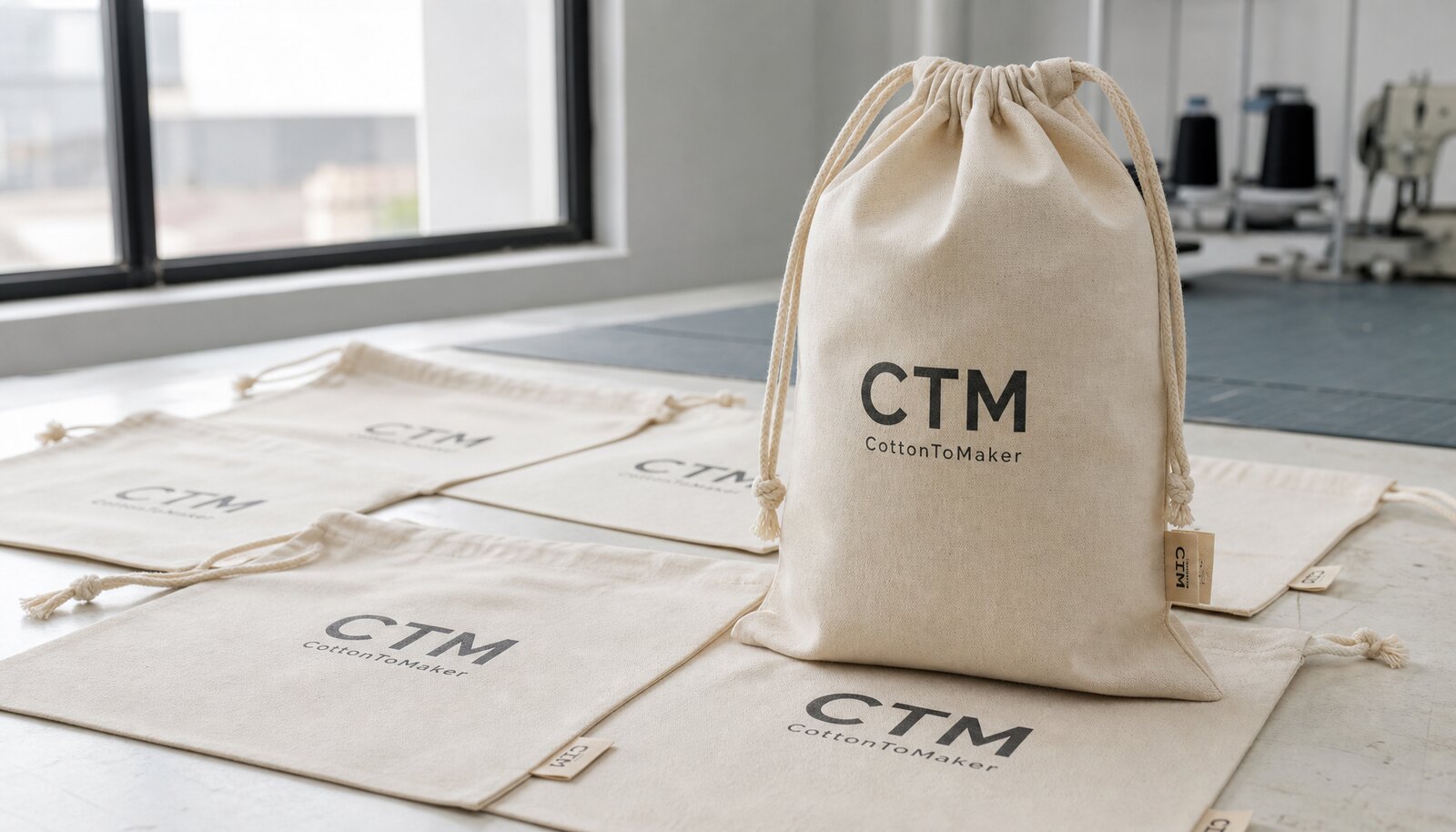
1. Start with the use case, not the logo
The fastest way to get a weak quote on drawstring bags with printed logo is to ask for the decoration before you define the job. Buyers get better pricing and less revision when they specify how the bag will be used, what it needs to carry, and how the customer will receive it. A pouch for a trade-show handout, a retail pouch sold with a product, and an ecommerce insert may all carry the same logo, but they are not the same purchasing problem.
Procurement teams should frame the brief around load, handling, presentation, and repeat use. If the bag holds a light accessory and is meant for one-time promotion, a simpler cloth and packing format may be sufficient. If the bag is expected to be reused or sit on a retail shelf, the factory should quote a more stable fabric, cleaner stitching, and a print method that survives handling. That single decision changes nearly every line item in the RFQ.
Commercially, it helps to identify which of three buckets the order falls into: promotional giveaway, retail pouch, or ecommerce insert. Promotional bags usually aim for the lowest acceptable unit cost and a controlled lead time. Retail pouches require stronger visual consistency and better workmanship because the customer sees them as part of the product. Ecommerce inserts often need efficient bulk packing and carton specifications that fit fulfillment workflows.
A useful brief should answer four questions before any supplier is invited to quote: what goes inside the bag, how the bag will be used, what the brand presentation should feel like, and when the goods must ship. Once those are fixed, suppliers can quote the same program instead of different assumptions. That is the difference between comparing offers and comparing guesses.
- Write the intended use in one sentence: retail resale, promotional giveaway, product insert, or packaging for a kit.
- State the expected fill weight or product dimensions so the factory can size the pouch correctly.
- Specify whether the bag must look premium from arm’s length or only meet a utility standard.
- If the program is launch-critical, define the ship date first and let the supplier work backward from material booking and print scheduling.
2. Choose the fabric by balancing appearance, structure, and print clarity
For many buyer programs, cotton in the 120–160 GSM range is the practical starting point. It gives enough body to hold shape without making the bag excessively stiff or expensive. Below that range, buyers should expect a softer drape, more wrinkling, and a thinner presentation. Above it, the pouch becomes more substantial, but it can also cost more to sew, take up more freight volume, and be unnecessary for basic promotional use.
The weave matters as much as the GSM number. A smoother cotton twill often produces cleaner logo edges than a rougher plain weave because the ink or transfer sits more evenly on the surface. Unbleached cotton is common for natural branding, but procurement teams should remember that “natural” means visible flecks, slight shade variation, and a less uniform look. That is acceptable if it is expected and documented; it becomes a problem when the buyer assumes a near-white appearance.
Fabric choice should also reflect the product load. If the bag will carry a denser or sharper item, strengthen the seam construction and cord channel rather than simply adding more GSM. A well-built 140 GSM bag with proper reinforcement may perform better than a poorly sewn 180 GSM version. That is why asking only for a heavier fabric is not always the right answer.
When comparing quotes, ask the supplier to state the actual lot-based GSM and whether the fabric is single-layer, lined, brushed, or twill. Also ask whether the cloth has been pre-shrunk or whether size variation after washing matters for the application. Buyers who plan reorders should keep one fabric reference sample and one written spec, because natural cotton can vary more than a catalog photo suggests.
- 120 GSM: cost-conscious, light-duty use, but check opacity and wrinkle behavior.
- 140 GSM: balanced default for many branded pouch programs.
- 160 GSM+: more structure and a premium feel, but confirm the extra freight and sewing cost are justified.
- Ask for actual lot GSM and a fabric hand-feel sample if the program is repeatable.
- If the bag will hold heavier contents, prioritize seam reinforcement and channel construction over weight alone.
3. Compare print methods by durability, artwork complexity, and reject risk
The best print method is the one that fits the artwork and the use case, not the one that sounds most advanced in the quote. For a one-color logo, screen printing is usually the most economical and repeatable option. It handles solid fills well, keeps unit cost under control at medium volumes, and is easier for factories to stabilize across repeat orders. The commercial advantage is predictability: once the artwork, ink, and placement are locked, the factory can produce consistent output without unnecessary complexity.
More complicated artwork needs more caution. Fine lines, small type, gradients, and multiple colors can look acceptable on screen but become crowded or muddy on textured cotton. If the supplier proposes heat transfer or another applied decoration, the buyer should ask how it will behave after folding, rubbing, and normal handling. For reusable bags, day-one appearance is not enough; the decoration needs to remain legible through the expected life of the program.
A procurement-grade RFQ should specify the print size in millimeters, the color target, and the placement tolerance from the seam and top edge. Those details do more to control quality than a generic instruction like “print logo on front.” If the design depends on tight registration between colors, ask whether the factory can hold that alignment on woven cotton at production speed. If they cannot state the limit clearly, treat the risk as real.
For buyers comparing commercial options, it is worth asking whether the supplier’s price includes screen setup, ink mix, curing, and remake allowance for first-run defects. That turns the quote into a real decision tool instead of a vague decoration promise.
- Use screen print for simple logos, solid colors, and repeatable reorder programs.
- Use transfer or another special method only if the artwork complexity justifies the extra process risk.
- Specify the print size in mm and show a reference drawing with seam margins.
- Avoid very fine text or hairline details unless the supplier has already proven that level of detail on the same fabric.
- Ask whether the quote includes screen setup, ink matching, and first-run remake handling.
4. Match the bag specification to the channel: promo, retail, or ecommerce
Different channels reward different bag builds. Promotional giveaways are usually judged on low friction: the bag should be easy to quote, easy to pack, and easy to ship. Retail pouches are judged on presentation: the cloth, print clarity, stitching, and cord finish all matter because the pouch is part of the perceived product value. Ecommerce inserts sit between the two: they do not usually need premium packaging, but they do need reliable dimensions, packing consistency, and damage-free arrival.
This distinction matters because some buying teams try to use one spec across all channels. That often creates unnecessary cost. A pouch intended for a trade-show gift set does not need the same packing detail as a retail pouch sold at shelf. On the other hand, a retail pouch should not be quoted like a throwaway promo bag if the brand expects it to live with the customer for months.
A better approach is to define the target channel first and then write the spec. For promo programs, limit the decoration to a simple logo and choose a standard cloth and packing format. For retail, add stricter requirements on seam appearance, print consistency, and carton cleanliness. For ecommerce, prioritize carton dimensions, count accuracy, and warehouse-friendly pack-out. That gives suppliers a cleaner target and prevents you from paying retail-level costs for a promo requirement, or promo-level quality for a retail shelf item.
- Promo programs: keep the spec simple and the packaging lean.
- Retail pouches: tighten appearance requirements and verify workmanship carefully.
- Ecommerce inserts: focus on carton efficiency, count accuracy, and bulk handling.
- Do not force one bag spec to serve every channel if the economics or quality expectations are different.
5. MOQ is a setup issue, not just a sales number
MOQ on sewn and printed pouches is shaped by how much setup the factory must do. A standard natural or white cotton bag with one logo color and one placement typically sits on the lower end because the factory can run it with less fabric changeover and fewer printing adjustments. Add dyed fabric, a second print location, custom cord color, or retail packaging, and the MOQ usually rises because more components and more labor are tied to the order.
That is why comparing MOQ without the full specification can be misleading. A supplier offering a lower MOQ may simply be quoting a simpler build. Another supplier may appear restrictive but actually be giving a more realistic production plan with fewer surprises during mass production. For procurement, the better question is not “what is your MOQ?” but “what MOQ applies to this exact spec, and what changes if I reduce print colors or simplify packing?”
Buyers should also ask for two commercial scenarios: a pilot quantity and a repeat-order quantity. This reveals how much of the first-run price is absorbed by setup, screens, sampling, and material booking. It also helps you decide whether to launch with a smaller pilot, then scale once the specification is proven. If the supplier cannot explain the difference between those two tiers, the quote may be hiding setup costs inside the unit price.
A useful negotiation point is spec simplification. If the MOQ feels too high, ask what can be reduced without affecting the product’s function: one print color instead of two, standard cord instead of dyed cord, or bulk packing instead of retail pack-out. That kind of adjustment is often more effective than pushing for an arbitrary low number.
- MOQ usually rises when you add custom dyeing, multiple print colors, or retail-ready packing.
- Ask the supplier to separate base bag MOQ from printing MOQ if the factory sources components differently.
- Request a pilot-lot quote and a repeat-lot quote so you can see the setup-cost effect clearly.
- Do not mix too many SKUs in one RFQ if you want a clean procurement comparison.
- If the MOQ seems high, ask what spec simplifications would lower it without changing function.
6. Compare supplier routes by traceability, not just price
For sewn and printed pouch programs, direct factory sourcing is usually the stronger route because the same operation controls cutting, sewing, printing, and pack-out. That matters when a buyer needs quick clarification on a print offset, a seam issue, or a shade concern. In a direct setup, the person who answers the quote is closer to the actual production line, which makes approvals and corrective actions faster.
A trading route can still be reasonable, especially when the buyer is consolidating multiple product categories or needs help coordinating different factories. The risk is not that trading companies are automatically poor; the risk is that buyers sometimes do not know who is actually making the bag or who owns the defect if one shows up after approval. If a supplier cannot name the factory, share sample origin, or explain the print and sewing flow, the quote should be treated as incomplete.
Procurement teams should ask for origin disclosure before awarding business. Who sews the bag, who prints the logo, where the fabric is sourced, and which site will ship the order are not optional details. Ask for the factory name and address, a production-line photo set, and any available business license or audit summary. If the supplier refuses to name the actual production site, the commercial risk rises because traceability is weak and accountability becomes unclear.
This is especially important for repeat programs. A supplier that cannot show the production path for the first order may not be able to duplicate it on reorder. If the goal is stable supply, factory transparency is part of the product, not just the paperwork.
- Direct factory: better for process control, repeatability, and issue ownership.
- Trading route: acceptable if the supplier fully discloses the factory and process flow.
- Ask for sample origin and production photos from the same line that will make your order.
- Request factory name, address, and proof of legal operation before award.
- Separate product cost from sourcing service fees so the comparison is not distorted.
7. Use the sample to lock the production standard, not just to approve the look
A sample should define the production standard, not just show what the supplier can make by hand. In many programs, the first sample looks excellent because it is made slowly by a skilled operator. The bulk order, however, is produced under normal factory conditions with different timing, different handling, and sometimes different material batches. If the buyer has not defined tolerances, the factory may still believe it fulfilled the order even if the final run differs in size, shade, or print placement.
The approval process should be specific and measurable. Record the finished width, height, and depth; note the print size and exact location; define the acceptable seam tolerance; and state whether the drawcord channel or eyelet style must remain unchanged. If the bag is for retail or branded resale, include the final insert card, barcode, and any warning label in the approval pack. Otherwise, those items often become last-minute additions that create rework.
A golden sample or sealed reference sample is useful for repeatable programs. It gives both sides a shared benchmark. If a dispute arises later, the factory can compare bulk output against the same physical reference rather than an email thread. Buyers should also retain the approved artwork file, the measured sample sheet, and the carton-marking spec together in one file so that future reorders do not rely on memory.
For procurement teams, the sample stage is where many hidden defects are cheapest to fix. It is far less expensive to correct a print placement or cord finish now than to reject several cartons after production is complete.
- Approve the sample with written tolerances, not only a yes/no signoff.
- Measure finished size after sewing and before shipment, not just cut dimensions.
- Confirm whether the logo placement is centered to seam references or only visually centered.
- Keep one reference sample or photo set tied to the PO for reorders.
- Include labels, barcode, and carton marks in the approval set if they are part of the final supply.
8. Packing, labeling, and cartons can move the real landed cost
Packing decisions often look minor in the quote but can materially change cost, freight, and damage risk. Loose bulk packing usually gives the lowest unit price and is often the best option for wholesale or distribution-center programs. If the bags are retail-facing, however, a buyer may need individual polybags, barcode stickers, or hangtag insertion. Each of those steps adds labor, extra material, and usually more carton volume, which then affects shipping cost.
The buyer should ask every supplier to quote the same packing standard. Otherwise one factory may be quoting bulk while another includes retail-ready pack-out, and the price difference will look like a product issue when it is really a packaging issue. This is one of the easiest places for RFQ confusion because suppliers often assume the buyer knows what “standard packing” means. In practice, it varies by plant.
A clean quote should show the bag count per carton, carton dimensions, gross weight, and whether the cartons are packed for export or for warehouse handling. Those details matter when you book freight, estimate warehouse storage, or plan a distribution rollout. If the carton is oversized or the bag count is low, you pay twice: once in unit price and again in logistics inefficiency.
If the order is going into retail, also ask how the supplier handles country-of-origin marking, barcode placement, and outer-carton labeling. These small details are often forgotten until the end of the order, when changes are more expensive.
- Bulk pack: lowest labor cost and best for non-retail distribution.
- Individual polybag: useful for retail presentation and cleanliness, but it increases packing cost and volume.
- Barcode-ready pack: needed for retail and some fulfillment centers; confirm label placement and scan standard.
- Ask for carton dimensions and gross weight before you approve freight planning.
- Confirm country-of-origin marking and outer-carton labels if the channel requires them.
9. Lead time should be built from the critical path, not from a hopeful quote
Lead time on drawstring bags with printed logo usually breaks into several parts: material sourcing, sample approval, cutting, printing, sewing, inspection, and export prep. The biggest schedule risk is often not sewing capacity; it is waiting for fabric booking or waiting for a logo approval that was not finalized early enough. A supplier may quote a short delivery window, but if the fabric is not in stock or the print artwork has not been approved, the calendar can slip quickly.
Buyers should ask which parts of the schedule are fixed and which depend on external factors. If the factory already stocks the base cloth, lead time can be materially shorter than if it must dye fabric or source a special cord color. If the artwork is simple and the print position is standard, the production flow is easier to lock. If the buyer changes placement after sample signoff, the factory may need to remake screens or revise setup, which adds both time and cost.
For seasonal launches, plan backward from the ship date and include buffers for sample iteration, carton approval, and any corrective action after inspection. The most common procurement mistake is treating the first quoted date as committed before materials are actually booked. Buyers should ask the supplier to identify the longest-lead item in the order and to state whether that item is already in stock, reserved, or still to be sourced.
If the program has a hard launch date, ask for a schedule with milestones rather than one single delivery promise. Milestones make delay visible earlier, which gives the buyer time to adjust instead of discovering the problem at final inspection.
- Ask for a time breakdown: sample, material booking, printing, sewing, inspection, and dispatch.
- Treat delivery dates as provisional until fabric and artwork are formally approved.
- If the program is seasonal, place the PO earlier than you would for replenishment orders.
- Build extra buffer if you are requesting dyed fabric, special cords, or unusual packing.
- Request milestone dates, not only one final delivery promise.
10. What a usable supplier quote should contain
A useful quote should let procurement compare offers without chasing basic clarifications. It should state the bag dimensions, fabric type and GSM, print method, logo size, number of colors, cord type, packing format, MOQ, sample fee, unit price by quantity tier, lead time, and carton details. If even one of those items is missing, the quote is not yet ready for apples-to-apples comparison.
The quote should also expose the cost drivers that change price. Setup fees for printing, artwork adjustments, special labels, custom packing, or dyeing should be visible as separate lines where possible. That helps the buyer decide whether to simplify the spec, accept the charge, or push for a better commercial structure on the next quote cycle. A quote that hides every increment inside one lump sum is harder to negotiate and harder to audit later.
For procurement teams, a good quote is not just cheaper; it is more informative. It should make it obvious what you are buying, what could change the price, and what the supplier expects you to approve before mass production begins. If the quote is vague on any of those points, it is usually carrying risk in a place the buyer will discover later.
One practical rule: the supplier should be able to restate your order in their own words without changing the meaning. If they cannot, the commercial spec is not locked tightly enough.
- Request tiered pricing by quantity, not only a single unit price.
- Ask whether sample charges are refundable on order and whether courier cost is separate.
- Require line-item visibility for screens, plates, labels, dyeing, or special packing.
- Match every quotation to one written spec sheet so the supplier cannot price a softer version of the bag.
- Ask the supplier to restate the order back to you before award.
Specification comparison for buyers
| Decision point | Option A | Option B | Option C | Buyer tradeoff |
|---|---|---|---|---|
| Fabric and feel | 120 GSM cotton | 140 GSM cotton | 160 GSM cotton or heavier | 120 GSM is lower cost and lighter for promos, but looks less substantial; 140 GSM is the most balanced default for many programs; 160 GSM+ improves structure and shelf presence, but raises sewing effort, material cost, and freight volume |
| Print method | Screen print | Heat transfer | Digital or other specialty decoration | Screen print is usually best for one- or two-color logos and steady reorders; heat transfer can suit short runs or complex art but needs stronger durability checks; specialty decoration can help with detailed graphics, but often adds setup complexity, reject risk, or higher unit cost |
| Program type | Promotional giveaway | Retail pouch | Ecommerce insert or kit bag | Promotional bags usually prioritize price and speed; retail pouches need cleaner stitching, better print consistency, and more demanding QC; ecommerce inserts often need bulk packing, barcode readiness, and carton efficiency |
| Packing format | Bulk packed | Individual polybagged | Retail-ready packed with label or insert | Bulk packing keeps cost and carton volume down; polybagging adds labor and cleanliness control; retail-ready packing increases labor and material cost, but may be required by the channel |
| Supplier route | Direct factory | Trading company with factory disclosure | Aggregator without transparent factory info | Direct factory usually gives better control over sewing, printing, and defect ownership; a trading company can work if it fully discloses the factory and process; opaque sourcing weakens traceability and makes claims harder to resolve |
| Lead-time profile | Stock fabric and standard print | Custom dyed fabric or special cord | Multiple revisions or retail pack-out | Stock material and simple artwork support shorter schedules; custom components or packing add time; extra approvals and artwork changes can extend the schedule even if the factory line is available |
| Commercial risk | Lowest complexity | Balanced spec | Highest customization | Lower complexity generally means fewer surprises and a more repeatable reorder path; higher customization can improve branding, but it also increases MOQs, setup charges, and QC requirements |
Buyer checklist before sampling
- Define the exact bag size, target fabric weight, weave or finish, cord style, logo placement, and whether the bag must close around the filled product.
- Separate the use case before the quote: promotional giveaway, retail pouch, ecommerce insert, or kit packaging, because each one changes cost and QC expectations.
- Send vector artwork and specify Pantone references only where color accuracy matters; state whether the logo is one color, multi-color, or tonal on natural cotton.
- Tell suppliers the packing method, carton count, label requirements, and whether the bags must arrive bulk packed, polybagged, or barcode-ready.
- Ask for a pre-production sample or photo approval set that shows print size, placement, stitch detail, cord finish, and carton marking.
- Set measurable acceptance criteria for finished size, print position, fabric shade, seam strength, cord performance, and packing count before production starts.
- Ask whether the quoted price includes printing setup, sample charges, labels, polybags, insert cards, carton marks, and export cartons.
- Use one specification sheet for every supplier so the RFQ comparison stays like-for-like and you can identify hidden scope gaps.
- Request origin disclosure: who sews the bag, who prints the logo, where the fabric is sourced, and which factory will actually ship the order.
- Ask for evidence: factory name, address, business license, photos of the production line, sample origin, and the QC sign-off process used for your order.
Factory quote questions to send
- What exact fabric options do you recommend for this bag size, and what is the measured GSM for each option by production lot?
- Is the logo printed in-house or outsourced, which print method will you use for this artwork, and why is that method suitable for cotton?
- What MOQ applies by fabric color, print color count, logo placement, packing format, and any special finishing steps?
- What exactly is included in the unit price: bag body, printing, cord, label, polybag, carton, and export packing?
- Do you charge a separate setup fee for screens, plates, artwork correction, dyeing, or special packing materials?
- How many sample rounds are included before mass production starts, and what is the charge for additional revisions or couriered samples?
- What is your standard lead time after sample approval, and which parts of the schedule depend on fabric booking or outsourced printing?
- Can you share finished carton dimensions, gross weight, and packing count per carton for freight planning and warehouse receiving?
- What tolerances do you hold for finished size, print placement, print size, seam alignment, and carton count?
- What happens if the bulk run matches the sample in print but not in shade, texture, or hand feel?
Quality-control points to confirm
- Measure finished width and height on at least five pieces per sampled carton set; do not rely on the first approved sample only.
- Check the logo placement against seam and top-channel reference points, and verify the actual print size matches the approved artwork sheet.
- Inspect print edges under daylight or neutral white light to detect feathering, offset, weak cure, ink starvation, or uneven coverage.
- Rub-test the printed area on a sample bag to check whether the ink smears, cracks, transfers, or shows visible loss after handling.
- Pull the drawcord repeatedly and check that it glides smoothly, does not snag at the channel, and does not distort the opening.
- Inspect stitch quality at side seams, corners, and cord openings for skipped stitches, loose thread ends, broken seams, or weak reinforcement.
- Confirm the cord ends are cleanly finished and that eyelets or stitched channels do not cut into the cord during use.
- Verify shade consistency across cartons if the order uses dyed cotton, and predefine acceptable variation for natural cotton before production.
- Check the actual packing count per carton, the carton marks, and the shipping label against the purchase order before release.
- If individual polybags are required, verify the bags are clean, correctly oriented, and free of lint, oil spots, print rub marks, or trapped debris.