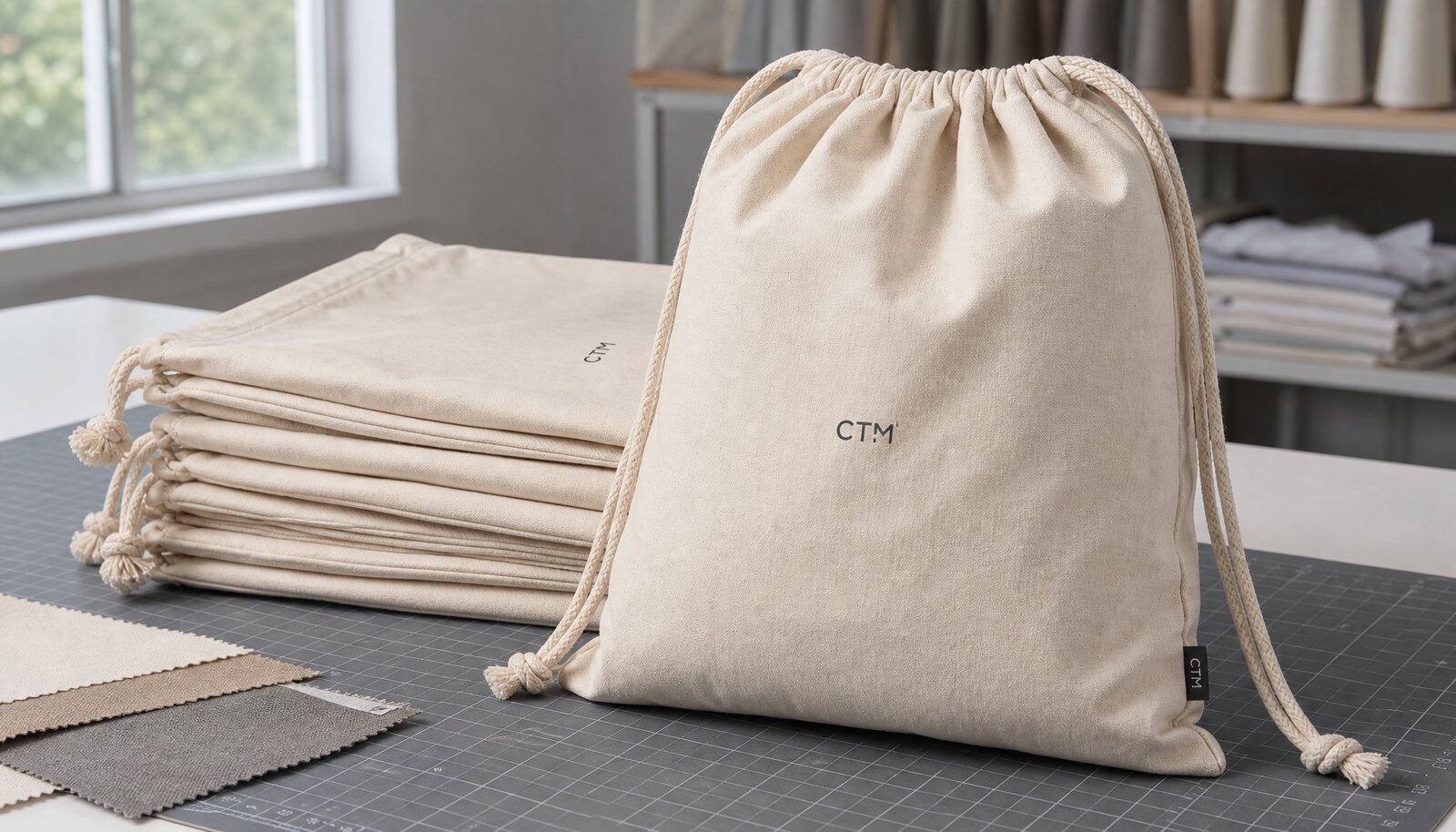
What buyers actually need from wholesale drawstring bags with logo
Most sourcing problems with drawstring bags with logo wholesale start with a vague brief. A buyer says “cotton drawstring bags with logo,” the factory quotes a basic size, and the first bulk lot arrives with the wrong fabric hand feel, a logo that sits too close to the tunnel, or a print method that looks weaker than expected. The bag itself is simple, which is exactly why the spec needs to be tighter than people assume.
For procurement teams, the buying goal is not only unit price. It is to get a bag that closes smoothly, prints cleanly, packs consistently, and lands at the right cost for the channel. A retail brand may need a better fabric surface and cleaner folding. A distributor may care more about carton efficiency and reordering speed. A promo buyer may want a lower GSM and a simpler print route. The right quote comparison starts with use case, not with the logo artwork.
- Retail channels usually need better fabric appearance and more consistent stitching than event giveaways.
- B2B gifting programs often need quick turnaround, clean print placement, and reliable carton labeling.
- If the bag will carry heavier items, cord strength and seam construction matter more than decorative details.
Choose the fabric first: GSM, weave, and feel decide most of the outcome
For cotton drawstring bags, the most useful first filter is GSM. In wholesale sourcing, 90–100 GSM works for lightweight promotional use and simple giveaways. 120–150 GSM is the safer range for brand programs, retail packing, or any customer-facing bag that must feel substantial. Once you go above that, the cost rises and the bag becomes more structured, which can help premium positioning but may be unnecessary for a low-cost promo brief.
The fabric surface affects printing and visual quality. A smoother woven cotton generally takes screen print better than a rough or highly open weave. If the bag is unbleached natural cotton, expect small flecks and shade variation; that is normal, but it should be described in the spec so no one treats it as a defect. If you want a bright white logo to pop, a cleaner bleached base often gives better contrast than a natural finish.
- 90–100 GSM: lower cost, lighter hand feel, acceptable for campaigns and inserts.
- 120–150 GSM: better for retail, resale, or premium gifting.
- Natural cotton: more eco-looking, but shade variation is normal and must be accepted in writing.
- Bleached cotton: cleaner print contrast, usually better for white-label branding.
Print method changes both the quote and the final appearance
For drawstring bags with logo wholesale, screen printing is still the most practical option for simple logos and repeat orders. It works well when you have one or two solid colors and want stable unit pricing. The key is to approve the print on the actual production fabric, because the same ink can look different on a 100 GSM bag versus a 140 GSM bag. Heat transfer can work for small runs or detailed logos, but it brings more risk around wash durability and edge lifting if the bag is folded aggressively.
If the artwork includes tiny text, gradients, or photographic detail, the supplier may suggest digital methods. That can be useful for limited launches, but buyers should compare the real use case carefully. Many wholesale bags do not need a complex print route. In a lot of programs, the safer choice is to simplify the artwork so the supplier can print it sharply and repeat it consistently across multiple cartons.
- Screen print: best for durable one- or two-color logos and stable reorders.
- Heat transfer: useful for small runs, but confirm adhesion and edge quality.
- Digital print: helpful for detailed artwork, but often higher cost and less repeat-efficient.
- Embroidery: possible on thicker bags, but it changes hand feel and unit price significantly.
How to compare supplier quotes without missing hidden cost
A low unit price can hide a weaker spec. One supplier may quote a 90 GSM bag with bulk packing, while another is quoting 140 GSM, print included, with retail folding and individual polybags. Those are not interchangeable offers. Before comparing price, line up fabric, print method, bag size, packing, carton size, and sample type so the quotes are truly comparable.
A useful quote review is to separate the cost into fabric, print, sewing, cord, packing, and shipping-ready carton work. If the factory is unwilling to break out the quote at least roughly, that is a warning sign for future change orders. The best supplier will show where the price moves when you change color count, bag size, or packing method.
- Compare quotes on the same GSM and same print count.
- Separate unit price from packing price and sample cost.
- Watch for hidden charges on color changes, plate fees, or artwork revision fees.
- If one quote includes cartons and another does not, normalize the comparison before approval.
Supplier route matters: direct factory vs trading company vs local stockist
When buying wholesale, the sourcing route changes both cost and control. A direct factory is usually the best choice for repeat branded programs because you can lock the exact material, inspect the sewing standard, and keep communication closer to production. A trading company can be useful when you need mixed-category consolidation, smaller MOQs, or extra export support, but only if they clearly disclose the real maker and the spec owner.
A local stockist or distributor is the fastest route for urgent needs, yet it limits customization. That route can make sense for testing a market before committing to a custom production run. For a branded program, though, it often creates inconsistency if the logo placement or bag shade changes from one replenishment to the next. Buyers should choose the route based on the risk of inconsistency, not just on the first landed price.
- Direct factory: strongest for repeat orders, custom size control, and stable QC.
- Trading company: useful for consolidation, but verify the manufacturing source.
- Local stockist: fastest for urgent supply, weaker for exact brand specification.
MOQ logic: why the cheapest unit price is not always the best order size
MOQ for drawstring bags with logo wholesale is usually driven by fabric color, print setup, and sewing efficiency. A natural cotton bag with one-color print may have a low MOQ because the factory can run it from common fabric and a simple screen. A dyed fabric, a special cord color, or a multi-color logo can push MOQ higher because of added changeover and material booking. Buyers should ask for MOQ by spec element, not only one total number.
The useful buying decision is often a tiered one. If the launch is unproven, start with a test order in a standard fabric color and standard print. Once sell-through is confirmed, move to a lower unit cost on a larger repeat run. That approach usually beats forcing a custom spec too early and then paying for dead stock. For distributors, a mixed-order logic can work better: one standard body with different prints or inserts, if the factory supports it cleanly.
- MOQ tends to rise when you change fabric color, cord color, print colors, or packing method.
- A standard natural cotton base often gives the most flexible MOQ.
- Test orders should use the same production route as the future repeat order.
Sample approval should be based on the exact production route
A blank sample is not enough for a logo bag order. The buyer needs at least one printed sample on the actual production fabric, ideally followed by a pre-production sample if the order is larger or the artwork is sensitive. The sample should confirm logo position, color, print opacity, seam alignment, cord movement, and the final folded size in packing. If the sample is approved only by photo, the buyer is taking unnecessary risk on color and print sharpness.
A strong sample approval process uses simple acceptance marks: center alignment, clear edge definition, no pinholes in print, no oil stains, no twisted tunnel stitching, and a clean cord finish. If the supplier sends a reference sample before mass production, keep it sealed and use it as the comparison standard at inspection. That sample becomes the dispute anchor if bulk deviates from the approved version.
- Approve sample on the exact fabric weight and color.
- Confirm print placement with a measured spec sheet, not only a visual image.
- Keep a signed or referenced sample for bulk comparison.
- Do not approve based only on digital renderings or a blank bag photo.
Packing details affect warehouse cost more than many buyers expect
Packing is often treated as a secondary detail, but it changes the total landed handling cost. Bulk-packed drawstring bags are usually better for promo distribution, storage, and cost control. Individual polybags may be needed for retail, e-commerce, or gift sets, but they add material cost, labor, and carton weight. If your channel requires barcode labels or SKU-specific folding, say that early, because the factory’s folding table and packing line may need to be set up differently.
Carton count matters because it affects warehouse receiving and shipping efficiency. A cleaner carton spec reduces miscounts and short-shipment disputes. If the bags arrive compressed too tightly, the fabric may show crease memory, especially on thicker cotton. If they are folded loosely, cartons become inefficient and freight cost rises. The buyer should define a realistic packing format that balances presentation, protection, and freight volume.
- Specify whether bags are bulk packed, polybagged, or retail folded.
- State carton count and if the carton must fit a receiving shelf or warehouse standard.
- Add barcode or carton label requirements before the PO is issued.
Lead time risk usually comes from material booking, not sewing
For this product category, sewing time is rarely the main bottleneck. The real schedule risk is material availability: the right GSM, the right color, the correct cord, and the print setup all need to line up. If the supplier says the production lead time is short but cannot confirm that fabric is already in stock, treat that timeline as tentative. A proper schedule separates sample lead time, material booking time, production time, inspection time, and export booking time.
A buyer can reduce delay by standardizing the base spec. Natural or common cotton colors, one-color print, and a standard size usually move faster than special dyed cloth or a complicated logo. When the order is seasonal, push for a pre-production sample and production slot reservation before the buying window gets tight. That is especially important for retail programs that must land before a launch date.
- Ask for each timeline stage separately, not only one overall lead time.
- Common fabric colors and simple prints usually reduce delay risk.
- Seasonal orders need material reservation before peak production periods.
Use a landed-cost view before you choose the supplier
The cheapest ex-factory quote is not always the cheapest landed cost. Buyers should compare not just unit price, but also packing efficiency, carton volume, inspection cost, print rework risk, and the cost of any air-freight rescue if the schedule slips. A slightly higher quote can still win if it saves warehouse handling or avoids inspection rejection. This is especially true for retail buyers, where a bad batch can create more cost in returns or relabeling than the bag itself.
A simple landed-cost comparison can be done by line item: ex-factory price, sample cost amortized across the order, carton and packing add-ons, inspection cost, freight estimate, and likely defect allowance. The purpose is not to build a finance model for its own sake. It is to make sure you are not selecting a supplier who wins on paper but loses in execution.
- Compare ex-factory price and total landed cost separately.
- Include sample and inspection costs in the real comparison.
- Do not ignore freight volume when the packing format differs.
Specification comparison for buyers
| Spec decision | Recommended option | When it fits | Buyer risk to check |
|---|---|---|---|
| Fabric choice | 120–150 GSM cotton for retail and brand use; 90–100 GSM for promo programs | Use cotton when hand feel, print quality, and reusability matter; use lighter GSM for cost-sensitive giveaways | Too-light fabric can show seams, distort after printing, and feel cheap in retail packaging |
| Print method | Screen print for 1–2 solid colors; heat transfer or DTG only for small runs or complex artwork | Use screen print for repeat orders and simple logos; use digital methods when artwork changes often | Fine lines, halftones, and gradients may lose clarity; get a print strike-off on the exact fabric |
| Drawcord material | Cotton cord for a natural look; polyester cord when abrasion resistance is more important | Cotton brands, gift sets, and eco-positioning often prefer cotton cord | Cord thickness affects closing function and knot security; thin cords can cut into the channel |
| Bag size route | One standard size with slight tolerance control instead of too many custom sizes | When you want lower MOQ, easier stocking, and simpler reorders | Over-customized sizes increase tooling, fabric waste, and quote spread |
| MOQ strategy | Tiered MOQ by print color and fabric color; plain stock options for test orders | Best for distributors and new product launches | A low MOQ quote may hide higher unit cost, weaker packing, or narrow fabric availability |
| Supplier route | Direct factory for repeat programs; trading company only if they add compliance or consolidation value | When you need stable QC, direct communication, and better cost control | Trading quotes can mask the true factory spec; verify who makes the bags and who signs off on samples |
| Packing format | Bulk pack with carton counts plus optional individual polybag for retail channels | Bulk shipping to fulfillment centers, warehousing, or promo distribution | Retail buyers may need clean fold direction, barcode labels, and carton markings that some factories forget |
| Logo placement | Front center or lower front panel with measured print area and safe margin | When the bag must stay readable after filling and folding | Printing too close to seams or drawcord channel can cause distortion and rework |
| Quality target | AQL-based inspection plus pre-production sample approval on color, size, print, and cord finish | For any branded order where replacement cost is higher than bag unit price | Without written acceptance criteria, disputes usually happen on color shade, print registration, and stitching appearance |
Buyer checklist before sampling
- Confirm fabric GSM, weave density, and whether the quoted price is for bleached, natural, dyed, or recycled fabric.
- Lock bag size, seam allowance, cord length, and logo placement with a sketch or marked spec sheet.
- State print method, number of print colors, print size, and whether the logo must sit clear of seams and the tunnel channel.
- Request sample approval on the exact production fabric, not only a digital proof or generic blank sample.
- Ask for carton packing details: inner pack count, carton dimensions, gross weight, labels, and barcode placement if needed.
- Compare lead time separately for sample making, raw material booking, production, inspection, and shipment booking.
- Get MOQ and price breaks by fabric color, print color count, and packing format so the quote is not misread.
- Require a written QC standard for stitch strength, size tolerance, print clarity, and odor/foreign matter control.
Factory quote questions to send
- What fabric GSM, yarn count, and weave are you quoting, and is that the same material that will be used for production?
- Is the price based on one-color print, two-color print, or no print, and what is the add-on cost per additional color?
- What is the MOQ by fabric color and by logo color, and do you offer a lower MOQ for plain stock or mixed designs?
- Can you share the actual bag dimensions, seam allowance, cord length, and finished weight per piece?
- What sample type do you provide first: blank sample, printed sample, pre-production sample, or production reference sample?
- How do you pack the bags for shipment, and what is the standard carton count and carton size?
- What is the production lead time after sample approval, and how much time do you need for raw material sourcing?
- Which QC points do you inspect before shipment, and do you provide photos, inspection report, or third-party inspection support?
Quality-control points to confirm
- Finished size should stay within an agreed tolerance, commonly around ±0.5 cm to ±1 cm depending on bag size and fabric type.
- Top tunnel and drawcord channel must be even, with no skipped stitches, loose threads, or blocked cord movement.
- Print position must match the approved placement mark and stay clear of seams and folds that distort the artwork.
- Logo color should match the approved sample under normal indoor light; large shade shifts from proof to bulk are not acceptable.
- Cord length and knot security should be consistent across cartons; cords must not pull out during a normal tug test.
- Fabric should be free from oil spots, holes, broken yarns, strong odor, and mixed shade issues within the same lot.
- Carton markings, inner pack count, and folding direction should match the packing instructions to reduce warehouse rework.