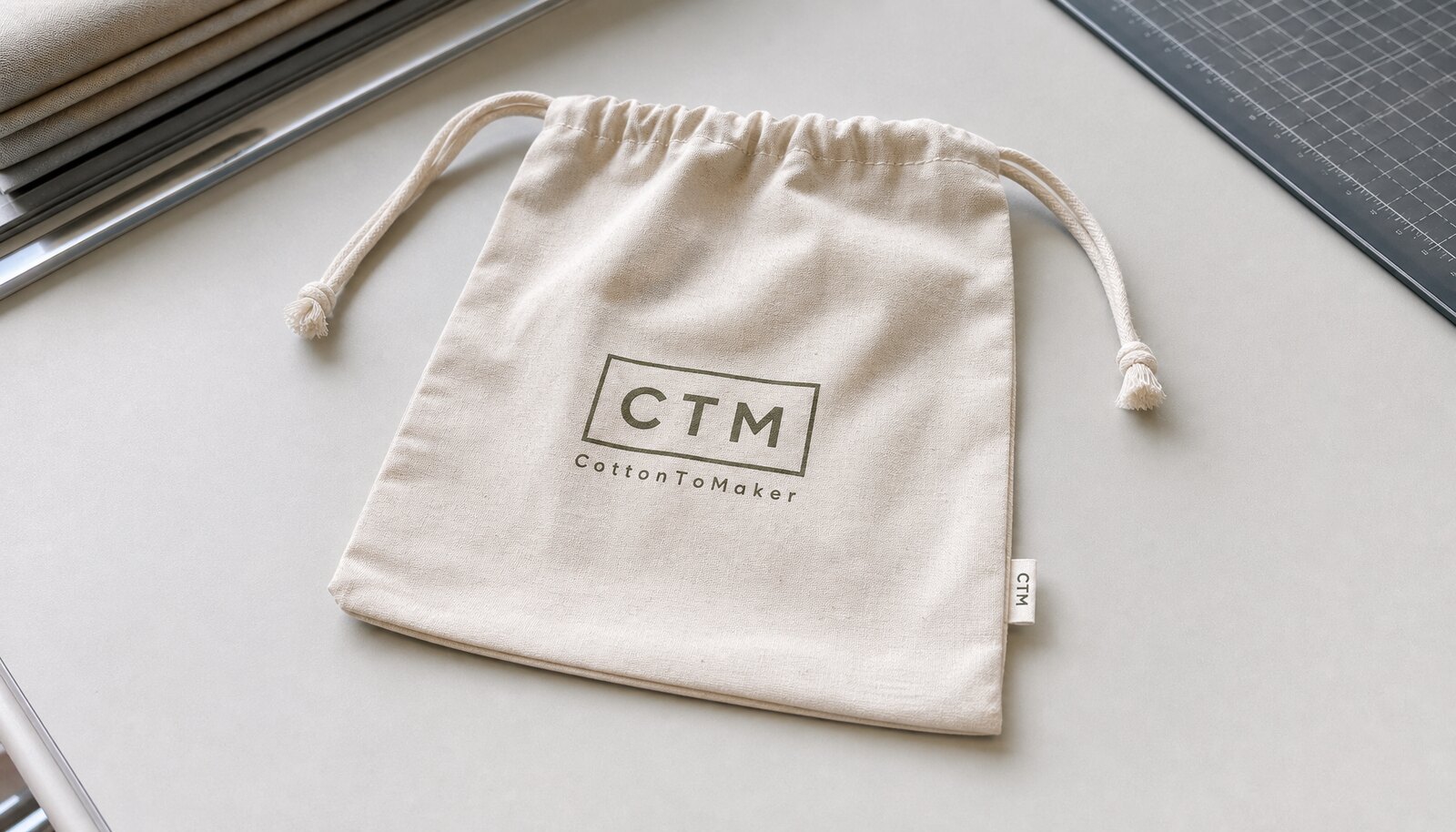
Start With The Use Case, Not The Logo File
The fastest way to overpay for a branded pouch is to buy the wrong construction for the job. A bag used as retail packaging, a pouch used for cosmetics, and a giveaway used at an event all have different tolerance for show-through, print durability, and handfeel. If the buyer starts with artwork and jumps straight to a quote, the supplier will fill in the gaps with their default spec. That default may be fine for a general promo item, but it is rarely the right answer for procurement.
A better request starts with how the pouch will be handled after it arrives. Will it carry a product with sharp edges, sit on a shelf, travel through e-commerce, or be opened and closed repeatedly by end users? That answer drives fabric weight, seam strength, cord length, and decoration method. It also determines whether you need a simple bulk pack or a retail-ready packed unit with barcodes and carton marks. The more precise the use case, the easier it is to compare supplier quotes on the same basis.
The practical goal is to move the order from a vague promotional item to a controlled product spec. Buyers who do that get fewer sample loops, fewer arguments at final inspection, and better reorder economics. Buyers who do not usually discover, too late, that one supplier quoted a thin muslin pouch while another priced a heavier canvas version that can never be compared on a true like-for-like basis.
- Define the end use before asking for price.
- Decide whether the pouch is packaging, retail product, or a giveaway.
- Treat the first sample as a production control tool, not as artwork approval only.
Choose Fabric, Weave, And Construction In The Order Buyers Actually Pay For Them
Fabric choice affects almost every other line item in the order. Light cotton muslin in the 120 to 140 GSM range is usually the lowest-cost entry point because it is easy to sew, light to ship, and flexible enough for simple branded packaging. The tradeoff is visibility. Thin cloth can show the contents, and a dark logo on a natural base can look less opaque than it did in the artwork file. That is acceptable for some inserts, but not for premium gifting or retail presentation.
Canvas and dense twill in the 180 to 220 GSM range move the bag into a different quality band. The pouch stands up better, feels more substantial in hand, and gives screen print more opacity. It also raises material cost and freight weight, which means the buyer has to compare landed cost rather than assume the unit price tells the whole story. Heavier cloth can also affect seam performance if the pattern was drafted for a lighter base and never rechecked after sampling.
Construction details matter just as much as GSM. A good pouch spec should name the seam type, top hem method, cord channel width, and whether the fabric is pre-shrunk or likely to move after steam or wash exposure. If the bag will sit near skin, food, or cosmetics, ask about dye stability and whether the cloth has a clean finish or a rougher hand that may shed lint. A small change in weave or finish can create a large change in customer perception.
- 120 to 140 GSM: good for light inserts, low-cost gifts, and short-term packaging.
- 150 to 180 GSM: a middle ground when the pouch needs better body without a large freight penalty.
- 180 to 220 GSM and above: better for premium retail, heavier contents, and repeated handling.
- Specify seam style, hem method, and any pre-shrink requirement in the RFQ.
Match Decoration Method To Artwork And Durability
Screen print remains the default choice for many branded pouch programs because it is predictable and cost-efficient when the artwork is simple. One or two solid colors on cotton or canvas usually print cleanly, especially if the logo area is large enough to avoid very fine details. It is also the best route when the buyer expects repeat orders, because the setup cost is absorbed over more units and the print result tends to be stable across production runs.
The weakness of screen print is detail. Very thin lines, soft gradients, tiny type, and overlapping color effects are more likely to fail on textured cloth than on paper. If the logo depends on fine registration, the buyer should ask whether the supplier can show a strike-off on the exact fabric color and weave, not just on a smooth test panel. For natural cotton and darker cloth, ink opacity and edge definition deserve as much attention as the artwork itself.
For more complex marks, DTF or digital transfer can be the better choice, but only if the buyer accepts the tradeoff. These methods can reproduce more detail, yet they often carry a higher decoration cost and should be tested for rub resistance, heat tolerance, and edge wear on the selected pouch fabric. Woven labels or sewn patches are more durable for premium branding, while embroidery can work well if the fabric is heavy enough to support the stitch density without puckering. The decision should be made on artwork complexity and wear, not habit.
- Use screen print for simple logos, repeat orders, and higher quantity runs.
- Use DTF or transfer when the logo has more color detail and the fabric has been tested for adhesion.
- Use woven labels or patches when the brand mark must survive heavy handling.
- Avoid embroidery on light fabric unless the sample proves the cloth can support it without distortion.
Read Quotes As A Production Spec, Not As A Price Sheet
A useful quotation breaks the pouch into its cost drivers. At minimum, the supplier should show fabric, GSM, finished size, print method, logo color count, setup fee, packing format, MOQ, and lead time. If you only get one all-in number, you cannot tell whether one supplier is cheaper because they used thinner cloth, simpler packing, or a lower-cost print method. That makes negotiation difficult and hides the real risk of rework later.
The buyer also needs to compare the same commercial terms. EXW and FOB are not the same as DDP, and a low factory price can become a bad landed price once the order absorbs freight, duty, carton labels, and inner packing. If the supplier quotes a lower unit price but leaves out sample fees, print setup, or retail prep, the buyer should treat the quote as incomplete rather than cheap. Procurement value comes from a clean apples-to-apples comparison, not from the biggest discount in a spreadsheet.
Good quote discipline also helps when you need to negotiate future reorders. If the supplier shows setup charges separately from recurring unit cost, the buyer can see whether a reprint is genuinely cheaper at scale. That matters for programs where the bag design stays stable but the artwork changes seasonally, or where the same pouch will be bought in one small test run and later in a larger replenishment order.
- Ask for price breaks at 1,000, 3,000, and 5,000 units if the order scale may grow.
- Separate setup fees from recurring unit price.
- Confirm what is excluded: freight, duty, testing, barcodes, carton marks, and retail inserts.
- Ask whether the price changes when you add a second print color, woven label, or custom cord.
Verify Supplier Capability And Compliance Before You Place The Order
Capability is not the same as willingness to quote. A factory can say yes to a pouch order and still fail on capacity, color consistency, or print control if it does not actually run the relevant processes in-house. Buyers should ask whether sewing, cutting, printing, and packing happen on the same site or whether parts of the order are pushed to subcontractors. The more handoffs there are, the harder it becomes to track accountability when a defect shows up.
A practical verification step is to ask for evidence, not promises. Request recent photos of the production line, the sample room, the quality inspection area, and the cartons used for packed goods. If the order is sensitive, ask what lot tracing exists for fabric rolls and whether the factory can keep the approved fabric shade locked for bulk production. For seasonal programs, also ask about holiday shutdowns, peak-season loading, and regional shipping risk. A supplier in a busy export cluster may be technically strong but still face longer lead times when fabric and freight are tight.
Compliance should be matched to the market, not assumed from a generic certificate. If the pouch is a retail item, ask whether the supplier can support any client-specific restricted-substance list, fabric content declaration, or market requirement such as REACH, CPSIA, or Prop 65 where applicable. Do not treat an old test report as proof of current control. Ask when the report was issued, what fabric lot it covered, and whether the same dye, ink, and construction method will be used for your order.
- Confirm whether sewing and printing are truly in-house.
- Ask for photos of the production line and the QC station.
- Check whether the supplier can lock a fabric lot or color reference.
- Match compliance questions to the destination market and intended use.
Use A Sample Chain That Actually De-Risks Production
A sample is only useful if each step answers a different question. A blank sample checks the fabric, size, seam construction, and cord action before decoration is added. A strike-off or print proof checks artwork size, color coverage, and placement. A pre-production sample, ideally built from the same fabric lot intended for bulk, is the final control point because it shows how the chosen cloth behaves after cutting, sewing, and finishing. Treating all samples as the same thing is one of the fastest ways to miss a production issue.
Approval should be based on measurements and visible reference, not a vague thumbs-up. Record the finished size, the position of the logo from the top edge and side seam, the cord length after knotting, and any special detail such as a woven label or side tag. If the buyer changes the artwork after the strike-off is approved, the sample should be reissued and the new version locked. Otherwise the factory and buyer may both think they are referencing the same control point when they are not.
For repeat orders, keep one approved sample on the buyer side and one with the factory. That sounds basic, but it prevents most of the argument that happens after bulk production starts. If the sample card also records the accepted fabric lot, print color reference, and packing style, it becomes a real production standard rather than a souvenir from the sales process.
- Use blank sample, strike-off, and pre-production sample as separate approvals.
- Record measurements and placement, not just a visual yes.
- Lock the final sample in writing before bulk cutting starts.
- If the artwork changes, restart the approval chain.
Specify Packing, Labeling, And Transport Protection
Packing changes both cost and risk. Bulk packing is usually cheaper because it minimizes labor and carton volume, but it exposes the printed surfaces to scuffing and can create mixed counts if the carton plan is not clear. Individual polybags raise labor and material cost, but they protect the print, improve shelf readiness, and reduce the chance of handling damage on the route to the distribution center. For retail programs, the buyer should decide this early rather than assume the factory will choose the right approach.
The carton spec should be part of the quote and part of the QC file. Ask for pieces per carton, carton dimensions, gross weight, carton marks, and whether palletization is required. If the bags are going into e-commerce or long-haul export, ask for a packed-carton drop check or another simple transit test on the finished pack. The objective is not laboratory perfection. It is making sure the logo does not rub, the bags do not crease badly, and the cartons do not collapse under normal handling.
Labeling also matters for receiving and inventory control. A barcode sticker on the inner pack or the carton may be enough for one distribution network, while another buyer needs retail hangtags and individual barcodes for shelf display. These details are not cosmetic. They affect warehouse speed, receiving accuracy, and the cost of repacking after arrival. If the supplier is quoting both bulk and retail-ready packing, ask them to show the exact labor difference so you can decide where to spend the money.
- Choose bulk pack only if you are prepared to handle repacking or if the bags are protected another way.
- Use individual polybags when logo abrasion or shelf presentation matters.
- Confirm carton counts, dimensions, and barcodes before production starts.
- Ask for a simple packed-carton transit check when the order will ship far or sit in storage.
Set QC Rules Around The Defects Buyers Actually Reject
Quality control for drawstring bags should focus on what the end user will see and feel first. In practice, buyers reject pouches for wrong size, crooked or faint logo placement, weak seams, stains, loose cords, and a drawstring that does not open smoothly. Those are the defects that affect resale, brand image, or usability. If the inspection plan spends too much time on obscure details and too little time on the logo area, seam integrity, and cord channel, it will miss the real failure points.
The best QC specs are measurable. State the allowed size tolerance, logo placement tolerance, acceptable stitch quality, and the defect classification for visible contamination. For example, a tiny thread tail may be a minor issue, while an open seam, missing stitch line, or visibly off-center logo is a major issue. If the bag is sold as a retail product, make the standard stricter on the visible face than on hidden internal seams. The buyer should also keep an approved sample on hand during final inspection, because a good visual reference is often faster and more reliable than a generic factory checklist.
If you use AQL, make sure the defect matrix is understood before inspection starts. The same visible problem can be classed differently by different teams, and that creates arguments after the carton is already packed. The practical way to avoid that is to write down a few examples of major and minor defects, show them against the approved sample, and require the factory to sign off on the same definitions. That way the inspection is a control tool, not a negotiation after the fact.
- Check the logo area first, then seams, then cord action.
- Use written tolerances for size, placement, and stitching.
- Define what counts as a major defect before inspection begins.
- Keep the approved sample visible during final QC.
Plan Lead Time From The Bottleneck Backward
The lead time buyers should trust is not the first date they hear from sales. It is the date built from the slowest production step. For branded pouches, the bottleneck is often sample approval, fabric sourcing, or print capacity rather than sewing itself. If the order uses stock fabric and a simple one-color logo, the path can be fairly fast. If the order needs custom dyed cloth, a special label, or a multi-color transfer, the schedule expands before bulk cutting even starts.
A good schedule separates the stages. Ask for estimated dates for sampling, bulk material arrival, cutting, printing, sewing, packing, and dispatch. That gives the buyer a way to spot slippage early. It also helps when a launch date is fixed, because a few days lost in the sample stage can become a full week if the factory is waiting for approval before it can book the next production slot. The more fixed your launch date, the earlier the safety buffer needs to be built into the plan.
Regional and seasonal risk matters as well. A factory in a strong export zone may have excellent production discipline but still face longer lead times during holiday shutdowns or peak freight periods. If the shipment is heading to a retailer or a distribution center with strict receiving windows, choose the freight mode only after the production calendar is stable. Air freight can save a launch date, but it changes landed cost immediately; sea freight lowers transport cost, but only if the schedule has enough slack to absorb transit time.
- Request a schedule by stage, not just a promised ship date.
- Build extra time for sample changes, fabric sourcing, and holiday closures.
- Choose air or sea after production timing is locked.
- For repeat programs, keep a small buffer stock if the pouch is business-critical.
Build The RFQ So You Can Compare Suppliers Cleanly
The best RFQ for a branded pouch is short enough to act on and detailed enough to stop assumptions. It should name the finished size, fabric, GSM, color reference, logo file, print method, placement, cord spec, packing format, target quantity, and delivery term. If the order is likely to repeat, add the approval path and the accepted sample reference. That turns the quote from a sales estimate into a production document that procurement, QA, and logistics can all use.
A practical rule is to separate stable requirements from variable ones. If the pouch is a one-off promotional item, use stock fabric and a simple decoration route so the quote stays fast and the MOQ stays manageable. If the pouch will be reordered across seasons, lock the fabric, the print standard, and the carton spec before negotiating price. That is how buyers avoid paying a low initial price and then absorbing hidden costs in every replenishment order.
For most procurement teams, the cleanest decision rule is simple. Direct factory sourcing is usually best when the quantity is meaningful and the spec is stable. A stockist or regional decorator makes sense when speed matters more than exact construction. A trading company is useful when one project manager needs to coordinate several moving parts. The quote should make those tradeoffs visible so you can choose the right route instead of the loudest salesperson.
- Send one RFQ that includes spec, artwork, packing, quantity, and delivery term.
- Choose a sourcing route based on control, speed, and complexity.
- Lock the sample, carton plan, and inspection standard before production starts.
- Treat reorder economics as part of the buying decision, not an afterthought.
Specification comparison for buyers
| Decision point | Best choice | Typical tradeoff | Buyer threshold / risk check |
|---|---|---|---|
| Sourcing route | Direct factory with in-house sewing and printing | Usually the lowest recurring unit cost once the spec is stable, but it can take longer to set up and it needs tighter technical input from the buyer | Best for repeat orders or 1,000 units and up; verify the factory really runs sewing and print in-house, not through a hidden subcontractor |
| Sourcing route | Trading company with one accountable project manager | Often adds an 8 to 15 percent margin, but it can simplify communication when you are buying several SKUs or coordinating packaging and freight | Good when internal bandwidth is limited; confirm who owns defects, who approves samples, and which factory is actually making the bags |
| Sourcing route | Local stockist or regional decorator | Fastest route, but fabric, size, and print options are usually limited and the per-unit price is often higher | Best for urgent events or very small runs under 500 units; watch for stockouts, color mismatch, and inconsistent lots |
| Base fabric | 120 to 140 GSM cotton muslin | Lowest material cost and light freight weight, but the cloth is more likely to show the contents and can look thin under dark print | Good for light inserts and giveaways; reject if the logo shows through too much or the handfeel is too flimsy |
| Base fabric | 180 to 220 GSM cotton canvas or dense twill | Typically 10 to 25 percent higher fabric cost and higher freight weight, but the bag has better structure, print opacity, and perceived value | Best for retail packaging or premium gifting; check whether the heavier cloth changes seam performance or lead time |
| Decoration method | 1-color screen print | Lowest setup cost and best repeat economics for simple artwork, but it is weak for gradients, small type, and tight registration | Use when line weight is generous and the logo can be read cleanly at arm's length on the chosen fabric |
| Decoration method | DTF or digital transfer | Usually costs more at low volumes and needs a durability check on the exact fabric, but it handles more detailed artwork | Use for multi-color logos or fine text; ask for rub testing and a wash or flex test if the pouch will be handled often |
| Decoration method | Woven label or sewn patch | Adds labor and can increase seam bulk, but it gives a more premium, durable mark than trying to force detail into rough cloth | Good when the brand mark must survive heavy handling; check edge finish, label size, and whether the patch interferes with the drawcord channel |
| Approval path | Blank sample, then strike-off, then pre-production sample | Small upfront cost and extra time, but it reduces the chance of bulk mistakes on size, print placement, or cord behavior | Use this chain for any new supplier, new fabric, new artwork, or order where rejection cost is high |
Buyer checklist before sampling
- Define the end use first: retail packaging, product insert, cosmetic pouch, or event giveaway. The use case should determine fabric weight, print durability, and packing.
- Specify finished size in centimeters and inches, plus whether the size is measured flat or filled.
- State the exact fabric, fiber content, weave, GSM, finish, and color reference. If you need pre-shrunk cloth or recycled content, say so explicitly.
- Attach vector artwork and define the print colors by Pantone, CMYK reference, or an approved visual standard.
- Set the logo placement, print size, and whether the artwork appears on one side, both sides, or centered on the pouch front.
- Confirm the cord type, cord length, knot style, and whether the top edge uses a hem, overlock, binding, or heat seal.
- Ask the supplier to separate pricing for the base pouch, decoration, setup fee, packing, and any special label or hangtag work.
- Ask for MOQ by size, color, and decoration method, not just one global order minimum.
- Request blank samples, strike-offs, or a pre-production sample before bulk cutting starts.
- Confirm the packing format: bulk packed, inner polybag, retail-ready bag, barcode sticker, master carton marks, and palletization if needed.
Factory quote questions to send
- Do you sew and print the bags in-house, or is any part subcontracted? If subcontracted, which process and who owns final QC?
- What is the exact fabric specification, including fiber content, GSM, weave, finish, and whether the cloth is pre-shrunk or dyed after weaving?
- What is the MOQ by size, fabric color, and logo color count? Does the MOQ change if I add a woven label, patch, or custom cord?
- What are the unit prices at 1,000, 3,000, and 5,000 pieces, and what changes the price at each tier?
- What sample types can you provide before bulk production, and what is the charge and turnaround for each one?
- What size tolerance do you hold on finished bags, logo placement, and seam alignment? Please state the acceptance range in writing.
- What are the standard defect categories for stains, holes, skipped stitches, crooked print, and cord issues?
- Can you provide a pre-production sample from the same fabric lot as the bulk order, and will you lock the approved sample for production reference?
- How are the pouches packed per carton, and what is the inner pack if I need retail-ready presentation or e-commerce protection?
- What test reports or compliance documents can you provide if the bags are sold as a retail item in our market?
Quality-control points to confirm
- Finished size should match the approved spec within a written tolerance, typically plus or minus 5 mm for small pouches and plus or minus 8 mm for larger bags.
- Logo placement should stay within the agreed visual tolerance, with no obvious skew, double strike, off-center print, or logo cut off by a seam.
- Print opacity should be strong enough that the logo reads cleanly at normal viewing distance, especially on natural cotton, dark cloth, and textured canvas.
- The print should not crack, smear, or transfer to adjacent bags during normal dry handling when tested against the approved sample.
- Seams should be straight and secure, with no open stitches, skipped stitches, broken needle holes, or loose thread tails that signal weak sewing control.
- Cord length should be even after knotting, and the drawstring should open and close smoothly without snagging, twisting, or pulling unevenly from one side.
- The channel and top hem should not pucker, twist, or collapse so much that the pouch mouth becomes hard to open or visually distorted.
- Fabric defects such as holes, oil stains, woven slubs, dark contamination, and color shade variation should be isolated and not appear at a visible rate in bulk.
- If the bag has a woven label, patch, or side tag, the edges should be clean, the stitching should be secure, and the label should not create uncomfortable bulk at the seam.
- Carton packing should protect the print from abrasion, moisture, and corner crush, with correct piece counts, carton marks, and no mixed sizes unless approved.