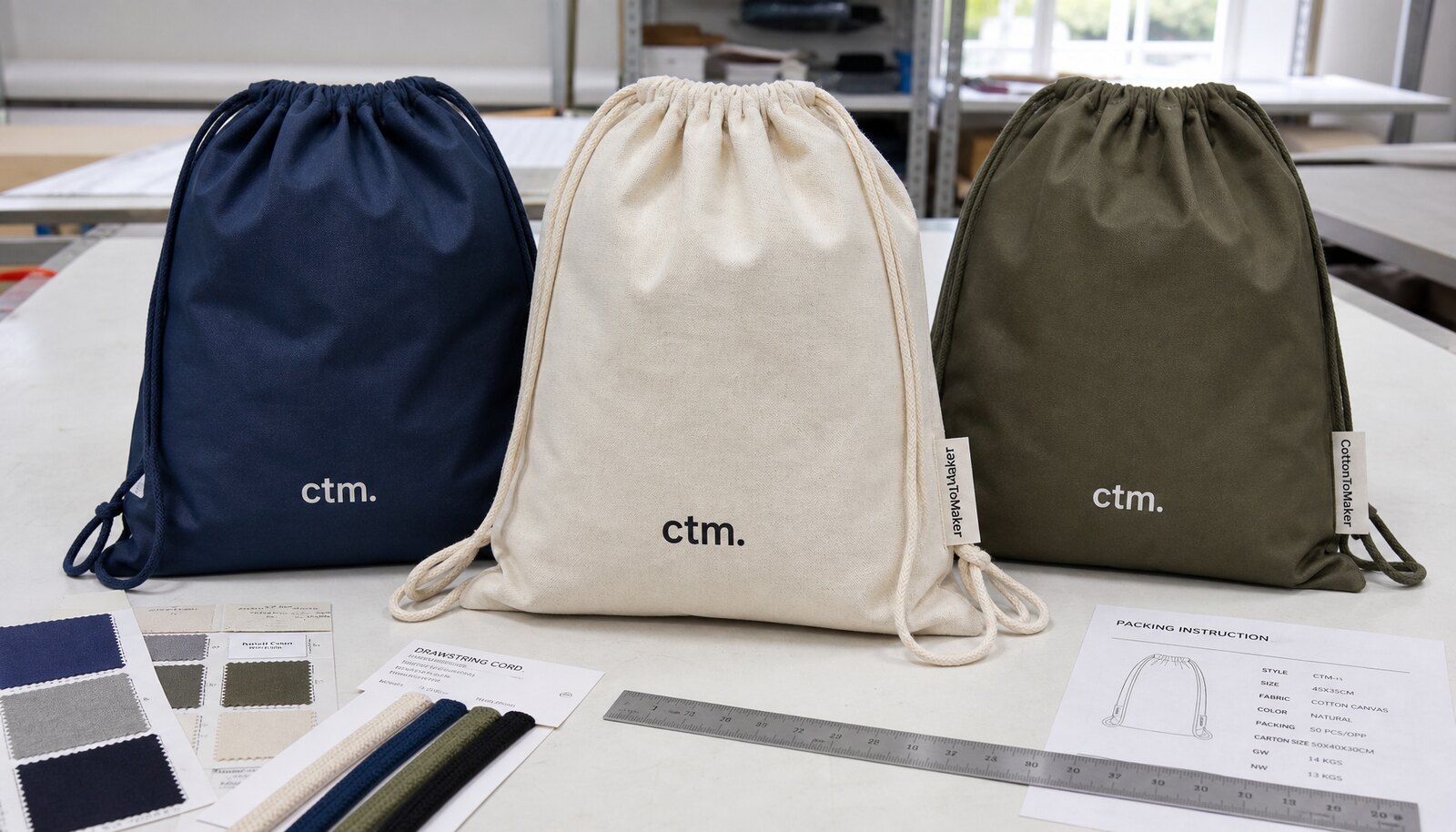
Why Compliance Must Be Built Into the RFQ
A drawstring backpack looks simple, but it combines fabric, cord, stitching, printing, labeling, and packing decisions. If the RFQ only says "210D drawstring bag with logo," suppliers will quote different constructions while appearing to offer the same product. One factory may include reinforced corners and cured screen print. Another may quote thinner fabric, loose cord knots, and a print method that looks acceptable on a photo but fails rub testing.
Compliance is not only about certificates. For procurement teams, compliance means the shipped bag matches the legal requirements, brand standards, performance expectation, packing instruction, and approved sample. The best time to control these points is before quote comparison, because after price negotiation the supplier has little room to upgrade fabric weight, replace ink, add warning labels, or improve carton quality without changing the price.
- Write the intended use first: event giveaway, retail sale, school pack, gym promotion, or product bundle.
- State destination market because labeling, chemical limits, and child safety rules vary by country.
- Separate legal compliance from performance compliance; both need acceptance criteria.
- Do not approve a quote until the supplier confirms the same specification can pass sampling and bulk production.
Fabric Weight, Material Claims, and Real-World Performance
The most common compliance gap in drawstring backpack sourcing is fabric substitution. Polyester suppliers often quote 190T, 210D, 300D, or 600D materials, while cotton suppliers quote in GSM or ounces. These terms are not interchangeable. A lightweight 210D polyester promotional bag may be acceptable for a one-day event, but it should not be compared directly with a 300 GSM cotton canvas bag intended for retail resale.
For cotton and canvas drawstring backpacks, buyers should specify GSM or ounce weight and ask whether the fabric is greige, dyed, washed, or pre-shrunk. A 180 GSM cotton bag is usually flexible and low cost, while 280-340 GSM canvas gives a more structured retail feel but increases sewing difficulty, carton weight, and freight cost. For polyester, ask for denier, coating, finished GSM if available, and tear strength expectation. If the supplier cannot explain the difference between denier and GSM, the quote needs extra verification.
- Low-cost event bag: 190T polyester or 210D polyester, often around 60-85 GSM depending on coating.
- Better promotional bag: 300D polyester or heavier non-coated polyester with reinforced corners.
- Cotton promotion bag: 140-220 GSM cotton, suitable for light items and simple printing.
- Retail canvas bag: 280-400 GSM cotton canvas, suitable for heavier branding and repeated use.
- Sustainability program: organic cotton, recycled cotton, or rPET only when documentation supports the claim.
Print Method Compliance: Logo Looks Good Is Not Enough
Printing is where many drawstring backpack orders fail visually. Screen printing is usually the best option for solid logos, event text, and 1-4 spot colors. It is cost-efficient and durable when the ink is compatible with the fabric and properly cured. Heat transfer works better for gradients, small details, and multi-color images, but buyers should check hand feel, edge lifting, and heat mark risk. Sublimation can be used for polyester panels when all-over or photo-style printing is required, but it is not suitable for cotton.
The RFQ should include vector artwork, Pantone references, print size, print position, and whether the logo may stretch over the cord channel or seam area. On textured cotton canvas, very fine lines can break or look uneven. On coated polyester, poor ink adhesion can cause cracking or rub-off. If the brand has strict color requirements, ask for a printed fabric strike-off before full sample approval, not only a digital mockup.
- Screen print: best for solid color logos and larger quantities; confirm ink type and curing process.
- Heat transfer: useful for gradients and full-color marks; check peeling, cracking, and hand feel.
- Sublimation: good for white or light polyester panels; color may shift after heat transfer.
- Embroidery: possible on heavier canvas, but usually not ideal for very thin polyester drawstring bags.
- Woven label: good for brand identification when front print must stay clean or minimal.
Construction Details That Affect Supplier Compliance
A compliant drawstring backpack must survive the intended use. The weak areas are usually the bottom cord exits, the top channel, and the side seams. Low-cost bags may use metal eyelets, stitched fabric tabs, or simple holes with reinforcement. Heavier bags should use fabric corner patches, bar tacks, or reinforced stitching. If the bag is expected to carry shoes, catalogs, samples, or drink bottles, the corner construction must be part of the RFQ, not left to factory habit.
The top drawstring channel also needs attention. If it is too narrow, cords do not slide smoothly. If the stitch line is weak, the top seam tears when users pull both cords. For children's products, long cords can create safety concerns depending on the market and age grading. Procurement teams should not assume an adult promotional backpack and a children's school activity backpack follow the same cord requirements.
- Specify finished size, not only cut panel size, because sewing shrinkage changes dimensions.
- Ask for cord diameter and material; 5-7 mm polyester cord is common for adult promotional use.
- Require bar tack or reinforcement where cords exit at the bottom corners.
- Check whether metal eyelets are rust-resistant and allowed under the buyer's safety standard.
- Confirm load expectation, such as light event materials or heavier retail use.
MOQ Logic: Why One Supplier's Minimum Is Not Enough Data
MOQ for drawstring backpacks depends on more than sewing capacity. The practical minimum is driven by fabric availability, dye lot size, print setup, label production, cord color, and packing style. A supplier may offer a low MOQ for stock black 210D polyester with one-color screen print, but the same factory may require a much higher MOQ for custom-dyed cotton canvas with a woven label and individual barcode sticker.
When comparing quotes, ask suppliers to separate MOQ by component. This prevents a common mistake: choosing a low unit price that only applies to stock colors, then discovering later that the brand color needs fabric dyeing, longer lead time, and a higher minimum. If a distributor needs several logo versions or mixed colors, ask whether the MOQ applies per total order, per fabric color, per logo artwork, or per packing SKU.
- Stock fabric and stock cord usually support lower MOQ and faster sampling.
- Custom fabric dyeing often sets the real MOQ, especially for cotton canvas and special polyester colors.
- Screen printing has setup cost per color and per artwork, even if the bag construction is the same.
- Custom woven labels, hangtags, and retail barcode labels can create separate supplier minimums.
- Mixed SKUs require clear packing rules to avoid warehouse receiving problems.
Compliance Documents Buyers Should Request
Do not ask for "all certificates" without defining the market and claim. A supplier may send an old fabric test report that does not apply to the current material, current ink, current coating, or current production batch. Better RFQ language asks for documents that match the exact order: material composition, restricted substances, colorfastness where needed, recycled content documents if claimed, and packaging compliance for destination rules.
For drawstring backpacks sold as adult promotional products, chemical and labeling requirements may be simpler than for children's products. If the bag is designed for children, school events, or toy-related promotions, the buyer should review age grading, cord safety, small parts, heavy metals in prints or metal eyelets, and market-specific testing. The supplier can support documentation, but the importer or brand owner remains responsible for choosing the correct compliance route.
- Match test reports to fabric type, color, coating, ink, and production period.
- For rPET, request recycled content documentation and verify whether the certificate scope covers finished bags or only yarn/fabric.
- For cotton claims, confirm whether wording is conventional cotton, organic cotton, recycled cotton, or blended cotton.
- Check country-of-origin labeling, fiber content labeling, warning labels, and retail packaging rules.
- Avoid printing sustainability claims on the bag until legal and documentation review is complete.
Sample Approval: What to Check Before Bulk Production
A photo sample is not enough for compliance approval. Buyers should approve a physical pre-production sample made with the intended bulk fabric, cord, print method, labels, and packing. If the supplier uses substitute sample fabric to save time, the sample may be useful for size review but not for final quality approval. This distinction should be written clearly in the sample approval record.
A strong sample review checks appearance and function. Measure the finished bag flat, test the cord sliding, load the bag with realistic weight, rub the print surface, inspect stitching, and check whether the logo placement is centered after the bag is closed. For cotton canvas, review shrinkage risk and print edge quality. For polyester, smell the coating, check creasing, and confirm whether the fabric surface causes ink adhesion issues.
- Measure width, height, top channel depth, cord length, and logo placement from fixed reference points.
- Compare fabric hand feel and weight against the signed swatch or lab-dip.
- Pull both cords repeatedly to confirm smooth closure and no seam tearing.
- Rub the print with dry and slightly damp white cloth to detect weak curing or dye transfer.
- Approve packing sample if retail presentation, barcode scanning, or carton display matters.
Packing, Carton Data, and Freight-Sensitive Decisions
Drawstring backpacks can look inexpensive in the unit quote but become inefficient in freight if packing is not controlled. Thin polyester bags can be packed tightly in bulk cartons. Heavy canvas bags, individual polybags, hangtags, and folded retail presentation increase labor, carton volume, and shipping cost. Buyers should request carton dimensions, gross weight, net weight, units per carton, and estimated CBM before final supplier comparison.
Packing compliance also includes destination rules. Some buyers need suffocation warnings on polybags, recyclable packaging marks, carton drop strength, moisture protection, or pallet instructions. If the order contains multiple colors, sizes, or artworks, the packing instruction must define SKU separation, carton marks, mixed carton approval, and barcode placement. Most receiving disputes are not caused by sewing problems; they are caused by cartons that do not match the warehouse system.
- Use bulk packing with carton liner for simple promotional distribution when individual bags are not required.
- Use individual polybags when retail handling, kitting, or warehouse cleanliness requires it.
- Confirm folded size because deep creases can affect print appearance on coated polyester.
- Ask whether desiccant, inner carton, or moisture protection is recommended for sea freight.
- Approve carton marks before production packing begins, not after cartons are printed.
Lead Time Risks and Production Sequence
Supplier lead time should not be treated as one number. A realistic drawstring backpack schedule includes artwork review, material sourcing, lab-dip or color approval when needed, sample making, sample shipping, buyer approval, bulk cutting, printing, sewing, trimming, final inspection, packing, and export booking. If the buyer changes artwork after screens are made or changes fabric color after dyeing, the production clock resets.
For simple stock fabric orders, lead time can be shorter because the factory can cut quickly after artwork and sample approval. For custom-dyed cotton canvas, rPET documentation, multi-color transfer printing, or retail packing, extra time is needed before sewing even begins. Procurement teams should ask when the quoted lead time starts. Some suppliers count from deposit. Others count from final sample approval, artwork approval, or material arrival.
- Clarify whether sample lead time includes artwork setup and material sourcing.
- Confirm bulk lead time starts after deposit, sample approval, and receipt of final artwork.
- Add review time for lab-dips, print strike-offs, labels, and packing mockups.
- Avoid approving mass printing before fabric color and logo color are both signed off.
- Book inspection early enough to allow rework before vessel or courier cutoff.
How to Compare Supplier Quotes Without Missing Compliance Cost
A low quote may exclude the exact items that make the order compliant. Common exclusions include screen charges, sample shipping, color matching, reinforced corners, custom labels, barcode stickers, individual polybags, test reports, and stronger export cartons. Ask for a structured quote so each supplier prices the same specification. If one supplier includes 300D polyester with reinforcement and another includes thin 210D without reinforcement, the lower price is not a real saving.
The quote should also identify assumptions. If the supplier assumes stock black fabric, one-color print, no test report, and bulk packing, that should be visible. For brand buyers and distributors, the goal is not to force every supplier into the cheapest configuration. The goal is to compare equivalent products and decide which specification gives acceptable risk for the order purpose.
- Request unit price by quantity tier, such as 1,000, 3,000, 5,000, and 10,000 pieces.
- Separate product cost from tooling, screen charge, sample cost, testing cost, and special packing cost.
- Ask for fabric weight and construction to be written directly on the quotation.
- Require carton data so logistics can calculate landed cost, not only factory price.
- Record quote validity because fabric, cotton, freight, and exchange rates can move.
Specification comparison for buyers
| Spec decision | Recommended option | When it fits | Buyer risk to check |
|---|---|---|---|
| Fabric for low-cost promotion | 210D polyester around 70-85 GSM | Event giveaways, school promotions, short-term campaigns, high carton efficiency | Check tear strength, colorfastness, coating odor, and whether supplier quotes true 210D or a lighter substitute |
| Fabric for retail or brand merchandise | 6-10 oz cotton canvas or 180-300 GSM cotton | Lifestyle campaigns, resale, eco-positioned products, heavier print coverage | Confirm shrinkage, fabric weight tolerance, cotton origin claims, and whether pre-shrinking is needed |
| Fabric for sustainability claims | rPET polyester with transaction certificate support where required | Brand programs that require recycled content documentation | Do not accept recycled claims without certificate scope, batch traceability, and label wording approval |
| Cord system | 5-7 mm polyester cord or cotton cord matched to fabric weight | General adult drawstring backpacks with repeated use | Test cord slip, knot security, shoulder comfort, and restricted drawcord rules for children's products |
| Print method | Screen print for solid 1-4 color logos; heat transfer for gradients; sublimation for full polyester panels | Most logo orders where cost, durability, and artwork consistency matter | Request print size, ink type, curing method, wash/rub test, and artwork color reference before pricing |
| Reinforcement | Bar tack or reinforced corner patch at cord exit | Orders where bags will carry shoes, books, samples, or bottles | Weak corners cause field failure; inspect stitch density, patch material, and load test result |
| Packing method | Individual polybag only when retail handling needs it; otherwise bulk packed with carton liner | Balancing presentation, labor cost, and destination packaging rules | Confirm suffocation warning, recyclable bag requirements, carton strength, and units per carton |
Buyer checklist before sampling
- Define the exact drawstring backpack use case: giveaway, retail merchandise, school kit, gym bag, or event pack.
- State fabric type, fabric weight or denier, color reference, coating requirement, and acceptable tolerance.
- Confirm finished size, seam allowance, cord length, cord thickness, corner reinforcement, and load expectation.
- Provide artwork in vector format with Pantone references, print size, placement, and print method preference.
- Ask for one pre-production sample using bulk fabric, bulk cord, correct print, label, and packing method.
- Require compliance documents that match the destination market, product age group, material, and claim wording.
- Check MOQ by fabric color, print method, label type, and packing style instead of asking only for one headline MOQ.
- Request a quote breakdown showing unit price basis, tooling or screen charge, sample cost, packing cost, carton data, and lead time.
- Approve carton marks, inner packing, barcode labels, warning labels, and country-of-origin labels before production.
- Set inspection acceptance criteria for fabric defects, print defects, dimensions, seam strength, color variance, and packing errors.
Factory quote questions to send
- What exact fabric are you quoting: material composition, denier or GSM, weave, coating, and weight tolerance?
- Is the quoted fabric stock material or made-to-order dyed material, and how does that affect MOQ and lead time?
- What is the finished size tolerance after sewing, and what seam allowance is used?
- What cord material, diameter, length, and color are included in the price?
- Are the bottom corners reinforced by metal eyelet, fabric patch, bar tack, or another construction?
- Which print method are you quoting, and what is the maximum print size included in the unit price?
- Are screen charges, heat transfer plate charges, digital setup fees, or artwork separation fees included or separate?
- Can you make the pre-production sample with bulk fabric, actual cord, final print, labels, and final packing?
- What compliance documents can you provide for this exact material and print, not only for a previous order?
- What is the MOQ by fabric color, logo color count, custom label, and custom packing requirement?
Quality-control points to confirm
- Fabric weight check by cutting and weighing a measured sample area, not only relying on supplier declaration.
- Finished size measurement across a statistically useful sample set, including width, height, and cord length.
- Print adhesion, rub resistance, curing quality, registration, edge sharpness, and color match under standard light.
- Cord pull test at top channel and bottom corner exit to identify weak stitching or loose knots.
- Seam inspection for skipped stitches, open seams, loose thread, uneven top channel, and broken needles.
- Load test using a realistic weight for the intended product use, with special attention to bottom corners.
- Colorfastness check for dark fabric and dark cords, especially when bags may contact light clothing.
- Label and marking verification including country of origin, fiber content if required, barcode, warning label, and customer SKU.
- Packing audit for units per polybag or carton, carton strength, carton marks, moisture protection, and mixed SKU separation.
- Compliance document review to ensure reports match the material, ink, age grading, destination market, and order date.