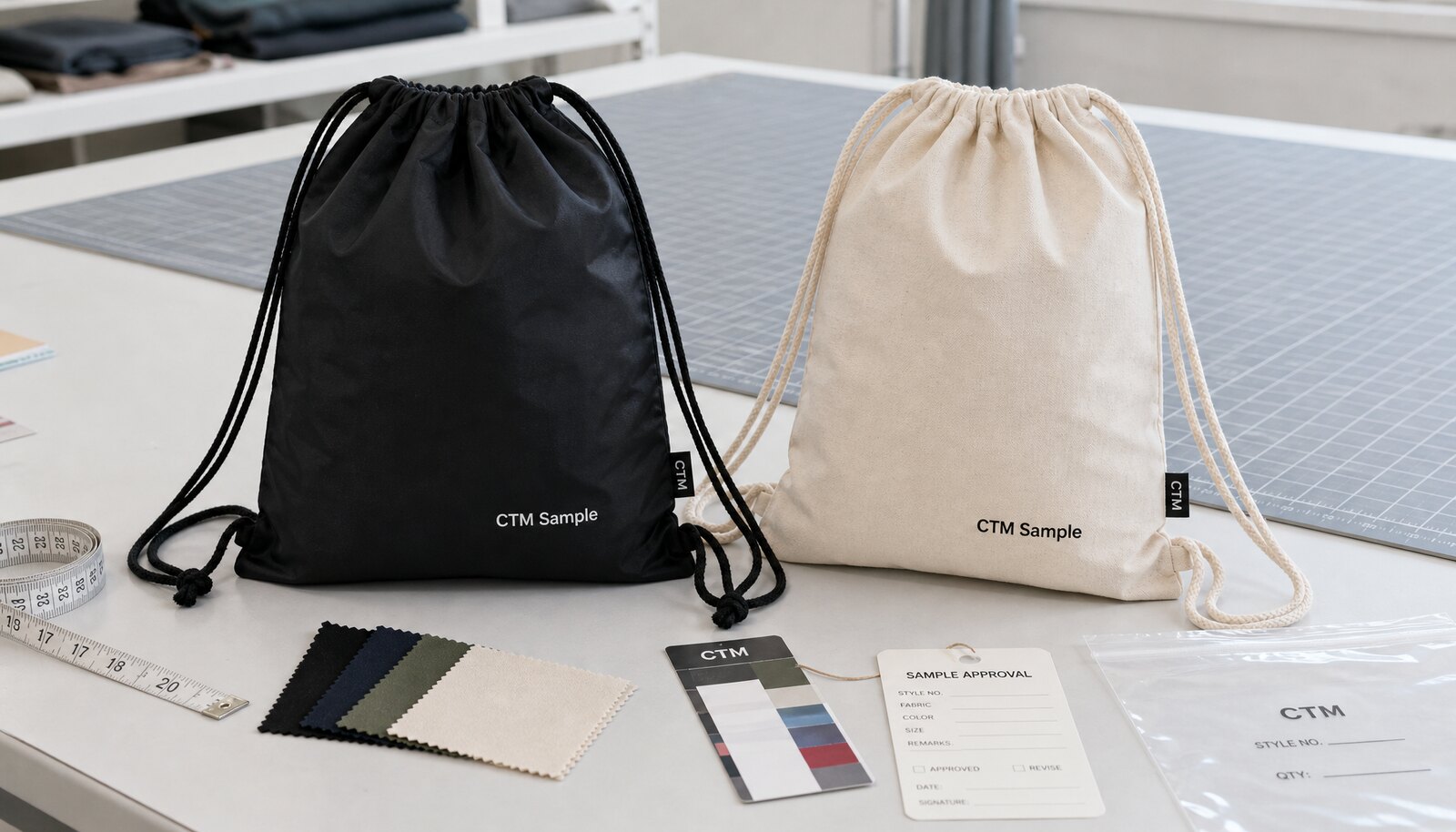
Why Sample Revision Requests Fail
A drawstring backpack sample revision request often fails because the buyer describes the problem too generally. Notes such as make the logo sharper, use stronger material, or improve the rope are not enough for a sewing factory to adjust production. The merchandiser needs measurable information: fabric weight, finished size, cord diameter, print position, sewing method, packing format, and the approval status of each change.
The other common problem is mixing design comments with commercial changes. A request to change 210D polyester to 300D polyester is not only a quality adjustment. It can affect MOQ, unit cost, fabric sourcing time, carton capacity, and freight volume. A good revision request separates critical corrections from optional improvements, so the factory can protect the schedule and quote accurately.
- Use dimensions in millimeters or centimeters, not visual descriptions.
- Refer to the sample version, artwork file name, and quotation number.
- Mark which changes are mandatory for approval and which are preferred.
- Ask the factory to confirm cost and lead time impact before making a revised sample.
- Keep one decision maker responsible for final sample approval.
Define the Sample Type Before Commenting
Not every sample is meant to prove the same thing. A first prototype may only confirm size, shape, and construction. A print strike-off checks ink color and artwork accuracy. A pre-production sample should reflect the final fabric, logo, accessories, and packing before mass production. If your team treats an early prototype as a final production sample, you may approve details that were never fully tested.
In the revision request, state exactly what type of sample you reviewed and what you expect next. For example, if the body size is correct but the print color is not approved, you may only need a revised print strike-off. If the cord channel is too narrow and the fabric weight is changing, a full physical resample is safer. This prevents paying for unnecessary samples while still controlling real production risks.
- Prototype sample: checks shape, size, and basic sewing feasibility.
- Material sample: checks GSM, denier, coating, hand feel, and color.
- Logo strike-off: checks print method, Pantone matching, and placement.
- Pre-production sample: checks final construction, print, labels, and packing.
- Packing sample: checks folding, polybag, barcode, carton mark, and carton count.
Fabric Weight Revisions: GSM, Denier, and Hand Feel
Fabric is one of the most important sample revision points because it affects appearance, strength, cost, and lead time. For polyester drawstring backpacks, common options include 190T polyester, 210D polyester, 300D polyester, and 600D polyester for heavier promotional or sports styles. For cotton or canvas versions, buyers often compare 5 oz, 6 oz, 8 oz, 10 oz, and 12 oz fabrics. These numbers should appear clearly in the RFQ, quotation, sample tag, and purchase order.
Do not approve fabric by hand feel alone. A coated 210D polyester may feel stiffer than an uncoated 300D fabric, but that does not mean it performs the same under load. Dark colors may also feel firmer than light colors due to dyeing and finishing. If the sample feels too thin, ask the factory whether the issue is denier, GSM, coating, weave density, or finishing. Each cause has a different cost and sourcing impact.
- For event giveaways, 210D polyester is often acceptable when load weight is low.
- For retail or sports programs, 300D polyester gives a more stable hand feel.
- For natural branding, 8 oz cotton canvas is a practical starting point.
- For heavier merchandise, consider reinforced corners before simply increasing fabric weight.
- Ask whether the revised fabric is stock fabric or requires dyeing, because MOQ may change.
Size, Shape, and Drawcord Fit Corrections
Small size changes can create bigger construction issues on a drawstring backpack than buyers expect. Increasing the bag height may require longer drawcords. Widening the bag can change the logo position and the way the top gathers when closed. Changing the bottom shape may affect where the cord attaches and how much stress sits on the lower corners.
When asking for a size revision, provide finished flat measurements and acceptable tolerances. A typical promotional drawstring backpack might be around 34 x 42 cm, while larger gym styles may run closer to 38 x 45 cm. The right size depends on the intended contents, not just the visual layout. If the bag must hold shoes, a hoodie, a bottle, or a retail kit, tell the factory the approximate load and dimensions of the contents.
- Measure width from side seam to side seam when the bag is flat.
- Measure height from top edge to bottom seam, excluding any cord loop below the bag.
- Specify print placement from the top edge or bottom edge, not only centered.
- Confirm cord length after the bag is fully opened and fully closed.
- Check whether the top channel still gathers smoothly after the size change.
Logo Revision: Print Method, Color, and Placement
Logo revision is where many bulk orders lose time. For drawstring backpacks, screen printing is usually the most economical option for solid logos and high-volume orders. Heat transfer can handle gradients, small details, and full-color artwork, but it may add cost and needs adhesion testing. Embroidery is less common on lightweight polyester drawstring bags because it can pucker the fabric, but it can work on canvas or with a sewn patch.
A useful revision request does not say make the logo brighter. It says, for example, revise logo color to Pantone 186 C, keep logo width at 180 mm, place center of logo 190 mm from top edge, and confirm ink curing test after printing on coated 210D polyester. If the sample print looks dull, the cause may be fabric color absorption, ink opacity, heat transfer film, or curing temperature. The factory needs the cause, or at least a clear target.
- Send vector artwork in AI, EPS, or PDF format whenever possible.
- Confirm whether the logo size is measured by width, height, or total print area.
- Give print placement from fixed edges, not from visual balance only.
- For polyester, ask about dye migration risk, especially on red, black, navy, and fluorescent fabrics.
- For cotton canvas, ask whether the fabric texture will make fine lines look broken.
Cord, Eyelet, and Corner Reinforcement Changes
The cord system is not a small accessory. It controls comfort, closure, and load strength. A thin cord may reduce cost and packing volume, but it can cut into the shoulder or fail at the bottom corner. A thick rope may look premium, but it may not slide well through a narrow top channel. If the sample feels uncomfortable, specify cord diameter, material, color, and finish rather than only asking for a better cord.
Bottom construction deserves special attention. Some low-cost drawstring backpacks attach the cord through a simple folded fabric corner. Stronger versions use a metal eyelet, PU patch, webbing loop, or reinforced triangle stitching. If your buyer team expects the bag to carry sports shoes, event kits, or bottled drinks, request a load test before approving the corner design. This is cheaper than discovering corner tearing during distribution.
- 5 mm to 6 mm polyester cord is a practical range for many promotional backpacks.
- Cotton rope improves natural appearance but may absorb moisture and show dirt faster.
- Metal eyelets can improve durability but may add rust, color, or compliance questions.
- Webbing loops are useful when the bag must handle repeated carrying.
- Ask the factory to photograph the inside corner construction, not only the outside view.
Sample Checks Before You Ask for a Resample
Before sending revision comments, inspect the sample like a basic incoming QC check. Put the bag on a flat table, measure it, photograph each issue, and compare it to the RFQ and quotation. Many disputes happen because the buyer compares the sample to an internal expectation that was never written into the original specification.
A simple practical test is to load the sample with the expected contents and hang it for a short period. This does not replace a formal lab test, but it shows whether the cord bites into the fabric, the seams twist, or the print cracks around stress areas. For cotton canvas, also check loose fibers, shade variation, and shrinkage risk. For polyester, check coating odor, crease marks, and ink adhesion.
- Check finished size tolerance before judging logo placement.
- Rub the printed area lightly to see if ink transfers after normal handling.
- Open and close the drawcord several times to check channel friction.
- Inspect bottom corners after loading the bag with realistic weight.
- Compare thread color, stitching density, and trimming against the approved standard.
- Check if folding creates a crease through the printed logo.
How to Write the Revision Request
The best revision request is short, numbered, and decision-ready. Each line should state the current issue, the required correction, and the acceptance criteria. Attach annotated photos, but do not rely on photos alone. A red circle around a print area does not tell the factory the new placement, size, or color target.
Also separate no-charge corrections from specification upgrades. If the sample is wrong against the approved artwork, that is a correction. If your team now wants heavier fabric or a larger logo, that is a spec change and may affect the quote. Being clear on this point keeps the supplier relationship professional and reduces back-and-forth negotiation.
- Sample version: PP sample V1 received on date.
- Issue: logo is 25 mm lower than approved layout.
- Required correction: move logo center upward by 25 mm.
- Acceptance criteria: logo center 185 mm from top edge, tolerance plus or minus 5 mm.
- Approval condition: send revised print photo first; physical resample required before bulk.
- Commercial note: confirm if this change affects unit price, screen charge, or lead time.
MOQ, Lead Time, and Quote Impact of Revisions
A sample revision request should always ask whether the change affects MOQ and timing. Stock 210D polyester in black, navy, red, or natural-looking standard colors may be available quickly. Custom dyed polyester, heavier canvas, special rope color, metal accessories, or a non-standard packing format may require higher MOQ or longer sourcing time. If the revised sample uses stock material but bulk requires custom dyeing, the approved sample may not represent bulk risk.
Lead time should be discussed in stages: revised sample production, sample transit, buyer approval, material preparation, bulk production, final inspection, and shipping. A change made after sample approval can push all later stages. For importers and distributors working with promotion dates or retail delivery windows, the revision request should ask for the last safe approval date, not only the estimated production days.
- Ask if revised fabric is in stock or needs weaving, dyeing, or coating.
- Confirm whether logo revision requires a new screen, film, transfer sheet, or embroidery program.
- Check whether heavier fabric reduces pieces per carton and increases freight volume.
- Ask whether packing changes affect barcode application labor or carton mark setup.
- Request an updated quote sheet after major sample changes, not only a chat confirmation.
Packing and Label Revisions Often Need Their Own Approval
Drawstring backpack buyers often focus on the bag and leave packing until the end. This is risky. A bag that looks correct can still fail receiving if the barcode is missing, the carton mark is wrong, or the polybag warning text is not suitable for the destination market. If the product is for retail, distributor warehouse, school program, or e-commerce fulfillment, packing should be part of the sample approval path.
Packing revisions can also change cost and logistics. Individual polybags add labor and material cost but protect the print and simplify distribution. Bulk packing reduces cost but can create wrinkles, print transfer, or mixed color issues. If the printed logo is large or soft before full curing, the folding method matters. Ask the factory to show the fold line on the sample and confirm it will not damage the logo.
- Confirm individual polybag size, thickness, warning text, and ventilation holes if required.
- Approve barcode label position and barcode readability before bulk packing.
- Specify carton quantity, inner pack quantity, carton mark, and gross weight limit.
- Check whether mixed colors or mixed sizes need separate inner bags.
- Ask for packed sample photos after folding, not only open product photos.
Specification comparison for buyers
| Spec decision | Recommended option | When it fits | Buyer risk to check |
|---|---|---|---|
| Fabric weight | 210D polyester, 300D polyester, or 8-10 oz cotton canvas | 210D for giveaway volume, 300D for retail promo, cotton canvas for natural brand positioning | A sample may feel acceptable empty but collapse, stretch, or show print-through after loading |
| Drawcord type | 5-6 mm polyester cord or cotton rope with reinforced bottom corners | Polyester cord for sports and school use, cotton rope for lifestyle or eco ranges | Cord diameter can change packing volume, user comfort, and eyelet stress |
| Print method | Screen print for solid logos, heat transfer for gradients, embroidery patch for premium styles | Screen print works best for most B2B bulk logos under controlled Pantone references | Wrong ink or curing can cause cracking, migration, or color shift on coated polyester |
| Bottom reinforcement | PU corner patch, metal eyelet, or stitched webbing loop | Required when the bag carries shoes, bottles, event kits, or retail merchandise | Weak corner construction is one of the first failure points in load testing |
| Sample approval status | Approve with written changes only after revised sample photos or physical resample | Useful when deadline is tight and changes are low risk, such as packing label text | Verbal approval creates disputes when bulk differs from the first sample |
| Packing format | Individual polybag or bulk inner bag with carton mark and barcode plan | Retail, distributor, and Amazon-style receiving need stricter packing control | Late packing changes can affect carton count, freight volume, and warehouse receiving |
Buyer checklist before sampling
- Confirm the sample version number, date received, and whether it is a pre-production sample, size set sample, print strike-off, or packing sample.
- Measure flat bag width, height, drawcord length, bottom corner position, and print placement against the approved specification sheet.
- Check fabric GSM or denier against the quote, not only by hand feel, because coating, weave, and color can make lighter fabric appear stronger.
- Compare logo color to Pantone or approved artwork under normal daylight and indoor lighting; photograph any mismatch beside the reference.
- Load the sample with a realistic weight, then inspect cord comfort, corner stress, seam slippage, and distortion around the drawstring channel.
- Review stitching density, backstitching, thread color, cord channel opening, corner reinforcement, and any loose trimming before approving.
- Confirm whether the revised request changes MOQ, unit cost, sample cost, mold or screen charge, lead time, carton size, or packing method.
- Write sample comments as measurable changes, not subjective notes such as better fabric, nicer logo, or stronger sewing.
- Request revised photos before resampling when the issue is simple, but require a physical revised sample for fabric, size, print, or construction changes.
- Do not release bulk production until the factory confirms the exact approved sample version and attaches it to the production order.
Factory quote questions to send
- Which fabric denier or GSM is quoted, and is the sample made from the same batch, coating, color, and shrinkage condition planned for bulk?
- If we revise from 210D to 300D polyester or from 6 oz to 8 oz cotton canvas, what are the changes to MOQ, unit cost, carton quantity, and lead time?
- Which print method is used on the sample, what ink system or transfer type is planned for bulk, and how will color matching be controlled?
- Can you confirm the exact logo size, print placement tolerance, and whether the drawstring channel or seams affect the printable area?
- What load test do you recommend for this construction, and which area usually fails first on similar drawstring backpack orders?
- Will the revised cord, eyelet, corner patch, or webbing loop require a different sewing operation or additional production days?
- What is the sampling timeline for a revised physical sample versus revised photos, and when must approval be given to keep the bulk ship date?
- Are individual polybags, barcode labels, retail hangtags, carton marks, and inner carton quantities included in the current quote?
- What information do you need from us before confirming the revised proforma invoice and production specification sheet?
- If bulk production follows an approved revised sample, how will your QC team control fabric weight, logo color, seam strength, and packing count?
Quality-control points to confirm
- Fabric weight or denier verified against the purchase order and approved sample.
- Bag dimensions checked flat before packing, including width, height, drawcord length, and print placement.
- Seam strength checked at side seams, bottom corners, and drawcord channel after a basic load test.
- Logo print checked for color, curing, adhesion, registration, bleeding, cracking, and migration risk.
- Cord, eyelet, and reinforcement checked for tension, abrasion, and symmetry between left and right sides.
- Thread trimming, stain control, needle holes, fabric scratches, and color shading checked before folding.
- Packing method checked against barcode, carton mark, polybag warning text, and final carton quantity.
- Approved sample version retained by both buyer and factory as the reference for final inspection.