Drawstring Backpack Sourcing Product Development Capability for United States Procurement
By Vincent Xi, Editorial Author
Decision first. United States B2B buyers should treat drawstring backpack sourcing product development capability as a go/no-go gate. Do not lock a factory or issue a bulk purchase order until the supplier documents how a tech pack becomes a sealed golden sample and then a repeatable cut-and-sew standard. The procurement job is to specify, compare, and approve that path so print, hardware, measurements, United States labeling, landed cost, and delivery dates are controlled in the RFQ—not discovered after fabric is cut.
Before factories are compared, assemble a minimum packet: finished dimensions, fabric GSM or denier, print method and millimeter registration, hardware callouts, a United States label drawing, CAD ownership, included sample rounds, MOQ and price breaks, a QC defect list, Incoterm, and a named United States place. The buyer task is procurement of a specified bag, not a tour of country manufacturing. Treat every published MOQ, sample promise, and process diagram as a specification to verify in a current quotation, not as a guaranteed commercial term.
Assessing Product Development Capability in Drawstring Backpack OEM and ODM Programs
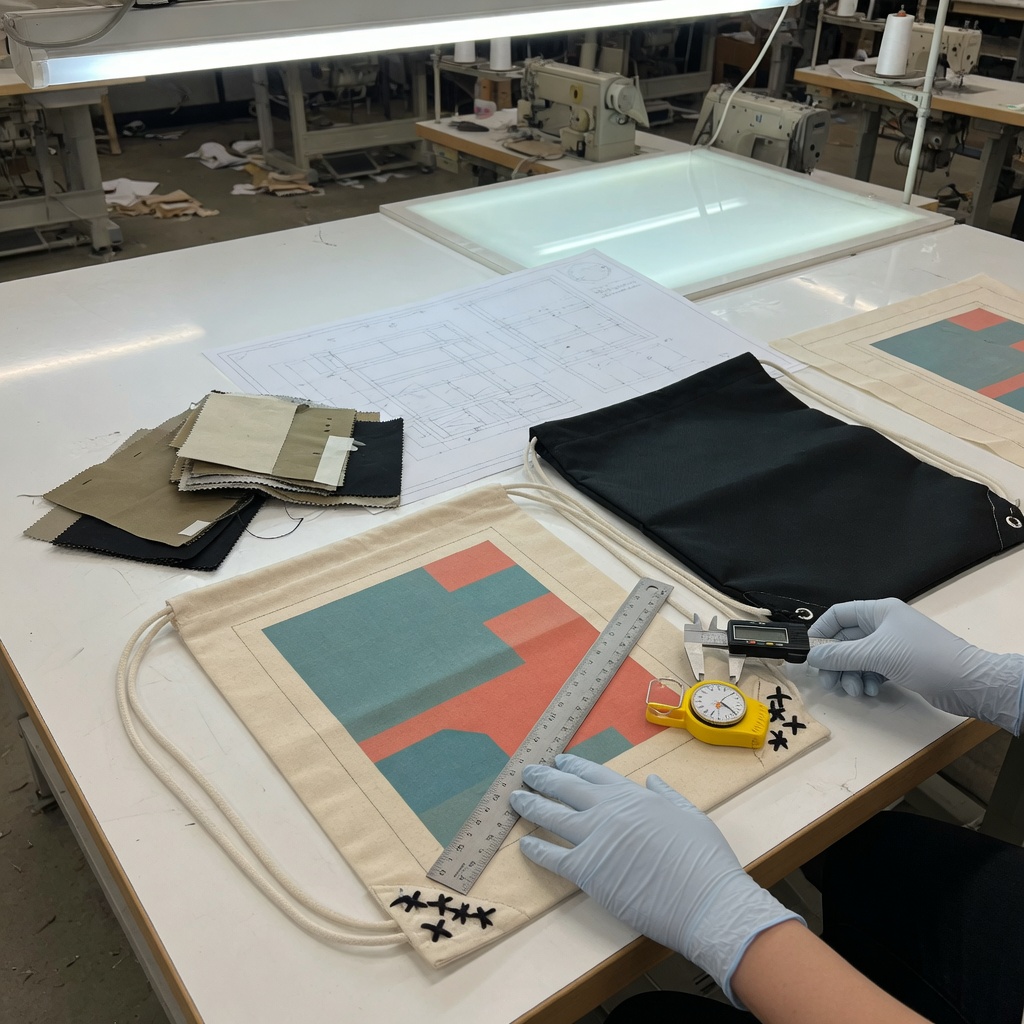
Product development capability is the factory’s ability to convert a tech pack into a repeatable cut-and-sew standard—not a reprint of a catalog bag.
On the cited Szoneier OEM/ODM manufacturer page, the described engineering sequence includes brand-requirement analysis, CAD pattern development, 3D mockups, physical sampling with revisions, and quality criteria aimed at durability, print quality, and load-bearing construction. That page presents the work as fabric R&D plus cut-and-sew. Szoneier’s OEM/ODM manufacturer overview
A Tony Sourcing guide, presented on that site as a 2025 article on custom drawstring backpacks from China, distinguishes direct factories—in that guide’s framing—as the usual fit for large MOQ, full OEM/ODM, and tighter quality control. That is the guide’s classification, not a ranking of any named mill and not a substitute for documents from the actual producing site. Tony Sourcing 2025 guide China is cited there as a manufacturing origin, not as a sales-market target for this page.
Measurable trade-offs for the United States buyer:
- Extra CAD and mockup cycles raise pre-production cost and calendar time but reduce first-bulk measurement drift and print mis-registration.
- A factory that will share a CAD file format (for example DXF or AI pattern) and a dimensioned 3D view tied to the same measurements gives the buyer an audit trail; a factory that only offers a photo of a similar bag does not.
- Ownership of patterns and graded nests should be stated in the RFQ. If the buyer may move production later, the CAD and the sealed sample are the portable assets.
RFQ control (buyer-specified; not a promise on the cited pages): Ask for a redacted example of a previous CAD-to-sample-to-bulk photo set (no other customer identity), a revision-log template, a written statement of how many sample rounds are included in the quoted development fee, and who owns the CAD after payment. If the factory cannot describe how a change in fabric lot or print setup is controlled after sample approval, product development capability is incomplete regardless of MOQ claims.
United States Labeling, Origin Marking, and Import Controls
United States importers of record remain responsible for country-of-origin marking, truthful textile fiber disclosure where the bag is a textile product, and any safety rules that apply to the actual end use. Promotional or general-use drawstring backpacks still need accurate fiber content if they are textile, a country-of-origin statement, and packing that supports CBP entry. FTC textile fiber identification rules, where they apply, are an importer obligation—not a factory marketing claim and not a statement taken from the cited manufacturer pages. If the SKU is intended for children, CPSIA tracking labels, testing, and certification may apply; that is a product- and age-specific legal determination, not a factory template decision. Do not import clothing-hood drawstring rules onto a backpack SKU unless counsel says those rules actually apply to that product.
Trade-offs the RFQ should force into the open:
- A sewn woven label with fiber percentages, origin, and any required care copy adds a small unit cost and a needle-position callout on the tech pack. A hangtag-only pack-out is cheaper but can fail retailer, marketplace, or state rules.
- Importer identity (RN/WPL where required) and the exact legal wording should be supplied by the buyer’s counsel, not invented by the factory.
- Restricted-substance or California Proposition 65 requirements, if the buyer’s legal team imposes them, belong in the RFQ as a positive list. A general factory claim of "compliant materials" is not evidence.
RFQ control: Build a broker or counsel review of the label drawing into the pre-production calendar the same way you build sample approval. Label errors create detention and relabel cost that dwarf a few cents of woven-label expense. Name the United States importer of record in the RFQ.
Material, Size, Print Method, and Hardware Trade-offs
A manufacturer guide lists common fabrics as cotton, polyester, nylon, and canvas, each affecting durability and print performance, with customization covering size, silk screen or sublimation printing, cords, and accessories such as zipper pockets. Yanxin drawstring backpack guide That list is a published menu of options, not a test report for a specific mill lot.
Specify, do not assume:
- Confirm denier or GSM in the RFQ. Do not treat a trade shorthand as a default and not as a measured result in this article. Polyester is the fabric family typically specified when the print method is dye sublimation; confirm polyester face content with the mill. Cotton or canvas can improve hand-feel and some screen-print appearances but may be heavier, cost more, and restrict sublimation unless the fabric is a blend. Nylon trades abrasion and moisture behavior against print and cost.
- Silk screen is typically the lower-setup path for one- to few-color logos in a fixed location. Specify maximum registration error in millimeters, ink type, and whether an underbase is required on dark fabric. Sublimation needs a polyester-rich face and different color-matching and crocking behavior; it is not a drop-in substitute for screen on cotton canvas.
- Hardware: cord diameter and material, grommet inner diameter and finish, bartacks at stress points, and optional zipper pockets each add stitch count, cost, and failure modes. A zipper pocket is a construction change, not an artwork change. Put those callouts on the tech pack; the cited guides do not replace dimensional hardware specs.
Example calculation/assumption to verify in the supplier quote (not a live price or measured mill result): promotional drawstring backpacks are often drawn with finished face panels near 14 × 17 inches (35.6 × 43.2 cm) or 15 × 18 inches (38.1 × 45.7 cm). Always put finished measurements, hem allowance, and a load or volume target on the tech pack. Changing a 13 × 17 inch (33.0 × 43.2 cm) face panel to a 15 × 18 inch (38.1 × 45.7 cm) face panel increases rectangular face-panel area from 221 in² to 270 in² (1,426 cm² to 1,742 cm²), or 49 in² / 221 in² ≈ 22 percent, before nesting waste and before counting the back panel, cord channel, or pockets. Scope: two hypothetical rectangle sizes used only to show why a nest/consumption chart is required. Request that chart rather than accepting a verbal "same price."
Sampling, Minimum Order Quantity, and Development Calendar
One OEM/ODM manufacturer lists a low MOQ starting at 30 pieces and describes sampling with revisions inside an engineering workflow. Szoneier OEM/ODM page The cited 2025 sourcing guide emphasizes that work should start with sampling and design confirmation, including logo samples used to lock material, size, and print quality before bulk. Tony Sourcing
Trade-offs:
- A 30-piece development run (unit: pieces; scope: listed starting MOQ for custom drawstring bags on one cited OEM page; as-of: as published on that page, not independently timestamped in this article; source: Szoneier OEM/ODM page) lets a United States brand test a new fabric-print combination with limited inventory risk. Unit price, screen or transfer setup amortization, and freight per piece are usually higher than at 500 or 1,000 pieces. Require a price-break table at the factory’s real breaks (ask for 30 / 100 / 500 / 1,000 pieces or the actual tiers).
- Sample rounds included, extra-colorway cost, and whether the approved sample is sealed as a golden sample with a signed spec sheet determine whether "fast sampling" is a slogan or a controlled process. A revision log is a buyer RFQ document; the cited Szoneier page describes sampling with revisions, not a named log format.
- Courier time to a United States office is part of the calendar. Do not treat an ex-factory sample date as an in-hands date.
Example assumption to verify in the supplier quote: first samples often need on the order of 7–21 calendar days (unit: calendar days; scope: directional pre-production window only; as-of: none—this is not a timed factory measurement; source: example assumption, not the cited pages) plus courier, and each revision cycle can add on the order of 5–10 calendar days depending on fabric mill position and factory queue. Put requested dates in the RFQ; do not copy typical ranges into a contract.
Quality Control from Tech Pack Through Bulk Production
QC belongs at incoming fabric and hardware, in-line (stitch, print, grommet seating, cord threading), and final (measurements, appearance, function). That three-gate structure is a buyer RFQ control. Manufacturer process language on the cited Szoneier page highlights durability, print quality, and load-bearing construction; it does not, by itself, prove incoming, in-line, and final inspection are staffed on the producing line. Szoneier
Write the gates in the RFQ:
- Incoming: fabric GSM or denier check, color versus approved lab dip or strike-off, hardware dimensional check.
- In-line: stitch type and SPI, bartack presence at specified points, print position versus artwork drawing, grommet flare.
- Final: finished panel measurements, drawstring function, optional pocket function, packing, and label presence.
If you cite an AQL, name the standard and the inspection level the factory actually uses (for example ISO 2859-1 general inspection level II with buyer-defined critical/major/minor lists). ISO 2859-1 is a sampling-inspection standard; naming it is a contractual inspection method, not proof of factory certification. Do not imply the factory is certified to that standard unless a current certificate for the producing site is provided. Distinguish the standard’s tables from this program’s own defect list.
Example defect definitions to put in writing (assumptions to confirm for the program): print misalignment beyond a stated millimeter tolerance; broken or skipped stitch at a stress point; grommet pull-out; measurement outside a stated tolerance (example: ±0.25 inch / ±6.4 mm on panel unless the program needs tighter; unit: inch and millimeter; scope: example finished-panel tolerance only; as-of: none; source: example assumption); incorrect origin or fiber label.
Tighter AQL and extra in-line photo reports raise inspection cost and can slow packing. They reduce United States return, chargeback, and relabel risk. Third-party inspection, if required, should be booked by the buyer with access to the golden sample and the defect list—not left as an optional factory courtesy.
Landed Cost, Freight, and Delivery into the United States
Landed cost for a United States buyer is FOB or EXW merchandise, international freight and insurance, merchandise processing fee, harbor maintenance fee on ocean entries, duty at the HTS rate that actually applies to the classified bag, brokerage, and domestic delivery to a named warehouse or 3PL. Classification and current duty come from a licensed customs broker and current USITC/CBP data, not from a factory’s informal "low duty" comment and not from the cited manufacturer pages.
Example calculation/assumption to verify with a quote and a forwarder (not a live offer; no as-of market rate claimed): on a 500-piece order (unit: pieces; scope: example replenishment quantity), if FOB were $2.40 per piece (USD per piece; example assumption), merchandise would be $1,200. If ocean origin and freight were allocated $0.45 per piece, duty plus United States fees a placeholder $0.30 per piece (insert the broker’s current figure; not a tariff lookup in this article), and domestic trucking $0.25 per piece, directional landed merchandise cost would sit near $3.40 per piece before warehousing and marketing. Recalculate at every price break and for air versus ocean. Air can multiply freight several times and is usually reserved for samples and launch quantity; ocean is the replenishment default if the calendar allows. For ocean, the buyer’s broker needs ISF 10+2 timing; state who files and who is importer of record.
Incoterm, named United States place, and peak-season blackout dates belong in the same RFQ block as MOQ. A factory "20-day production" statement is not a delivery promise until material approval, golden sample sign-off, and a booked sailing or flight exist.
Buyer Decision Table: Spec and Partner Choices for Product Development
| Buyer task | Option A | Option B | Measurable trade-off | What to verify before approval |
|---|---|---|---|---|
| Fabric family | Polyester with stated denier/GSM | Cotton, canvas, or nylon | Weight, print method, cost, moisture and abrasion behavior | Mill or equivalent, GSM/denier, lab dip, any test report tied to the actual quality |
| Print method | Silk screen, 1–3 colors, fixed location | Dye sublimation or all-over print | Setup, color count, fabric constraint, flex/crock performance | Vector art, PMS or digital proof, max registration error (mm), ink system |
| Order scale | Development quantity from a listed 30-piece MOQ | Volume breaks at 500–1,000+ | Unit price, setup amortization, inventory risk, freight per piece | Written price breaks, whether 30 pcs applies after sample, true production MOQ |
| Factory model | Direct cut-and-sew OEM with CAD | Trading or mixed-source | Pattern control, QC depth, communication layers | Who builds CAD, who owns files, who staffs in-line QC, sample revision policy |
| Hardware | Standard cord and grommets | Upgraded cord, metal hardware, zipper pocket | Cost, stitch count, extra failure points | Cord diameter (mm), grommet ID, bartack map, zipper gauge if used |
| United States pack-out | Sewn fiber/origin label | Hangtag plus carton origin mark | Unit cost versus retail/marketplace and CBP risk | Counsel-approved legal text, placement drawing, importer-of-record name |
| QC intensity | Factory final check only | Defined AQL plus buyer-booked inspection | Inspection cost and packing speed versus defect escape | Defect list, golden sample control, photo protocol, inspector access |
| Freight mode | Ocean to United States port plus truck | Air to a United States airport | Calendar versus freight $ per piece | Incoterm, ISF responsibility, in-hands date at named 3PL |
Every row is a specify-compare-verify action. Do not leave "standard quality" or "export packing" as the only language on the purchase order.
Practical RFQ Checklist for Drawstring Backpack Sourcing Product Development Capability
- Attach a complete tech pack: finished dimensions in inches and millimeters, panel layout, seam and hem allowances, load or volume target, vector artwork with print size and location, and a hardware callout drawing.
- State fabric in measurable terms: fiber content percentages, denier or GSM, color standard (Pantone or lab dip), and any recycled or special-finish claim only if current lot documentation will be supplied.
- State print method, ink system, color count, lighting for approval (for example D65), and a numeric registration tolerance in millimeters.
- State construction: stitch type, SPI, bartack locations, grommet material and inner diameter, cord type/diameter/length, knot or aglet, optional pocket and zipper gauge.
- Provide United States labeling copy and a placement diagram: fiber, country of origin, any care, importer or RN if applicable. Name the importer of record. State whether the SKU is a children’s product (yes/no) so CPSIA scope is explicit.
- Require a written product-development workflow: CAD file format and ownership, 3D mockup if quoted, number of sample rounds included, golden-sample sealing, and lead time in calendar days from material and artwork approval.
- Request MOQ and price breaks at 30 / 100 / 500 / 1,000 pieces or the factory’s actual tiers, and a statement of whether the 30-piece figure applies only to first development.
- Define QC: inspection standard and level if used, critical/major/minor defect list, whether a buyer-appointed inspector may attend, and in-line photo requirements.
- Define packing: individual poly, carton inner pack, carton outer dimensions and gross weight limits for United States parcel or LTL, palletization if needed, and carton marks (PO, SKU, quantity, origin).
- State commercial terms: Incoterm, named United States place, payment, sample charges and whether they credit against bulk, artwork IP, and a requirement that any mill certificate or test report is for the actual production lot.
- State calendar: requested sample ship date, bulk ex-factory date, and United States in-hands window; identify peak-season constraints; do not treat ex-factory dates as in-hands dates.
- Require change control: bulk must follow the sealed sample and CAD; fabric lot, print setup, or hardware substitutions need written re-approval.
- Ask for a consumption and nest statement so size or fabric changes can be repriced from data rather than a round-number uplift.
- Name who books freight and who files ISF 10+2 so landed-cost ownership is unambiguous. Require the factory to quote only the merchandise terms they control (EXW/FOB) and leave duty and domestic delivery for the buyer’s broker and forwarder to confirm.
- Attach a positive restricted-substance list only if counsel requires it; reject generic "compliant materials" language as evidence.
- Require written confirmation that pattern files and the sealed sample remain available to the buyer if production later moves.
Evidence Notes, Methodology, and Limitations
Source context 1: The Tony Sourcing guide on sourcing custom drawstring backpacks from China, presented on that page as a 2025 article, describes China as a manufacturing hub for custom backpacks, notes extensive factory options, and outlines sampling and design confirmation with logo samples for material, size, and print quality, with direct factories positioned for large MOQ, full OEM/ODM, and strict QC. China is cited there as a manufacturing origin, not as a sales-market target for this page.
Source context 2: Szoneier’s drawstring bag manufacturer page describes combined fabric R&D, cut-and-sew, material sourcing, and OEM/ODM engineering, including brand-requirement analysis, CAD pattern development, 3D mockups, sampling with revisions, QC for durability, print quality, and load-bearing construction, and a listed low MOQ starting at 30 pieces.
Source context 3: Additional fabric and print-method context is taken from Yanxin’s manufacturer guide to drawstring backpacks (cotton, polyester, nylon, canvas; silk screen or sublimation; cords and zipper pockets).
Methodology: Editorial synthesis of those publicly described OEM workflows and sourcing steps into a United States procurement specification and RFQ structure. No factory was audited for this article. No live FOB, freight, or duty quotes were collected. United States labeling, origin-marking, CPSIA, ISF, and duty comments are general importer-of-record controls; they are not taken from the three manufacturer pages and must be confirmed with licensed counsel and a customs broker. Exact figures below that are not the 30-piece listed MOQ are labeled example calculations or assumptions.
Limitations / what to verify: The 30-piece MOQ is a listed figure from one manufacturer page and may not apply to every fabric, print, hardware, or factory. Sample calendars, CAD practice, and QC rigor vary and must be confirmed in writing for the actual program. Example figures (face-panel area change of about 22 percent from 221 in² to 270 in² on the 13 × 17 inch to 15 × 18 inch rectangles above, sample day ranges of about 7–21 and 5–10 calendar days, directional landed-cost build-up at an assumed $2.40 FOB on 500 pieces, ±0.25 inch panel tolerance) are assumptions to replace with supplier and forwarder numbers. HTS classification, duty, textile labeling, children’s product rules, and any state chemical rules are the importer’s legal responsibility and change; use a licensed customs broker and counsel. Do not treat factories named in third-party articles as endorsed, currently certified, or available. This page is editorial procurement guidance for the drawstring-backpack product family and the product development capability facet; any supplier’s current product development capability is proven only by documents, sealed samples, and a commercial offer.
Vincent Xi, Editorial Author. Profile: https://cottontotemaker.com/authors/vincent-xi/
Discuss Your Requirements
Review our manufacturing capabilities, then share your specifications for a supplier-fit review.