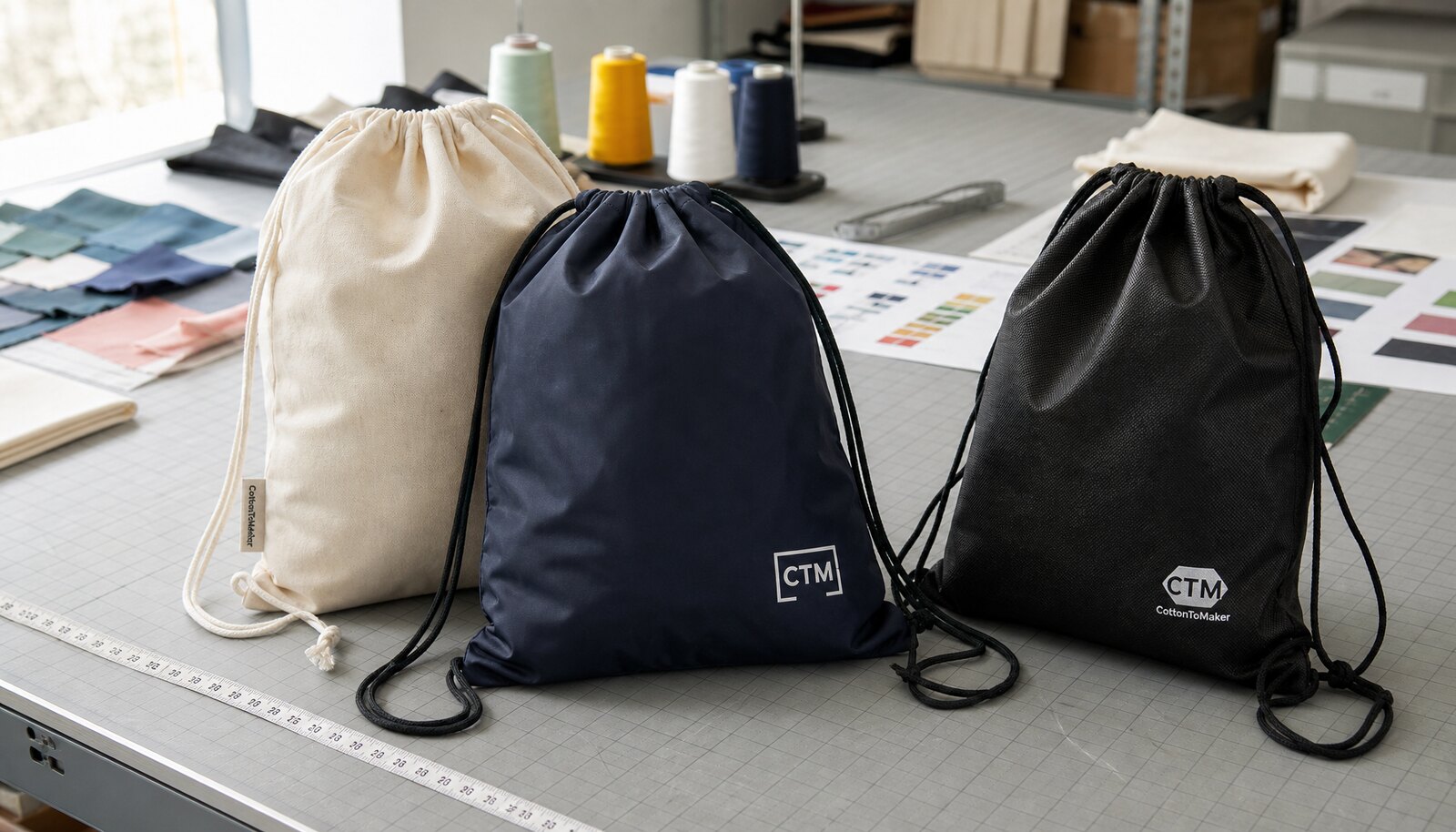
The Buying Problem: Print Method Changes Cost, MOQ, and Defect Risk
For drawstring backpacks, the logo is usually the part your customer notices first and the part that creates the most production arguments. Two quotes may both say "logo print included," but one factory may be quoting a one-color screen print on 210D polyester while another is using heat transfer film, sublimation panels, or a sewn woven label. Those are not equal offers.
A good RFQ for drawstring backpack print methods should connect the artwork, fabric, order quantity, packing, and lead time. If procurement only asks for "drawstring bag with logo," suppliers will fill the gaps in different ways, and the cheapest quote may not survive sampling.
- Screen print is usually efficient for simple spot-color logos and medium to large runs.
- Heat transfer works better for full-color graphics but needs checks for hand feel and edge durability.
- Sublimation is suitable for polyester all-over prints, usually on white or light base fabric.
- Embroidery or patches can lift perceived value but add sewing steps, MOQ, and inspection points.
- Woven side labels are useful for retail programs where subtle branding is preferred.
Start With Fabric: Print Performance Depends on the Backpack Material
The same artwork can behave very differently on non-woven PP, 210D polyester, Oxford fabric, cotton, or canvas. Before asking which print method is cheapest, buyers should confirm the fabric construction and weight. Fabric cost may be more important than print cost, but fabric also controls ink adhesion, color sharpness, and heat tolerance.
For promotional drawstring backpacks, common materials include 80 to 100 gsm non-woven PP, 190T polyester, 210D polyester, and 300D Oxford. For more durable retail or merchandise bags, buyers often use 5 oz cotton, 8 oz canvas, 10 oz canvas, or 12 oz canvas. Heavier fabric normally gives better body and longer use, but it can also increase sewing time, carton volume, and freight cost.
- 80 to 100 gsm non-woven PP: low-cost event bags; avoid oversized heavy ink areas that may distort the panel.
- 190T polyester: light and packable; better for simple prints than heavy-duty retail use.
- 210D polyester: common balance for promotional drawstring backpacks; suitable for screen print and heat transfer after testing.
- 300D Oxford: stronger hand feel; useful for sports or school programs, but coating must be checked for ink adhesion.
- 5 oz to 8 oz cotton: natural look; screen print works well when artwork is not too fine.
- 10 oz to 12 oz canvas: premium feel; print over texture needs a strike-off before mass approval.
Screen Printing: Best for Simple Logos and Controlled Bulk Cost
Screen printing is often the most practical option for drawstring backpacks with one to three solid logo colors. It is suitable for many polyester, cotton, canvas, and non-woven orders, provided the ink system matches the fabric. Buyers should not treat screen print as one universal process; ink type, mesh, curing, and coating compatibility matter.
Screen printing is usually quoted by logo size, number of colors, fabric type, and quantity. A large one-color front print may be cheaper than a small four-color print because every additional color needs setup, alignment, and production control. If the artwork has fine lines, small text, or tight registration, ask the supplier to confirm minimum line width before sampling.
- Use screen print for simple brand logos, event names, school emblems, or sponsor marks.
- State exact print size, such as 20 x 18 cm, instead of saying "front logo."
- Provide Pantone references for each spot color and approve on actual fabric.
- Avoid placing large ink blocks too close to the drawcord channel, bottom corner, or side seam.
- Ask whether the bag is printed before sewing or after sewing, because placement tolerance will differ.
Heat Transfer and Digital Transfer: Useful for Full-Color Artwork
Heat transfer is often selected when the artwork has gradients, photos, many colors, or short-run personalization. It can make the quote easier when the buyer does not want to pay for multiple screen setups. However, buyers need to check the transfer edge, hand feel, stretch behavior, and resistance to rubbing or peeling.
On drawstring backpacks, heat press temperature and pressure can affect coated polyester, non-woven fabric, eyelets, drawcords, and seam areas. The safest approach is to approve a transfer on the actual bulk fabric before the supplier cuts or sews the full order. If the backpack has a front pocket, zipper, mesh panel, or thick cord channel, confirm whether the logo can be pressed flat.
- Use heat transfer for multi-color logos, small MOQs, gradients, and photo-style artwork.
- Check whether the supplier uses cut transfer, digital transfer, or DTF-style transfer, because finish and durability differ.
- Ask for edge inspection after bending, rubbing, and light washing if the bag is expected to be reused.
- Avoid very large transfers on thin fabric if breathability, softness, or folding marks matter.
- Confirm whether heat marks are visible on dark polyester or coated Oxford fabric.
Sublimation, Embroidery, Patches, and Woven Labels: When to Upgrade
Sublimation is normally used for polyester drawstring backpacks when the buyer wants all-over artwork or full-panel graphics. The design is printed on fabric before cutting and sewing, so it is more of a fabric printing decision than a logo placement decision. It can look strong for sports, school, travel, and licensed artwork, but buyers must manage panel alignment and color matching carefully.
Embroidery, rubber patches, PU patches, and woven labels are better for programs that need a more durable or premium appearance. They are not always suitable for the lowest-cost giveaway bag because they add material, sewing labor, and sometimes mold or label MOQ. For retail buyers, however, a small woven side label can be cleaner than a large front print.
- Use sublimation for white polyester panels, all-over patterns, and full-color sports graphics.
- Use embroidery for small logos on heavier fabric, not for very thin non-woven panels.
- Use rubber or PU patches when a raised brand mark is required and the MOQ supports mold cost.
- Use woven side labels for subtle retail branding or private label programs.
- Check sewing reinforcement around patches so the front panel does not pucker.
MOQ Logic: The Cheapest Method Is Not Always the Lowest-Risk Method
MOQ for drawstring backpack print methods is not only about the final bag quantity. A supplier may have separate minimums for fabric dyeing, stock fabric color, printing setup, transfer film, woven labels, patches, rubber molds, and carton packing. Buyers should ask suppliers to break out these limits instead of accepting one vague MOQ number.
For example, a stock 210D polyester bag with one-color screen print may support a lower MOQ than a custom dyed fabric with sublimation panels. A woven label may have its own label MOQ even if the bag order is smaller. A rubber patch may be practical only when the same patch will be used across several production runs.
- Ask whether the quote uses stock fabric or custom dyed fabric.
- Separate bag MOQ from print MOQ and accessory MOQ.
- Confirm whether setup charges are one-time charges or repeated for every reorder.
- For repeat programs, ask if screens, molds, or label files can be kept for future orders.
- If several logo versions are needed, ask whether each version is treated as a separate MOQ.
Sample Approval: Do Not Approve Print From a Digital Mockup Only
Digital visuals are useful for layout discussion, but they do not show ink absorption, fabric texture, transfer edge, color shift, or placement tolerance. For production, buyers should approve a real print strike-off on actual fabric and then a pre-production sample with the final drawstring backpack construction.
The sample process should match the order risk. A one-color print on stock fabric may only need a print strike-off and one finished sample. A full-color sublimation backpack, retail patch program, or tight Pantone job should go through artwork proof, fabric swatch, print strike-off, pre-production sample, and sealed approval sample.
- Check logo size with a ruler on the finished backpack, not only on the artwork proof.
- Compare color under stable lighting and keep the approved sample signed or labeled.
- Pull the drawcords and fold the bag to see whether the print cracks or rubs.
- Inspect whether the logo is centered after sewing and corner reinforcement is added.
- Confirm sample packing if the order needs retail barcode labels or individual polybags.
Packing, Lead Time, and Quote Data Buyers Should Lock
Print method affects packing and lead time. Screen printed panels may need curing and drying space before sewing or packing. Heat transfer pieces need cooling time and inspection for lifting. Sublimation requires printed fabric panels before cutting. Patches and woven labels require accessory production before the sewing line can start.
A useful supplier quote should show more than unit price. Procurement teams should ask for construction specs, fabric weight, finished size, print method, logo size, color count, sample lead time, bulk lead time, packing details, carton size, gross weight, and estimated CBM. Without this data, two quotes cannot be compared on landed cost.
- State finished backpack size, such as 34 x 42 cm, and cord type, such as PP rope or cotton cord.
- Specify whether the bag has reinforced corners, metal eyelets, zipper pocket, mesh pocket, or lining.
- Ask for carton quantity, carton dimensions, gross weight, net weight, and CBM estimate.
- Confirm individual polybag, bulk pack, hangtag, barcode sticker, or retail display requirement.
- Ask for lead time by stage: artwork proof, sample, material preparation, printing, sewing, inspection, packing.
Specification comparison for buyers
| Spec decision | Recommended option | When it fits | Buyer risk to check |
|---|---|---|---|
| One-color logo on polyester drawstring backpack | Silk screen print with spot color ink | Promotional orders, school campaigns, event giveaways, simple brand marks under 25 x 25 cm | Ink adhesion on coated 210D polyester, registration on dark fabric, curing temperature marks |
| Full-color artwork or gradients | Heat transfer print or sublimation, depending on fabric | Retail graphics, sports clubs, lifestyle artwork, small batches with many colors | Transfer hand feel, edge outline, washing resistance, color shift after heat pressing |
| Logo on cotton or canvas backpack | Screen print or water-based print, tested on fabric GSM | Natural fabric programs, retail gift bags, branded merchandise with matte finish | Ink absorption on 6 oz to 12 oz canvas, uneven print over slubs, shrinkage after washing |
| Premium retail branding | Woven label, rubber patch, or embroidered patch sewn to front panel or side seam | Higher-value drawstring backpacks where logo durability matters more than lowest unit cost | Patch MOQ, sewing position tolerance, needle marks, added labor cost and longer sampling |
| Very light non-woven backpack | Screen print with controlled ink loading | Low-cost events, conferences, short-use promotions | Fabric distortion, ink bleed, weak seam strength if logo is too large or too close to edges |
| Large all-over design | Sublimation on white polyester before sewing | Sports drawstring backpacks, fashion graphics, repeated pattern programs | Panel cutting alignment, minimum fabric order, color matching between printed panels and cords |
Buyer checklist before sampling
- Confirm the backpack fabric before choosing the print method: 190T polyester, 210D polyester, 300D Oxford, non-woven PP, cotton, canvas, or recycled fabric.
- State fabric weight clearly, such as 80 gsm non-woven, 210D polyester, 5 oz cotton, 8 oz canvas, or 12 oz canvas, because ink behavior and cost change by material.
- Send editable artwork in AI, PDF, EPS, or high-resolution vector format, with Pantone references for spot colors and actual print size in centimeters.
- Lock logo position from finished bag edges, not only from the fabric panel, because seam allowance and drawcord channel can shift the visible area.
- Ask for a print strike-off on actual bulk fabric before approving the full pre-production sample.
- Check whether the quoted MOQ is based on bag sewing MOQ, fabric MOQ, print setup MOQ, or patch/label MOQ.
- Specify packing method: individual polybag, bulk carton packing, hangtag, insert card, barcode label, or retail-ready pack.
- Ask suppliers to separate tooling, screen, transfer film, patch mold, and sample charges from the unit price.
Factory quote questions to send
- Which print methods are available for my selected drawstring backpack fabric, and which one do you recommend for my artwork?
- What is the minimum order quantity for the bag style, the fabric color, and the chosen print method separately?
- Can you quote the same backpack with screen print, heat transfer, and woven label options so we can compare landed cost fairly?
- What is the maximum printable area on the front panel after allowing for seams, bottom corners, and drawcord channel?
- Will the logo be printed before sewing or after sewing, and how does that affect registration and lead time?
- What artwork format, Pantone information, and print size do you need before confirming price?
- Can you provide a print strike-off on actual bulk fabric before the pre-production sample?
- What tests do you normally run for ink adhesion, rubbing, washing, color fastness, and print alignment?
- How many days are needed for artwork approval, sample making, bulk printing, sewing, final inspection, and packing?
- Are screen charges, transfer plate charges, patch mold charges, woven label MOQ, and carton marking charges included or separate?
Quality-control points to confirm
- Compare production print color against approved Pantone or signed sample under consistent light, not only by phone photo.
- Check logo placement from finished bag edges on at least the first 20 pieces from bulk production.
- Run dry rub and wet rub checks on dark and light prints, especially on coated polyester and non-woven fabric.
- Inspect heat transfer edges for lifting, cracking, scorching, and uneven pressure marks.
- Check screen printed panels for pinholes, ink bleeding, missed areas, and poor curing before sewing continues.
- Confirm drawcord channel, corner reinforcement, eyelets, and stitching are not damaged by heat press or post-print handling.
- Open several packed cartons to confirm correct logo version, color, packing ratio, barcode label, and carton marks.
- Keep one approved pre-production sample and one bulk shipment sample for dispute reference.