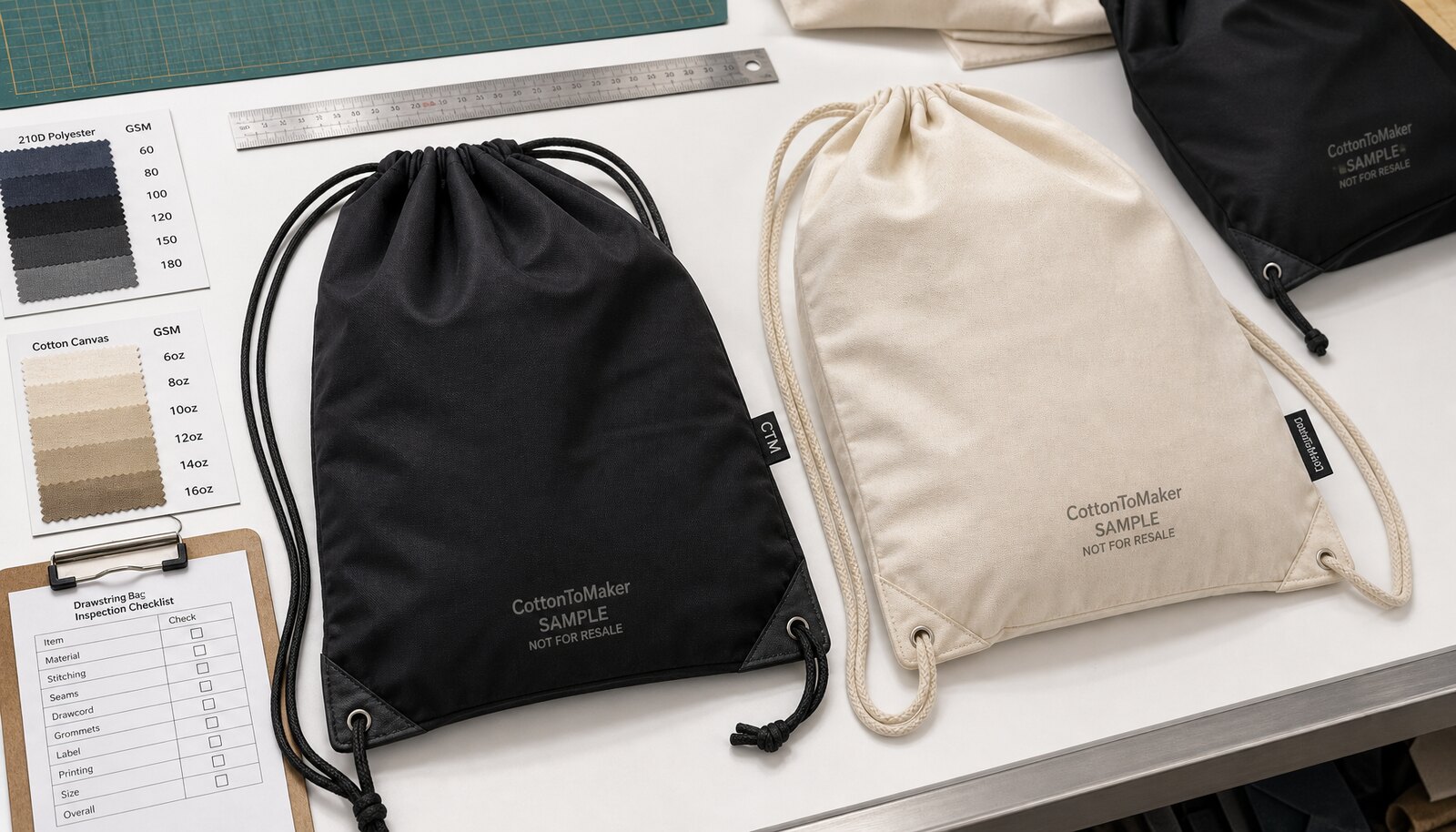
Why Pre-Shipment Inspection Matters for Drawstring Backpacks
Drawstring backpacks look simple, but bulk orders fail for practical reasons: thin fabric substituted for the quoted weight, poor cord exit reinforcement, logo misplacement, weak stitching, or cartons packed before ink is fully cured. By the time the goods arrive, a buyer may be dealing with event deadlines, retailer chargebacks, or distributor returns. A pre-shipment inspection gives you one last controlled moment to confirm the goods are saleable before balance payment and export.
For procurement teams, the goal is not to create a perfect laboratory report. The goal is to confirm that the bulk production matches the approved sample, the quote, and the real use case. A promotional 210D polyester bag for a one-day event does not need the same stress criteria as a cotton canvas drawstring backpack sold in retail. However, both need clear acceptance points before cartons leave the factory.
- Use the approved pre-production sample as the inspection reference, not only a photo or PDF artwork.
- Define important defects before production starts, especially print position, fabric weight, reinforcement, and packing.
- Inspect after at least 80 percent of goods are packed, but before the full shipment is sealed and loaded.
- Make sure the inspection covers different production batches, not only cartons selected by the packing team.
Set the Inspection Standard Before You Place the Order
Many inspection disputes start because the purchase order says only “drawstring backpack with logo.” That is not enough. A useful order sheet should name the fabric, finished size, drawcord type, reinforcement method, print process, packing method, carton data, and approved sample reference. If those details are missing, the factory may pass its own internal standard while the buyer considers the goods unacceptable.
For larger orders, buyers often use AQL sampling. The actual AQL level depends on your company policy and sales channel, but the important point is to classify defects clearly. A wrong logo, unsafe sharp metal eyelet, mold, severe color mismatch, or incorrect SKU packing is more serious than a few trimmed thread ends. If you do not define this hierarchy, the inspection result becomes a negotiation instead of a quality decision.
- Critical defects: safety risk, mold, wrong product, wrong logo, illegal labeling, or contamination.
- Major defects: weak seams, incorrect fabric, obvious print failure, wrong dimensions, missing reinforcement, or wrong packing count.
- Minor defects: small thread ends, slight acceptable shade variation, or small cosmetic marks within agreed limits.
- Reference documents: signed sample, artwork file, Pantone or color standard, purchase order, packing instruction, and carton mark layout.
Fabric Checks: GSM, Denier, Coating, and Hand Feel
Fabric is one of the easiest areas for quote gaps. One supplier may quote 190T polyester, another may quote 210D polyester, and another may quote 300D polyester, all described casually as “polyester drawstring backpack.” The cost, strength, hand feel, and print result are not the same. For cotton or canvas bags, the difference between 5 oz, 8 oz, and 10 oz fabric changes both perceived value and carton weight.
During pre-shipment inspection, the inspector should compare fabric against the signed sample and order sheet. A factory may not always cut a GSM test from finished goods, but the buyer can still require fabric swatch records, roll labels, and physical comparison. For high-volume or retail orders, ask for fabric weight tolerance in the contract. Without tolerance, a supplier can argue that a lighter fabric is still commercially acceptable.
- Light promotion: 190T polyester or lighter 210D polyester can work, but check tearing at cord corners.
- Standard promo and school use: 210D or 300D polyester gives better body and better perceived value.
- Heavy-duty or retail: 600D polyester, 8-10 oz cotton canvas, or blended canvas should be inspected for bulk and seam strength.
- Coating: PU or PVC backing can improve body but may affect print adhesion and odor if poorly controlled.
- Color: check under consistent lighting and compare to approved sample, especially for navy, black, red, and natural cotton.
Size, Construction, and Drawcord Usability
Finished size should be measured on sewn bags, not only cut panels. A bag quoted as 34 x 42 cm can become smaller if seam allowance is increased, fabric shrinks during processing, or the top channel is folded deeper than planned. For retail buyers, usable internal space matters because the product must hold shoes, gym clothing, documents, or promotional kits as advertised.
The drawcord system is the core function of this product. Inspect cord length, cord thickness, exit position, knot security, and whether the bag opens and closes smoothly. If the cord is too thin, it may cut into the user’s shoulder or slip through the eyelet. If it is too thick, the top channel may bunch badly and make packing uneven.
- Measure width and height on at least several pieces from different cartons.
- Check top channel width and stitching line consistency so the cord pulls smoothly.
- Pull both cords with moderate force to see whether the corner stitching opens.
- Check whether left and right cord lengths are balanced when the bag is closed.
- Confirm the selected cord material: polyester, nylon, cotton, or PP, and whether the color matches the approved sample.
Print Inspection by Method: Screen Print, Heat Transfer, Sublimation
Logo problems are the fastest way for a bulk drawstring backpack order to become unsellable. The inspection should check print position, print size, color, registration, surface cleanliness, and durability. A logo that is 15 mm too low may still be usable for a giveaway, but the same error can be rejected by a retail brand with packaging photography and planogram requirements.
The correct inspection method depends on the printing process. Screen print is common for solid logos and cost control, but ink thickness and curing must be checked. Heat transfer handles detailed artwork but can peel if pressure, temperature, or adhesive film is wrong. Sublimation is suitable for polyester and all-over designs, but not for cotton canvas. If the RFQ does not name the print method, quote comparison will be unreliable.
- Screen print: check ink coverage, pinholes, registration between colors, curing, cracking, and hand feel.
- Heat transfer: check edge lifting, film marks, color density, transfer position, and peeling after rub or flex.
- Sublimation: check fabric compatibility, color accuracy, ghosting, and panel alignment before sewing.
- Cotton canvas print: check ink absorption, rough fabric texture, and whether fine artwork loses detail.
- Dark fabric print: confirm whether an underbase layer was included in the quote to avoid dull logo color.
Reinforcement and Stitching: Where Failures Usually Start
Drawstring backpacks usually fail at stress points, not in the middle of the fabric panel. The bottom corners, cord exits, side seams, and top channel carry most of the load. Low-cost bags may use only a folded seam and cord knot, while better constructions may use fabric triangles, PU patches, metal eyelets, or bar tacks. The right choice depends on expected load, target price, and market positioning.
Inspection should include both visual checks and practical pull checks. The buyer does not need to destroy many samples, but several pieces should be opened, pulled, and examined. If the stitching starts to separate under light manual force, the shipment should not be approved without rework. Also check whether reinforcement material is compatible with the main fabric; a stiff patch on thin polyester can tear the surrounding fabric if the stitching is too close to the edge.
- Stitch density should be consistent and suitable for the fabric, without long skipped areas.
- Backstitching or bar tacking should appear at stress points, not only decorative seams.
- Eyelets should be fixed cleanly with no sharp edges, rust marks, or fabric cracking.
- PU patches should not peel, crack, or be stitched too close to their edge.
- Loose threads should be trimmed, but do not treat trimming as a substitute for weak seam correction.
Sample Checks Before Bulk Inspection
A pre-shipment inspection is much easier when the sample process was controlled. The buyer should approve a production-ready sample, not only a showroom sample. A showroom sample may use available fabric, a temporary logo, or hand-finished details that are not realistic for bulk production. A production-ready sample should use the quoted fabric, final print method, final drawcord, final reinforcement, and final packing if possible.
For repeat orders, keep the previous approved sample but do not assume the new batch will automatically match. Fabric dye lots, cord suppliers, ink batches, and sewing operators can change. If the new order has a different logo size, fabric color, or packing method, treat it as a new inspection risk. Good factories keep a signed sample at the sewing line and another at the QC table so operators can compare real goods during production.
- Pre-production sample: approve before bulk cutting and printing.
- Print strike-off: approve logo color, size, and position before mass printing.
- Packing sample: approve polybag, insert card, barcode, carton mark, and folding method.
- Golden sample: sign and date one physical sample for final inspection reference.
- Change record: document any approved deviation from the original RFQ before production continues.
Packing Inspection: Cartons, Polybags, Labels, and Moisture
Packing mistakes are expensive because they are often discovered at the warehouse, not at the factory. A correct bag packed under the wrong SKU, wrong barcode, wrong carton mark, or wrong quantity can delay distribution and create chargebacks. For event orders, a carton count mistake may mean one location receives too few bags while another receives excess stock.
Drawstring backpacks are often folded tightly, so print curing and surface protection matter. If screen printed bags are packed too soon, ink can block, stick, or transfer onto the next bag. Natural cotton and jute blend styles need moisture control because they can absorb humidity during storage and sea shipment. Carton strength should match carton weight, and cartons should not bulge badly after packing.
- Confirm pieces per inner pack and master carton match the purchase order.
- Check whether individual polybags are required for retail, e-commerce, or clean warehouse handling.
- Verify suffocation warning text where required by the buyer’s market and bag size.
- Confirm barcode readability and SKU separation before cartons are sealed.
- Check carton dimensions and gross weight because they affect freight quote accuracy.
- Use carton liners or moisture protection when fabric and route conditions require it.
Lead Time and MOQ Risks That Affect Inspection Results
Quality problems often trace back to unrealistic lead time or unclear MOQ logic. If a buyer asks for custom fabric color, custom cord color, several print colors, individual barcoded polybags, and a tight delivery window, the factory may compress sampling, curing, sewing, or internal QC time. The pre-shipment inspection then catches problems that could have been prevented earlier.
MOQ should be separated by component. A supplier may accept a low order quantity for finished bags but require higher MOQ for dyed fabric, custom drawcord, special eyelets, or printed packaging. If the factory uses stock fabric to meet a low MOQ, the buyer must accept the available color and weight range. If the buyer requires exact brand color, the lead time and minimum quantity may change.
- Ask whether the quoted MOQ is for finished bags only or includes custom fabric and accessories.
- Confirm fabric availability before approving delivery dates.
- Allow time for print strike-off approval, especially for multi-color logos or heat transfers.
- Include curing and drying time in the schedule, not only sewing capacity.
- Schedule inspection before the cargo closing date so failed goods can be reworked.
Quote Data to Confirm Before You Approve Shipment
Pre-shipment inspection is not only a visual quality check. It is also the final chance to confirm that the supplier delivered what was quoted. If three suppliers quoted different fabrics, print methods, packing counts, and reinforcement methods, the lowest unit price may not represent the same product. Buyers should bring quote data into the inspection checklist so the inspector can verify the commercial assumptions.
A complete quote for drawstring backpacks should include material specification, size, print method, number of print colors, logo size, reinforcement, drawcord type, packing, carton data, sample cost if any, production lead time, payment terms, and validity. If any of these items are missing, inspection will be less effective because the buyer cannot prove whether the bulk goods are wrong or merely unspecified.
- Fabric: material, denier or GSM, color, coating, and tolerance.
- Size: finished size, seam allowance expectation, and measurement tolerance.
- Logo: method, artwork size, color standard, print position, and setup charge if applicable.
- Accessories: drawcord type, cord diameter, eyelet or patch material, and label details.
- Packing: polybag style, carton quantity, carton size, gross weight, and carton marks.
- Timeline: sample approval date, bulk start date, inspection date, and shipment readiness date.
Specification comparison for buyers
| Spec decision | Recommended option | When it fits | Buyer risk to check |
|---|---|---|---|
| Fabric for low-cost promotion | 190T polyester or 210D polyester, usually around 55-80 GSM depending on construction | Short-term event giveaways, school campaigns, lightweight retail add-ons | Fabric may feel thin, print may show weave texture, corner tearing risk if reinforcement is weak |
| Fabric for reusable retail bag | 300D polyester, 600D polyester, or 8-10 oz cotton canvas | Sports clubs, merchandise programs, youth retail, recurring distributor stock | Higher fabric weight changes carton volume, lead time, and drawcord compatibility |
| Print method for simple logo | Screen print with confirmed ink type and curing method | One to three solid colors, medium to large front logo, stable repeat orders | Ink cracking, poor registration, color shift on colored fabric, insufficient curing before packing |
| Print method for full-color artwork | Heat transfer or sublimation depending on fabric and artwork coverage | Gradient graphics, photo-style logos, complex sponsor artwork | Transfer edge marks, peeling after rubbing, sublimation only suitable for compatible polyester |
| Drawcord construction | Round polyester cord or flat cotton cord matched to fabric and target market | Round cord for sports/promo bags, cotton cord for natural cotton canvas positioning | Cord diameter too thin, uneven length, loose knotting, color bleeding during damp rub test |
| Corner reinforcement | PU leather patch, fabric triangle, metal eyelet, or bar-tacked corner based on load requirement | Orders expected to carry shoes, sportswear, catalogs, or retail purchases | Eyelet rust, patch cracking, weak seam allowance, cord cutting through fabric |
| Packing method | Individual polybag or bulk pack with carton liner, based on retail channel and compliance needs | Individual polybag for retail or e-commerce, bulk pack for event distribution | Wrong barcode placement, excessive carton weight, moisture risk, crushed print from packing too early |
Buyer checklist before sampling
- Confirm the inspection sample matches the approved pre-production sample, not only the digital artwork.
- Check fabric type, GSM or denier, color, hand feel, and coating against the final order specification.
- Measure finished bag size, drawcord length, seam allowance, and corner reinforcement position on multiple pieces.
- Inspect print color, logo position, registration, ink curing, transfer adhesion, and rubbing resistance before carton sealing.
- Open cartons from different production times, not only the top cartons prepared by the factory.
- Check stitch density, skipped stitches, loose threads, backstitching, and stress points around cord exits and bottom corners.
- Verify packing count, carton marks, polybag warning text if required, barcodes, carton size, gross weight, and carton strength.
- Record any deviation with photos, measured values, defect quantity, and the factory’s proposed corrective action before approving shipment.
- Do not release final balance payment until inspection result, packing list, and shipment documents are aligned.
Factory quote questions to send
- Which exact fabric are you quoting: material, denier or GSM, yarn count if cotton, coating, and finished fabric weight tolerance?
- Will the bulk order follow our approved sample, and can you keep one signed golden sample in the production line for inspection reference?
- Which print method is included in the quote, and what are the limits for logo size, number of colors, curing, and artwork setup?
- What reinforcement is included at the drawcord exit and bottom corner: eyelet, patch, bar tack, folded seam, or another construction?
- What MOQ applies to the fabric color, drawcord color, print method, and packing style separately?
- What is the estimated production lead time after artwork approval, deposit, fabric availability confirmation, and sample approval?
- What is the standard packing method, pieces per carton, carton size, carton gross weight, and whether individual polybags are included?
- What inspection standard do you accept before shipment, and can you rework or replace defective goods if the result fails the agreed criteria?
- Can you provide production photos during cutting, printing, sewing, and packing so inspection can focus on real risk areas?
Quality-control points to confirm
- Fabric weight and construction must match the order sheet within agreed tolerance, especially when comparing quotes from different suppliers.
- Finished size should be measured after sewing and drawcord insertion, because fabric folding and seam allowance can reduce usable space.
- Print adhesion should be checked by rub, tape pull, and light stretch tests where suitable for the fabric and print method.
- Drawcord length, cord thickness, knot security, and cord colorfastness should be checked because they directly affect usability and complaint rate.
- Corner reinforcement must be strong enough for the expected load, with no sharp eyelet edges, cracked patches, or loose bar tacks.
- Packing should protect print surfaces from sticking, transfer marks, moisture, and carton compression during sea or air shipment.
- Carton marks, quantities, SKU separation, and barcode labels must match the purchase order and final packing list.
- Inspection results should separate critical, major, and minor defects instead of treating all cosmetic issues the same.