Why MOQ Changes the Real Price of Drawstring Backpacks
The buying problem is not only finding a low unit price. For drawstring backpacks, MOQ controls fabric buying, cutting efficiency, print setup, labor planning, packing labor, and how much risk the factory accepts. A quote for 500 pieces and a quote for 5,000 pieces may look like the same product, but the factory is not costing them the same way. At low quantity, setup time and material waste carry more weight than sewing time.
Procurement teams often compare quotes too early, before the MOQ logic is clear. One supplier may quote from stock 210D polyester and include only a one-color print. Another may quote custom dyed cotton canvas with reinforced corners and individual barcode labels. The cheaper quote is not always wrong, but it may be based on a different buying assumption. Your RFQ should force each supplier to show what the MOQ includes and what changes when quantity, color split, or print version changes.
- Ask for MOQ per fabric color, not only per total order.
- Ask if the price changes when the same total quantity is split across two or more logos.
- Ask whether print setup cost is included or shown as a separate one-time charge.
- Ask if packing labor changes for retail labeling, store sorting, or individual polybags.
- Compare quotes using the same finished size, fabric, print area, cord type, and packing method.
Start with the Use Case Before You Ask for Price
A drawstring backpack used for a one-day event should not be specified like a retail merchandise bag. The load, expected lifetime, brand position, and distribution channel decide the correct fabric, stitching, and reinforcement. If the use case is not stated, factories will usually quote the lowest safe-looking option, because that makes the first price attractive. Later, when you add heavier fabric, better cord, or stronger bottom corners, the quote changes and sourcing time is lost.
A practical RFQ should describe what the bag will carry and how it will be distributed. A school promotion may need to hold notebooks and a water bottle. A sports event bag may need to carry shoes or damp clothing. A cosmetic gift set may only need to hold lightweight retail products but must look clean in photos. These differences affect fabric weight, seam allowance, print placement, and packing protection.
- For low-cost mass giveaways, 190T or 210D polyester is common, but confirm seam strength and coating quality.
- For sports or active use, consider 420D polyester, 600D polyester, or reinforced lower corners.
- For premium brand merchandise, 8 oz, 10 oz, or 12 oz cotton canvas gives better hand feel but changes print absorption.
- For eco-positioned promotions, cotton, recycled cotton, RPET polyester, or jute-blend designs may require higher MOQ.
- For retail sale, include hangtag, barcode, carton allocation, and stricter cosmetic inspection in the RFQ.
Fabric Weight and Material Choices That Affect MOQ
Fabric is usually the biggest specification driver. Polyester drawstring backpacks are often quoted by denier, such as 190T, 210D, 420D, or 600D. Cotton and canvas are often quoted by oz or GSM, such as 6 oz, 8 oz, 10 oz, 12 oz, or roughly 200 to 400 GSM depending on construction. Nonwoven bags are normally quoted by GSM, such as 80 GSM, 100 GSM, or 120 GSM. The unit price cannot be judged correctly unless the weight and construction are visible in the quote.
MOQ changes because stock fabric and custom fabric are not the same supply situation. A factory may accept a smaller order when using stock black, white, navy, or natural cotton fabric. If you request a special Pantone fabric color, water-resistant coating, recycled yarn, or custom width, the material mill MOQ may become the real minimum order. This is why some suppliers say yes to 1,000 pieces in black but require 3,000 or 5,000 pieces for a custom color.
- Use denier for polyester: 210D is common for promotions, while 420D or 600D is stronger and bulkier.
- Use oz or GSM for cotton canvas: heavier fabric improves structure but increases sewing and freight cost.
- Ask whether the fabric is stock, made-to-order, dyed-to-order, or coated-to-order.
- Confirm color tolerance, especially for natural cotton, dyed cotton, and recycled fabric lots.
- Ask if fabric weight tolerance is included, for example a normal mill tolerance rather than an exact fixed weight.
Print Method Decisions Before Comparing Quotes
Printing is where many drawstring backpack quotes stop being comparable. A one-color screen print on cotton canvas is very different from a full-color heat transfer on coated polyester. Screen printing is efficient for solid logos and larger runs, but setup cost must be allocated across quantity. Heat transfer can support more complex artwork but may add film, transfer paper, or labor cost. Sublimation works only on suitable polyester and usually requires white or light base fabric for accurate color.
The buyer should provide artwork size, color count, position, and file type before asking for a final price. A logo printed 120 mm wide on the lower corner is not costed like a 280 mm front-panel design. A print close to the cord channel or bottom seam also needs more attention during sewing and printing. For cotton canvas, ink absorption and fabric texture affect sharpness. For coated polyester, ink adhesion and rubbing resistance are more important.
- For simple one-color logos, ask for screen print cost with setup shown separately.
- For gradients or photographic graphics, ask if heat transfer or digital print is more stable on the chosen fabric.
- For all-over polyester artwork, ask whether sublimation is possible and whether seams will interrupt the design.
- For dark cotton fabric, ask whether an underbase print is required and whether that changes hand feel.
- For retail orders, approve a physical print sample, not only a digital layout.
How to Read MOQ Price Breaks Without Being Misled
Price breaks should be requested in a controlled way. If you ask suppliers for their best price without defining quantity brackets, each supplier may quote a different level and make comparison difficult. A clean request uses the same specification and asks for prices at practical quantities, such as 500, 1,000, 3,000, 5,000, and 10,000 pieces. The exact brackets should match your buying pattern, but they must be consistent across suppliers.
When reviewing price breaks, look for the reason behind each drop. A small decrease may reflect better cutting efficiency. A bigger drop may happen when print setup is absorbed, fabric purchasing reaches a better tier, or packing labor becomes more efficient. If a quote drops sharply at a certain quantity, ask what changes. Sometimes the lower price assumes simplified packing, thinner fabric, stock color only, or a different print method.
- Request price breaks using one fixed specification, not several changing options.
- Ask suppliers to state if the MOQ is flexible for repeat orders or only for first production.
- Separate one-time setup charges from recurring unit cost so reorders are easier to compare.
- Check whether mixed colors can share one price break or must each meet MOQ.
- Confirm whether rejected pieces, production waste, or overrun quantity are included in the final shipment policy.
Sample Approval Should Match the Bulk Specification
A blank sample is useful for checking size, shape, and basic sewing quality, but it is not enough for a custom printed drawstring backpack order. A logo sample shows print scale and placement, but it may still use substitute fabric or stock cord. The strongest approval sample is a pre-production sample made with the planned bulk fabric, cord, print method, label, and packing. This sample becomes the reference for production and inspection.
Sampling cost should not be judged only by whether it is free. A free sample that does not match bulk materials may create false confidence. For procurement, the important question is what the sample proves. Before approving, measure the bag, pull the cords, inspect the print under light, compare fabric hand feel, and pack the sample the same way the final goods will be packed. If the bag will carry weight, test it with a realistic load.
- Check finished size after sewing, not just cut panel size.
- Measure print position from fixed edges: top seam, side seam, or bottom corner.
- Pull both cords several times to check channel smoothness and cord length balance.
- Rub the printed logo with a dry white cloth to detect weak adhesion or color transfer.
- Confirm side label, woven label, hangtag, barcode, and polybag details before bulk packing starts.
Packing Choices That Quietly Change MOQ and Cost
Packing is often treated as an afterthought, but for distributors and retail buyers it can change labor time and carton planning. Bulk packing in master cartons is faster and cheaper. Individual polybags, warning text, barcode stickers, retail sleeves, hangtags, and destination sorting all add handling. If these details are added after the first quote, the factory must revise price and lead time.
The packing requirement also affects inspection and receiving. A warehouse receiving 5,000 pieces needs correct carton marks, carton count, gross weight, and destination labels. A retailer may need individual barcodes facing outward. An ecommerce seller may need clean individual packing with scannable labels. These requirements should be priced at RFQ stage, not negotiated after production is finished.
- State whether bags are bulk packed, individually polybagged, or packed with retail inserts.
- Confirm pieces per inner bundle and pieces per export carton.
- Request carton dimensions and gross weight for freight planning.
- Provide barcode artwork and carton mark requirements before sample approval.
- Ask whether cartons are single SKU only or mixed by color, size, or destination.
Lead Time: Break It Into Real Production Steps
A single lead time number is not enough for procurement planning. Drawstring backpack production includes material confirmation, sample making, sample approval, fabric purchasing, cutting, printing, sewing, trimming, packing, inspection, and export handover. If a supplier says production takes 20 days, ask when that clock starts. Many disputes happen because the buyer counts from PO date while the factory counts from sample approval and deposit receipt.
Lead time also changes with MOQ. A small stock-fabric order may move quickly after artwork approval. A large order with custom dyed fabric, multiple print versions, and retail packing will need more coordination. If the order supports a campaign launch or retail delivery window, build a timeline that includes approval delays, possible resampling, inspection booking, and freight cutoff dates.
- Ask for sample lead time separately from bulk production lead time.
- Ask whether fabric is already available or must be purchased after deposit.
- Confirm printing schedule, especially if the factory uses an outside print workshop.
- Reserve time for first-article approval before the full production run continues.
- Include final inspection and carton correction time before vessel or courier handover.
Quote Data You Need in a Comparable Supplier Sheet
A good supplier quote should be more than a unit price. It should show what is included, what is excluded, and which assumptions drive the price. For drawstring backpacks, this means fabric specification, size, print method, print area, accessories, packing, MOQ, price breaks, sample cost, lead time, payment term, and trade term. Without these fields, procurement teams may select the wrong supplier because the cheapest line does not include the same work.
Build your comparison sheet so hidden charges become visible. For example, one quote may include individual polybags and carton marks while another includes only bulk packing. One may include print setup while another adds it later. One may quote FOB while another quotes EXW. The goal is not to force every supplier into the same pricing style, but to normalize the commercial data before making a decision.
- Record trade term clearly: EXW, FOB, CIF, DAP, or another agreed term.
- Separate unit price, print setup, sample cost, packing cost, and tooling cost.
- List MOQ by total order, color, logo, and packing version.
- Record carton quantity, carton size, gross weight, and estimated CBM.
- Add notes for supplier assumptions, such as stock fabric only or price valid for 15 days.
Common Production Mistakes and How to Prevent Them
Most drawstring backpack problems are preventable if the RFQ and approval process are specific. Common mistakes include fabric that feels thinner than expected, print placed too low, cord too short, bottom corners tearing, carton counts not matching the packing list, and logo color looking different on cotton versus polyester. These issues are not always caused by bad intent. Often they come from incomplete specifications or approval based only on a visual mockup.
Set acceptance criteria before production starts. Tell the factory what tolerance is acceptable for size, print placement, shade, and stitching. Request first finished piece photos from the production line before the full batch is completed. If the order is high value or time sensitive, arrange inspection before shipment. The cost of clarifying these points is lower than the cost of sorting unusable bags at destination.
- Do not approve print placement without dimensions from fixed edges.
- Do not switch fabric weight after sample approval without a revised sample or written acceptance.
- Do not assume the same logo ink looks identical on cotton, polyester, and nonwoven fabric.
- Do not leave cord thickness, cord color, eyelets, and reinforcement as factory choice if durability matters.
- Do not approve shipment until carton count, packing method, and SKU labeling match the purchase order.
Specification comparison for buyers
| Spec decision | Recommended option | When it fits | Buyer risk to check |
|---|---|---|---|
| Fabric for low-cost event giveaway | 210D polyester or 190T polyester, simple single-panel body | Short-term promotion, mass distribution, low unit value | Confirm denier, coating feel, seam strength, and whether quoted MOQ assumes stock fabric colors |
| Fabric for retail or brand merchandise | 8 oz to 12 oz cotton canvas or recycled cotton blend | Higher perceived value, lifestyle brand use, gift-with-purchase packs | Check shrinkage, fabric weight tolerance, color lot variation, and whether washing is required before cutting |
| Print for one-color logo | Screen print with matched Pantone ink | Most bulk orders above MOQ with solid logo areas | Ask whether setup charge is included, maximum print size, and whether ink is suitable for coated polyester or absorbent cotton |
| Print for photo or gradient artwork | Heat transfer, sublimation on polyester, or digital print depending on fabric | Complex artwork, small logo runs, multiple colors | Check hand feel, wash/rub resistance, edge cracking, and sample approval under actual fabric |
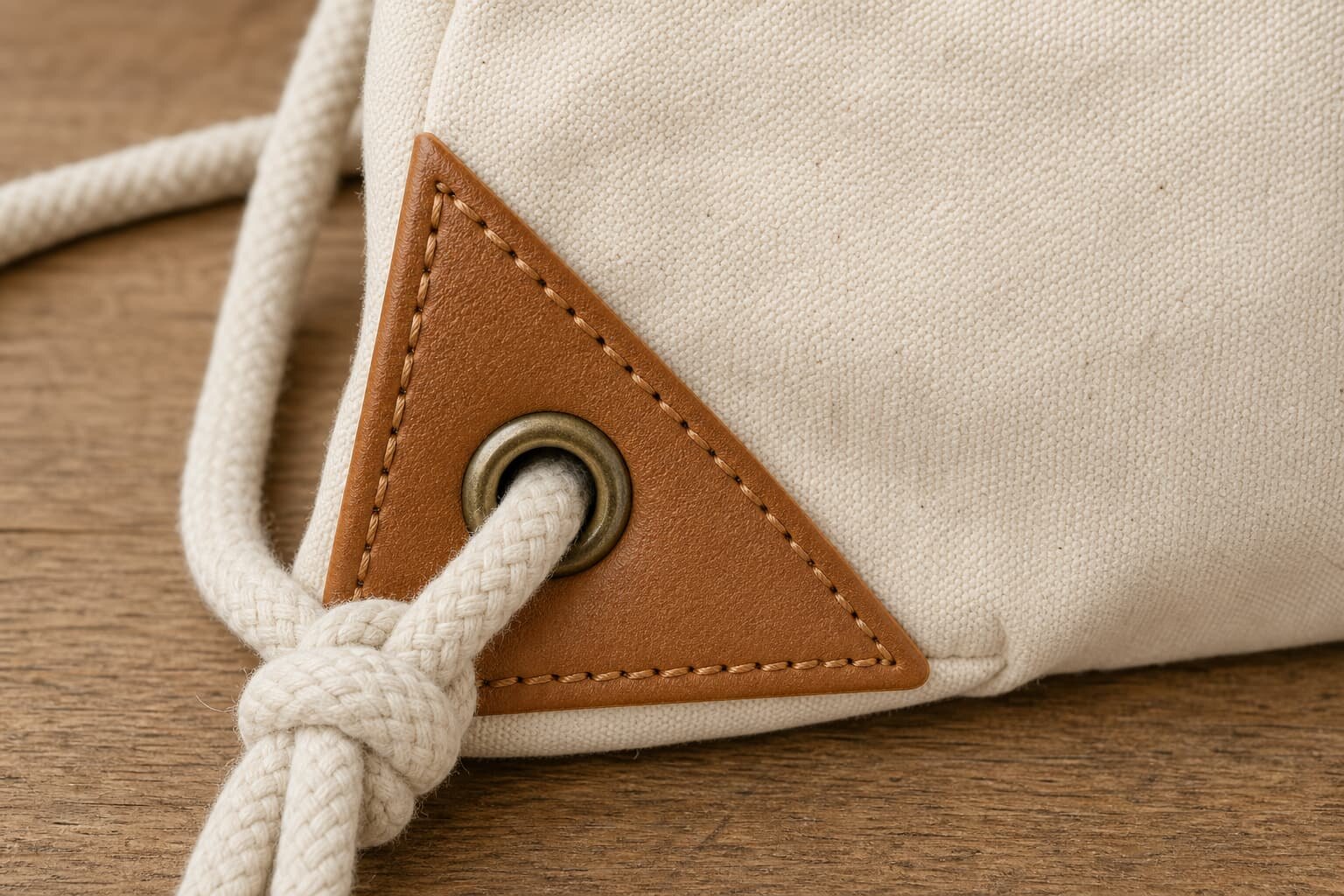
| Cord and reinforcement | Polyester drawcord with reinforced bottom eyelets or bar-tacked channels | Backpacks carrying shoes, brochures, sportswear, or retail items | Cheap quotes may omit reinforcement or use thin cord that cuts through fabric under load |
| MOQ structure | Separate MOQ by fabric, color, print method, and packing style | Multi-SKU orders, assorted colors, distributor programs | A low headline MOQ may become expensive when split across colors, logos, or carton labels |
| Packing for retail or distributor resale | Individual polybag or kraft sleeve with carton mark and inner count control | Ecommerce, retail allocation, or warehouse receiving | Confirm bag warning text, barcode placement, carton dimensions, and whether repacking is priced |
| Sampling before bulk | Pre-production sample using bulk fabric, cord, print, and packing | Any custom fabric color, new logo position, or first-time supplier | Do not approve only a digital mockup; check size, sewing, print placement, drawcord length, and load feel |
Buyer checklist before sampling
- Define the intended use: giveaway, school kit, sports bag, retail merchandise, or packaging bag for another product.
- Specify finished size in width x height, plus acceptable tolerance, instead of asking for a generic adult drawstring backpack.
- Confirm fabric type and weight: 190T, 210D, 420D, 600D polyester, nonwoven GSM, or cotton canvas oz/GSM.
- State whether the color is stock fabric, custom dyed fabric, or Pantone matched print only.
- List artwork size, print location, print method preference, number of colors, and whether the logo crosses seams or folds.
- Ask if the MOQ is per order, per fabric color, per logo, per print method, or per packing version.
- Request itemized pricing for bag body, printing, accessories, packing, sampling, tooling, and export carton.
- Confirm sample type: blank stock sample, logo sample, or full pre-production sample using final materials.
- Ask for lead time split into material sourcing, sampling, bulk production, packing, inspection, and export handover.
- Include packing requirements: individual polybag, master carton quantity, carton marks, barcode label, silica gel, or retail insert.
Factory quote questions to send
- What is your MOQ for this drawstring backpack by fabric type, fabric color, logo version, and packing method?
- Is the quoted fabric from stock inventory or will it be woven, dyed, or coated for this order?
- What fabric weight or denier is included in the quoted price, and what is the normal production tolerance?
- Which print method are you quoting, and does the price include screen setup, film, plate, or transfer mold charges?
- What is the maximum stable print size on this fabric without distortion, cracking, bleeding, or excessive hand feel?
- Can you quote price breaks at 500, 1,000, 3,000, 5,000, and 10,000 pieces with the same specification?
- Are drawcords, eyelets, reinforced corners, side labels, hangtags, and barcode stickers included or charged separately?
- What sample cost and sample lead time apply for a logo sample and for a full pre-production sample?
- What is the bulk production lead time after sample approval and deposit, excluding ocean or air freight?
- What packing configuration is included: pieces per polybag, pieces per carton, carton size, gross weight, and carton markings?
Quality-control points to confirm
- Measure finished width, height, channel width, and drawcord length against approved sample and tolerance.
- Check fabric weight or denier, coating feel, shade consistency, and visible defects before cutting begins.
- Confirm logo position from top edge and side seam, not only by visual center.
- Perform dry rub and light scratch checks on printed areas, especially on coated polyester and dark cotton canvas.
- Inspect bottom corner reinforcement, eyelet setting, bar tacks, and cord channel stitching under pulling force.
- Open and close the drawcord several times to check friction, cord length balance, and fabric puckering.
- Review loose threads, skipped stitches, needle holes, dirty marks, and uneven seams on front-facing panels.
- Verify individual packing, warning labels, carton count, carton marks, barcode labels, and destination sorting.
- Compare bulk pieces to the approved pre-production sample under neutral lighting before shipment release.