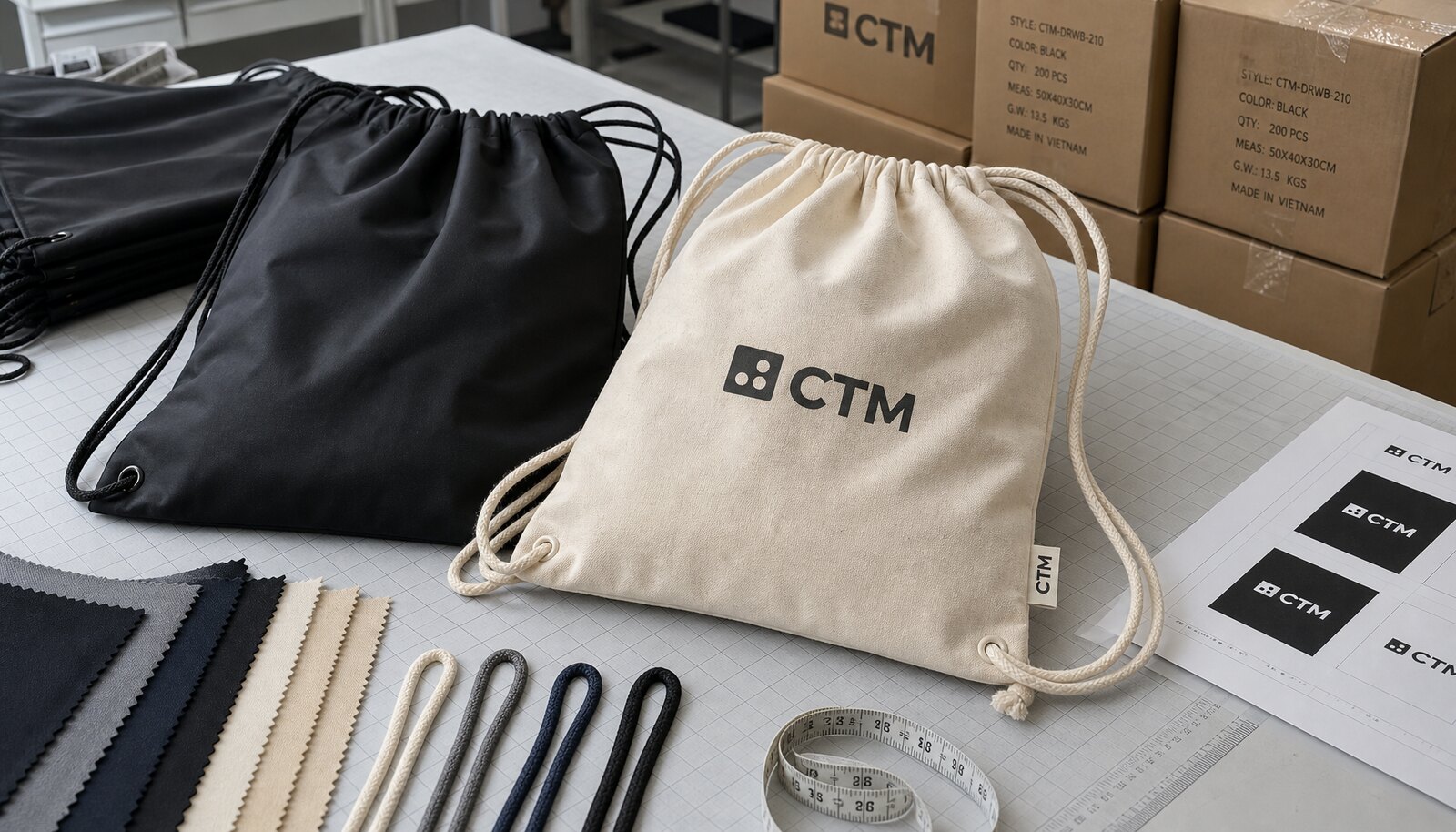
Why MOQ Planning Matters Before You Send the RFQ
For drawstring backpacks, MOQ is not just a sales number. It is usually the result of fabric roll quantity, color availability, print setup, cutting loss, accessory sourcing, and packing labor. If a buyer sends only a total quantity and a logo, factories may quote different assumptions. One supplier may quote 210D polyester from stock, another may quote 300D polyester, and another may include individual barcode packing. The unit prices will not be comparable even if the item name looks the same.
Good MOQ planning helps procurement teams decide which specifications are fixed and which can move. If the campaign requires a strict Pantone body color, the MOQ may be driven by fabric dyeing. If the order is for a short event giveaway, stock fabric and standard cord can reduce risk. If the product goes to retail shelves, the MOQ discussion should include packing, barcode labels, and carton data from the beginning, not after price approval.
- Separate total order quantity from quantity per color and per design.
- Ask the factory to explain the MOQ driver instead of accepting a single number.
- Do not compare prices until fabric, print, packing, and incoterm are aligned.
- Use price breaks to see where production becomes efficient instead of pushing only for the lowest MOQ.
Start With Use Case, Not Only Target Price
A drawstring backpack for a marathon sponsor, a school program, a sports club shop, and a retail gift set may all look similar in photos. In production, they need different fabric strength, print durability, packing control, and inspection points. The use case should be the first line in the RFQ because it tells the factory how much stress the bag will face and how much finish quality the buyer expects.
For a short-use event bag, a basic 210D polyester body may be commercially acceptable if the logo is simple and the load is light. For merchandise or retail, buyers usually need heavier polyester, cotton canvas, reinforced corners, better drawcord, and cleaner sewing. A factory can quote a lower MOQ when it uses standard components, but if the buyer later upgrades the material after sample review, the earlier MOQ and price may no longer apply.
- Event giveaway: prioritize stock fabric, simple screen print, bulk packing, and fast approval.
- Retail product: prioritize fabric hand feel, seam consistency, individual packing, barcode control, and carton presentation.
- School or sports use: check cord strength, bottom corner stress, colorfastness, and heavier loading.
- Kitting bag: confirm internal size, packing sequence, carton quantity, and whether the bag must fit another product.
Fabric GSM and Denier Choices That Change MOQ
The most common fabric discussion for drawstring backpacks is polyester denier or cotton canvas weight. Polyester may be quoted as 190T, 210D, 300D, 600D, or similar grades. Cotton canvas may be quoted in ounces or GSM, such as 6 oz, 8 oz, 10 oz, or around 200-340 GSM depending on the weave. The higher the fabric weight, the higher the cost, carton weight, and sometimes the minimum quantity, especially if the color is not available from stock.
Buyers should not write only cotton or polyester in the RFQ. That leaves too much room for substitution. State the intended fabric grade and allow the factory to suggest an alternative with clear explanation. For example, a factory may recommend 210D polyester for 3000 event bags because stock colors are available, but recommend 300D or 600D if the bag will carry shoes, bottles, or heavier sports gear.
- 210D polyester around 70-80 GSM: economical, light, common for promotional programs.
- 300D polyester: better body and abrasion resistance, useful for mid-range brand giveaways.
- 600D polyester: stronger and more structured, often used when durability matters more than lowest price.
- 6-8 oz cotton canvas: natural look, suitable for casual brand use but may wrinkle and shrink differently than polyester.
- 10 oz cotton canvas or heavier: more premium hand feel, higher weight, higher freight cost, and slower drying after printing.
How Printing Method Affects MOQ and Quote Comparability
Logo method can create hidden MOQ differences. A one-color silkscreen print on a stock polyester bag is usually the simplest route. It has setup cost but can be efficient across medium and large quantities. Full-color heat transfer, sublimation, digital print, embroidery, woven patches, and reflective prints all have different material requirements and approval steps. If buyers compare quotes without fixing the print method, the cheapest quote may simply be using a lower-cost or less durable process.
For RFQs, include artwork file type, print size, print colors, placement, and any wash or rub expectations. If the logo has gradients or very fine text, ask the factory to confirm whether screen print is suitable. If a large solid print covers most of the bag front, ask whether the ink will stiffen the fabric or cause blocking when bags are stacked. The goal is not to over-specify every detail, but to prevent the factory from guessing.
- Screen print: good for solid logos, fewer colors, and larger promotional runs.
- Heat transfer: useful for full-color graphics, but check hand feel, edge quality, and peeling resistance.
- Sublimation: suitable for polyester panels and all-over graphics, but usually requires white or light fabric and separate panel printing.
- Embroidery or patch: more premium look, but may require backing control and can distort light fabric.
- Reflective print: useful for sports or night-event bags, but confirm reflection level and test area before bulk.
Understand MOQ by Color, Design, and Component
Many MOQ disputes happen because the buyer and factory use the word MOQ differently. A buyer may think 3000 pieces means 1000 pieces in three colors. The factory may mean 3000 pieces per fabric color or per design. For drawstring backpacks, the MOQ can also change if each color has a different print, different cord, different label, or different packing assortment.
A practical RFQ should ask for the MOQ structure. If the factory says the MOQ is 1000 pieces, ask whether that applies to one body color, one logo design, one print position, and one packing method. If the order has multiple colors, ask whether the factory can combine colors under one fabric order or whether each color needs its own roll minimum. This question is especially important when the buyer wants custom Pantone fabric.
- Per order MOQ: the total quantity required for one production run.
- Per color MOQ: the minimum quantity for each body fabric color.
- Per design MOQ: the minimum quantity for each artwork or logo version.
- Per accessory MOQ: the minimum for custom drawcord, stopper, label, zipper, or eyelet.
- Per packing MOQ: sometimes relevant when special retail packing or printed polybags are required.
Price Breaks: Where Small Orders Become Expensive
A small drawstring backpack order can look simple, but the factory still needs to prepare artwork, make a screen or transfer, cut fabric, set sewing lines, inspect goods, and pack cartons. These fixed steps are spread across fewer units at low quantity. That is why buyers may see a sharp price difference between 300 pieces and 1000 pieces, then a smaller difference between 5000 and 10000 pieces.
Instead of asking only for the lowest MOQ, request price breaks using the same specification. This gives procurement a clearer view of whether it is worth increasing quantity, reducing color count, or simplifying packing. If the campaign volume is uncertain, ask whether the factory can keep screens, patterns, or approved materials for a repeat order, but do not assume repeat pricing unless the factory confirms material availability.
- Ask for price breaks at realistic levels such as 500, 1000, 3000, 5000, and 10000 pieces.
- Keep fabric, print size, packing, and incoterm identical across all price breaks.
- Ask whether setup charges are included or listed separately.
- Check whether lower quantities require a sample charge, small-order surcharge, or limited color options.
- Compare total landed cost, not only ex-works unit cost.
Sampling Plan Before Bulk MOQ Commitment
Sampling should reduce uncertainty before the buyer commits to the MOQ. For drawstring backpacks, a photo sample is not enough when fabric, print, and cord strength matter. A proper sample plan may include fabric swatches, a logo strike-off, a pre-production sample, and a sealed approval sample. The buyer should decide which sample stage is needed based on order value and risk.
For simple stock-fabric promotional bags, a digital layout plus print strike-off may be enough if timing is tight. For retail, a full pre-production sample is safer because it confirms finished size, seam shape, cord length, logo position, label placement, and packing method. The approved sample should be treated as the production reference, and any change after approval should trigger a revised quote or written confirmation.
- Fabric swatch: confirms material grade, color, coating, and hand feel.
- Print strike-off: confirms logo size, color, ink coverage, and curing result.
- Pre-production sample: confirms full construction before bulk cutting.
- Packing sample: confirms polybag, barcode, carton quantity, and label position.
- Sealed sample: used by QC and factory production team as the final reference.
Packing and Carton Details That Influence MOQ
Packing is often added late, but it can affect both MOQ and unit cost. Bulk-packed drawstring backpacks are faster to produce and suitable for event distribution. Individually packed bags with barcode labels require more labor, more inspection control, and more space on the packing line. Retail or distributor orders may also need carton assortment, inner cartons, master carton labels, pallet instructions, and warehouse receiving marks.
Buyers should ask for carton data during the RFQ stage because freight cost can change the real buying decision. A cheap unit price may lose its advantage if cartons are oversized or poorly packed. Ask for pieces per carton, carton dimensions, gross weight, net weight, and whether the carton can pass normal export handling. If the bag has heavy cotton canvas or reinforced panels, carton weight may become a limit before carton volume.
- Bulk pack: lower packing cost, good for direct event distribution, higher counting control needed.
- Individual polybag: cleaner for retail and warehouse handling, adds labor and material cost.
- Barcode label: requires label file approval and scanning check before shipment.
- Inner bundle: useful when a distributor needs controlled handout quantities.
- Carton marks: must match PO, destination, color, quantity, and any retailer routing guide.
Lead Time Planning Around MOQ and Approvals
Lead time should be split into stages. A factory lead time of 25 days may mean 25 days after deposit, artwork approval, material approval, and sample approval. If the buyer delays Pantone confirmation or changes artwork after the print screen is made, production timing moves. MOQ planning is connected to lead time because custom dyed fabric, custom cord, and special packing may each add their own preparation period.
For time-sensitive programs, the buyer should identify which choices are flexible. Stock fabric colors, standard cord, simple screen print, and bulk packing usually reduce lead-time risk. Custom body color, multi-color print, zipper pocket, reinforced corners, and retail packing increase coordination. A realistic RFQ should ask the factory for the critical path instead of requesting a single delivery date.
- Sample time: includes artwork layout, material swatch, print strike-off, and courier time if physical samples are needed.
- Material time: depends on stock fabric, custom dyeing, cord, label, and accessory sourcing.
- Bulk production time: includes cutting, printing, sewing, trimming, inspection, and packing.
- QC window: final inspection should be scheduled before shipment booking, not after cartons are sealed for pickup.
- Shipping preparation: includes carton marks, packing list, booking data, and any retailer documents.
Quote Data Needed for a Clean Supplier Comparison
A useful supplier quote should do more than give a unit price. It should show what is included, what assumptions were made, and where the price changes. For drawstring backpacks, ask the factory to list fabric grade, GSM or denier, bag size, cord material, print method, print size, packing method, carton data, sample terms, lead time, MOQ, and price breaks. Without this data, a low quote may hide weaker fabric, smaller print, or cheaper packing.
Procurement teams should build a comparison sheet using the same columns for each supplier. If one factory cannot provide carton dimensions or fabric weight, that is a risk signal. If another gives clear MOQ logic and sample checkpoints, the quote may be easier to manage even if the unit price is slightly higher. The best supplier for a drawstring backpack order is not always the one with the lowest MOQ; it is the one whose MOQ, quality control, and delivery path match the project.
- Quote basis: currency, incoterm, validity period, payment terms, and export port.
- Product basis: fabric, GSM or denier, finished size, cord, seams, reinforcement, and accessories.
- Logo basis: method, colors, size, placement, setup charge, and approval sample.
- Packing basis: unit packing, carton quantity, carton size, carton weight, and carton marks.
- MOQ basis: per order, per color, per design, and per custom component.
- Timing basis: sample time, production lead time, inspection window, and shipment readiness.
Specification comparison for buyers
| Spec decision | Recommended option | When it fits | Buyer risk to check |
|---|---|---|---|
| Fabric for low-cost event giveaway | 210D polyester, around 70-80 GSM, single-layer body | Promotions, school events, races, short-use campaigns where low unit cost and fast output matter | Very thin fabric can show wrinkles, light colors may be translucent, and heavy ink coverage may affect hand feel |
| Fabric for retail or reusable brand bag | 300D polyester, 600D polyester, or 8-10 oz cotton canvas | Retail programs, club merchandise, staff kits, and products expected to hold heavier items | Higher GSM raises material cost, carton weight, and sometimes MOQ if fabric color is custom dyed |
| Logo method for simple one or two color artwork | Silkscreen print with confirmed Pantone and print size | Most promotional drawstring backpack orders with bold logos and moderate detail | Small text and fine lines may fill in; request a print strike-off before bulk printing |
| Logo method for full-color artwork | Heat transfer, sublimation on suitable polyester, or digital print panel | Gradient logos, photo graphics, team artwork, and retail graphics requiring color detail | Different methods have different MOQ, feel, wash resistance, and color tolerance; do not compare only by unit price |
| MOQ for standard fabric and stock color | Usually easier to quote from lower factory MOQ if fabric, cord, and accessories are available | Repeat promotional orders, mixed-brand distributors, and buyers testing a market | Factory may still need minimum print setup, cutting efficiency, and carton packing quantity |
| MOQ for custom dyed fabric or custom cord | Plan higher MOQ and longer lead time because dyeing and accessory production have their own minimums | Brand programs requiring exact Pantone body color or matching drawcord | Buyer may receive higher fabric overage, longer sampling, and color approval delays |
| Packing for ecommerce or retail units | Individual polybag or recycled bag with barcode label and carton assortment plan | Amazon FBA, retail distribution, kitting, and distributor warehouse receiving | Packing labor and label control can change cost; barcode position and carton marks must be approved before packing |
| Packing for bulk event distribution | Bulk pack by color and size in master cartons, with inner bundles if needed | Large events, schools, conference giveaways, and direct venue delivery | Low packing cost, but higher counting risk; carton quantity and inner bundle count must be clear |
Buyer checklist before sampling
- Define whether the order is a giveaway, retail product, kit bag, school bag, or event bag before asking for MOQ.
- State the target quantity by color, not only the total order quantity.
- Confirm fabric type, GSM or denier, coating, color standard, and whether stock fabric is acceptable.
- Send logo file with print size, Pantone colors, placement, and required print method if already decided.
- Ask whether the MOQ is driven by fabric, printing, cord, label, packing, or carton handling.
- Request sample approval steps: material swatch, print strike-off, pre-production sample, and sealed reference sample.
- Specify packing format, carton quantity, barcode needs, carton marks, and pallet requirements if applicable.
- Ask for lead time split into sample time, material preparation, bulk production, inspection, and packing.
- Compare quotes using the same incoterm, currency, carton data, and included packing details.
- Keep a written tolerance for fabric color, print position, finished size, and carton quantity before production starts.
Factory quote questions to send
- What is your MOQ for this drawstring backpack if we use stock fabric color and standard cord?
- What changes if we need custom dyed fabric, custom cord color, or a non-standard GSM?
- Is the MOQ per order, per color, per print design, or per shipment?
- Which item controls the MOQ: fabric roll quantity, cutting efficiency, printing setup, accessory sourcing, or packing labor?
- Can you quote price breaks at 500, 1000, 3000, 5000, and 10000 pieces using the same specification?
- What fabric weight, denier, and coating are included in your quoted price?
- Which print method is included, and what is the maximum print size before the price changes?
- How many samples are included, what is the sample charge, and is it refundable against bulk order?
- What are the estimated carton size, gross weight, net weight, and pieces per carton?
- What lead time applies after sample approval and deposit, and what materials must be approved before the clock starts?
Quality-control points to confirm
- Finished bag size must match the approved sample within the agreed tolerance, especially width, height, and corner shape.
- Fabric GSM or denier must match the quoted specification and not be substituted without buyer approval.
- Drawcord length, thickness, color, knotting, and pull-through performance must be checked on packed goods.
- Print position, ink coverage, color, registration, and curing must be checked against the approved strike-off.
- Seam strength at bottom corners and cord channel must be tested because these are common failure points.
- Metal eyelets, reinforced corners, zipper pockets, or labels must be checked for placement and secure attachment.
- Carton quantity, inner packing, barcode labels, and shipping marks must match the buyer packing instruction.
- Random packed cartons should be opened during final inspection to confirm counting, color assortment, and bag cleanliness.