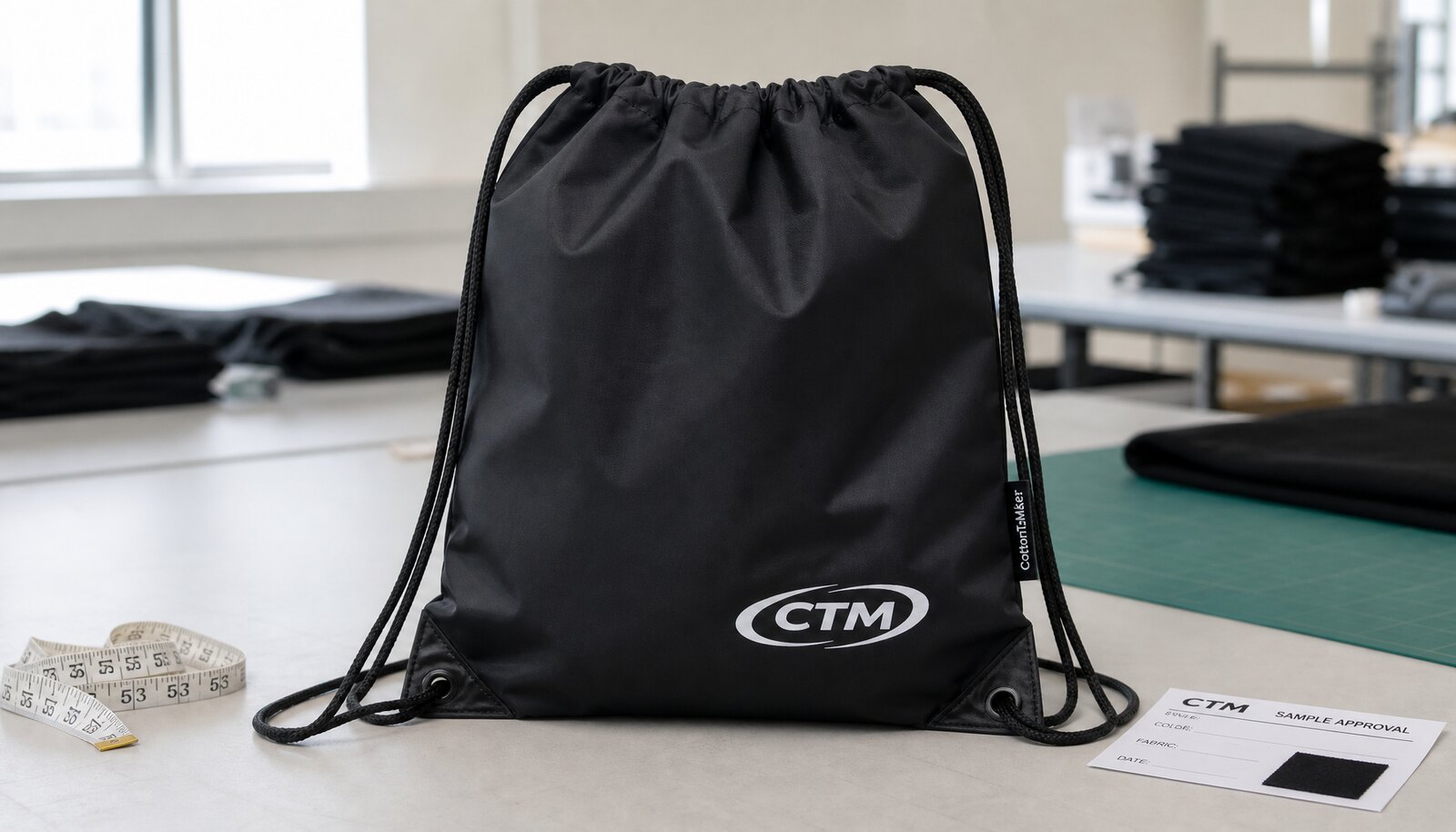
Why the Signoff File Matters
A drawstring backpack looks simple, but logo placement is one of the easiest places for an order to go wrong. The bag is soft, the front panel changes shape when filled, the top hem gathers when cords are pulled, and bottom corner reinforcement can visually shorten the printable area. If the buyer only sends a logo file and says center front, the factory still has to guess what center means.
A proper drawstring backpack logo placement signoff file prevents that guessing. It gives the merchandiser, printing operator, sewing line, inspector, and buyer the same reference. For procurement teams, it also makes supplier quotes easier to compare because every factory is pricing the same print size, print position, sample process, and tolerance.
- Use one final signed PDF for placement, not separate comments buried in email.
- Show the logo on the actual bag outline, including top hem, seams, cords, and bottom corners.
- Add dimensions in mm, not only visual arrows or approximate percentage.
- Reference the exact artwork version and bag specification version on the signoff file.
Start With the Bag Construction
Logo placement cannot be fixed before the bag construction is fixed. A 210D polyester promotional drawstring backpack, an 8 oz cotton canvas gym sack, and a nonwoven event bag may share the same finished size, but the usable print area is not the same. Fabric thickness, seam allowance, top hem fold, corner reinforcement, and cord channel width all reduce the clean print zone.
For RFQs, ask the factory to confirm both finished size and practical print area. A typical economy size may be around 34 x 42 cm, but the safe print area may be much smaller after allowing for a 2.5-4 cm top hem, 1 cm side seams, and triangular bottom corner patches. If the logo is large, these details decide whether the print is safe or likely to hit wrinkles and seams.
- For 210D polyester, check coating and surface smoothness because ink behavior changes by supplier.
- For 420D polyester, allow for heavier fabric memory and stronger fold marks after packing.
- For cotton canvas, check whether the quoted weight is 5 oz, 6 oz, 8 oz, or stated in gsm.
- For nonwoven, confirm gsm because 70 gsm and 100 gsm do not carry ink or heat equally.
- For bottom-gusset or reinforced-corner styles, request a real front panel drawing before approving artwork.
Define Placement From Fixed Reference Points
The most common placement dispute comes from measuring from the wrong place. A buyer may measure from the top of the flat bag. The factory may measure from the top of the print panel before sewing. An inspector may measure from the edge of the top hem after cords are inserted. These are not the same reference point on a soft bag.
Your signoff file should state how to measure placement in bulk. For most drawstring backpacks, the safest method is to measure the logo centerline from the finished left and right side seams, then measure the top of the logo or logo center from the finished top edge or top hem stitch line. If the top edge gathers strongly when the bag is closed, use the top hem stitch line as the reference because it is more stable.
- State whether the measurement is from finished top edge, top hem stitch, bottom seam, or panel center.
- Mark logo width and height, plus distance from logo top to top edge or stitch line.
- Add a centerline through the bag and logo so skew is easier to judge.
- Use placement tolerance such as plus or minus 5 mm for standard economy production.
- Avoid instructions like slightly higher, centered nicely, or same as last time without a file reference.
Match Print Method to Fabric and Logo
A placement signoff file is not only about location. It must connect location with the print method. A 180 mm wide one-color CTM logo on 210D polyester can usually be handled by silkscreen. A small logo with gradients, fine text, or photo detail may need heat transfer. A premium canvas bag may use screen print, embroidery patch, woven label, or sewn label depending on the brand look.
The factory quote should identify the print method because each method has different placement limits. Screen printing needs a flat loading area and can be difficult too close to seams or thick corner reinforcements. Heat transfer needs pressure and temperature control; it may leave a press mark or adhesion issue if placed over uneven stitching. Embroidery directly on thin polyester can pucker unless backing and stitch count are controlled.
- Screen print is efficient for simple solid logos and larger quantities, but setup cost matters for low MOQ.
- Heat transfer handles gradients and small detail, but check stretch, rub, and wash expectations.
- Embroidery is better for small premium marks than large solid areas on thin drawstring bags.
- Woven or sewn labels work well for subtle branding but need seam placement and label allowance.
- Reflective print or specialty ink should be sampled because curing and packing risks are higher.
Build the Signoff File So a Factory Can Use It
A usable signoff file should look more like a production control drawing than a sales mockup. Mockups are useful for presentations, but factories need measurable instructions. The file should include the bag front view at correct proportion, finished bag size, logo artwork, dimensions, reference points, color callouts, fabric specification, print method, tolerance, and revision date.
Keep the document simple enough that the printing room can follow it. If the file contains too many design layers, hidden comments, or unconverted fonts, mistakes happen. For international production, avoid relying only on English descriptions. Measurement arrows and numbers are clearer than long paragraphs, especially when the factory operator is checking a printed sheet at the machine.
- Include order name, item number, PO number if available, and revision number.
- Show front and back if both sides are printed, even when only one side has the main logo.
- Convert fonts to outlines and provide editable vector artwork separately.
- State fabric color, logo color, and whether color is matched to Pantone, sample, or buyer standard.
- Lock the file after approval and name it clearly, for example CTM-DB-Logo-Placement-RevB-Signed.pdf.
Sample Checks Before Bulk Approval
For a first order, a new logo, a new fabric, or a high-visibility campaign, do not rely only on a digital drawing. Ask for a pre-production sample or at least a printed panel strike-off. The sample should be made using the quoted fabric, quoted print method, quoted ink or transfer material, and the same placement reference used for bulk production.
When checking the sample, do not judge only whether the logo looks good in a close-up photo. Ask for a full front view with a ruler, a side seam view, a top hem view, and a photo of the bag lightly filled. A logo that looks centered on an empty flat bag may look too low when the backpack carries a hoodie, shoes, or event literature.
- Measure the logo width and height on the sample, not just the placement.
- Check distance from top edge, side seams, bottom seam, and reinforcement stitching.
- Pull the cords closed and confirm the top gathering does not distort the logo area.
- Rub the print surface lightly after curing to check obvious adhesion weakness.
- Fold the bag as packed and confirm the fold line does not crack or mark the logo.
MOQ and Cost Logic Buyers Should Understand
Logo placement decisions affect cost even when the bag price looks unchanged. A small one-color screen print near the center front is usually straightforward. A large print close to the top hem, print on both sides, oversized heat transfer, or multiple logo positions can slow loading and raise rejection risk. Factories may not break this out unless procurement asks the right questions.
MOQ also has several layers. The bag body may have one MOQ, custom fabric color another MOQ, cord color another MOQ, and printing setup another cost threshold. A supplier may accept 500 pieces with standard black 210D polyester and one-color logo, but require higher quantity for custom dyed fabric, pantone-matched cords, or multiple print colors. Your signoff file helps the factory calculate whether the requested placement fits standard production or needs special handling.
- Ask whether screen setup is charged per color, per logo size, or per position.
- Confirm whether sample cost is refundable or included in bulk price before comparing quotes.
- For small orders, compare standard fabric colors before requesting custom dyed material.
- For large logos, ask if printing is done before sewing or after sewing because workflow changes risk.
- For repeat orders, keep the approved screen size and placement file to avoid new setup discussions.
Lead Time and Approval Workflow
A realistic lead time is not only sewing time. It includes artwork checking, layout confirmation, material purchase, sample making, buyer review, possible correction, bulk printing, sewing, trimming, inspection, packing, and export preparation. If the logo placement file is late or unclear, the factory may start with assumptions or hold production, both of which can create cost and schedule pressure.
For procurement teams, the best workflow is to approve the technical placement before final sample making, not after bulk fabric is cut. If marketing keeps changing logo size after the factory has prepared screens or transfers, the supplier may need to remake tools and reset production. Put approval deadlines into the PO schedule so the factory and buyer both know when the placement file becomes final.
- Day 1-2: factory checks artwork, bag size, print feasibility, and missing information.
- Day 3-7: sample or printed panel is prepared, depending on fabric and print method.
- Buyer review: measure, photograph, and approve or reject with clear marked corrections.
- Bulk stage: first article photos should match the signed file before full run continues.
- Packing stage: final inspection should include placement measurement records, not only visual review.
Packing Risks That Change Logo Appearance
Packing is often treated as a separate issue, but it directly affects logo quality. Freshly printed drawstring backpacks may be folded through the logo, stacked under pressure, or packed before curing is complete. Polyester coatings, transfer films, and screen inks can mark, block, or shine differently if they are handled too soon.
Your signoff file or PO notes should state any packing rule related to the logo. For retail-facing orders, ask whether the bag is folded logo-out or logo-in, whether individual polybags are used, whether tissue is needed, and how many pieces are packed per carton. For promotional bulk orders, simple bundle packing may be acceptable, but you still need curing and transfer risk controlled.
- Avoid a hard fold through the center of a large heat transfer logo when possible.
- Confirm curing time before bulk packing, especially for dark fabric with thick white ink.
- Ask for carton packing photos showing fold direction and logo exposure.
- Use clean interleaving or individual bags for high-gloss, puff, reflective, or sensitive prints.
- Check carton weight because over-compression can crease the front panel and print area.
Acceptance Criteria for Claims and Inspections
Logo placement claims are difficult when the PO only says print logo on front. Strong acceptance criteria make inspection faster and disputes less emotional. Define measurable tolerances before production: placement tolerance, skew tolerance, color tolerance, print defect allowance, and what counts as major or minor defect for your market.
For economy promotional drawstring backpacks, a plus or minus 5 mm placement tolerance is often more realistic than a very tight rule, but the right number depends on fabric, logo size, print method, and order grade. If the logo is small and centered, 5 mm may be visible. If the logo is large, the same 5 mm may be commercially acceptable. The point is to agree before production, not after cartons arrive.
- Major defect: logo printed in wrong position beyond agreed tolerance or visibly crooked on shelf display.
- Major defect: wrong logo version, wrong color family, missing underbase, or print on wrong side.
- Minor defect: very small placement variation within tolerance and not visible in normal use.
- Check at least first-run samples and random packed pieces, not only loose pieces from the top of cartons.
- Keep measurement photos with ruler for any rejected pieces so the claim file is objective.
Specification comparison for buyers
| Spec decision | Recommended option | When it fits | Buyer risk to check |
|---|---|---|---|
| Front logo vertical position | Center logo between bottom reinforcement and top hem, with a measured distance from top edge | Most promotional, school, sports, event, and retail drawstring backpacks | Logo may look low after the bag is filled if the signoff file only shows a flat empty bag |
| Logo size reference | State exact logo width and height in mm, not only percentage of panel | Multi-supplier RFQs and repeat programs with different factories | Factories may scale artwork differently when panel size, seam allowance, or print frame changes |
| Print method | Silkscreen for simple one to three color logos; heat transfer for gradients or tight detail | Common 210D polyester, 420D polyester, cotton canvas, and nonwoven drawstring backpacks | Heat transfer can crack or peel on heavy folding points; screen print can blur on coarse canvas |
| Fabric weight | 210D polyester for economy promotions; 5-8 oz cotton canvas for natural look; 80-100 gsm nonwoven for low-cost giveaways | Choose by use life, brand position, and print detail requirement | Thin fabric can grin through light ink, while heavy canvas can distort small logo text |
| Artwork file control | Vector AI, PDF, or EPS plus a signed placement PDF with dimensions | Any order where logo claim risk is higher than basic commodity risk | A beautiful artwork file does not control placement unless the bag panel dimensions are also locked |
| Sample signoff | Approve one physical pre-production sample and one photo layout with ruler visible | Custom color, new logo, new factory, or order above trial MOQ | Photo approval alone can hide fabric skew, cord obstruction, and print hand feel |
| Packing orientation | Logo-facing single fold with tissue or polybag when print surface is sensitive | Retail or distributor shipments where first impression matters | Fresh prints can transfer, crease, or stick if packed before curing or folded through the logo |
| Tolerance rule | Use plus or minus 5 mm for placement on economy bags; tighter only after factory confirmation | Manual loading and sewing production with soft fabric panels | Unrealistic tolerance causes disputes even when the factory has made normal commercial goods |
Buyer checklist before sampling
- Confirm the finished bag size, front panel usable print area, seam allowance, top hem height, bottom corner reinforcement, and drawcord exit location before fixing logo placement.
- Put logo width, height, centerline, distance from top edge, distance from bottom seam, and minimum clearance from side seams into one signed PDF.
- Specify whether placement is measured on the flat empty bag, after light filling, or from sewn panel before cord insertion.
- Attach final vector artwork and convert fonts to outlines; include Pantone or approved ink references when color is controlled.
- State print method, fabric type, fabric weight, coating, and whether a white underbase is required on dark fabric.
- Require a pre-production sample or at least a printed panel strike-off for first orders, new colors, or logo sizes above standard.
- Define acceptable placement tolerance, print color tolerance, logo skew tolerance, and treatment for minor fabric wrinkles under print.
- Ask for sample photos with ruler, top hem, side seams, bottom corners, and full bag view, not just a cropped logo close-up.
- Check whether packing folds pass through the logo and whether curing time is complete before bulk packing.
- Keep the signed placement file, sample approval photos, and final carton mark details in the PO file for claim handling.
Factory quote questions to send
- What is the finished bag size, cut panel size, top hem height, and usable front print area after sewing?
- What fabric do you quote: 210D polyester, 420D polyester, 5 oz cotton, 8 oz canvas, nonwoven gsm, or another construction?
- Which print method do you recommend for this logo on this fabric, and why?
- What is the minimum safe clearance from top hem, side seams, bottom corners, eyelets, and drawcord exits?
- What logo placement tolerance can you hold in bulk production for this fabric and order quantity?
- Does your quote include artwork handling, screen setup, sample print, pre-production sample, and revised sample if placement changes?
- What MOQ applies for the bag body color, custom fabric color, logo printing, and accessory color separately?
- How many days are needed for artwork checking, sample making, buyer approval, bulk material preparation, printing, sewing, inspection, and packing?
- How will you pack the bag so the logo is not folded, rubbed, or transferred before curing is complete?
- What photos and measurement records will you provide at line release, during production, and before shipment?
Quality-control points to confirm
- Measure logo placement from fixed sewn edges, not from a flexible drawcord or wrinkled fabric point.
- Check first 20-30 bulk pieces after print setup before allowing the full batch to continue.
- Compare print color against approved sample under consistent light, especially on dark polyester and natural canvas.
- Inspect for logo skew caused by fabric stretch, panel feeding, or uneven heat press pressure.
- Check that bottom reinforcement stitching, eyelets, and cord knots do not cover or visually compete with the logo.
- Verify curing, adhesion, rub resistance, and folding impact before the bags are bulk packed.
- Separate inspection by size or color if the order includes mixed bag dimensions or mixed fabric colors.
- Keep rejected placement examples with photos and measured values so rework decisions are based on evidence.