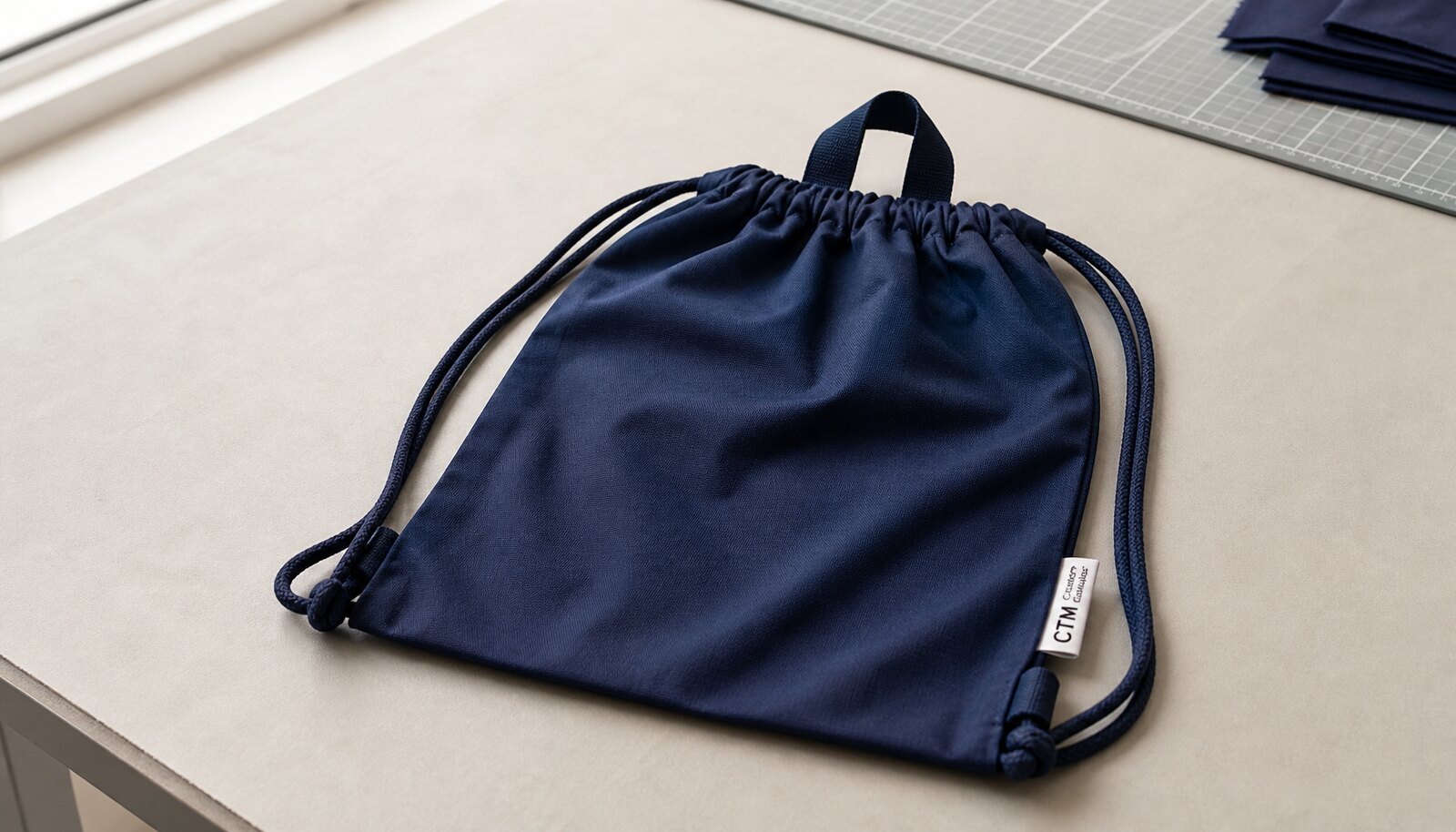
1. Why handle seam claims happen in drawstring backpacks
Handle seam claims usually start after the bag has already entered real use: a student carries books, a retail customer stuffs the bag too full, or a distributor receives a small percentage of tears at the top handle. In drawstring backpacks, the handle is often small, and that makes buyers underestimate how much stress is concentrated in one seam line. The failure may show up as seam opening, broken thread, fabric tearing around the stitch holes, or the handle pulling away from the body panel. If the handle seam is also tied into the drawcord channel, the load path becomes more complicated and the failure becomes harder to argue without evidence.
For procurement, the important point is not just whether the bag failed. It is whether the construction was specified well enough that the supplier knew what was expected, and whether the evidence shows a manufacturing defect or simply a design that was too weak for the intended use. A clean claim file should separate product design risk, material weakness, print-related weakening, and actual assembly defects. If those are mixed together, quote comparisons become meaningless and dispute resolution drags on.
- Treat the handle as a structural feature, not a cosmetic loop, unless the RFQ says otherwise.
- Record the exact failure mode: torn fabric, popped stitches, seam slippage, or handle detachment.
- Note whether the handle seam failed at the same place across multiple units or only on random pieces.
2. Define the construction before you ask for evidence
A drawstring backpack is often quoted with only a fabric name and a print note, but handle seam risk lives in the construction details. The buyer should define whether the top handle is made from self-fabric, webbing, folded tape, or a separate reinforcement strip. The supplier should also specify whether the handle is stitched into the top hem, into the drawcord channel, or onto a reinforced patch. If you do not define that front end, you cannot later prove that the factory built the wrong thing.
This is where many claim files fall apart. A buyer receives a sample, assumes the handle is reinforced, and never asks for the actual stitch diagram. Then the bulk order arrives with a lighter seam or fewer reinforcement passes, and the factory points back to the sample or an unclear email thread. The fix is simple: put the handle construction in the RFQ, ask for a technical drawing, and keep one signed sample as the reference standard.
Key construction terms to standardize in the quote request:
- Handle material: self-fabric, webbing, or binding tape.
- Reinforcement method: box-x, bar-tack, double-topstitch, or patch reinforcement.
- Seam allowance: the actual fabric margin sewn into the seam, not a generic claim like 'strong stitching'.
- Stitch density: stitches per inch or per 3 cm.
- Load path: whether the handle carries weight independently or shares load with the drawcord channel.
3. The evidence packet buyers should build before a claim
If a claim is already under discussion, the fastest path is to assemble a fact-based evidence packet before emotions take over. Start with dated photos of the failed units, then add close-ups of the seam on both the front and back side. Include a wider photo showing the bag shape, the top edge, and any print or embroidery near the failure. If available, keep at least one unopened carton from the same lot so the supplier can see whether the issue is isolated to a batch or spread across the shipment.
A strong packet also includes the purchasing and production records: PO number, style code, color, lot or batch number, sample approval date, and the exact revision of the spec sheet. Add simple measurement data: handle length, handle width, seam allowance, stitch count, and fabric weight. If the issue happened after a usage test or returns analysis, note the load applied, how many cycles were used, and whether the same failure reproduced on multiple samples. Evidence is only useful if it tells a supplier what changed and where to look.
Good claim evidence usually contains:
- Clear failure photos with a ruler or measuring tape.
- One intact comparison sample from the same lot.
- Spec sheet and approved sample reference.
- Carton labels and production batch identification.
- A short failure log with date, quantity, and observed defect type.
4. Which materials and GSM levels change seam strength the most
Fabric choice has a direct effect on seam performance, even when the handle itself is reinforced. Lightweight 210D polyester is common for low-cost promotions because it is cheap, printable, and easy to pack. It can work well for light loads, but it gives less resistance to seam pull-out than 300D or 420D polyester. Cotton canvas, often sold around 8 oz to 10 oz or roughly 250 to 340 GSM depending on construction, can hold up well, but it also introduces different risks such as shrinkage, tighter seam puckering, and print cracking if the process is not matched correctly.
When buyers compare quotes, they should ask for actual measured fabric weight, not just the marketing name. If a factory says '210D' or 'canvas' without confirming weight, you may be comparing different materials that look similar on paper but behave differently in the handle seam. The thread, needle, and stitch balance matter too. A heavier fabric with weak thread can still fail, and a lighter fabric with a well-engineered reinforcement can sometimes outperform a bulkier but poorly assembled bag.
Practical material checks for RFQs and samples:
- Ask for fabric GSM or ounce weight with tolerance, not just the fabric name.
- Confirm whether the fabric is coated, laminated, or uncoated, because coating changes stitch behavior.
- Request the thread type and size, especially on the handle reinforcement.
- Check whether the handle area uses a different layer or reinforcement patch than the body panel.
- Make sure print, embroidery, or woven labels do not sit directly on the highest-stress stitch line unless approved.
5. Comparison table: which handle construction is safer for claims control
The best handle construction depends on how much load the buyer expects and how much proof they need after production. A promotional giveaway bag can tolerate a simpler build if the load is light and the instruction is clear. A retail bag, campus bag, or membership pack usually needs more structure and better traceability. The point is not to overbuild every item. The point is to match construction to the use case and then document it well enough that claim disputes can be settled fast.
Use the table below to compare the most common choices before you finalize the quote. It is not enough to ask for 'strong handle stitching'; the supplier should know which construction is being judged and which defect would trigger rejection.
Handle comparison table:
- Box-x handle on reinforced patch: strongest and easiest to inspect, but adds labor and cost.
- Bar-tack plus double-topstitch: efficient for medium load, but depends on placement accuracy.
- Single seam into top hem: lowest cost, but highest risk when the bag is used as a real carry item.
- Webbing handle sewn separately: best when you need a clearer load path and cleaner claim evidence.
For claim control, the safest option is usually the one that separates the handle from the drawcord tension path and gives you a visible reinforcement pattern you can inspect quickly at receiving.
- Insist that the factory state which stitch pattern is used and where it begins and ends.
- Ask for a photo of the first sewn sample before bulk approval.
- Reject vague wording like 'reinforced as usual' if the bag is for a controlled program.
6. How to write an RFQ that exposes seam risk early
A useful RFQ does more than ask for price and lead time. It forces the supplier to reveal the construction choices that will later matter in a claim. Start with the bag size, target load, fabric weight, print area, closure type, and handle purpose. Then specify whether the handle must support full carry weight or only assist with lifting. If you expect the bag to carry books, samples, or heavier retail goods, say so clearly. A handle used only as a hang loop is a different product from a handle used to lift the entire bag.
The RFQ should also ask the factory to quote any cost impact separately: extra patch material, extra stitch passes, heavier thread, testing labor, and additional sample rounds. That makes it easier to compare suppliers on a like-for-like basis. When buyers skip this step, the lowest quote often hides a weaker seam construction, and the first time you discover it is after a complaint or return. A better RFQ reduces the chance that price comparisons reward the supplier who cut the most corners.
RFQ fields worth requiring:
- Product size, fabric type, and measured fabric weight.
- Handle use case: decorative, light carry, or full-load carry.
- Reinforcement style and stitch count.
- Print method and print location relative to the seam.
- Required tests and pass criteria for preproduction sample approval.
- MOQ by color, print version, and packaging format.
- Lead time by stage: sample, bulk, and shipment.
- Ask the supplier to quote with and without reinforcement so you can see the true cost delta.
- Require a first-sample photo before you approve a second sample or bulk run.
- Use the same RFQ wording across suppliers so quote differences are meaningful.
7. Sample checks that matter more than a pretty approval photo
A good-looking sample is not enough. For handle seam claims, the sample has to prove construction, not just appearance. Check the inside of the top seam, the handle attachment points, and the edge finish where the load is transferred into the panel. Measure stitch length and count the reinforcement passes. If the sample has print near the handle, flex that area by hand and look for surface cracking, lift, or heat distortion. If the bag uses embroidery, inspect whether the backing or thread density stiffened the seam enough to cause puckering.
Do not approve a sample until you have tested the exact failure zone. Fill the bag with a realistic load and lift it repeatedly by the handle. That does not replace a formal lab test, but it will reveal obvious problems such as seam stretch, thread popping, or the handle rolling under stress. For buyers who need claim evidence later, a preproduction sample should be stored with a signed approval note, photos, and the test condition used during signoff.
Sample checks to complete before bulk:
- Visual inspection of both handle attachment points.
- Measurement of stitch density and seam allowance.
- Load-lift test with a realistic packed weight.
- Check for puckering, skipped stitches, and thread tails.
- Compare bulk PP sample against the approved reference sample, not only against a verbal description.
8. QC acceptance criteria for incoming goods and claim defense
Once bulk production starts, quality control should be built around simple acceptance criteria that a warehouse team can actually use. The first check is visual: the handle seam should sit symmetrically, with no broken stitches, loose thread loops, or pulled fabric at the attachment point. The second check is dimensional: the handle length, seam placement, and top-edge position should match the approved sample closely enough that one unit does not behave differently from another. The third check is stress-related: the unit should survive a reasonable pull test or lift test without audible seam failure or visible opening.
For claim defense, keep inspection records tied to lot numbers and carton IDs. If a defect is found, you need to know whether it was concentrated in one day of production, one sewing line, or one carton sequence. That information matters more than a vague reject rate. If possible, take a short video of the test method and the failure mode. A supplier can argue about a photo; it is much harder to argue with a time-stamped test record that shows repeated failure in the same spot.
Minimum acceptance criteria to consider:
- No open stitches or broken seam lines at the handle base.
- No fabric tear extending beyond the reinforcement zone.
- No skipped stitches visible under normal inspection.
- Handle placement within agreed tolerance from center and top edge.
- Test units must hold the agreed load without seam opening or distortion beyond tolerance.
9. Quote data buyers should compare line by line
A clean quote should let you compare more than unit price. The handle seam often hides cost differences in labor, reinforcement, and sampling. Ask each supplier to break out the main variables so you can see why one quote is higher or lower. If one factory includes extra bartacks, heavier thread, and a second PP sample round, that may be a better deal than a cheaper quote that leaves those items out. Buyers who only compare the headline price often pay for the omission later in returns, inspection fees, or claim handling.
Useful quote data includes material basis, print method, labor assumption, sample costs, carton configuration, and lead time by stage. You also want to know whether the factory is using stock fabric or purchasing fresh fabric for the order, because that changes both MOQ logic and consistency risk. If the supplier is quoting a custom color or custom print, ask whether the reinforcement stitch and handle patch are standard or require a separate setup. That detail often explains why two quotes look similar but behave differently in production.
Quote comparison fields:
- Fabric basis and measured GSM or ounce weight.
- Handle reinforcement method and stitch pattern.
- Print method, print size, and print placement.
- MOQ by color, logo version, and packaging style.
- Sample lead time, bulk lead time, and shipment packing method.
- Any separate charges for testing, re-sampling, or artwork setup.
- Ask for a line item when the reinforcement changes the sewing time.
- Make the factory state whether the quote assumes one sample round or multiple.
- Compare carton count and pack method so you can judge logistics cost, not only factory price.
10. Packing, lead time, and traceability when a seam claim appears
Packing is not just a shipping detail; it is part of claim control. If drawstring backpacks are packed loosely without lot separation, a handle seam issue becomes hard to isolate. Ask for clear carton labels showing style, color, quantity, production date, and lot code. If the program has multiple colors or print versions, keep those in separate cartons and, if possible, separate pallet positions. When a claim appears, traceability can tell you whether the issue belongs to one fabric roll, one operator shift, or one sewing line.
Lead time should also be quoted by stage, not only as a single number. Sample timing matters because a revised handle seam may need one extra approval cycle. Bulk timing matters because a factory may need to source a heavier fabric or a different reinforcement tape. If the supplier is using stock material, ask what happens if that stock is depleted before your PO is scheduled. For claim-prone programs, a slightly longer but controlled lead time is often better than a fast quote that cannot explain how it will maintain consistency.
Traceability and packing points to lock in:
- Carton labels tied to lot and color.
- Separate pack lists for different print versions or handle styles.
- A retained sealed sample from each shipment lot.
- Clear split between sample lead time and bulk lead time.
- Written note of any material substitution before production starts.
Specification comparison for buyers
| Spec decision | Recommended option | When it fits | Buyer risk to check |
|---|---|---|---|
| Handle reinforcement | Box-x or bar-tack plus seam allowance over the handle base | Daily-use bags, school promos, retail packs, heavier contents | Ask for stitch density, thread spec, and seam extension beyond the handle edge |
| Body fabric | 210D polyester for low-cost promos; 300D-420D polyester or 8-10 oz cotton canvas for stronger programs | Choose by budget, print area, and expected load | Confirm GSM/oz actually measured, not only named fabric |
| Thread | Polyester core-spun or bonded polyester | When abrasion and moisture resistance matter | Check thread count, ticket number, and colorfastness |
| Print method | Screen print for solid logos; heat transfer or embroidery only when approved for the fabric | Depends on artwork size, quantity, and handfeel target | Ask how print affects seam area flexibility and wash performance |
| Top handle construction | Reinforced handle with separate stitching path from drawcord channel | When buyers want a real carry handle, not just a decorative loop | Verify handle seam sits outside the drawcord tension path |
| Inspection focus | Pull test on handle seam, seam allowance check, and top-edge stress check | Any claim-prone program or first production run | Set pass/fail criteria before production starts |
| Packing | Flat pack with count and lot code, then carton traceability | When claims may require lot isolation | Make sure packing labels keep seam lots traceable |
| MOQ logic | Higher MOQ for custom fabric/print; lower MOQ if using stock fabric and standard colors | Seasonal promos versus ongoing replenishment | Ask whether MOQ changes with reinforcement or print colors |
Buyer checklist before sampling
- Confirm the handle is structural, decorative, or both, and state the required load expectation in the RFQ.
- Request a seam construction sketch with stitch type, stitch count per inch, seam allowance, and reinforcement method.
- Ask for fabric weight in GSM or ounces, plus actual sample measurement and tolerance.
- Approve the print method separately from the seam area so ink, heat, or embroidery does not weaken the top edge.
- Check one preproduction sample for handle alignment, stitch skips, puckering, thread tails, and stress whitening.
- Require carton traceability by color, lot, and production batch before mass shipment.
Factory quote questions to send
- What exact handle seam construction are you quoting: box-x, bar-tack, double-topstitch, or another method?
- What is the fabric weight, and is that a stock base fabric or a custom weave/lamination order?
- How many stitches per inch, what thread type, and what seam allowance will be used at the handle base?
- Will the handle be sewn into the same seam as the drawcord channel, or separated with reinforcement patches?
- What is the MOQ by color and print method, and does reinforcement change the MOQ or lead time?
- What tests can you support on the sample: pull load, seam slippage, and repeated carry simulation?
- How will you pack and label cartons so we can isolate one claim to one lot if needed?
- What sample changes are included after the first round, and how many rounds are quoted before tooling or extra charges?
Quality-control points to confirm
- Measure handle position from the top edge to confirm both sides match within the agreed tolerance.
- Inspect the reinforcement pattern for complete box-x corners, secure bartacks, and no missed penetrations.
- Verify stitch density and thread tension on both the handle seam and the drawcord channel.
- Check for puckering, skipped stitches, broken thread tails, and heat damage near printed areas.
- Pull-test the handle seam on at least one sample per lot and compare the result to the agreed standard.
- Confirm carton labels, lot codes, and sample references so failed units can be traced back fast.