Why Drawstring Backpack Quotes Are Hard to Compare
A drawstring backpack looks simple, so many buyers expect the quote comparison to be simple. In practice, two factories can quote the same requested size and logo but base their prices on different fabrics, different drawcords, different corner construction, and different packing assumptions. The cheapest quote often wins only because it left several cost items unstated.
For procurement teams, the main problem is not finding a factory willing to make the bag. The problem is comparing factory quotes on the same technical basis before purchase order approval. If your RFQ only says drawstring backpack with logo, the supplier has too much room to choose the lowest-cost interpretation.
- A low unit price may use lighter fabric than your target sample.
- A logo charge may cover one color only, not your final artwork.
- A stated MOQ may apply to one fabric color and one print design only.
- A production lead time may start after fabric arrival, not after PO release.
- A packing quote may exclude barcodes, inner cartons, or individual polybags.
Start the Comparison With a Fixed Product Baseline
Before you request prices, define a baseline product that every factory must quote. For drawstring backpacks, the core baseline is fabric, size, construction, cord, print, packing, and order split. If one factory quotes a 210D polyester backpack and another quotes a 190T polyester bag, the comparison is not valid even if both call the item a drawstring bag.
The baseline does not need to be over-engineered, but it must prevent vague substitutions. A practical RFQ can state a finished size of 34 x 42 cm, 210D polyester around 60-75 GSM with PU coating, two black PP drawcords around 5 mm diameter, reinforced bottom corners, one front screen print at 25 x 25 cm, and bulk packing 100 pieces per export carton. You can later ask for upgrade options, but the first quote round should use one clear standard.
- Finished size: state length, width, and acceptable tolerance.
- Fabric: state material, denier or ounce weight, GSM if available, coating, and color.
- Cord: state material, diameter, color, and whether knots or tips are required.
- Construction: state bottom reinforcement and any bartacks or eyelets.
- Decoration: state print method, colors, size, position, and artwork file type.
- Packing: state individual pack or bulk pack, carton quantity, carton marks, and label needs.
Fabric Weight Is the First Cost Driver
Fabric is usually the biggest material variable in a drawstring backpack quote. A promotional order may use 210D polyester, while a higher-value retail or school program may require 300D, 600D, non-woven PP, cotton canvas, or recycled rPET. The fabric name alone is not enough because different mills can supply different densities, coatings, and handfeel under the same common description.
Ask the factory to state fabric weight in a measurable way. For polyester, denier is useful but should be supported by GSM or a sample reference. For cotton or canvas, use ounces per square yard and GSM where possible. For example, an 8 oz cotton canvas drawstring backpack may feel acceptable for light merchandise, while 10 oz or 12 oz may be better for a retail product but will increase sewing difficulty, cord stress, and shipping weight.
- 210D polyester: common for low to mid-cost promotional drawstring backpacks.
- 300D polyester: stronger handfeel and better perceived value for sports or school use.
- 600D polyester: more durable but heavier, bulkier, and usually higher in freight cost.
- 8-10 oz cotton canvas: suitable for natural-look merchandise and brand retail.
- Non-woven PP: economical for very light use, but less durable at cord corners.
- rPET fabric: useful for sustainability programs, but requires clear material claims and documentation from the supplier.
Print Method Must Match Artwork and Use Case
Logo decoration can change both the price and the production risk. Screen printing is usually the most cost-effective for simple spot-color logos on polyester, cotton, or non-woven material. The quote should state how many print colors are included, the print size, the print position, and whether setup charges are included or separate. A factory quote that only says logo included is not enough for buyer comparison.
For full-color artwork, gradients, small photographic details, or multi-design campaigns, heat transfer, sublimation, or digital print may be more realistic. Each method has a trade-off. Heat transfer can reproduce complex artwork but may add a film handfeel. Sublimation works best on white or light polyester and is not suitable for cotton canvas. Digital print may work for smaller runs but needs a careful sample check for color, adhesion, and edge quality.
- Screen print: best for simple logos, bold shapes, and controlled unit cost.
- Heat transfer: useful for full-color graphics, but check film edge and flexibility.
- Sublimation: good for all-over polyester graphics, but base fabric color matters.
- Embroidery: possible on heavier fabric, but may distort thin polyester panels.
- Woven label or side label: useful for subtle branding and repeat retail programs.
MOQ Logic: Separate Fabric, Logo, and Packing Minimums
Many quote problems start when buyers treat MOQ as one number. For drawstring backpacks, MOQ can be driven by fabric purchase, fabric dyeing, print setup, cutting efficiency, sewing line planning, or packing material. A factory may say MOQ is 500 pieces, but that may mean 500 pieces of one fabric color with one logo design and one packing method.
If your order includes four school colors, three sponsor logos, and different carton labels for distributors, the supplier may need to split production into many small batches. That can add setup cost, increase defect risk, and lengthen lead time. Ask for MOQ by fabric color, print design, and packing version. This makes the quote more useful and prevents a surprise surcharge after artwork approval.
- Ask for MOQ per fabric color, not only total order quantity.
- Ask for MOQ per logo version if artwork changes by branch, event, or language.
- Ask whether print screens or transfer setup charges repeat for each design.
- Ask whether cartons, polybags, and barcode labels have their own minimums.
- Ask if excess fabric will be charged, stored, or used for future repeat orders.
Construction Details That Change Claims Risk
The most common failure points are not the middle of the fabric panel. They are the cord channel, bottom corners, eyelets, loops, seams, and areas near the print if the bag is overloaded. A low quote may remove reinforcement or use a smaller seam allowance, which is not always visible in a simple price table. Buyers should request close-up sample photos or a physical sample before confirming bulk.
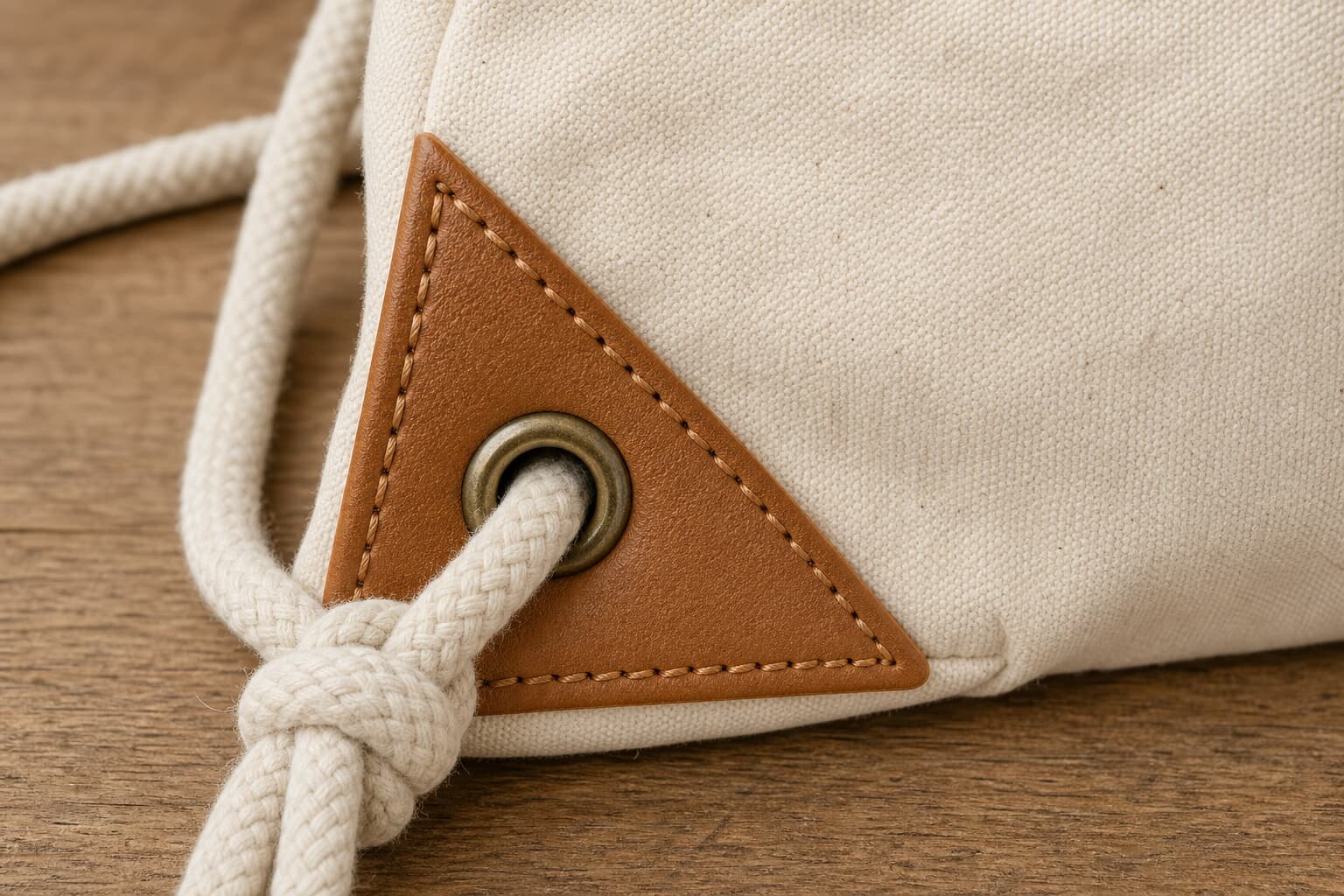
For lightweight promotional use, a basic triangle corner with stitching may be acceptable. For school packs, sports events, or retail merchandise, stronger bottom reinforcement is safer. Metal eyelets can look cleaner but must be properly set so they do not cut thin fabric. Fabric loops can be durable if bartacked well. The right choice depends on expected loading, not only appearance.
- Cord channel should open and close smoothly without twisting or catching.
- Bottom corners should be reinforced if the bag will carry shoes, bottles, or books.
- Eyelets should be smooth, centered, and tested for pull-out resistance.
- Fabric loops should have secure bartacks and enough seam allowance.
- Cord ends should be knotted or finished consistently to prevent slipping.
- Stitch density should be stable and not cut through coated fabric.
Packing and Carton Data Affect Landed Cost
A drawstring backpack unit price can look attractive until the buyer checks carton volume, gross weight, and packing labor. Thin polyester bags can pack tightly, while cotton canvas or 600D polyester bags can increase carton size quickly. If you compare FOB prices without carton data, your landed cost estimate may be wrong, especially for air shipment or courier distribution.
Ask each factory for pieces per carton, carton size, gross weight, net weight, and total CBM for the quoted order quantity. Also confirm whether the quote includes bulk packing, individual polybags, barcode labels, warning labels, retail hangtags, or inner cartons. These items sound small, but they affect labor time, packing material cost, warehouse receiving, and retailer compliance.
- Bulk pack is cheaper but may not suit retail or distributor pick-pack operations.
- Individual polybags protect print surfaces but add labor and plastic cost.
- Barcode labels require correct SKU control and label placement approval.
- Inner cartons help distribution but increase carton count and handling.
- Desiccant may be needed for cotton or jute blends in humid seasons.
- Carton marks should match the purchase order, destination, item code, and quantity.
Lead Time Should Be Broken Into Real Production Steps
A quoted lead time of 20 days or 30 days is only useful if you know when the clock starts and what is included. Some factories count from deposit receipt. Others count from artwork approval, fabric arrival, or sample approval. For a buyer with a fixed campaign date, that difference matters more than a small unit price saving.
Ask the factory to split the schedule into sampling, material purchase, printing, cutting, sewing, packing, inspection, and delivery to the port or forwarder. If fabric is stock, production can move faster. If fabric needs dyeing or special coating, the material stage can become the bottleneck. For multiple designs, print approval and packing label approval can also add time.
- Sampling time: confirm if it uses available fabric or actual bulk material.
- Material time: confirm stock fabric, dye-to-order fabric, or imported material.
- Printing time: confirm screen setup, transfer production, curing, and drying.
- Sewing time: confirm whether production is continuous or split by design.
- Packing time: confirm barcode labeling, inner carton sorting, and final carton marking.
- Inspection time: reserve time for rework if defects are found.
How to Read the Quote Data, Not Just the Unit Price
A useful factory quote should let a buyer understand what is included, what is excluded, and what can change later. The quote should identify the product spec, unit price, currency, trade term, MOQ, sample cost, setup cost, packing method, carton data, lead time, payment terms, quote validity, and assumptions. Without these details, the buyer is comparing partial answers.
When two quotes differ, do not immediately push the higher factory to match the lower price. First find the technical difference. The higher quote may include heavier fabric, individual polybags, print setup, better reinforcement, or realistic carton data. The lower quote may still be usable, but only if the buyer accepts the downgraded spec. Good sourcing work is not about selecting the lowest number; it is about selecting the best controlled number.
- Check whether setup charges are included or listed separately.
- Check whether the price changes by order quantity break.
- Check whether freight to port, export documents, and local handling are included in the trade term.
- Check whether sample cost is refundable or separate from bulk order cost.
- Check whether the quote validity covers enough time for internal approval.
- Check whether the factory names all assumptions that affect price.
Sample Approval Should Lock the Quote Assumptions
The approved sample should not be treated as only a visual reference. It should lock the commercial assumptions behind the quote. If the approved sample uses heavier fabric, thicker cord, better print coverage, or a different corner reinforcement than the quoted spec, the factory may request a price adjustment before bulk. This is why the buyer should connect the sample approval sheet to the quote line by line.
For drawstring backpacks, sample checks should include finished size, fabric handfeel, GSM or denier confirmation, drawcord smoothness, corner strength, logo color, logo position, print adhesion, stitch quality, and packing method if relevant. Take photos of measured points and keep one signed reference sample. If the factory sends a sample made from substitute fabric, mark it clearly as construction sample only, not bulk approval.
- Approve fabric, cord, print, construction, and packing as separate items.
- Record tolerances for finished size and logo position.
- Confirm whether color approval is by Pantone, lab dip, strike-off, or physical sample.
- Do a simple load check using the expected contents weight.
- Keep one sealed approved sample for inspection comparison.
- List all sample revisions before the purchase order is finalized.
Specification comparison for buyers
| Spec decision | Recommended option | When it fits | Buyer risk to check |
|---|---|---|---|
| Fabric for budget promotion | 210D polyester, usually 60-75 GSM depending on coating and yarn | Mass events, giveaways, school promotions, race packs, light retail bundles | Factories may quote thinner 190T or low-density 210D unless GSM and handfeel are specified |
| Fabric for retail or heavier use | 300D polyester, 600D polyester, or 8-10 oz cotton canvas | Sports clubs, campus shops, brand merchandise, kits with heavier contents | Higher fabric weight changes drawcord strength, carton weight, and freight cost |
| Logo print for simple artwork | Screen print with Pantone reference and print size stated in centimeters | One to three spot colors, large front logo, strong unit cost control | Low quotes may exclude setup, color matching, or extra charge for double-side printing |
| Logo print for gradients or full-color art | Heat transfer, sublimation on white polyester, or digital print after factory review | Complex graphics, photos, event artwork, small quantity personalization | Print feel, wash resistance, and color shift need sample approval before bulk |
| Drawcord construction | PP cord, polyester cord, or cotton rope matched to fabric strength and buyer market | Standard backpacks, retail upgrade, eco-positioned cotton bags | Cord diameter and knot finishing are often missing from cheap quotes |
| Corner reinforcement | Triangle stitched corner, metal eyelet, or bartacked fabric loop | Any bag expected to carry shoes, bottles, books, or sports kits | Unreinforced corner holes can tear during loading and cause claim risk |
| Packing method | Individual polybag or bulk pack by fixed inner quantity, then export carton | Retail, distributor warehouse, FBA-style preparation, or event distribution | Quote may not include barcode labels, carton marks, desiccant, or inner bundle counts |
| MOQ comparison | Separate MOQ by fabric color, print design, and packing version | Orders with multiple branches, teams, languages, or seasonal campaigns | One total MOQ can hide small-run surcharges when designs are split |
Buyer checklist before sampling
- Confirm the quoted fabric type, GSM or denier, coating, color, and whether the factory will use stock fabric or dye-to-order material.
- Ask each factory to quote the same bag size, seam allowance, drawcord diameter, corner reinforcement, and closure construction.
- Separate logo cost by print method, number of colors, print position, print size, setup charge, and sample charge.
- Compare MOQ by fabric color, print design, packing version, and shipment destination instead of accepting one blended MOQ.
- Request gross weight, net weight, carton size, carton quantity, and packing method before comparing FOB or EXW prices.
- Check whether sample cost includes artwork setup, material matching, print strike-off, courier charge, and one revision.
- Require a production lead time split into material purchase, printing, sewing, packing, inspection, and delivery to port.
- Make the approved sample, artwork file, packing spec, and carton mark the control documents for bulk production.
- Ask what changes trigger price adjustment, such as higher GSM, extra print color, longer cord, reinforced corners, or individual polybags.
- Do not compare quotes until all factories have answered the same quote data sheet with no blank assumptions.
Factory quote questions to send
- What exact fabric are you quoting, including denier or ounce weight, GSM, coating, and color source?
- Is the fabric in stock, or does it require dyeing? What MOQ applies to each fabric color?
- What is the finished bag size and what cutting tolerance and sewing tolerance do you apply?
- What drawcord material, diameter, color, and finishing method are included in the quoted price?
- Are the bottom corners reinforced by stitching, eyelet, fabric loop, or another method?
- Which logo method is included, and what print size, color count, position, and setup fee are assumed?
- Can you provide a pre-production sample using the actual fabric, actual cord, and actual print process?
- What is the MOQ per design and per color if the order has several logo versions?
- What packing is included: bulk pack, individual polybag, barcode label, inner carton, or master carton only?
- What are the carton dimensions, carton quantity, gross weight, and estimated CBM for the quoted order?
Quality-control points to confirm
- Measure finished bag length and width against approved tolerance after the bag is laid flat without stretching.
- Check fabric weight or denier confirmation against the approved sample and purchase specification.
- Inspect drawcord diameter, color, length balance, knot security, and smooth opening and closing.
- Pull-test bottom corners, eyelets, or fabric loops to confirm they do not tear under normal loading.
- Review stitch density, skipped stitches, loose thread trimming, seam allowance, and bartack placement.
- Compare logo color, print position, print size, curing, edge sharpness, and adhesion against the approved artwork.
- Load-test sample bags with the expected product weight to check seam strain and cord comfort.
- Confirm polybag, barcode, inner quantity, carton mark, carton strength, and master carton dimensions.
- Check color shade consistency between panels, cords, labels, and any contrast trims.
- Seal one approved production sample and keep it as the reference for final inspection.