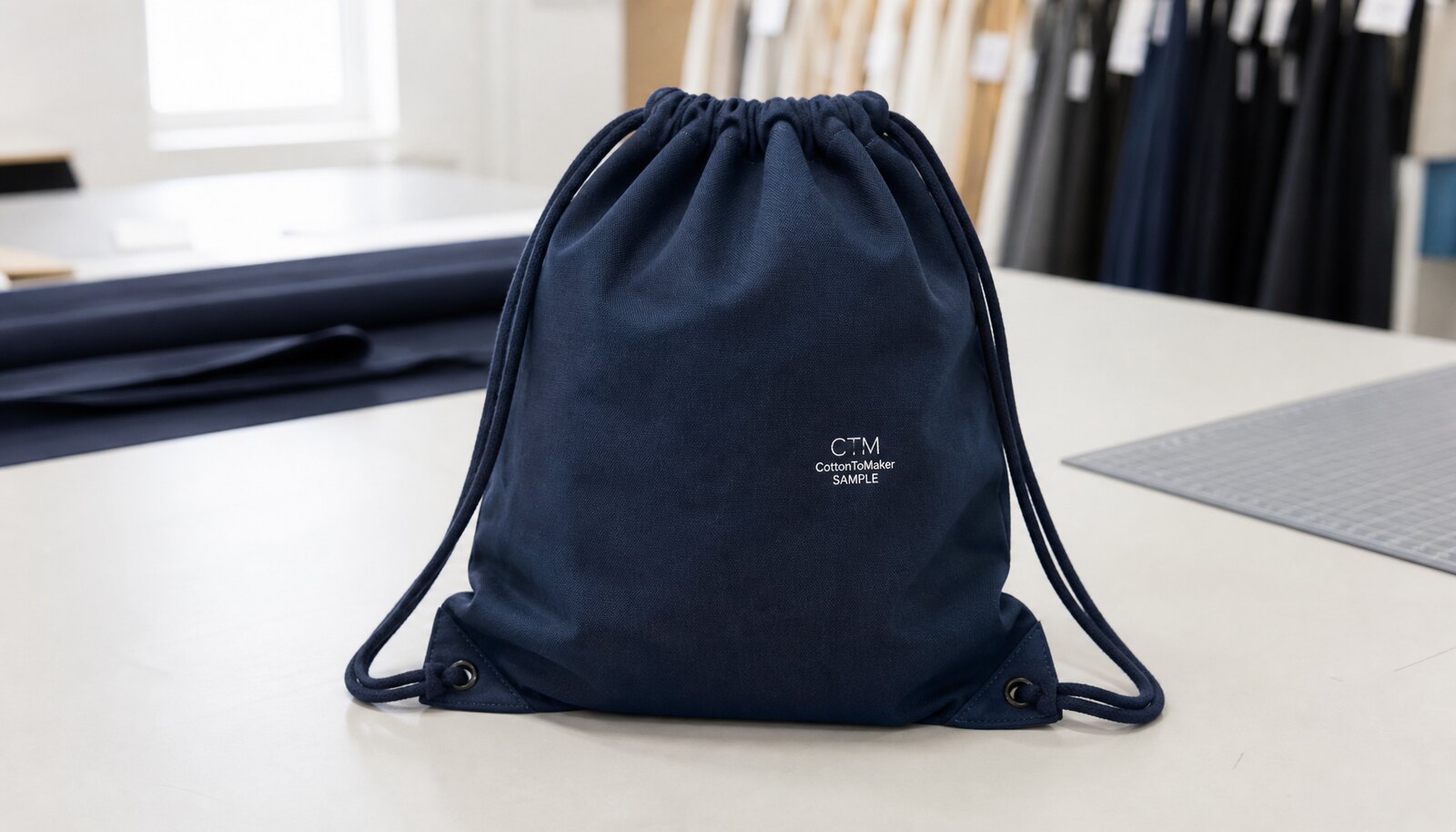
Start With the Use Case, Not the Logo
A drawstring backpack custom logo order fails most often when the buyer starts with artwork and ends with the bag structure. The same logo can be printed on a cheap event bag, a student backpack, or a retail-grade carry bag, but the right spec is different in each case. If the bag only needs to survive a one-day promotion, the sourcing target is cost and clean brand presentation. If it is going into retail or repeated daily use, the buyer has to prioritize seam strength, cord life, print durability, and a fabric that does not collapse after one trip.
The practical way to write the brief is to define the load, use pattern, and expected service life before you ask for pricing. State whether the bag will carry apparel, shoes, books, samples, or light promotional material. Then define the failure you care about most: tearing at the cord exit, fading logo, bag distortion, or a premium look that does not hold up. That one decision controls fabric weight, reinforcement, decoration method, and how much you should spend on packing.
- Event giveaways can use a lighter body, but they still need a clean logo and stable drawcord stitching.
- School or retail use usually needs heavier fabric, stronger seams, and a more durable print or patch.
- If the bag is sold online, the look in the carton matters as much as the print on the front panel.
Pick the Body Fabric and Hardware First
For most custom logo drawstring bags, the fabric choice drives both cost and user satisfaction more than the decoration method does. A 210D polyester body is a common promotional choice because it is light, inexpensive, and easy to print. A 420D polyester or oxford bag gives a better handfeel and more structure for general retail or school use. A 600D polyester version is heavier, more durable, and easier to justify when the bag needs to support books, shoes, or repeated daily carry. If the buyer wants a softer, more natural look, cotton canvas in the 6 oz to 10 oz range is a common premium route, but it will change the quote and the pack-out weight.
Hardware details matter more than many buyers expect. The cord should not be treated as a generic accessory; its diameter, weave, and end finishing affect comfort and failure rate. Eyelets or reinforced cord exits need to match the fabric weight so the opening does not tear under load. If the bag will be pulled open and shut many times, ask for bartacks at stress points and a sample that shows the finished stitch path clearly. A low-cost fabric with weak reinforcement is the fastest way to create returns after the first customer use.
- 210D polyester fits light promotional use and short life cycles.
- 420D polyester is a safer middle ground for school, retail, and distributor programs.
- 600D polyester or oxford works when the bag must carry weight without looking flimsy.
- Cotton canvas is better for a natural brand image, but it raises weight, sewing time, and packing cost.
- Confirm cord diameter, stopper style, and reinforcement at the exit points before artwork is approved.
Choose a Logo Method the Factory Can Hold
The decoration method should follow the fabric, not personal preference. Screen printing is usually the best value for one to three solid colors on flat areas because it gives good opacity and repeatability. Heat transfer or digital transfer is better for full-color graphics, gradients, or fine text, especially on polyester surfaces that need crisp detail. Embroidery works well on heavier polyester or canvas when the buyer wants a more premium retail feel, but it adds thread cost, stitch time, and some bulk. A woven label or rubber patch can be the right answer when the logo needs to look clean and durable without covering a large part of the bag.
Buyers often overreach on logo placement. A large front print sounds good in theory, but the print may break across seams, interfere with the cord opening, or look too promotional for retail. Ask the supplier for a placement map with measured distances from the top edge, side seam, and cord tunnel. For a simple custom logo bag, one front placement is usually enough. Add a second placement only if it serves retail branding or compliance, not because the artwork team wants more surface area.
- Use screen print for flat, simple logos and stable volume orders.
- Use heat transfer when the art has gradients, tiny type, or multiple colors.
- Use embroidery for canvas or premium polyester if the added thickness is acceptable.
- Use woven labels, side labels, or rubber patches when the buyer wants a cleaner retail look.
- Hold the exact print size and placement on a dimensioned approval sheet, not in email notes.
Compare Supplier Routes Before You Ask for Price
The wrong supplier route can make a decent spec look expensive or create avoidable quality risk. A direct factory is usually the best route when the buyer wants control over fabric, print method, packing, and long-term reorders. A trading company can be useful when the program is messy, the shipment has several moving parts, or the buyer needs one point of contact to coordinate multiple factories. A local decorator or stock program is faster for launch work, but it usually limits bag construction options and can weaken cost control over time.
Before you request quotes, decide whether you are buying manufacturing capacity or buying speed. If you need repeatable output, ask who actually cuts, sews, prints, and packs the bag. If the supplier only assembles someone else’s blanks, the quote may look simple but quality responsibility becomes fragmented. This is why route selection belongs in the first page of the RFQ, not in a follow-up email after the first quote lands.
- Direct factory: best for cost control, repeat orders, and custom construction.
- Trading company: useful when multiple destinations or mixed product lines need coordination.
- Local decorator: useful when speed matters more than exact construction control.
- Stock blank plus local print: best for test buys and low MOQ launches.
- Hybrid sourcing: useful when packing, labeling, or kitting must happen in a different market.
Understand What Moves MOQ and Unit Cost
MOQ is not a random number. It usually reflects how many units are needed to cover fabric setup, print screens or transfer setup, sewing line changeover, packing labor, and waste from the first production run. A one-color logo on one side of a single-fabric bag is the cheapest configuration because the factory can run longer without changes. Every added color, second placement, special label, or retail pack-out step pushes the minimum order upward or adds a setup charge that should be visible in the quote.
The right quote format is a cost build-up, not a single unit price. A buyer should see the body fabric, cord, decoration, labor, packing, inner packaging, carton spec, and any setup or sampling fee separately. If the supplier combines all of that into one number, compare it carefully because the missing line items will usually reappear later as a charge for art revision, color matching, cartons, or export paperwork. For a clean comparison, keep the same artwork, same bag size, and same packing format across every supplier you invite to quote.
- One fabric, one logo placement, one color print, and one packing format usually create the lowest MOQ.
- Multiple artwork versions or multiple bag colors almost always increase the minimum order.
- Retail packaging, insert cards, and hangtags add labor even when the bag itself is unchanged.
- Ask for separate lines for sample cost, setup cost, and bulk unit cost so you can see what is reusable on reorder.
- If a quote is much lower than the others, confirm whether it excludes packing, cartons, or freight documentation.
Use the Sample to Prove the Spec
A pre-production sample is not just a visual approval. It is the only chance to verify whether the real fabric, decoration, and construction match the written spec. Check the sample against the target size, not against memory. Measure the body height, width, cord length, logo placement, and opening tolerance. On a custom logo backpack, the sample should also show the final stitch path, the exact placement of bartacks, and the real handle behavior when the bag is pulled open and loaded. If the sample uses substitute fabric or a different print method, it should be treated as a development sample only, not as approval for bulk production.
Good sample approval is specific. A buyer should mark what is acceptable, what must be corrected, and what must not change in bulk. If the print is slightly too low, say how far it can move and in which direction. If the fabric is the right weight but the handfeel is too stiff, decide whether that is a cosmetic issue or a rejection issue. The factory should not be left to infer brand standards from vague comments like looks better or make it premium. Those words do not survive production.
- Measure every critical dimension and compare it against the written tolerance.
- Inspect print opacity, edge sharpness, and any distortion near seams or the cord channel.
- Pull the cords repeatedly and look for eyelet movement, seam opening, or thread breakage.
- Check color against the approved Pantone or fabric swatch under consistent light.
- Keep one signed sample as the production reference and one as the inspection reference.
Hold the Right QC Points in Production
The main QC risk in drawstring backpack production is not one dramatic failure; it is a collection of small inconsistencies that make the shipment look careless. A bag can pass a quick visual check and still fail because the logo is off-center, the seam line wanders, the cord lengths are uneven, or the bulk packing gives the bags a crushed appearance. For that reason, the factory should inspect early units on the line and the buyer should lock an end-of-line standard before the whole batch is completed. If the order is retail-facing, use a clear AQL standard and define which defects are critical, major, and minor.
Critical defects are the ones that make the bag unusable or unsafe: broken cords, open seams, missing bartacks, wrong artwork, or serious color mismatch. Major defects are items that reduce saleability: crooked print, wrong size, twisted cord, loose threads, or weak packing that damages the bag in transit. Minor defects are cosmetic but still worth counting if the buyer sells into retail. The value of an inspection plan is not that it eliminates every defect. It is that it keeps the factory from arguing after shipment about what should have been obvious before packing.
- Use a signed inspection sheet with photo references for print position and seam appearance.
- Define allowable variation for bag size, cord length, and logo placement.
- Require pull or load testing for orders that will carry real weight.
- Inspect random packed units, not only the first-off sample.
- Reject any shipment with wrong artwork, open seams, or recurring sizing drift.
Do Not Let Packing Create Hidden Cost
Packing is one of the easiest places for a quote to drift away from the real landed cost. Some buyers want bulk-packed cartons because the bags are giveaways and the destination warehouse will handle final distribution. Others need each bag polybagged, folded in a specific way, and marked with a retail barcode or insert card. Those are different jobs, and the factory should price them differently. If the bag is sold through retail or e-commerce, ask how the fold direction affects the front logo and whether the cord can leave visible pressure marks during transit.
Carton specification matters because it changes freight efficiency and damage risk. A bag that looks light on paper can still ship poorly if the cartons are overfilled, the inner packs are inconsistent, or the outer cartons do not hold shape. Require carton dimensions, gross weight, and unit count before approval. If the buyer plans to palletize, ask whether the carton size stacks cleanly and whether the labels remain visible after pallet wrap. The cheapest unit price can disappear quickly when carton shape forces extra air freight or damages the retail presentation.
- Choose bulk packing only if the downstream warehouse can rework the goods efficiently.
- Use individual polybags when the bags go directly into retail or subscription programs.
- Specify fold direction, barcode location, and insert card size if the bag is shelf-ready.
- Ask for carton dimensions and gross weight before the order is released.
- Check that printed bags do not rub against each other in the packed state.
Plan Lead Time and Landed Cost Like a Buyer
A realistic schedule starts with artwork approval, then sample approval, then bulk production, then inspection, then freight booking. If the supplier says lead time only in calendar days without separating sample, production, and transit, the buyer is missing the real schedule risk. A simple screen-print order on a standard fabric can move quickly. A bag with embroidery, a custom label, special packing, or several approvals will need more time. The long pole is usually not sewing; it is waiting for a clear decision on artwork, color, or packing details.
Landed cost should be compared on the same basis by every supplier. Include fabric, decoration, labor, packing, cartons, inland trucking, export docs, testing if required, and freight from origin to warehouse. For repeat programs, the best savings often come from standardizing the fabric, keeping one decoration method, and avoiding unnecessary packaging changes from reorder to reorder. If a buyer changes the logo placement every season, the factory has to rework setup and the quote will not behave like a stable SKU. Consistency is what lowers risk and makes the landed-cost model useful.
- Separate sample lead time from bulk lead time when you plan the launch date.
- Do not approve artwork until the final bag size and logo placement are fixed.
- Compare quotes on the same Incoterm so freight and destination charges are visible.
- Freeze fabric code, cord spec, and packing format for reorders.
- Treat artwork revisions as schedule risk, not as a minor admin task.
Write the RFQ So Quotes Match
A clean RFQ is the fastest way to get comparable quotes. Put the size, fabric, decoration method, logo size, print colors, cord spec, packing format, carton count, target quantity, delivery term, and sample requirement in one place. If any part is left vague, every supplier will fill the gap differently and the quote comparison becomes noise. Buyers do not need more words; they need fewer surprises. The best RFQ format is short enough to read in one pass and specific enough that the factory can price without guessing.
The other discipline is to say what is not allowed. If you will not accept substitute fabric, note it. If you need the bag folded a certain way, say so. If a second decoration method is acceptable only as an alternate price, separate the alternate line from the primary line. That way, the quote shows the true cost of each option instead of mixing them into one number. A supplier that can price clearly is easier to manage later in production, because the same discipline usually shows up in sampling and shipping documents.
- Use the same RFQ sheet for every supplier.
- Ask for primary and alternate pricing only when the alternate is truly acceptable.
- Require all exclusions to be listed in the quote.
- Keep the approved sample, art proof, and packing spec attached to the PO.
- Make sure the final order repeats the same wording used in the approved quote.
Specification comparison for buyers
| Spec decision | Recommended option | When it fits | Buyer risk to check |
|---|---|---|---|
| Lowest landed cost at scale | Direct factory in Asia with one decoration method | Forecasted repeat orders, simple artwork, and a long enough timeline for sea freight | A quote that leaves out setup, packing, or inland charges and looks cheaper than it is |
| Fastest first shipment | Local decorator or regional stock program | Launches, events, and urgent replenishment where speed matters more than unit cost | Limited fabric choice, weaker control over exact pantone matching, and less flexibility on bag construction |
| Complex multi-color branding | Factory with in-house print control or a proven decoration partner | Detailed logos, gradients, small type, or several placement areas | Artwork that passes on screen but fails on curved seams, zippers, or textured fabric |
| Low MOQ test launch | Stock blank bags plus local printing | Market tests, distributor trials, or seasonal checks before a larger buy | Inconsistent body shades between blank stock lots and future reorders |
| Strict color consistency across reorders | Direct factory with Pantone approval and retained lab dips | Core SKUs that will be reordered through the year | No retained standard for fabric dye lot, cord color, or print ink formula |
| Retail-ready packing and inserts | Factory that can print, fold, polybag, and carton-pack in line | E-commerce and retail programs that need shelf-ready presentation | Packing cost hidden as an afterthought, which creates rework and carton overfill |
| Audit trail and compliance documents | Audited factory or importer-managed factory program | Corporate, institutional, or export programs with vendor approval rules | Weak documentation on labor, materials, or origin claims |
| Mixed SKU rollout | Trading company or hybrid sourcing route | Programs with multiple bag colors, logo variants, or destination markets | Margin stacking and unclear ownership of quality issues when something goes wrong |
Buyer checklist before sampling
- Define the end use first: giveaway, retail, school, promotion, or corporate kit.
- Lock bag body size, fabric, and target weight before sending artwork.
- State the logo method you will accept, not just the logo file.
- Confirm color standards for fabric, cord, print, and any label or patch.
- Require a sample that matches the real production fabric, not a substitute.
- Specify MOQ by color, artwork, and packing format in the RFQ.
- Ask for carton dimensions, gross weight, and units per carton before approval.
- Set the inspection standard and critical defects before bulk starts.
- Keep all approvals in one file: art, sample, packing, and carton mark.
- Compare quotes on the same terms: Incoterm, packing, setup, and testing.
Factory quote questions to send
- Which parts of the bag are made in-house, and which steps are outsourced?
- What exact fabric code, denier, GSM, coating, or oz weight is quoted?
- What cord material, diameter, and stopper or eyelet specification is included?
- Which decoration method is priced, what is the maximum print area, and what are the setup fees?
- How does the MOQ change by color, artwork version, and packaging format?
- Will you send a pre-production sample made from production fabric before bulk?
- What tolerance do you use for size, print position, stitch quality, and color variation?
- What packing format is included: bulk, polybag, insert card, hangtag, or master carton only?
- What is the lead time after art approval and deposit, and what can delay it?
- Which Incoterm, export documents, and testing reports are included in the quote?
Quality-control points to confirm
- Fabric weight, handfeel, and coating match the approved sample or signed spec sheet.
- Bag dimensions stay within the agreed tolerance, and both panels are symmetric.
- Cord length, cord diameter, and stopper position match the approved sample.
- Eyelets, bartacks, and stress points are reinforced and free of tearing or deformation.
- Logo position, size, color, and opacity match the approved artwork and placement map.
- Print or embroidery passes rub, cure, and wash expectations for the intended channel.
- Stitch count, seam straightness, and loose-thread cleanup meet the agreed workmanship level.
- No oil marks, odor issues, stains, holes, skipped stitches, or broken cords appear in packed units.
- Carton count, inner packing, and outer marks match the shipping list and carton spec.
- Random pull or load tests confirm the bag will survive the intended carry weight.