Why carton packing needs to be specified before quotation
For drawstring backpacks, carton packing is often treated as a small detail until the buyer receives a freight quote, warehouse complaint, or print damage report. The same bag can have very different carton quantity depending on fabric GSM, cord thickness, folding method, print size, inner packing, and whether each piece is individually polybagged. If two suppliers quote the same unit price but one packs 100 pieces per carton and the other packs 60, your freight cost and receiving labor will not be the same.
A practical RFQ should ask the factory to quote the product and the packing method together. This is especially important for promotion orders, retail programs, and distributor replenishment where cartons may be handled many times before final use. Good packing protects the print, keeps cartons easy to count, controls CBM, and reduces receiving disputes. Poor packing can make a correct product look defective before the buyer even checks stitching or fabric.
- Ask for carton size, gross weight, net weight, and pieces per carton in the first quote.
- Do not approve a low unit price without checking whether it assumes bulk packing or individual polybags.
- Make sample approval include packing approval, not only the bag appearance.
- Treat carton packing as part of the product specification when comparing suppliers.
Start with the backpack structure, not the carton
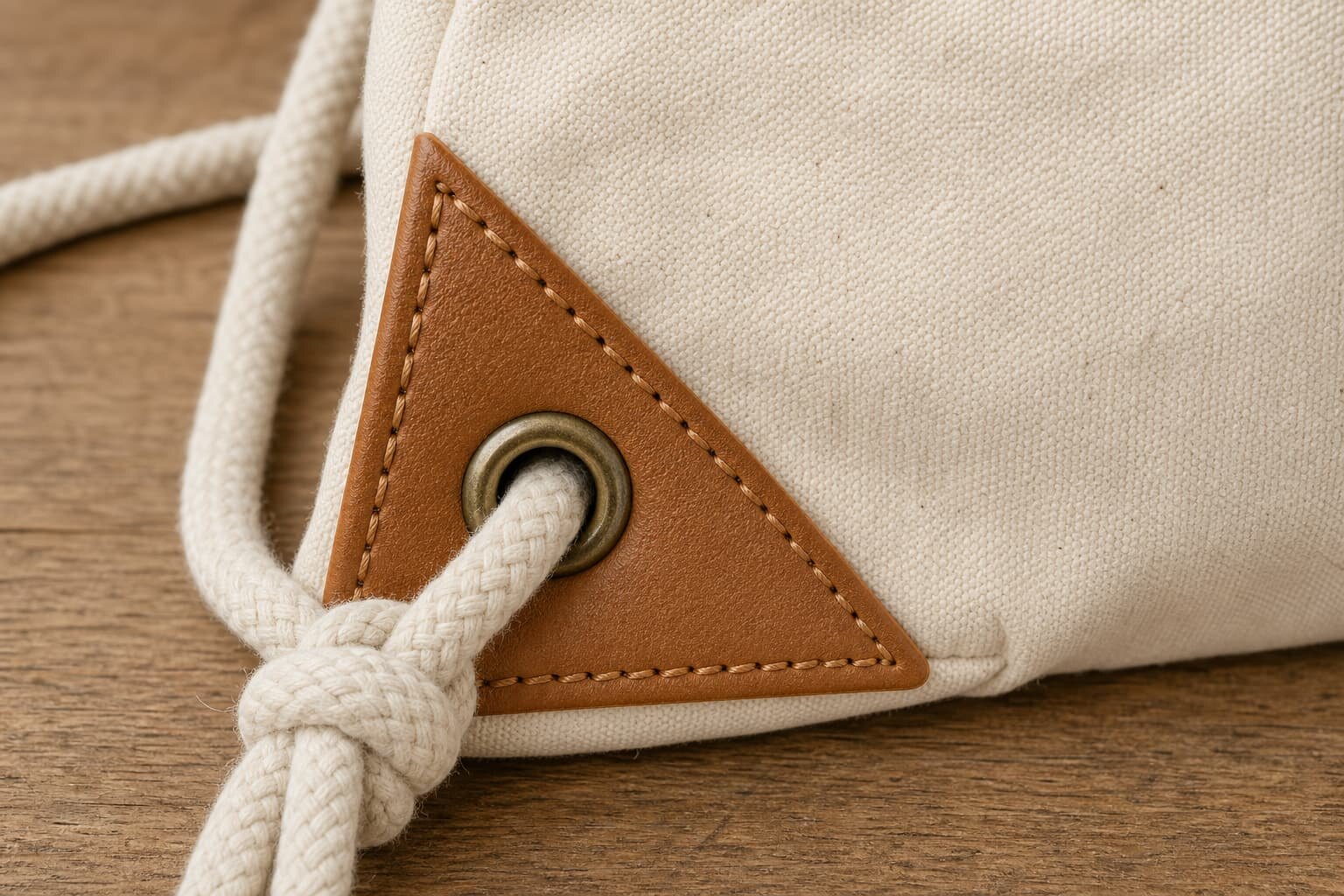
A drawstring backpack looks simple, but the structure changes how it folds and packs. A thin 190 GSM polyester bag with 4 mm cord can lie flat and pack tightly. A 10 oz cotton canvas drawstring backpack with reinforced corners, metal eyelets, a front zipper pocket, and thicker rope cord needs more carton space. If the supplier gives a carton quantity before confirming these details, the number is only a guess.
The buyer should define the finished bag size, fabric weight, lining if any, cord type, reinforcement, print area, and accessories before asking for final carton data. Front pockets, zipper heads, PU patches, woven labels, reflective strips, or metal eyelets can create pressure points during packing. These pressure points may leave marks on cotton canvas or transfer dents onto printed panels if bags are compressed too tightly.
- Common light promo spec: 190-220 GSM polyester, simple front print, polyester cord, no pocket.
- Common cotton spec: 6-10 oz cotton canvas, cotton or polyester cord, screen print or heat transfer logo.
- Heavier retail spec: 10-12 oz canvas, reinforced bottom corners, metal eyelets, zipper pocket, woven label.
- Higher bulk spec: thick cord, padded panel, lining, or hardware that increases folded thickness.
How fabric weight changes packing quantity and freight cost
Fabric GSM is one of the fastest ways carton planning becomes inaccurate. A quote based on 190 GSM polyester cannot be compared directly with a quote based on 220 GSM polyester or 10 oz canvas. A heavier fabric increases product weight and folded thickness. It may also require a larger carton or fewer pieces per carton to avoid crushed corners, hard creases, and carton bulging.
For import costing, ask the supplier to show the packing assumption next to the fabric spec. If your order is near an MOQ break point, carton quantity can also affect the final landed cost. A factory may quote a competitive unit price but use a packing method that increases total CBM. For air freight, gross weight may matter more. For sea freight LCL, CBM often becomes the key cost driver. Your RFQ should make the supplier reveal both.
- Quote line example: 210 GSM polyester drawstring backpack, 100 pcs/carton, estimated carton 45 x 40 x 35 cm.
- Quote line example: 8 oz cotton canvas drawstring backpack, 60 pcs/carton, estimated carton 50 x 42 x 38 cm.
- Quote line example: 10 oz canvas with zipper pocket, 40-50 pcs/carton depending on folded size and accessories.
- Always check whether quoted carton data is estimated or confirmed from a packed sample.
Choose folding and inner packing based on print risk
Most carton damage complaints for drawstring backpacks are not caused by the carton itself. They come from print surfaces rubbing against each other, cords pressing into printed panels, or bags being packed before the print is fully cured. Screen print, heat transfer, rubber ink, puff print, metallic ink, and large white prints on dark fabric all need more careful packing than a small one-color logo.
The safest standard for printed drawstring backpacks is usually flat fold with the printed panel facing inward or protected. For individual retail packing, one piece per polybag keeps the bag clean and makes barcode control easier. For bulk promotional orders, 10 to 25 pieces per master polybag may be acceptable, but the supplier should still control cord placement and print-to-print contact. If the order uses water-based ink or discharge print, confirm curing and washing conditions before mass packing.
- Use face-in folding when the logo print is large, raised, metallic, or light-colored.
- Add tissue, interleaf, or print protector when the print surface may block or rub.
- Keep cords tucked away from printed areas to prevent pressure marks.
- Do not pack immediately after printing if the ink needs curing or cooling time.
- For heat transfer, check peeling and edge lifting after folded storage.
Set carton weight limits that warehouse teams can handle
Factories often try to optimize packing by putting more pieces into each carton. This can reduce carton count and sometimes CBM, but it can create other problems. If a carton becomes too heavy, it is more likely to burst, deform, or be dropped during handling. Receiving teams may also complain if every carton requires two people to lift. For drawstring backpacks, a practical gross weight limit is often below 15 to 18 kg unless the buyer has approved a heavier handling standard.
The right limit depends on fabric weight, destination rules, warehouse process, and shipping mode. A distributor shipping cartons onward by courier may prefer smaller cartons, even if the carton count increases. A full-container buyer may accept larger cartons if palletization is controlled. The mistake is to let the supplier choose carton weight only for factory packing convenience. Put the maximum gross weight into the RFQ and ask the factory to propose the best pieces per carton under that limit.
- For manual warehouse handling, keep cartons light enough for one person where possible.
- For courier or parcel re-shipment, avoid oversized cartons that exceed service limits.
- For LCL sea freight, check both gross weight and CBM because either can affect cost.
- For retail DC delivery, confirm whether the buyer has carton weight and size rules.
Specify carton marks before sealing the cartons
Carton marking is a low-cost detail that prevents expensive receiving delays. A drawstring backpack order may include several colors, sizes, artwork versions, or promotional kits. If cartons are marked only with a generic product name and quantity, the warehouse may need to open cartons to identify SKUs. This creates labor cost and increases the chance of shortage claims.
A useful carton mark should match the buyer's PO and packing list. At minimum, it should show PO number, item or SKU, color, quantity per carton, carton number, gross weight, net weight, carton size, and destination mark if required. If country of origin marking is required on the carton, confirm the exact wording before production. Do not wait until the final inspection day to discuss carton marks because changing sealed cartons wastes time and may delay vessel booking.
- Use one color or one SKU per carton when receiving accuracy is more important than small packing savings.
- If mixed cartons are necessary, print the mix ratio clearly on the carton and packing list.
- Match carton numbers to the final packing list so the buyer can trace shortages.
- Confirm barcode carton labels separately if the retail DC requires them.
Connect MOQ logic with packing decisions
MOQ is not only about fabric buying and printing setup. Packing materials also have minimum quantities. Custom polybags, barcode labels, hangtags, insert cards, printed cartons, and carton stickers may each have their own MOQ or setup cost. If your drawstring backpack order is small, the factory may quote standard plain polybags and standard export cartons unless you specify otherwise.
For larger orders, packing can be optimized by SKU. For example, a single-color promotion order may use bulk packing with master polybags to save cost and reduce plastic. A retail order with multiple SKUs may require one-piece polybags, barcode stickers, and carton-level labels. Buyers should tell the factory whether the order is for direct consumer handout, retail shelf, ecommerce fulfillment, or distributor storage. The correct packing method depends on the route after import, not only on the factory's normal practice.
- Low MOQ orders usually work best with standard export cartons and standard clear polybags.
- Retail programs may need custom barcode labels, hangtags, warning text, or suffocation notices.
- Distributor bulk orders may accept master polybags to reduce handling and packaging cost.
- Custom printed cartons should be costed separately unless the volume justifies them.
Build the packing spec into sample approval
Many buyers approve the bag sample but forget to approve how the bag is folded and packed. This is risky because the mass production packing method can change the appearance of the product. Cotton canvas can hold strong fold lines. Heat transfer prints may show pressure marks. Thick cords may press into the bag body. Metal eyelets can rub against neighboring bags if the carton is too tight.
Ask the factory to send packing photos or a packed sample once the pre-production sample is approved. The review should include folded size, cord position, polybag type, carton layout, carton mark, and carton quantity. If the order is large or the logo print is sensitive, request a short storage test: fold and pack several printed pieces for a few days, then open them and check for blocking, odor, color transfer, print cracking, or pressure marks.
- Approve one open bag photo, one folded bag photo, and one packed carton photo.
- Check whether the sample polybag size matches mass production, not just any available bag.
- Confirm that the printed logo is not directly rubbing against cord knots, eyelets, or zipper pulls.
- Ask inspection to open inner packs, not only count sealed cartons from the outside.
Use quote data to compare suppliers fairly
A clean supplier quote for drawstring backpacks should not stop at unit price. It should show product material, fabric GSM, print method, accessory details, packing method, pieces per carton, estimated carton size, gross weight, net weight, lead time, sample time, MOQ, and trade terms. Without those details, the buyer cannot compare quotes fairly. One supplier may include individual polybags and barcode labels, while another quotes bulk packing. One may use 8 oz canvas, while another uses 6 oz.
When reviewing quotes, separate product cost, decoration cost, packing cost, and freight impact. This does not mean the factory must disclose every internal cost, but the quote should make the assumptions visible. If a supplier cannot explain carton CBM, print protection, or carton mark handling, the risk will move to inspection or receiving. A professional factory should be able to revise the quote when the buyer changes packing from bulk pack to individual polybag or from mixed colors to one SKU per carton.
- Compare fabric weight and construction before comparing unit price.
- Compare print method and number of colors before accepting a lower quote.
- Compare packing method because it affects labor, material, carton volume, and claims.
- Compare lead time with print curing, packing approval, and carton label preparation included.
- Compare total estimated CBM, not only pieces per carton.
Lead time impact: printing, curing, packing, and inspection
Carton packing can affect lead time more than buyers expect. Drawstring backpacks with simple one-color screen print may move quickly after sewing. Orders with heat transfer, rubber ink, puff print, reflective print, or large solid print areas may need extra curing or cooling time before folding. If the factory rushes packing, the buyer may see blocking, ink odor, surface tackiness, or transfer marks when cartons are opened.
Include packing approval in the production schedule. A realistic workflow is material preparation, cutting, printing, sewing, trimming, thread cleaning, final checking, folding, inner packing, carton packing, carton marking, and inspection. If the buyer needs a pre-shipment inspection, the cartons must be ready early enough for the inspector to open and check them. Last-minute carton mark changes, barcode label delays, or unclear packing ratios are common reasons shipments miss planned closing dates.
- Ask for sample lead time and mass production lead time separately.
- Confirm whether print curing time is included in the quoted lead time.
- Approve carton marks before mass packing begins.
- Schedule inspection after enough cartons are packed, but before all goods are sealed beyond correction.
- Leave time to correct packing errors without missing vessel or courier cutoff.
Specification comparison for buyers
| Spec decision | Recommended option | When it fits | Buyer risk to check |
|---|---|---|---|
| Fabric weight for carton planning | 190-220 GSM polyester for lightweight promo bags; 8-10 oz cotton canvas for retail or merchandise programs | Use lighter GSM when freight cost and event volume matter; use canvas when structure and perceived value matter | Do not compare carton quantities without confirming fabric GSM because thicker fabric reduces pieces per carton |
| Folding method | Flat fold with cords tucked inside and print facing inward or protected by tissue | Best for screen printed, heat transfer, or large logo backpacks | Exposed print surfaces can rub during sea freight and show scuff marks before unpacking |
| Inner packing | 1 piece per polybag for retail; 10-25 pieces per master polybag for bulk distribution | Retail buyers need barcode control and clean shelf handling; distributors may prefer faster bulk unpacking | Individual polybags increase packing cost and carton volume; bulk packs increase handling marks if not controlled |
| Carton weight limit | Keep gross weight usually under 15-18 kg unless the buyer approves heavier export cartons | Suitable for manual handling, courier sampling, and mixed warehouse teams | Very heavy cartons save a little volume but increase burst risk, worker handling complaints, and receiving damage |
| Carton size control | Ask supplier to quote carton dimensions after confirming fold size and pieces per carton | Needed for freight estimate, pallet planning, and warehouse slotting | A low unit price can be offset by oversized cartons with poor CBM efficiency |
| Carton marking | Use buyer PO, SKU, color, quantity, carton number, gross/net weight, carton size, country of origin if required | Works for import receiving, distributor allocation, and retail DC intake | Missing or inconsistent carton marks cause receiving delays even when the product itself is correct |
| Mixed color packing | One color per carton unless buyer approves a mixed-color carton layout | Best for wholesale, retail replenishment, and barcode control | Mixed cartons reduce factory handling cost but can create shortage claims if color count is not easy to verify |
| Print protection | Allow full curing time, use face-in folding, and add tissue or interleaf for sensitive prints | Important for rubber ink, puff print, metallic ink, heat transfer, or dark fabric with light print | Packing too soon after printing can cause blocking, odor, transfer marks, or peeling during inspection |
Buyer checklist before sampling
- Confirm fabric type and weight before approving carton quantity per carton.
- Specify folded size target, cord position, and whether logo faces inward or outward.
- State whether packing is individual polybag, bulk polybag, retail hangtag, barcode sticker, or no plastic.
- Set maximum acceptable carton gross weight and carton burst strength requirement if known.
- Require carton dimensions, gross weight, net weight, and pieces per carton in the formal quote.
- Define whether each carton contains one SKU/color only or mixed colors by approved ratio.
- Ask for pre-production packing photos using the approved sample and carton layout.
- Check whether print curing time affects packing date and final lead time.
- Confirm carton mark format before mass packing begins, not after goods are sealed.
- Request final packing list by PO, SKU, carton number, quantity, gross weight, and CBM before shipment booking.
Factory quote questions to send
- What fabric GSM or oz weight is your quote based on, and how does it affect pieces per carton?
- What is the proposed folded size of one drawstring backpack before polybagging?
- How many pieces are packed per inner polybag and per export carton?
- What are the estimated carton dimensions, gross weight, net weight, and total CBM for my order quantity?
- Is the quoted price based on individual polybag, bulk pack, barcode sticker, hangtag, or plain carton packing?
- How will the printed logo be protected from rubbing, blocking, or transfer marks during packing and shipment?
- Can you keep one color or one SKU per carton, and is there any packing surcharge for this requirement?
- What carton material or burst strength do you normally use for export drawstring backpack orders?
- At what production stage will you send packing photos for approval?
- Will the sample packing match mass production packing, including fold method, polybag, carton marks, and carton quantity?
Quality-control points to confirm
- Measure finished bag size and folded size against the approved packing spec before carton loading.
- Check fabric GSM, drawcord diameter, seam strength, and print position before confirming carton quantity.
- Inspect print dryness, adhesion, and rubbing resistance before bags are folded together.
- Verify pieces per polybag, polybags per carton, and total carton quantity against the packing list.
- Check that cords are not trapped in seams, zip pulls, eyelets, or carton flaps during folding and sealing.
- Confirm carton gross weight does not exceed the buyer-approved maximum.
- Compare carton marks with PO, SKU, color, quantity, carton number, and destination requirements.
- Open several sealed cartons during final inspection to confirm packing consistency, not only top-layer appearance.
- Check whether mixed-color cartons, if approved, follow the exact ratio and are clearly labeled.
- Confirm cartons pass normal handling condition: no bulging, crushed corners, weak tape, or loose straps.