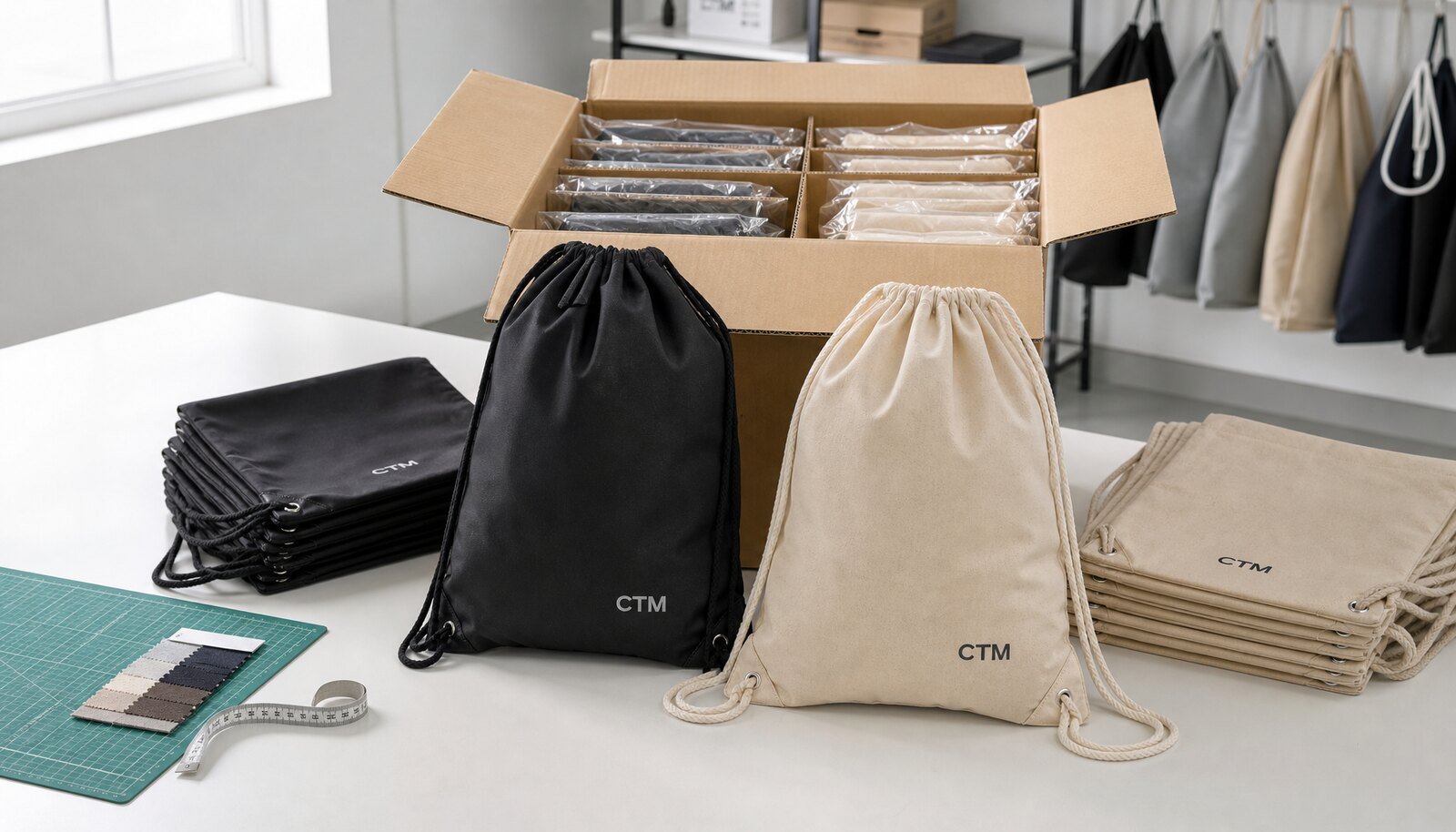
Why Carton Packing Belongs in the Buying Specification
Drawstring backpack carton packing is not a back-office detail. It affects quoted freight, warehouse receiving, barcode control, print condition, carton damage claims, and the buyer's ability to compare suppliers fairly. The same bag can be quoted with different folding methods, pieces per carton, carton grades, polybags, paper bands, and carton marks. If those assumptions are not visible in the RFQ, the lowest unit price may not be the lowest landed cost.
A procurement-ready specification separates the backpack itself from the packing plan. The product line should define fabric, size, construction, cord, accessories, and print. The packing line should define unit pack, inner bundle, export carton, carton quantity, carton dimensions, N.W., G.W., total CBM, SKU rules, and carton mark layout. This prevents a common problem: the buyer approves a price, then discovers after sampling that the cartons are larger, heavier, weaker, or less warehouse-ready than expected.
The best approach is not to force one universal carton count. A light promotional polyester bag, a retail cotton bag, and a heavy canvas merchandise bag need different packing priorities. The useful rule is to make the supplier show the basis of the carton data and update it after the approved sample is packed.
- Do not compare FOB prices unless the packing method and carton assumptions are also compared.
- Ask for carton data at quotation, then require an update after sample approval.
- Treat carton packing as part of QC and logistics, not only as factory convenience.
- Write SKU rules and carton mark requirements into the PO or packing instruction.
- Keep estimated ranges clearly labeled until a packed sample or trial carton confirms them.
Start With Bag Construction Before Asking for Pieces per Carton
The question 'How many pieces per carton?' should come after the bag specification is stable. Finished size, fabric weight, drawcord thickness, eyelets, reinforced corners, zipper pockets, lining, foam panels, hangtags, and unit packaging all change the carton count. A number taken from a previous order may be useful for early budgeting, but it should not become the final packing rule without confirmation.
A 210D polyester drawstring backpack is usually thinner and more compressible than a 120 GSM cotton bag. A 6 oz or 8 oz canvas bag can look premium but becomes heavy quickly. A bag with thick cotton rope, metal eyelets, PU corner patches, or a front zipper pocket may need fewer pieces per carton than a flat promotional bag of the same open size.
The folded size matters as much as the open size. A 38 x 45 cm backpack folded once with cords tucked inside packs differently from the same bag folded twice with cords laid flat. The fold also determines whether a printed panel bends across a heavy ink edge or sits under pressure.
- State open size and expected folded size if your warehouse or retail team has a preference.
- Identify material clearly: 210D polyester, 300D polyester, 120 GSM cotton, 6 oz canvas, 8 oz canvas, jute blend, or nonwoven.
- List construction details that add bulk: lining, gusset, zipper, mesh pocket, eyelets, patches, metal tips, and thick cords.
- Confirm print method, print size, ink coverage, and whether artwork crosses a fold line.
- Require revised carton data if any fabric, accessory, packaging, or folding detail changes.
Select Packing Method by Channel, Not Habit
Bulk pack can be appropriate for event handouts, internal campaigns, and orders that will be repacked locally. It can reduce packaging material, labor, carton volume, and waste. The tradeoff is less unit-level protection, more risk of cord tangling, slower unit counting, and less control if cartons are opened in multiple locations.
Individual packing is more useful when the bag moves through retail, ecommerce, distributor allocation, or barcode-controlled receiving. A recycled polybag, paper belly band, hangtag, or label can improve presentation and traceability. It also adds cost, labor, packaging waste, and sometimes carton volume. Buyers should compare the operational value against the cost rather than defaulting to a premium pack.
A middle option often works well: counted inner bundles inside the export carton. Bundles of 10, 20, or 25 pieces can speed receiving without fully retail-packing each unit. For many promotional orders, this gives enough count control while keeping packaging lean.
- Event handout: bulk pack or counted bundles may be sufficient if print and cleanliness risks are controlled.
- Distributor stock: one SKU per carton and clear carton marks usually matter more than premium unit packaging.
- Retail shelf: consistent folding, barcode, hangtag, and clean unit presentation are usually required.
- Ecommerce: confirm barcode scan position, polybag seal, warning text, and fulfillment-bin fit.
- Local repacking: avoid paying for retail packaging that will be removed immediately after import.
Use Carton Ranges for Budgeting, Then Confirm With a Packed Sample
Typical carton ranges are useful only when they are treated as examples. A light 210D polyester drawstring backpack may fit far more pieces than a cotton or canvas version, but the final number depends on finished size, print area, cord bulk, folding method, and packaging. A supplier estimate of 100, 150, or 200 pieces per carton should be labeled as an estimate until a trial pack confirms it.
For early freight planning, ask for carton dimensions in centimeters and the calculation behind the CBM. For example, a 50 x 40 x 40 cm carton equals 0.080 CBM. If the carton holds 100 pieces, the carton volume is 0.0008 CBM per piece before pallet factors. If the same bag requires individual packaging and the carton holds 80 pieces, the CBM per piece increases to 0.0010. On a large order, that change can affect freight noticeably.
Gross weight should be reviewed separately from volume. Polyester bags may fill the carton before weight becomes the limiting factor. Canvas bags may hit a safe handling limit before the carton is full. If your warehouse, retailer, or courier has a maximum carton G.W., state it in the RFQ and ask the supplier to adjust pieces per carton accordingly.
- Label carton data as estimated, similar-order based, trial-pack based, or approved-sample based.
- Request total CBM and CBM per piece when comparing landed cost.
- Check whether dimensional weight or actual weight controls air and courier shipments.
- For heavy cotton or canvas, set a maximum carton G.W. before production.
- Reject carton plans that require the factory to force the last layer into the carton.
Compare Unit Pack, Inner Pack, and Export Carton Costs Together
Packing cost is not only the price of a polybag or carton. It includes labor, material, carton volume, gross weight, barcode handling, inspection time, waste targets, and receiving efficiency. A lower packing cost can be the wrong decision if it creates rework at the warehouse. A higher packing cost can also be unnecessary if the goods are handed out at an event and never enter retail inventory.
Procurement teams should ask for packing alternatives in the same quote format. Quote A may be bulk pack. Quote B may be counted inner bundles. Quote C may be individual recycled polybag with barcode. Quote D may be paper band plus hangtag. Each line should show unit price, included packaging, pieces per carton, carton dimensions, N.W., G.W., carton count, and total CBM.
This structure makes tradeoffs visible. If individual packaging increases unit cost and CBM but removes local relabeling labor, it may be justified. If paper bands look better but reduce carton efficiency, the buyer can decide based on channel need rather than guesswork.
- Ask whether export cartons, inner bundles, labels, hangtags, and packing labor are included in the unit price.
- Quote alternate packing options side by side instead of relying on one factory default.
- Compare carton count, CBM, G.W., and receiving value together.
- Confirm whether barcode printing, barcode application, and scan testing are included.
- Update the landed-cost comparison after the packed sample changes the carton data.
Protect Printed Panels Before Folding and Compression
Print defects often appear after packing, not on the loose sample table. Screen print, heat transfer, puff print, reflective print, rubberized ink, and large solid logos can react differently under pressure. If printed panels touch each other before curing is complete, cartons may open with blocking, ghosting, dull patches, gloss differences, color transfer, cracking, or pressure lines.
The packing instruction should show how the printed panel is folded, whether print-to-print contact is allowed, and whether interleaving is required. Small one-color logos may need only normal curing and careful folding. Large ink coverage, raised print, transfer edges, and reflective materials may need face-out folding, longer curing time, a lower carton quantity, or separation paper. These choices affect cost and lead time, so they should be decided before mass production.
Buyers should inspect a packed-carton sample, not only a loose pre-production sample. Open a carton after normal compression, remove units from the top, middle, and bottom, and check the logo surface. Where appropriate, use a clean white cloth rub check and a gentle peel or bend check suitable for the print method.
- Ask how long the print cures before folding and sealing cartons.
- Confirm whether printed surfaces touch printed surfaces in the folded state.
- Avoid folding directly across thick heat-transfer or puff-print edges where possible.
- Use interleaving only when the print risk justifies added material and cost.
- Add a packed-carton print check for large logos and specialty inks.
Specify Carton Strength, Tape, and Moisture Controls
Writing 'standard export carton' is not enough for every drawstring backpack order. Carton strength should match product weight, route, stacking, palletization, and handling risk. A light polyester order may perform well in a normal export carton. A heavy cotton, canvas, or jute order moving by LCL sea freight or through multiple inland transfers may need a stronger carton and tighter inspection.
Regional grade terms such as K=A, A=A, or 5-ply can be useful shorthand, but they are not universal performance guarantees. Board quality, flute type, carton dimensions, moisture exposure, tape quality, and stacking method also matter. Ask the supplier to state the carton construction used for the quoted plan and provide a carton photo, sample, or equivalent strength reference for important orders.
Moisture control is especially important for cotton, canvas, jute, and natural fibers. Goods should be dry before packing. Cartons should not be stored on wet floors or sealed in damp conditions. Desiccant may help on some routes, but it does not fix wet goods or wet cartons. Inspection should include odor, hand feel, visible mildew risk, and carton softness.
- Define a maximum carton G.W. if your receiving operation has one.
- Ask for carton construction instead of accepting only the phrase 'export carton.'
- Check tape width, seam closure, crushed corners, bulging, and weak sidewalls.
- For absorbent fabrics, inspect dryness and odor before shipment release.
- Use desiccant as part of a moisture plan, not as a cure for poor storage.
Control SKU, Color, Language, and Destination Packing
A shipment can contain good backpacks and still fail receiving if cartons are hard to identify. This risk increases when the order includes multiple colors, artwork versions, language labels, school names, store allocations, or destinations. Similar colors such as navy and black can be confused. Similar logos can be mixed if carton marks use only factory item numbers.
The safest rule is one SKU per carton. It simplifies counting, scanning, warehouse slotting, and claims. If the program needs a fixed assortment, the exact ratio must be written into the PO, packing instruction, packing list, and carton mark. A carton mark that only says 'assorted' is not enough unless the receiving team has approved that language.
Carton marks should use buyer-facing codes. Include buyer PO, buyer SKU, color name or color code, quantity, destination if required, carton number, total carton count, N.W., G.W., and country-of-origin marking where applicable. For split shipments, request carton mark photos before release so errors can be corrected before goods leave the factory.
- Use one SKU per carton unless a fixed assortment is approved in writing.
- Match carton marks to buyer SKU codes, not only supplier style numbers.
- List exact assortment ratios when mixed cartons are required.
- Use carton number sequences that match the packing list and delivery allocation.
- Approve carton mark photos before shipment for multi-destination orders.
Approve the Packed Sample, Not Only the Loose Backpack
A loose sample approval confirms the bag design. A packed sample approval confirms how the bag will arrive. It shows whether the folding method protects the print, whether cords are tidy, whether the polybag fits, whether the barcode scans, whether the carton is filled without forcing, and whether carton marks match the buyer's receiving system.
For simple promotional orders, clear photos and a short packing video may be enough. Ask the factory to show one folded unit, one unit in its final pack, an inner bundle if used, a partially filled carton, a full carton before sealing, the sealed carton, and the carton mark. For retail, ecommerce, strict warehouse programs, or heavy canvas orders, approving a physical packed carton sample may be worthwhile.
The approval should be practical enough for production workers to repeat. If cords must sit to one side, say so. If barcode labels must face outward through a clear bag, state it. If the carton cannot exceed a set G.W., include it in the packing instruction. Save the approved photos with the PO, artwork, and final inspection checklist.
- Approve folding direction, cord placement, polybag size, barcode position, and carton fill.
- Check the bag appearance after it is opened from the approved folded state.
- Confirm barcode labels scan without opening the polybag or untying bundles.
- Review carton mark layout before labels or cartons are printed in bulk.
- Share approved packing photos with production and QC teams.
Final Inspection Criteria for Packed Drawstring Backpacks
Final inspection should include product quality and packed-carton quality. A drawstring backpack can pass measurement, stitching, fabric, and logo checks while still causing complaints because cartons are overweight, labels do not scan, units are miscounted, prints are stuck together, or cartons collapse in transit. For B2B shipments, the carton is the handling unit that moves through freight and receiving.
The inspection plan should tell QC which cartons to open and what to record. If goods are palletized, sampling should include top, middle, bottom, outside edge, and inner stack positions where practical. This helps reveal pressure damage, moisture, compression, and inconsistent packing. QC should measure carton dimensions, weigh selected cartons, count units, verify inner bundles, scan barcodes, and compare carton marks to the PO and packing list.
For printed bags, inspectors should unpack units after compression and review the print surface. For cotton, canvas, jute, and other absorbent fabrics, they should check dryness, odor, and visible mildew risk. If the order has destination allocation, QC should confirm that carton sequencing and the packing list support the receiving plan before shipment release.
- Measure carton dimensions and calculate CBM against the approved packing plan.
- Weigh selected cartons and investigate large differences from approved G.W.
- Open cartons from multiple pallet positions, not only top cartons.
- Count pieces and inner bundles, then compare with the packing list.
- Check print condition, moisture, odor, barcode scan, cord placement, and carton mark accuracy.
- Release shipment only when carton photos, packing list, and inspection results are consistent.
Specification comparison for buyers
| Packing scenario | Typical carton approach | Typical data to request | Buyer risk to check |
|---|---|---|---|
| Light event giveaway: 210D polyester or 70-90 GSM nonwoven | Bulk pack or counted inner bundles; carton quantity depends on bag size, print area, cord thickness, and compression tolerance | Example only: supplier may estimate 100-200 pcs/carton; request carton L x W x H, N.W., G.W., total cartons, and whether the estimate is sample-based | Thin fabric can crease, cords can tangle, and large prints may mark if packed before curing |
| Retail cotton bag: 120-180 GSM cotton | Individual recycled polybag, paper belly band, hangtag, or barcode label, then counted cartons | Example only: carton quantity may drop after hangtag, barcode, folded size, and packaging material are added; confirm with approved packed sample | Wrinkles, moisture, label position, barcode readability, and warning text must be approved before bulk packing |
| Heavy canvas school or merchandise bag: 6-8 oz canvas | Lower pieces per carton, stronger export carton, and less compression | Ask supplier to calculate carton quantity against your maximum carton G.W.; many buyers set internal limits, but the limit must come from your receiving rules | Carton weight may exceed handling limits before the carton is full; canvas can crease and weak cartons can bulge |
| Large-logo or specialty-print order | Fold to avoid print-to-print pressure; use interleaving or reduced carton quantity only when the print risk justifies it | Request curing time, folding photo, print-contact rule, rub test result, and first packed-carton opening check | Blocking, ghosting, gloss change, cracking, or transfer can appear after cartons sit under pressure |
| Distributor or ecommerce SKU-controlled order | One SKU per carton unless a written fixed assortment is required | Request SKU, color, barcode file, carton number sequence, carton mark proof, packing list format, and scan test photo | Mixed SKUs, unclear carton marks, or unscannable labels slow receiving even when the bags are acceptable |
| Air or courier shipment | Carton optimized for dimensional weight as well as product protection | Request carton dimensions in cm, total CBM, G.W., and the dimensional-weight divisor used by the forwarder or courier | Oversized cartons can erase a low unit price; carton data must be updated after final packaging is approved |
| Sea freight LCL or long inland transit | Stronger carton, moisture checks, careful pallet stacking, and carton-opening inspection | Request carton construction or equivalent strength reference, desiccant plan if applicable, pallet loading photos, and final carton condition check | Weak cartons deform under stack load; cotton, canvas, and jute can absorb moisture during long routes |
Buyer checklist before sampling
- Lock the finished bag size, fabric type, GSM or oz weight, lining, gusset, zipper pocket, eyelets, reinforced corners, and drawcord thickness before accepting pieces-per-carton data.
- State the sales channel: event handout, retail shelf, ecommerce fulfillment, distributor stock, school program, warehouse allocation, or local repacking.
- Ask suppliers to quote bulk pack, counted inner bundle, individual recycled polybag, and paper band or hangtag options separately when you are comparing landed cost and waste.
- Require pieces per carton, carton dimensions, N.W., G.W., total carton count, total CBM, and a clear note showing whether the figures are estimated, similar-order based, or approved-sample based.
- Set a maximum carton G.W. if your warehouse, retailer, courier, or safety policy has one; do not rely on the supplier's normal carton weight.
- Approve folding direction, cord placement, polybag size, label position, barcode visibility, carton fill, carton mark format, and mixed-SKU packing rules before mass packing starts.
- For sensitive prints, confirm curing time, print-to-print contact rules, interleaving requirement if any, and a packed-carton rub or blocking check.
- Use one SKU per carton unless a fixed assortment is written into the PO, packing instruction, packing list, and carton mark.
- Include carton dimensions, carton condition, moisture, odor, barcode scan, print condition after unpacking, carton count, and carton mark verification in the final inspection instruction.
- Require updated carton data after pre-production sample approval and before freight booking, especially if fabric, print, accessories, or packaging changed after quotation.
Factory quote questions to send
- For this exact finished size, fabric weight, drawcord, print method, and accessory set, how many pieces do you recommend per export carton, and what is the reason for that count?
- Are the carton dimensions, N.W., G.W., and CBM based on a catalog assumption, a similar order, a trial pack, or the approved pre-production sample?
- Can you quote bulk pack, counted inner bundle, individual recycled polybag, and paper belly band or hangtag packing as separate lines with carton data for each?
- What carton gross weight do you expect, and can you reduce pieces per carton if our warehouse or courier limit is lower?
- What carton construction will be used for this route and weight, and can you provide a carton photo, specification, or equivalent strength reference?
- Will any printed surface touch another printed surface after folding, and what folding method prevents blocking, ghosting, gloss marks, or pressure lines?
- How long will screen print, heat transfer, puff print, reflective print, rubberized ink, or other specialty printing cure before folding and carton sealing?
- If the order has multiple colors, SKUs, languages, or destinations, will cartons contain one SKU only or a fixed written assortment?
- Can the packing approval include photos or video of the folded unit, polybag or band, barcode label, inner bundle, full carton before sealing, and carton mark?
- At final inspection, can QC open cartons from top, middle, bottom, and edge pallet positions to check quantity, moisture, print condition, cord placement, carton damage, and carton mark accuracy?
Quality-control points to confirm
- Measure actual carton length, width, and height, calculate CBM, and compare the result with the approved packing plan and freight booking data.
- Weigh selected cartons and compare N.W. and G.W. against the approved specification; investigate deviations that could indicate wrong count, missing accessories, wet goods, or changed packing.
- Open cartons from different pallet positions, not only the easiest top cartons, to check pressure marks, print blocking, fabric creasing, cord deformation, and carton compression.
- Count units in sampled cartons and verify inner bundles, assorted ratios, SKU codes, carton numbering, and packing list quantities.
- Inspect individual polybags, paper bands, hangtags, and barcode labels for correct size, seal quality, warning text if required, scan readability, and no trapped moisture.
- For cotton, canvas, jute, or other absorbent materials, check odor, hand feel, dryness, and visible mildew risk before approving sealed cartons.
- For printed bags, perform appropriate rub, peel, and unpacking checks after carton compression, especially on large screen prints, heat transfers, puff prints, reflective inks, and rubberized prints.
- Check drawcords are even, not tangled, not caught in seams, and not sharply bent by tight folding or over-compression.
- Verify carton marks show buyer PO, SKU, color, quantity, destination if required, carton number, total carton count, N.W., G.W., and country-of-origin marking where applicable.
- Save final packing photos, carton mark photos, pallet photos if used, packing list, and signed inspection report before shipment release.