Why AQL Must Be Written Before the Drawstring Backpack Order
A drawstring backpack looks simple, but the usual quality problems are not simple once the goods are packed and ready to ship. A missing drawcord, weak corner seam, wrong logo color, or mixed carton can create the same receiving problem as a more expensive bag. AQL inspection gives the buyer and factory a common rule for how many defects are acceptable in a random sample, but it only works when the defect rules are written before production.
For procurement teams, the main buying problem is not choosing a beautiful inspection standard. It is converting your product expectations into inspection points the factory can quote, produce, and check. If the RFQ only says good quality or standard AQL, the supplier may inspect mainly appearance and ignore load-bearing seams, print curing, carton packing, or SKU separation. A proper checklist also helps compare quotes because a factory quoting reinforced corners, heavier fabric, and individual packing is not pricing the same product as a factory quoting a thin event giveaway bag.
- Use AQL as a commercial agreement, not only a third-party inspection form.
- Attach the AQL defect list to the RFQ or purchase order before deposit payment.
- Separate critical, major, and minor defects so the factory knows what cannot ship.
- Make fabric, print, stitching, and packing measurable wherever possible.
Choose the Right AQL Level for the Order Value and Selling Channel
Most drawstring backpack inspections use ANSI/ASQ Z1.4 or ISO 2859-1 sampling logic. For general export orders, General Inspection Level II is a practical default because it gives a balanced sample size without inspecting too few pieces. Some very low-cost promotion orders use Level I to reduce inspection time, but this increases risk. Retail or brand-sensitive shipments may use Level II with tighter acceptance numbers for major defects, especially when logos, barcodes, and packaging are important.
A common structure is Critical 0, Major 2.5, Minor 4.0. This means any critical defect can fail the inspection, while major and minor defects are judged against the allowed quantity in the selected sample size. Buyers should not copy these limits blindly. If the bag is for children, sports clubs, retail shelves, or a brand launch, wrong logo, sharp parts, color bleeding, or severe odor may need stricter treatment. If the bag is a short-term event giveaway, you may accept slightly more cosmetic variation but still reject functional failures.
- Critical defects: unsafe parts, mold, needle fragments, wrong brand logo, prohibited packaging, severe odor.
- Major defects: open seams, missing drawcords, broken eyelets, print peeling, wrong size, wrong color, wrong SKU packing.
- Minor defects: small loose threads, slight crease marks, minor washable stains, small print specks within tolerance.
- Recommended RFQ wording: Final random inspection to AQL General Level II, Critical 0, Major 2.5, Minor 4.0 unless otherwise agreed in writing.
Define the Approved Sample So Inspectors Know What to Compare
The approved sample is the inspector's reference point. It should not be a rough concept sample made from substitute fabric unless that is clearly marked. For drawstring backpacks, the approved sample should show the final fabric weight, color, drawcord, seam construction, reinforcement method, logo size, logo color, label, and packing. If the buyer approves only a digital artwork file but not a physical print sample, the final inspection may become an argument about shade, placement, or handfeel.
For a practical RFQ, request one pre-production sample before bulk cutting and keep at least one sealed approved sample at the factory. If the logo uses screen printing, include print curing and rub resistance in the approval. If the fabric is cotton canvas, confirm shrinkage and shade before production. If the bag uses 210D polyester or coated polyester, check coating smell, fabric thickness, and whether the print sits cleanly on the surface.
- Measure finished bag width and height flat, not from an unfinished cut panel.
- Record fabric GSM for cotton, canvas, non-woven, and jute-based materials; record denier for polyester or nylon.
- Photograph logo placement from top edge, side seam, and bottom seam so tolerances are clear.
- Seal approved samples with date, order number, version number, and buyer signature or written approval.
Inspect Fabric Weight, Color, and Cutting Before Stitching Problems Appear
Fabric is where many quote differences hide. A 210D polyester drawstring backpack, a 190T polyester event bag, an 80 GSM non-woven promo bag, and an 8 oz cotton canvas retail bag can all be described as drawstring backpacks, but they have different strength, print results, carton weights, and costs. AQL inspection at the final stage can catch obvious fabric problems, but buyers should still request fabric details in the quote to avoid approving a price based on a weaker material.
During inspection, the fabric should be checked for shade consistency, coating defects, dirty marks, weaving flaws, and GSM or denier consistency where possible. Cutting accuracy also matters. If panels are cut off-grain or different sizes, the finished backpack may twist, the front print may appear tilted, or the drawcord channel may not close evenly. Small cutting errors become major when the bag carries a centered logo.
- Typical lightweight promo options: 190T polyester, 210D polyester, 75-100 GSM non-woven.
- Common stronger options: 300D polyester, 6 oz cotton, 8 oz cotton canvas, laminated jute blends.
- Useful tolerance example: finished size plus or minus 5 mm for small bags, plus or minus 10 mm for larger promotional backpacks.
- Reject major fabric defects when they are visible on the front panel, affect printing, or reduce seam strength.
Check Stitching, Drawcords, and Reinforcement as Functional Items
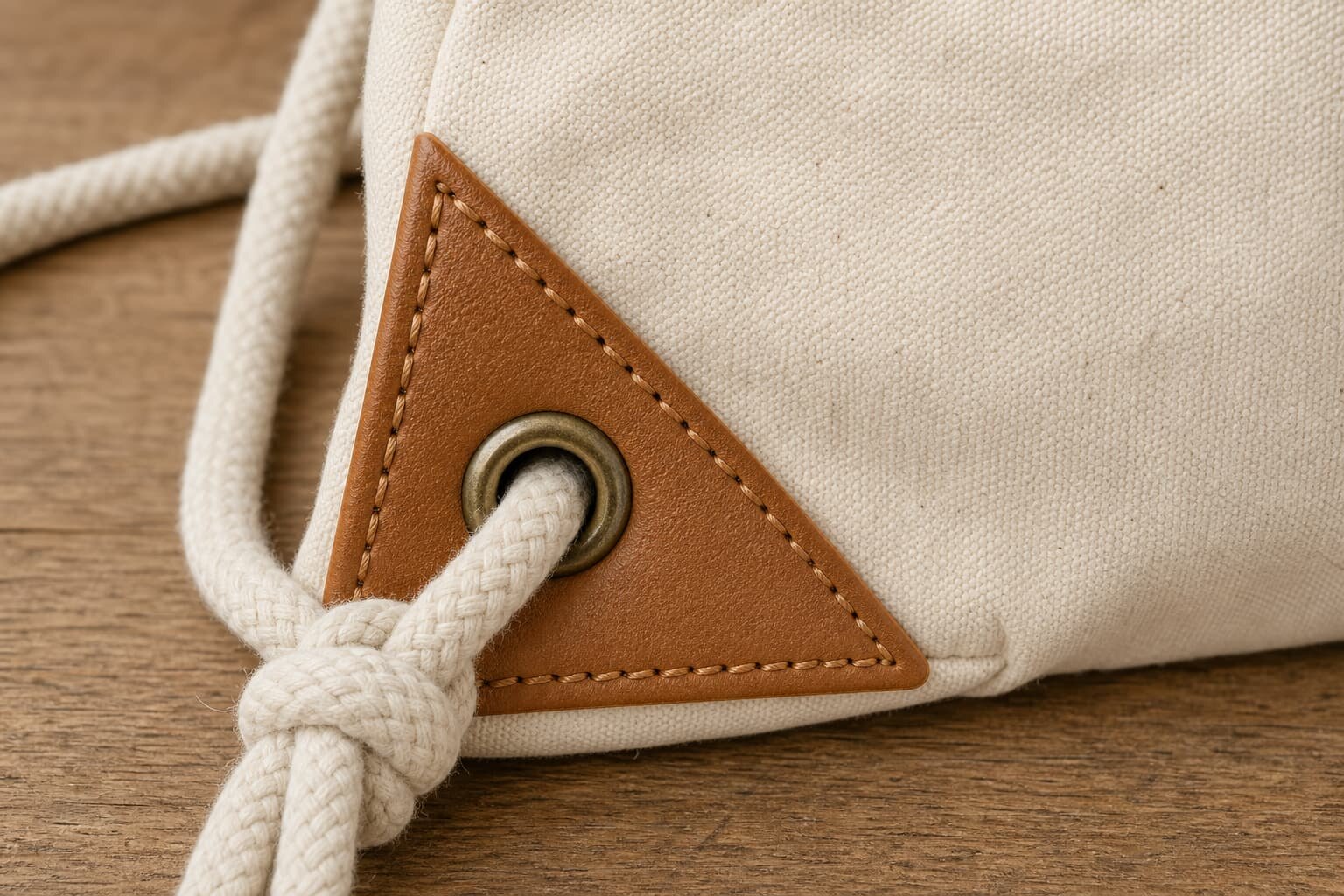
Drawstring backpacks usually fail in predictable places: side seam openings, bottom corner tearing, drawcord channel stitching, eyelet pull-out, and loose cord knots. These are functional defects, not cosmetic details. If the bag will carry shoes, bottles, catalogs, or school items, the RFQ should specify reinforcement instead of assuming the factory will choose it. Reinforced bottom corners, bartack stitches, metal eyelets, or stitched fabric tabs can all change the unit cost and the inspection standard.
A practical final inspection should include manual pull checks on the drawcord and corners. This does not replace a lab test, but it catches many weak sewing problems. Inspectors should pull both cords evenly, check whether the channel gathers smoothly, and confirm the cord does not cut through the fabric. For cotton rope or thick polyester cord, the channel width must be large enough to prevent jamming. For flat tape, twisting and fraying should be checked.
- Major defect examples: missing cord, different cord color, open channel seam, loose corner stitching, eyelet detached, cord too short to close.
- Minor defect examples: small loose thread, slightly uneven stitch length, cord end not trimmed neatly but still functional.
- Ask the factory how many stitches per inch are used on side seams and whether backstitching is included at stress points.
- For heavier bags, request reinforcement photos before production because this detail is often removed in low-price quotations.
Set Logo Inspection Rules for Screen Print, Heat Transfer, and Labels
Logo defects create the fastest commercial rejection because the bag is often bought for brand exposure. Screen printing is the usual choice for solid one-to-four-color logos on polyester, cotton, and non-woven bags. Heat transfer can handle gradients and fine detail but needs correct temperature, pressure, and curing. Woven labels or sewn side labels are better for some premium cotton or canvas drawstring backpacks, but the buyer must define label size, position, fold type, and stitch color.
The AQL checklist should define how to judge print color, size, position, adhesion, cracking, smudging, and registration. For Pantone matching, allow realistic tolerance based on fabric type. The same ink can look different on natural cotton, black polyester, and coated fabric. A buyer who needs tight brand color control should approve a strike-off on the final fabric, not only a digital proof. During final inspection, the logo should be compared against the approved sample under consistent lighting.
- Screen print risks: pinholes, poor opacity, ink bleeding, wrong curing, registration shift between colors.
- Heat transfer risks: peeling edges, glossy patch effect, poor wash resistance, heat marks on polyester.
- Woven label risks: wrong fold, loose stitching, label tilted, scratchy edge, wrong brand color.
- Useful tolerance example: logo position within plus or minus 5 mm for standard promo orders, tighter only when agreed before production.
Include MOQ Logic and Lead Time in the Inspection Planning
MOQ affects quality control more than many buyers expect. If the order uses stock fabric colors and a simple one-color logo, the factory may produce a smaller quantity with less material preparation risk. If the order needs custom dyed fabric, special drawcord color, custom zipper pocket, or many artwork versions, the MOQ usually increases because the factory must purchase fabric, dye lots, print screens, labels, and packaging materials. Low MOQ with too many variations can cause mixed shades, mixed cords, and packing errors.
Lead time should include sampling, material purchase, printing, sewing, packing, inspection, correction time, and export booking. A final random inspection should not be scheduled on the same day the factory claims production will finish. If problems are found, there must be time to sort, repair, reprint, or repack. For urgent promotional events, the buyer should decide before production which defects are shipment-blocking and which minor issues can be accepted with written concession.
- Stock fabric orders can usually move faster than custom dyed fabric because shade approval is simpler.
- Multiple logo versions need separate inspection counts to avoid one SKU passing while another has hidden defects.
- Reserve inspection time after goods are fully sewn and mostly packed, not while production is still on sewing lines.
- Ask for a production schedule with fabric arrival, print date, sewing start, packing date, inspection date, and shipment date.
Inspect Packing, Carton Marking, and Quantity Before Shipment Release
Many drawstring backpack claims are packing claims, not sewing claims. A distributor may receive good bags packed in the wrong color ratio. A retailer may reject cartons because barcodes are missing or the inner polybag warning is wrong. An importer may pay extra freight because carton dimensions changed after quote approval. The AQL inspection should include packing checks as a normal quality item, not as an afterthought.
Before final inspection, the buyer should provide a packing instruction with units per polybag, units per inner carton if any, carton quantity, carton marks, barcode placement, and SKU separation rules. If the bag is for retail, confirm hangtags, care labels, origin labels, suffocation warnings, and barcode scanability. If the bag is for event distribution, bulk packing may be acceptable, but carton strength and moisture protection still matter.
- Check quantity by carton and compare it with the packing list, not only the total production count.
- Measure carton dimensions and gross weight because freight estimates depend on this data.
- Reject major packing defects such as mixed SKUs, missing barcodes, wrong carton marks, wet cartons, or crushed export cartons.
- Use carton liners or moisture control for cotton, canvas, and jute-style bags when shipping routes are humid.
Use Defect Classification to Avoid Arguments During Inspection
The strongest AQL checklist is one that names likely defects before they happen. If a factory and buyer wait until inspection day to decide whether a print smudge is major or minor, the discussion becomes emotional and shipment timing creates pressure. The RFQ should include defect examples for the exact drawstring backpack design. This is especially important when the product has a front pocket, reflective strip, zipper pocket, reinforced corners, or multiple logo colors.
Classify defects based on customer impact. A tiny loose thread on the inside seam may be minor. A loose thread causing the side seam to open is major. A wrong logo or unsafe sharp object is critical. A slightly shifted logo might be minor for a low-cost giveaway if still presentable, but major for retail packaging where the logo must align with a hangtag window. Buyers should also state whether the factory may repair defects during inspection and how repaired items are rechecked.
- Critical: unsafe metal, needle, mold, wrong brand, severe chemical odor, child safety packaging failure.
- Major: function failure, wrong material, wrong size outside tolerance, missing parts, obvious front-panel stain, unreadable barcode.
- Minor: small thread end, slight crease, tiny print speck, small internal stain not visible in normal use.
- State that repaired goods must be segregated and rechecked before being counted as acceptable.
Quote Data Buyers Should Collect Before Comparing Suppliers
A low unit price is not meaningful unless the quotation includes enough production data to compare. For drawstring backpacks, ask each supplier to quote the same fabric weight, finished size, drawcord type, reinforcement, logo method, print size, packing, carton quantity, sample cost, mold or screen charges, lead time, and inspection terms. Without these fields, one supplier may remove reinforcement, use lighter fabric, bulk pack instead of individual polybags, or exclude barcode labeling.
Buyers should also request carton dimensions and weight before order confirmation when freight cost matters. A small change in carton quantity or packing style can affect volumetric weight. For large promotional orders, confirm whether the quoted price includes export carton quality strong enough for sea shipment or only light domestic cartons. When inspection is required, state whether the factory must have goods ready at least 80 percent packed and whether the buyer's inspector can open cartons randomly.
- Minimum quote data: fabric spec, size, logo method, logo size, cord spec, reinforcement, packing, MOQ, sample time, production time.
- Commercial data: unit price, tooling or screen charge, payment term, trade term, carton data, inspection responsibility.
- Quality data: AQL level, approved sample process, tolerance sheet, defect classification, reinspection rule.
- If two quotes differ by more than expected, compare GSM, reinforcement, print area, and packing before negotiating price.
Specification comparison for buyers
| Spec decision | Recommended option | When it fits | Buyer risk to check |
|---|---|---|---|
| Fabric weight | 210D polyester, 80-120 GSM non-woven, or 6-8 oz cotton canvas | Promotions, retail gifts, school events, gym packs, and reusable merchandise | Too-light fabric can pass visual inspection but fail seam pull, print opacity, or repeated drawcord use |
| Seam construction | Double stitch at side seams and reinforced bottom corners | Orders where the bag may carry shoes, books, bottles, or event merchandise | Loose backstitching, skipped stitches, and weak corner reinforcement are common major defects |
| Drawcord material | Polyester rope, cotton rope, or flat tape matched to bag weight | Light promo packs to heavier retail drawstring backpacks | Cord diameter, color bleeding, poor knotting, and rough cord ends can cause functional complaints |
| Logo method | Screen print for solid logos; heat transfer for gradients; woven label for premium canvas | Brand promotions, retail packaging, club merchandise, and corporate gifts | AQL must define acceptable print position tolerance, color deviation, cracking, and registration error |
| Packing method | Individual polybag or bulk pack with carton liner depending on retail channel | Retail distribution needs barcodes; event giveaways often accept bulk packing | Incorrect pack ratio, missing labels, carton weakness, and moisture risk can block receiving |
| Inspection timing | Final random inspection after 100% production and at least 80% packed | Most import orders before balance payment or shipment release | Inspecting too early hides packing defects, quantity shortages, and final shade mixing |
Buyer checklist before sampling
- Confirm the AQL level in the purchase order, normally General Inspection Level II with separate critical, major, and minor defect limits.
- Attach approved sample photos showing fabric shade, GSM, drawcord type, logo position, stitch style, label position, and packing method.
- Define measurable tolerances for bag size, logo position, print color, carton weight, and quantity per carton instead of relying on general wording.
- Classify likely defects before production: broken seams, missing drawcords, wrong logo, print peeling, dirty fabric, mixed colors, and wrong packing.
- Require pre-production sample approval before bulk cutting, especially when fabric is custom dyed or the logo uses Pantone matching.
- Check whether the order contains mixed SKUs, sizes, colors, or print versions, because each version needs separate quantity and defect tracking.
- Request fabric GSM or denier test data from the factory and compare it with physical approved samples, not only the quotation.
- Ask the factory to keep production samples from first bulk output for shade, stitching, and logo comparison during final inspection.
- Confirm carton marking, barcode, inner pack, and polybag warning requirements before inspection to avoid repacking after finished goods are sealed.
- Decide who pays for reinspection if the shipment fails AQL and state this clearly in the purchase order.
Factory quote questions to send
- What fabric construction, denier or GSM, coating, and finished bag weight are included in your quoted unit price?
- What AQL standard and inspection level do you normally accept for drawstring backpack orders, and can this be written into the proforma invoice?
- Which logo method is included in the quote, what is the maximum print area, and what color tolerance will you use for bulk production?
- Are reinforced corners, metal eyelets, bartacks, or extra stitching included, or are they priced as optional upgrades?
- What is your MOQ for stock fabric colors versus custom dyed fabric, and does the MOQ change for multiple logo designs or mixed colors?
- How many pre-production samples are included, what sample lead time is realistic, and are print screens or mold charges separate?
- What packing method is included: individual polybag, master polybag, barcode sticker, retail hangtag, carton liner, or bulk carton packing?
- At what production stage can a final random inspection be arranged, and how many days should be reserved before the booked vessel or courier pickup?
- Can you provide carton dimensions, gross weight, net weight, units per carton, and HS code information before order confirmation?
- If the goods fail inspection due to factory workmanship defects, what is your correction process and who covers reinspection cost?
Quality-control points to confirm
- Fabric GSM or denier matches the approved specification and does not vary heavily between color lots.
- Finished bag dimensions stay within the agreed tolerance after stitching and drawcord insertion.
- Drawcord length, diameter, color, knotting, and smooth function match the approved sample.
- Side seams, bottom seams, corner reinforcement, and eyelet areas withstand reasonable manual pull testing.
- Logo print color, position, size, registration, curing, and adhesion match the approved production sample.
- No critical defects such as needles, sharp metal fragments, mold, severe odor, wrong logo, or unsafe packaging.
- No major defects such as missing drawcords, open seams, broken eyelets, wrong fabric, upside-down logo, or badly shifted print.
- Minor defects such as small loose threads, slight washable marks, or minor shade variation remain within the agreed AQL limit.
- Inner packing, carton marking, SKU separation, barcode placement, and carton strength match the buyer instruction.
- Final quantity by SKU, color, and design matches the purchase order and packing list.