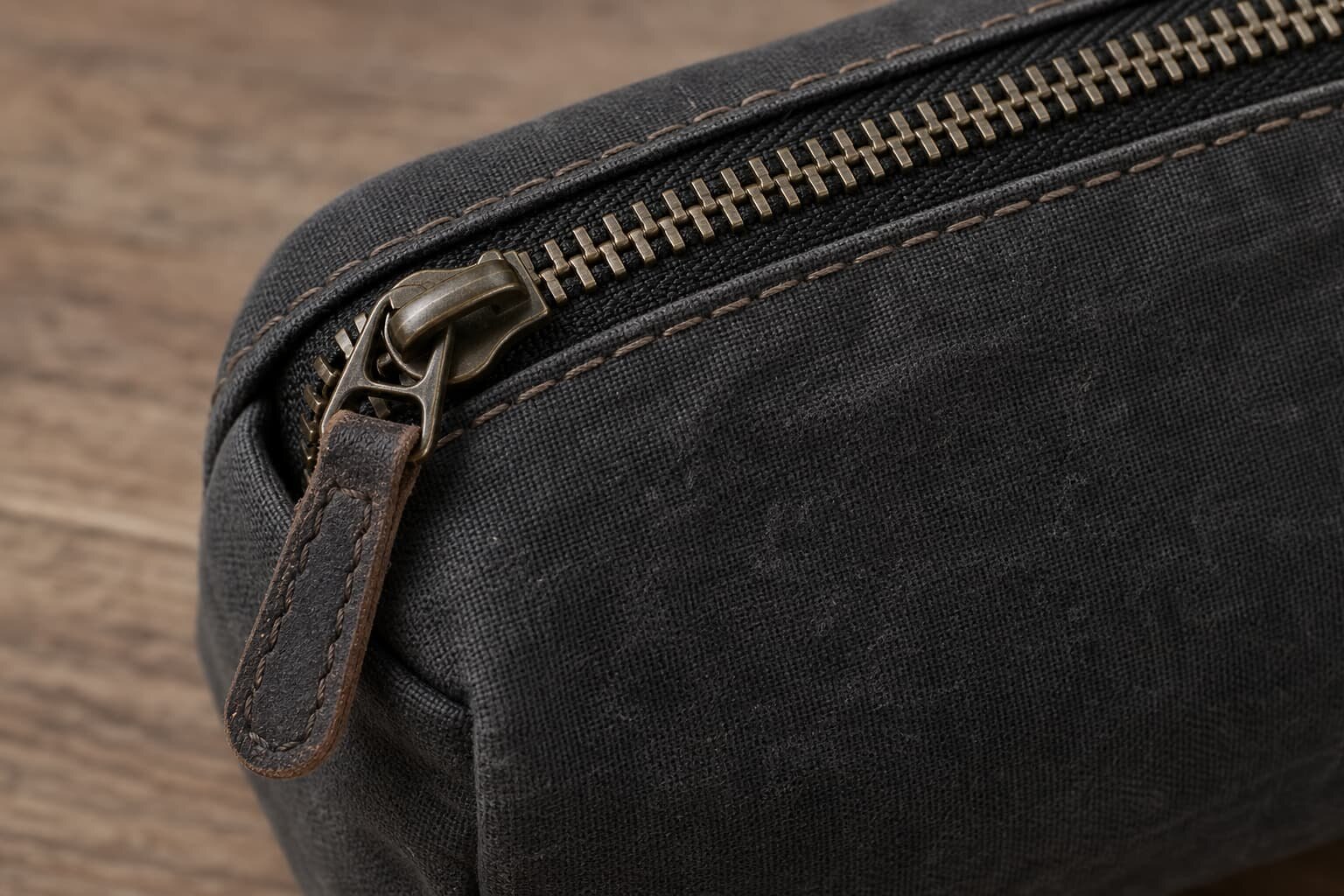
Why handle strength is the first failure point
Most buyers focus on zipper quality, logo placement, or fabric feel when they source a document zipper bag. In the field, the handle is often the part that fails first. That matters because a broken handle creates a visible quality complaint even if the zipper still works and the body fabric looks fine. For a buyer, that means returns, replacement cost, and a supplier discussion that becomes much harder after the goods have already landed.
A document zipper bag is not a duffel. It usually carries paper files, brochures, catalogs, training kits, or lightweight samples. That sounds mild, but the handle still takes repeated vertical pull, sideways twist, and sudden jerk loads when people walk, climb stairs, or lift the bag out of a car. A good RFQ should therefore describe the handle as a load-bearing part, not just a convenience feature.
- Handle failures usually start at stitch ends, not in the middle of the strap.
- Weak reinforcement shows up as seam creep before the handle fully tears off.
- A bag that passes a visual check can still fail after a few dozen carry cycles.
Start with the real use case, not a generic load number
Before you ask a factory for a handle strength test, define what the bag will actually carry. If the use case is a conference handout bag, the load may be only 1 to 2 kg. If it is a retail document organizer that holds notebooks, samples, and a tablet, the carry load can rise fast. The right target is the one that matches the real packed weight, plus a sensible safety margin. Buyers often get better results by specifying both the normal load and the abuse load, because the supplier can then design the handle instead of guessing.
Fabric weight and handle structure need to match that load. For example, light 210D polyester can work for low-load bags, but a 300D or 600D body gives the handle stitches a better base. Premium canvas may sit around 10 to 12 oz, which gives stronger hand-feel and better stitch bite, but it also changes cost and weight. If the handle is stitched directly to the body fabric, ask the supplier how they prevent tearing at the anchor point. If the handle uses webbing, ask for the webbing width, denier, and whether the end is folded or heat-cut.
- State the expected carry weight in your RFQ, not just the bag size.
- Tell the factory whether the contents are paper-only or paper plus harder inserts.
- Specify whether the bag will be carried daily, occasionally, or only for events.
Use a finished-bag test, not a loose-material test
The most useful handle strength test is on the finished bag with the zipper closed and the intended load inside. A pull test on handle tape alone can be useful for engineering, but it does not fully predict what happens when the handle is sewn to a zipper bag body. The handle area, top seam, zipper tape, and body panel work as one system. If one part is weak, that weakness can move into the seam or zipper corner instead of the handle itself.
For buyer RFQs, ask for a clear test method. A common approach is a static hang test, where the filled bag is suspended by the handle for a set time. Another is a repeated carry cycle test, where the bag is lifted and set down many times to simulate daily use. For higher-risk programs, ask for a controlled pull force measurement on the sewn assembly. The exact numbers should fit your product, but the important part is that the method be repeatable, documented, and done on the final construction.
- Static hang test checks whether stitches creep or open under continuous load.
- Cycle testing checks handle comfort, stitch fatigue, and seam stability.
- Pull force testing helps compare suppliers that use different reinforcement patterns.
What pass-fail criteria should buyers ask for
A good supplier quote should not stop at 'strong handle' or 'reinforced handle.' Buyers need acceptance criteria. For a practical document zipper bag, the bag should survive the agreed test load without stitch break, seam opening, zipper distortion, or body fabric tear. Cosmetic marks such as minor wrinkling may be acceptable if they do not affect strength, but the bag should still look saleable after the test. If the handle is webbing, check for fray, edge curling, or glazing after load. If it is self-fabric, check for seam slippage and corner deformation.
It helps to set the test target as a ratio of working load, not a random number. For example, if the normal packed weight is 3 kg, the buyer can ask the factory to confirm a higher test load for a limited duration or repeated cycles. That does not mean the bag must be designed for the heaviest abuse imaginable; it means the quote should reflect a margin that protects against field failures. The best buyers keep the requirement simple enough that the factory can quote it consistently across sample, approval, and bulk production.
- Define a pass as no stitch break, no seam opening, and no zipper frame distortion.
- State whether minor fabric whitening, wrinkle marks, or handle flattening are acceptable.
- Ask the factory to report the test setup, load amount, duration, and sample quantity.
Choose a handle construction that matches the price point
Handle construction is where many quote comparisons go wrong. Two factories can both say 'reinforced handle,' but one may mean a simple folded strap and the other may use webbing, a hidden patch, and double bartacks. Those are not equivalent builds. Buyers should decide early whether the priority is low cost, clean appearance, comfort, or high load tolerance. Once that is clear, the supplier can build the handle around the goal instead of pushing the cheapest option by default.
The table below gives a practical way to compare common constructions. The point is not that one style is always best. The point is that the buyer can tie the handle choice to expected use, quote clarity, and failure risk. If the bag is for trade show documents and light handouts, a simpler build may be enough. If the bag will be reused for meetings or field visits, webbing with stronger reinforcement is usually the safer source decision.
Fabric weight, print method, and stitching all affect the result
Handle strength is not only about the handle itself. The body fabric is the anchor surface, so fabric weight matters. A light fabric with a strong handle can still fail if the seam area is too soft or if the stitches cut through the weave. That is why buyers should request the body fabric GSM or oz weight alongside the handle specification. For many document zipper bags, 300D to 600D polyester gives a more dependable base than ultra-light fabric. Canvas can provide more stitch bite, but it also changes the bag's hand-feel and freight weight.
Decoration can also influence the construction. Screen printing is cost-effective for simple logos, but the print area should not crowd the handle anchor point. Heat transfer or sublimation can work for full-color graphics, yet the buyer should confirm that heat does not deform coatings or weaken nearby seams. Embroidery and woven labels are durable, but they add localized thickness, so the factory must keep stitches clear of hard edges. If the sample includes a CTM or CottonToMaker side label, make sure it is placed where it does not interfere with the load path.
- Ask for the body fabric GSM or oz weight in the quote, not just the fabric name.
- Keep heavy print, embroidery, or labels away from the handle stress zone.
- Confirm that coating, lamination, or backing layers do not hide weak stitching.
How to inspect the sample before you approve bulk production
A sample approval should do more than confirm color and logo placement. Put the sample through a buyer-style check that mirrors the real use. Open and close the zipper several times, load the bag with the expected contents, lift it by the handle, and look at the seam after the load is removed. Pay attention to the first sign of strain: slight stitch pulling, seam ridge movement, zipper tape twisting, or uneven handle angle. Those are early warnings that the bulk order may need a stronger reinforcement layout.
Ask the factory to send a pre-production sample that uses the final fabric, zipper, thread, print method, and handle construction. If the sample is only a visual prototype, it is not enough for a load-bearing bag. Measure handle drop, seam allowance, and reinforcement patch size against the tech pack. If the factory changes the handle after your comment round, re-check the load path. One extra bartack or a wider patch can be the difference between a stable bag and a return-prone one.
- Check the sample with the zipper closed and with the intended load inside.
- Measure the handle angle on both sides to make sure it is symmetrical.
- Confirm the final print method and label placement before giving bulk approval.
Read the factory quote like a production engineer
A useful quote should show more than a unit price. For a document zipper bag, the buyer should see fabric type, GSM, handle material, reinforcement method, print method, zipper spec, sample cost, lead time, and carton pack data. If the supplier only quotes a single number, you cannot tell whether the handle construction changed, whether the print method is being downgraded, or whether the reinforcement layer was removed to save cost. That makes quote comparison unreliable and often leads to a weak final product.
MOQ logic matters here. A stronger handle may increase cutting time, stitching time, or material usage, which can affect the minimum order quantity or the quantity break pricing. Custom webbing colors, extra bartacks, or a separate reinforcement patch may also raise the setup effort. Ask the supplier to show the quote by tier, such as sample, small run, and bulk run, so you can see whether the handle spec changes with volume. A good quote should hold the construction stable and only improve the economics at scale.
- Request separate lines for sample charge, bulk unit price, decoration, and packing.
- Ask whether handle reinforcement or extra bartacks change the MOQ.
- Confirm if the same construction is used across every quantity tier.
Packing and freight can damage the handle before the customer even sees it
Handle strength is not only a use-phase issue. Bad packing can flatten a handle, crease the anchor area, or deform the top edge of the bag before the cartons reach your warehouse. If the handle is padded or has a shaped loop, ask how the factory protects that shape in packing. If the bag is shipped flat, check whether the handle is folded in a way that creates permanent bends or weak points. A bag can pass the factory test and still arrive visually damaged if it is packed too tightly.
For importer planning, ask for carton dimensions, piece count per polybag, and outer carton weight. If the bag is going into retail, ask whether an insert board or tissue sheet is needed to keep the front panel from crushing the handle area. Lead time should also include any sample rework after the first test result. A practical program may need time for one prototype revision, one pre-production sample, and then bulk stitching, so the quote should show that workflow clearly.
- Confirm handle folding direction and whether the bag is packed flat or stuffed.
- Check carton load so the top layer does not press hard on the handles.
- Ask whether the packing spec changes if the bag includes a padded handle or hard board insert.
A buyer workflow that avoids handle mistakes
The cleanest sourcing process is simple: define the load, define the handle, test the sample, then lock the quote. Start with a one-page spec that states the bag size, fabric GSM, handle style, print method, intended use, and expected carry weight. Then ask the factory to return a sample and quote based on that exact construction. Do not approve a visual sample first and leave the handle spec open for later, because handle changes often trigger hidden cost or quality changes in bulk production.
Before mass production, run a final comparison between supplier options using the same test target. If one factory quotes a lower price but uses a lighter body fabric or a shorter bartack, that is not a real cost saving. It is a different product. Buyers who compare only unit price often miss the hidden risk in the handle area. Buyers who compare construction, test method, and packing together usually get cleaner bulk results and fewer post-shipment disputes.
- Lock the load target before asking for sample revisions.
- Compare suppliers on the same handle construction and test method.
- Treat a handle change as a spec change, not a casual sample note.
Specification comparison for buyers
| Spec decision | Recommended option | When it fits | Buyer risk to check |
|---|---|---|---|
| Handle material | 25 mm polyester webbing with reinforced box-X bartack | Most A4 and letter-size document zipper bags carrying 2 to 5 kg | Check webbing denier, edge fray, and whether bartacks hit all layers |
| Handle style | Folded self-fabric handle with hidden reinforcement patch | Cleaner retail look when the bag is not meant for rough daily carry | Check seam slippage and whether the body fabric is strong enough on its own |
| Grip comfort | Padded handle with foam insert | Premium bags for sales reps, events, and repeated hand carry | Check bulk near zipper ends and whether padding weakens stitch access |
| Reinforcement method | Separate patch at handle anchor points | Heavier contents, larger bags, or frequent transport | Check patch size, stitch density, and whether the patch material matches the load |
| Low-cost build | Single-layer handle with short bartacks | Giveaways or very light document sets | Check that the quoted test target matches the real use case, not just the lowest BOM |
Buyer checklist before sampling
- Define the expected carry weight in kilograms or pounds and state whether the bag will hold paper only, paper plus catalogs, or mixed inserts.
- Confirm the handle construction in writing: webbing width, fabric type, reinforcement patch size, stitch pattern, and thread type.
- Ask for the test method used on the finished bag, not just on fabric or handle tape by itself.
- Request a pre-production sample with the final zipper, handle, print method, and carton pack count.
- Verify the fabric GSM or oz weight and make sure the handle and body materials are balanced, not overbuilt in one area and weak in another.
- Check how logo printing, embroidery, embossing, or woven labels affect the handle area and seam layout.
- Confirm quantity breaks, sample charges, lead time, and whether the factory quotes the same construction at every MOQ tier.
- Ask for packing details that protect the handle shape and prevent crush damage during transit.
Factory quote questions to send
- What exact handle construction is quoted, including width, material, reinforcement patch, and stitch pattern?
- What load test or pull test does the factory use on the finished bag, and what pass/fail result is expected?
- What fabric GSM or oz weight is being quoted for the body, lining, and handle reinforcement layer?
- Does the quote include the same print method across all quantity tiers, or does the decoration method change at higher or lower MOQ?
- What are the sample charge, bulk unit price by tier, and any extra cost for custom handle reinforcement or extra bartacks?
- What is the estimated lead time for sample, approval revision, and bulk production?
- How is the bag packed for shipment, and how many pieces per carton or polybag are used?
- If the buyer requests a stronger handle after sample approval, what parts of the quote change?
Quality-control points to confirm
- Check that handle anchor points sit evenly on both sides and do not twist under load.
- Inspect bartack length, density, and placement at the top and bottom of each handle end.
- Measure the finished bag against the approved spec sheet for width, height, handle drop, and reinforcement size.
- Run a finished-bag load test with the zipper closed and the intended insert weight inside.
- Look for seam creep, stitch popping, body fabric tearing, and zipper top distortion after the test.
- Check print adhesion, embroidery stability, or woven label placement near the handle area.
- Verify that the fabric GSM or oz weight matches the approved sample and that the reinforcement layer is present.
- Review carton packing so handles are not crushed, bent, or trapped under tight straps during shipment.