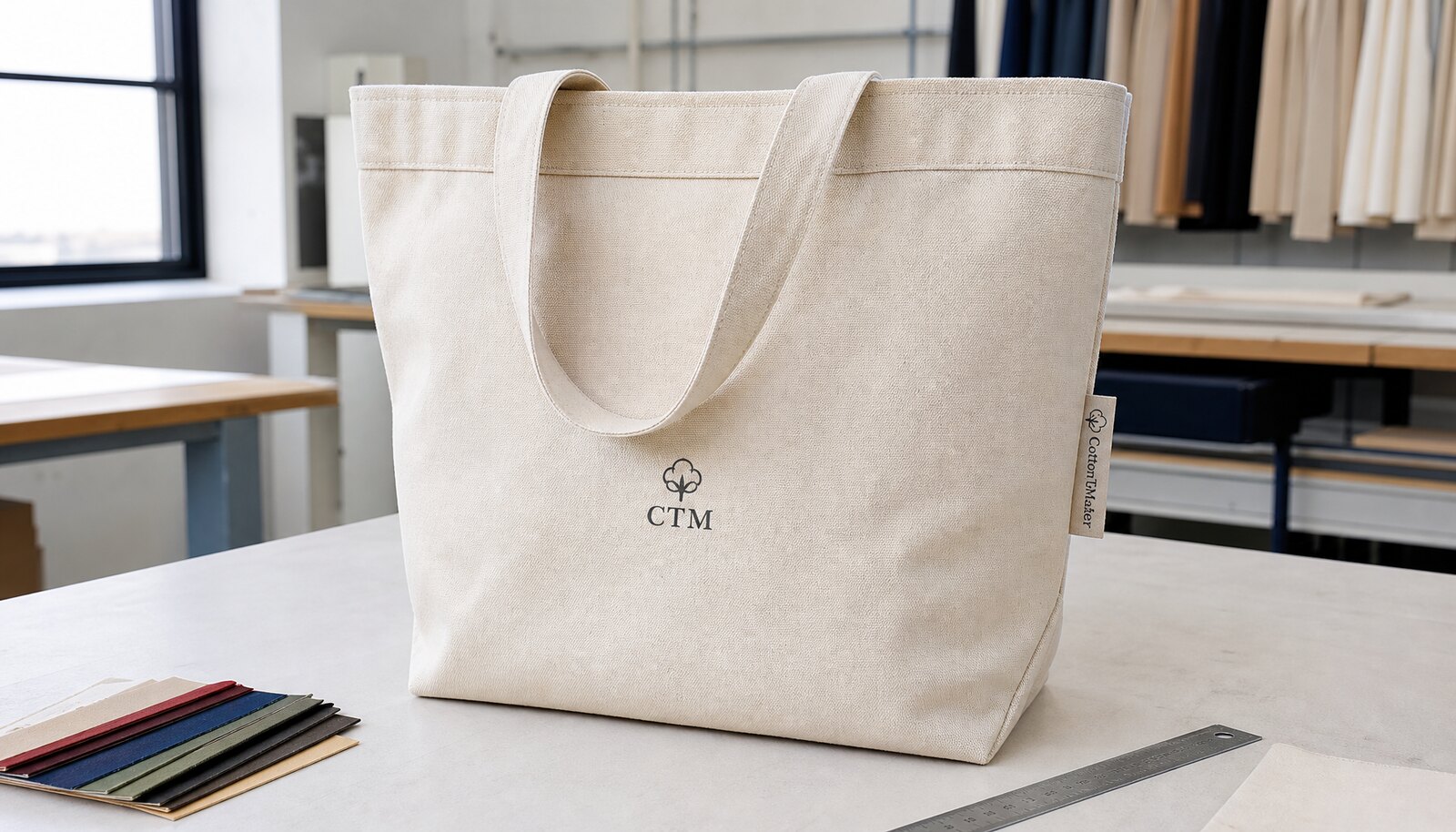
Why digital printing is used on canvas bags
Digital printing earns its place when the artwork is too detailed, too colorful, or too changeable for a simple screen-print program. On canvas bags, that usually means campaign artwork, retail graphics, licensed art, photo-style visuals, or seasonal designs that will change faster than a traditional print screen amortizes. For procurement teams, the appeal is not just image quality. It is the ability to move from file to sample without paying for a full screen setup and without locking the buyer into a large minimum run before the design is approved. That flexibility matters when the bag is part of a launch, a promotion, or a retailer's short test order.
The tradeoff is that digital print on canvas is only as stable as the rest of the bag spec. The same artwork can look clean on a tight, smooth 10 oz canvas and noticeably rougher on a coarse, open-weave fabric. Dark fabric may need a white base, which changes both cost and feel. A loose quote that says only 'digital print on canvas bag' does not tell you whether the supplier understands the substrate, the ink system, or the finishing steps that actually determine the result. Buyers should treat print method, fabric, and sewing as one system.
- Use digital print when the art is multi-color, gradient-heavy, or likely to change after the first sample.
- Do not treat the bag as a blank blank; the fabric weave and finish change the print outcome.
- A good quote ties the print route to the bag spec, not just to the artwork file.
Lock the canvas spec before you ask for pricing
Canvas weight is the first commercial decision that affects print quality, bag structure, and freight. Buyers should ask for both GSM and ounce weight because suppliers often default to one measurement and leave the other implicit. As a working range, 8 oz canvas is lighter and cheaper, 10 to 12 oz is the common middle ground for branded totes, and 14 oz or above gives a stiffer, more premium feel. The heavier the canvas, the more material and sewing time you buy, and the more the bag resists folding and packing. That can be useful for retail presentation, but it raises unit cost and carton volume.
The finish matters as much as the weight. Raw natural canvas gives a softer, more textured look and can mute very fine detail. Bleached or whitened canvas gives the printer a cleaner base and usually supports sharper graphics. Dyed stock colors can look strong in retail, but they are harder to keep consistent across production lots. If the bag will be washed, pre-shrunk, or garment-dyed, the buyer should say so before quoting, because those steps affect both size stability and print behavior. Leaving those variables open usually creates a price that is not comparable across suppliers.
- Ask for GSM, ounce weight, weave type, and fabric finish together.
- State whether the bag must keep a structured retail shape or can remain soft and foldable.
- If you need repeatable color, avoid leaving the fabric finish open for the supplier to decide.
Match the print technology to the artwork and bag construction
The phrase 'digital printing' hides several process choices. Some factories print on cut panels before sewing, which usually improves alignment because the artwork can be positioned before seams are closed. Others print on finished bags, which can be faster for simple jobs but gives the factory less control when handles, gussets, or stitching lines distort the image. Some suppliers use direct-to-fabric methods, while others rely on transfer-based digital processes that behave differently on canvas. The buyer does not need to pick the machine model, but the buyer does need to know where the print happens and what that means for registration, hand feel, and durability.
Artwork should be written for the process, not the other way around. Ask the supplier for a minimum line weight, minimum text size, and safe zone from seams and folds. Small reversed text, thin hairlines, and tiny QR codes often fail first on canvas because the weave is too open or the bag is folded through the print area. If the design relies on exact Pantone matching, say whether you want a visual match to a physical sample or a tighter numeric target. Also ask whether the supplier needs a white underbase on dark stock, because that changes ink laydown, opacity, drying time, and cost.
- Prefer panel printing when the artwork needs tighter placement near seams or edges.
- Ask for the supplier's minimum text size and minimum line thickness before you approve the file.
- If the bag is dark, confirm whether the print needs a white underbase and how that changes price and hand feel.
Use the comparison table to compare real sourcing routes, not just prices
The quote comparison needs more than a route label. A direct bag factory with in-house digital print usually gives the cleanest control because sewing and printing are managed by the same production team. That reduces handoff risk when the bag has handles, gussets, labels, or a print that sits close to a seam. A bag factory that outsources print can still work, but the buyer must know exactly who owns the proof, who owns the reprint if the artwork shifts, and who is accountable if the fabric lot or panel orientation changes between the print shop and the sewing line. Trading companies can simplify admin, but they are only useful when they can show the actual factory and process behind the order.
Short-run and nearshore suppliers are often the fastest way to validate a design. They can be expensive per piece, but they shorten the feedback loop when you need a sample correction before bulk. At the other end of the range, low-cost offshore factories can be the best value for stable, repeatable programs if the fabric, artwork, and packing are already locked. The buyer should not compare these routes on unit price alone. Compare MOQ by artwork, correction speed, print ownership, packing discipline, and the failure mode that is most likely to hit the order.
- Use the table to compare MOQ, print process, cost position, failure mode, and buyer check.
- If two quotes look close, ask which one includes the print process that matches your approval sample.
- A lower unit price is only meaningful if the route can repeat the same result on the second order.
How to write an RFQ that produces comparable quotes
The fastest way to get unusable quotes is to ask for 'digital printed tote bags' and leave the supplier to fill in the gaps. A useful RFQ for digital printing on canvas bags should force the supplier to quote the same bag dimensions, the same canvas weight, the same print area, the same finish, and the same packing format. Ask for one artwork file and one approved size spec. If you allow suppliers to choose their own assumptions, they will optimize differently and the prices will not be comparable. One quote may exclude setup, one may assume a lighter fabric, and another may include packing that the others left out.
The RFQ should also separate one-time costs from recurring costs. Sample fees, print setup, and proof corrections belong in one place. Bulk sewing, printing, and packing belong in another. If the supplier offers tiered pricing, ask for at least three quantity breaks and ask for the exact change drivers at each step. The best RFQ also calls out exclusions explicitly: no hidden freight assumption, no unquoted hangtag, no unquoted polybag, no unquoted carton mark. That is how you avoid a quote that looks cheap until the first revision lands.
- Quote against one locked spec sheet and one file set.
- Separate sample cost, print setup, production cost, and packing cost.
- Require suppliers to list exclusions so the numbers can be compared cleanly.
Sample approval should prove the process, not just the artwork
A sample for digital printing on canvas bags should be judged as a process check, not a decorative preview. Start with the digital proof to verify layout, artwork size, and placement. Then review the printed strike-off or printed panel under neutral light to see whether the tone, opacity, and edge sharpness match the approved reference. Finally, review the sewn preproduction sample with the actual handles, seams, and labels in place. That last step matters because stitching can pull a printed panel out of square, shift the fold line, or expose a seam allowance that was not visible in the flat proof.
Buyers should define what counts as approval and what counts as a revision. If the sample color is off but the line work is acceptable, decide whether the supplier may adjust ink density or whether a new sample is required. If the print is in register but the seam pulls the bag panel, do not approve bulk until the construction issue is fixed. The most useful approval record is a physical master sample, labeled with date, fabric lot, print method, and packing method. Keep the approval path explicit so the bulk run does not quietly drift away from the sample that won the order.
- Approve proof, strike-off, and sewn sample in that order.
- Keep one physical master sample and mark the approved fabric lot and print date on it.
- Do not approve bulk from a flat image if the final bag shape matters.
Set QC acceptance criteria that the factory can actually inspect
QC gets weak when it stays abstract. Buyers need acceptance criteria that can be checked by the factory before cartons are sealed. For print placement, define the tolerance in millimeters and reference where the art is measured from, such as centerline, top edge, or seam point. For readable text, define the smallest acceptable font size and reject any line that breaks or fills in. For color, compare against the approved physical sample under the same light source, and if your team uses a numeric target, ask the supplier to report it against the master instead of against a screen image. A simple rule works better than a vague one: the printed bag must match the approved sample in tone, layout, and edge clarity without visible misregistration at normal viewing distance.
The physical tests should also be simple enough to repeat on the line. A dry rub test with a white cloth should show no visible transfer after repeated back-and-forth strokes. A fold test should show no cracking or flaking at the packed fold line after several manual folds. Check seam strength, bartacks, and handle attachment on both sides of the bag, because weak sewing can deform the print after the bag is loaded. If the bag includes a label, heat transfer, or barcode, inspect those items before shipment as part of the same QA pass, not as a separate task. QC is cheaper before cartons are taped than after the container is closed.
- Set print placement tolerance in millimeters and state the measurement reference.
- Use a physical master sample and a neutral light source for color approval.
- Run a dry rub check and a fold check before carton release.
Packing and labeling should protect the print, not just count the pieces
Printed canvas bags are easy to damage in packing because the print sits on a flexible, foldable surface. The buyer should decide early whether each bag needs an individual polybag, a belly band, tissue, or only a master carton pack. If the print falls on the fold line, the factory should adjust the fold direction so the artwork does not crack or crease in transit. If the print surface is likely to rub, ask the supplier what material separates the bags in the carton. A cheap packing method can erase the value of a good print by the time the carton reaches the warehouse.
Carton labeling needs the same level of control as the bag itself. The master carton should show style, color, size, quantity, PO number, and any barcode or warehouse label exactly as required by the buyer. Confirm whether counts are packed by piece, dozen, or inner pack, and ask the supplier to state the exact count per carton before the order is released. For ecommerce or retail distribution, carton strength and outer marking become more important because the bag may be shipped again after arrival. Packing mistakes usually appear as disputes, not as production issues, so they need to be written into the PO.
- Choose the fold pattern based on where the print lands after folding.
- Specify the separation material inside the carton if abrasion is a risk.
- Match carton marks and barcode labels to the buyer's warehouse format before bulk shipping.
Lead time, landed cost, and supplier selection should be built around risk, not only price
Digital printing on canvas bags often moves quickly at the sample stage and then slows once the buyer approves the file and the factory starts to reserve fabric and capacity. That is normal, but it means lead time should be broken into stages. Ask for proof time, sample time, bulk sewing time, packing time, and booking time separately. If the factory only gives one final delivery date, you cannot tell where the delay risk sits. The most common schedule slips come from incomplete artwork, unresolved sample comments, or fabric lots that were not reserved early enough.
Landed cost should be compared on the same basis across suppliers. One factory may quote a lower ex-factory price but exclude inner packing, label application, or a higher carton count that changes freight. Another may include a better pack format that reduces damage and returns. The cheapest quote can become the most expensive order if it creates rework or a second sample round. For buyers, the right question is not 'Who is cheapest?' but 'Who can repeat the approved sample at the lowest total cost to receive saleable goods?' That is the question that keeps the sourcing decision honest.
- Separate proof, sample, bulk, packing, and booking time in the timeline.
- Compare ex-factory price only after you verify packing, label, and freight assumptions.
- Use the supplier that can repeat the approved sample with the least correction risk, not just the lowest opening bid.
What to watch when reordering the same digital print
Repeat orders often fail in quiet ways. The first order may have been approved from a perfect sample, but the second run can shift because the factory changed fabric batch, adjusted ink density, or moved the print to a different line. Buyers should treat a reorder as a controlled replication, not a simple refill. Reconfirm the approved spec, the approved artwork file version, the approved fabric weight, and the approved packing method before the factory starts the new run. If the factory says the old settings are still saved, ask them to prove they are using the same master reference and not a similar one.
The most useful re-order check is short and concrete. Ask for a current production photo, a pre-bulk reference sample, or a fresh strike-off before the factory commits to volume. If the order is large enough to matter, ask for first-piece inspection at the beginning of the bulk run. That is the point where the factory can still correct placement, shade, or fold direction without reworking the whole order. Reorders go wrong when teams assume the last approved bag still describes the next shipment. It does not unless the process is written down and verified again.
- Treat each reorder as a fresh confirmation of spec, file version, and fabric lot.
- Request a current sample or first-piece image before the full run starts.
- Do not assume saved machine settings guarantee the same outcome on a new order.
Specification comparison for buyers
| Supplier route | Typical MOQ or run size | Print process | Cost position | Common failure mode |
|---|---|---|---|---|
| Direct bag factory with in-house digital print | Often 100-1,000 pcs per artwork once the line is set | Panel print before sewing or print on finished bag, depending on line layout | Mid-range; lower coordination cost and fewer handoffs | Print and sewing specs drift apart if the factory does not control both departments |
| Bag factory outsourcing print to a local print shop | Often 200-2,000 pcs, depending on print shop limits | Usually printed panels or finished bags hand-carried between vendors | Can be competitive on simple jobs, but handoff cost is real | Version errors, panel orientation mistakes, and color mismatch between vendors |
| Dedicated print house sewing outsourced blanks | Often 300-3,000 pcs when blank bag supply is stable | Strong on digital image quality, then sewn by a partner factory | Good on print-heavy art; sewing cost can move depending on bag complexity | Blank spec mismatch, shrink variation, and seam distortion after sewing |
| Trading company bundling bag and print | Often 500 pcs minimum, but sometimes flexible on repeat orders | Depends on the subcontractor they place the order with | Usually higher than factory-direct, but simpler for multi-item sourcing | Hidden subcontracting and weak process control if the trader is only forwarding specs |
| Nearshore short-run supplier | Often 50-500 pcs for test launches or urgent replenishment | Varies by local equipment; often digital transfer or direct print | Higher unit price, lower freight risk, faster sample loop | Higher unit price and more frequent material substitution to hit schedule |
| Low-cost offshore factory | Often 1,000 pcs and up to make the setup efficient | Usually panel print or finished-bag print with more emphasis on volume | Lowest ex-factory price at scale if specs are stable | MOQ inflation by color, higher shade variation, and longer corrective cycle |
| Eco-positioned supplier using recycled or organic canvas | Often 300-2,000 pcs depending on certification and fabric availability | Same digital print methods, but substrate and finishing options may be narrower | Can cost more because of certified fabric and narrower sourcing windows | Claims without traceability documents or inconsistent supply of certified fabric |
Buyer checklist before sampling
- Confirm canvas weight in GSM or ounce weight, plus whether the fabric is raw, bleached, dyed, garment-washed, or pre-shrunk.
- State the bag dimensions, handle length, seam allowance, gusset depth, and whether the print lands on front only, both sides, or wraps near a side seam.
- Define the print area in millimeters and identify any safe zone from seams, edges, handles, rivets, or labels.
- Specify the artwork file type, minimum line thickness, smallest text size, and whether the design needs a white underbase or other backing on dark fabric.
- Target the MOQ by artwork and by fabric color, not only the total purchase quantity.
- Require a physical preproduction sample or strike-off that shows actual print tone, alignment, and seam behavior after sewing and pressing.
- Set the packaging requirement up front, including inner polybag, hangtag, barcode label, carton count, and master carton mark.
- Ask for lead time by stage: artwork proof, sample, bulk sewing, packing, and export booking.
Factory quote questions to send
- Is the digital print done in-house on cut panels or on assembled bags, and what is the exact print technology used?
- What canvas weight do you recommend for this artwork, and how will that affect opacity, drape, print sharpness, and unit price?
- Is the quoted price based on one side or both sides, and does it include artwork setup, color correction, proofing, and packing?
- What is the MOQ by print design, by fabric color, and by bag size?
- What sample type will you supply first: digital mockup, printed strike-off, or sewn preproduction sample?
- What color reference do you use for approval, and how do you handle a mismatch against the approved physical sample?
- What is your tolerance for print placement, panel alignment, and text drift toward a seam or fold line?
- How do you pack printed bags to prevent abrasion, creasing, and ink transfer during transit?
- Which inspection checks do you use for print quality, seam strength, carton count, and label accuracy?
- What lead time should we plan for bulk after sample approval, and what factors could extend it?
Quality-control points to confirm
- Print placement should stay within an agreed tolerance so the image does not drift into a seam, handle, gusset, or fold line.
- Critical text and logos should not be cut off or distorted after sewing, folding, or pressing.
- Color should be approved against a physical master under the agreed light source, not only on screen.
- Ink cure or fixation must be verified so the print does not crack, rub off, or stick during packing and transit.
- A simple dry rub check should show no visible transfer after repeated rubbing on a white cloth.
- Seams around the print area should not pucker, tunnel, or cause the artwork to bow when the bag is filled.
- Handle attachment, bartacks, and topstitching should remain clean after folding, with no scorch marks or print shine.
- Carton count, bag count, barcode label content, and packing format must match the PO and packing list before shipment release.