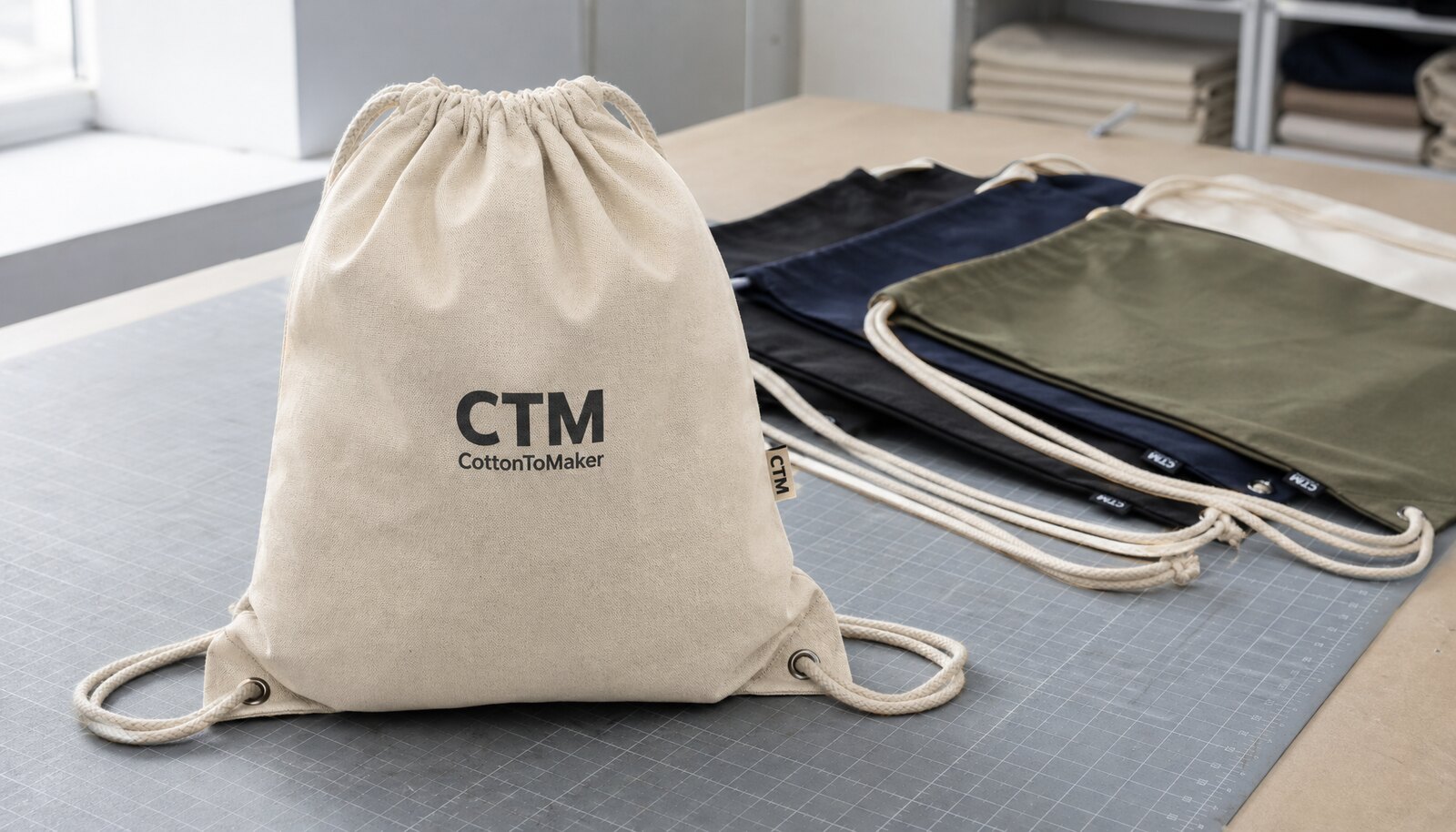
Start with the channel and load, not the artwork
Most sourcing errors happen before the logo file is ever opened. If you want to design your own drawstring backpacks in a way that survives procurement, the first decision is the channel. A conference giveaway, a school distribution pack, a retail add-on, and a sports bag all need different fabric weight, construction, print durability, and packing assumptions even when the front art looks the same.
The simplest way to avoid a bad buy is to define the contents and the handling environment first. If the bag will only hold leaflets or a T-shirt, a lighter build may be enough. If it must carry shoes, bottles, stationery, or repeated daily load, the seams, cord exit points, and fabric body matter more than a low first price. A cheap bag that fails in the first week creates replacement cost, complaint handling, and brand damage that was easy to avoid on paper.
Buyers should also separate promotional intent from durability intent. If the bag is meant to disappear after one event, the brief can favor cost and print visibility. If it must sit on a shelf, be resold, or be reused frequently, the brief should favor cleaner stitching, stronger material, and more controlled packing. That distinction changes the supplier shortlist before anyone starts quoting.
Turn the idea into a quote-ready specification
A usable RFQ for drawstring backpacks should be built around measurable fields, not general descriptions. At minimum, specify finished size, flat cut size, fabric denier or GSM, weave or finish, cord type, reinforcement style, print method, print area, color count, label type, packing method, and destination. If any of those are vague, every supplier will fill the gap differently and the quotes will not compare cleanly.
Size is one of the most common traps. One supplier may quote the sewn finished bag, while another quotes the pre-sewn panel. The difference can change apparent price and effective capacity at the same time. Ask for both finished dimensions and flat cut dimensions, plus an agreed tolerance. If the bag has to fit a specific retail shelf or a school locker, that tolerance should be part of the PO, not just a conversation.
The RFQ should also state what is included in the unit price. For custom bags, the first number is rarely the full story if setup, screen charges, label work, inner polybags, or carton marks are billed separately. Ask for itemized pricing so the commercial side is visible before selection. If the supplier cannot separate the elements, you will struggle to compare landed cost later.
Choose fabric and build level with a budget band in mind
Fabric choice should be made as a buying decision, not a style decision. For the lowest-cost promo bag, 210D polyester is still a common starting point because it is light, easy to print, and usually economical at scale. For better feel or repeat use, 300D to 420D polyester is a more credible middle ground. If the bag needs a heavier handfeel, stronger presentation, or a retail position, 600D polyester or cotton canvas is more appropriate, but the cost base changes quickly.
Indicative FOB pricing for simple custom bags often moves in bands rather than exact points. For large run promo bags, a basic 210D build with one-color silkscreen can sometimes sit around $0.45 to $1.10 depending on quantity, region, and included packing. Standard branded builds with heavier fabric, better reinforcement, or extra print work often move into the $1.10 to $2.20 range. Retail-ready or canvas-heavy programs often start above that. Use those ranges only as a planning guide, not as a market promise, because freight, duty, and regional sourcing can move the final number materially.
Construction detail matters as much as fabric. A reinforced cord channel, balanced drawcord, and stronger top hem usually cost more than a purely cosmetic build, but they also reduce pull-through and repair risk. If the program is meant to be kept and reused, that extra cost is often justified. If the program is disposable and event-driven, the buyer may accept a lighter construction as long as the spec is explicit.
Make print and branding choices that match the artwork
Silkscreen is still the default for most custom drawstring backpack programs because it is stable, repeatable, and economical for simple logos. It works best when the artwork is clean, the color count is low, and the print area is generous. Heat transfer or digital print is better when the design includes fine lines, gradients, small text, or a more complex brand treatment. Embroidery can work on heavier bags, but it changes both the look and the cost structure and should not be treated as a default for thin promo builds.
The buyer should not choose by decoration name alone. What matters is how the method handles the actual art and volume. A low screen quote can become expensive once the supplier adds color separations, setup fees, or a second print location. Ask for the exact print size in millimeters, the number of screens or passes, and whether the quoted price includes one side or both sides. If the artwork is small, also ask the supplier how they will prevent blur, distortion, or ink bleed on the chosen fabric.
For procurement, simple artwork usually wins. Every extra color, second placement, or effect layer adds risk to matching and lead time. If the brand can accept a single solid logo, the sourcing process is easier and the unit cost is more predictable. If the design must be detailed, build the extra time and inspection into the schedule from the start instead of expecting the factory to solve it later.
Source by region and supplier type, not just by price
A drawstring backpack is a simple product, but the sourcing options are not interchangeable. China remains the most flexible choice for broad customization, repeatability, and a mature soft-goods supply chain. India and Pakistan can be competitive where cotton canvas or textile-heavy construction is important, and they may be attractive when the bag is part of a wider garment or textile program. Vietnam can fit broader soft-goods sourcing strategies, especially when the buyer already has regional manufacturing relationships. Nearshore sourcing reduces transit time and can simplify replenishment, but it usually trades off on unit cost, MOQ, or decoration flexibility.
The right question is not which country is cheapest in the abstract. It is which region can meet the specific combination of price, lead time, QA control, and communication quality that the program needs. A low quote from the wrong route can become expensive if the supplier cannot support repeat orders, handle color consistency, or keep packing stable. Ask the supplier to quote with the same spec, packing, and incoterm across regions before comparing them. Without that discipline, the result is not a sourcing decision; it is a list of unrelated numbers.
Supplier type matters inside each region. Factory direct is best when the same bag will reorder, because it gives the buyer the most control over fabric, sewing, and finishing. Trading companies are better when the purchase is broader than one item or when the buyer needs a single commercial interface. Stock and semi-stock routes are useful for urgent replenishment, but they usually limit custom color, custom labels, and carton control. Match the supplier route to the business problem instead of assuming one route fits every program.
Compare landed cost, not just the first unit price
A good procurement comparison separates ex-works price from total landed cost. The factory line is only one piece of the buy. Setup charges, sample cost, inner packaging, barcode work, carton marks, inland transport, freight, duty, and the cost of rework all belong in the decision. A quote that looks slightly higher at the factory can still win if it includes the right packing and avoids hidden charges that appear later.
For decision-making, it helps to ask every supplier for three versions side by side: economy promo, standard branded, and retail-ready. The economy version may use 210D polyester, one-color silkscreen, and bulk carton packing. The standard version may step up the fabric, reinforcement, and inspection detail. The retail version may include cleaner finishing, tighter folding, barcode handling, and more controlled carton presentation. That structure turns a vague comparison into an operational one.
Buyers should also ask for a price ladder by quantity. The key breakpoints are often the sample order, the first production run, and the repeat order. Screen or plate reuse can materially change the reorder price if the supplier is set up correctly. If the supplier cannot show how the price changes at 500, 1,000, 3,000, and 5,000 pieces, the quote is probably too loose to support an actual buying decision.
Use a sample gate that mirrors bulk reality
A sample is only useful if it is production-equivalent. That means the same fabric, same print process, same cord, same reinforcement, and same build method intended for bulk. A digital mockup is useful for artwork alignment, but it is not enough for approving color, print hand, cord tension, or stitch behavior. Buyers should require a physical pre-production sample before bulk cutting starts, especially when the bag is custom, the color is sensitive, or the order has multiple SKUs.
The sample review should be practical. Load the bag with the actual contents or a realistic substitute, pull the cords several times, check the top hem and entry points, inspect print alignment, and confirm that the bag folds and packs the way the receiving team expects. If the sample shows puckering, skewed print, uneven cord ends, or poor label placement, the factory should correct those issues before bulk. It is cheaper to delay approval by a few days than to discover the same defect after production is complete.
Record the sample version, approval date, and any agreed exceptions. This sounds basic, but it is what protects the reorder. If the supplier later changes fabric lot, print screen, or packaging, the approved sample becomes the reference point for the dispute. Without that record, the buyer has no stable standard to enforce.
Write QC thresholds by product tier
Quality control for drawstring backpacks should focus on the failure points that affect use, not just appearance. The usual problems are size drift, weak cord channels, poor seam consistency, print misregistration, color variation between cartons, and packing drift. If those items are not written into the spec, the inspection team is left to interpret what is acceptable after the product has already been made.
A better method is to set different pass/fail thresholds by product tier. For economy promo bags, a practical standard is size tolerance of plus or minus 7 mm, print placement tolerance of plus or minus 4 mm, and a service-load test of 3 kg for 30 seconds with no seam opening or cord pull-through. For standard branded bags, tighten the size tolerance to plus or minus 5 mm, the print tolerance to plus or minus 3 mm, and the service-load test to 5 kg for 60 seconds. For retail-facing or heavy-use programs, tighten again to plus or minus 3 mm, plus or minus 2 mm, and 8 kg for 60 seconds, unless the buyer's own use case demands a higher test.
Print durability should also be tiered. A practical benchmark is a dry rub test and, where relevant, a wet rub test on the approved sample using white cloth or another clear transfer medium. The test should pass if there is no visible flaking, smearing, or transfer beyond the acceptance limit defined in the spec. The exact method matters less than consistency: the factory and the receiving team need to check against the same rule. When QC is written this way, inspection stops being subjective.
Pack for the route, not just for the factory floor
Packing is not a cosmetic afterthought. It affects freight, damage risk, labor cost, and the way the product arrives at the buyer's warehouse or customer. For bulk promotional orders, simple fold-and-carton packing is usually enough, with inner polybags only where the print or fabric needs protection. For retail or shelf-ready use, the bag may need a specified fold standard, barcode application, and cleaner presentation so it can move straight into fulfillment or display.
Carton planning deserves its own line in the quote. Ask for carton count, carton dimensions, gross weight, and whether the cartons are single-wall or double-wall. As a working handling target, many buyers try to keep cartons in the 12 to 15 kg range unless their warehouse can handle heavier units safely. Overweight cartons slow receiving and increase damage risk, while underfilled cartons waste freight volume. If the order includes multiple colors or artworks, also define carton segregation so mixed packing is only used when it is approved.
For sea freight and long transit, moisture and compression matter. Cotton canvas and other natural-fiber builds may need more protection than coated synthetic builds. If the destination is humid or the route is long, ask the supplier how the product is packed to reduce creasing, odor pickup, and scuffing. These details do not usually show up in the product photo, but they show up immediately at receiving.
Evaluate suppliers with a scorecard and control reorders
Supplier selection should be scored against the actual buying risks. A usable scorecard gives weight to spec transparency, sample fidelity, QC capability, price clarity, lead time reliability, and communication quality. One simple model is 20 points each for spec control, sample accuracy, and QC process, 15 for price and lead time, and 10 for communication and change control. The exact weights can vary, but the point is to compare suppliers on the things that prevent failure, not just on the lowest number.
Before awarding business, check whether the supplier can explain how they will keep the bag stable on a reorder. Ask who owns the approved master sample, how revisions are numbered, and what triggers a new sample approval. If the factory plans to change fabric lot, print setup, cord source, or packing format on a repeat order, that change should be written and approved first. Reorders are where many programs drift because the buyer assumed last time's product would repeat automatically.
For procurement teams, the final rule is simple: if the supplier cannot explain the spec, cannot show the sample standard, and cannot define the QC limit, the price is not yet actionable. A slightly higher quote from a disciplined supplier is often the safer purchase because it reduces ambiguity, rework, and receiving disputes. That is especially true when the bag is branded, time-sensitive, or part of a larger campaign where failure on one item affects the whole program.
Specification comparison for buyers
| Spec decision | Recommended option | When it fits | Buyer risk to check |
|---|---|---|---|
| Fabric choice | 210D polyester for lowest-cost promo; 300D to 420D polyester for better handfeel and repeat use; 600D polyester or cotton canvas for heavier branding programs | Short-run giveaways, school kits, gym promos, and retail or resale programs where presentation matters | Do not accept just "polyester" or "canvas" on the quote; ask for denier or GSM, weave, finish, and whether the same fabric lot will be used for bulk. Indicative FOB Asia pricing often lands around $0.45-$1.10 for simple 210D promo bags, $1.10-$2.20 for standard branded bags, and $2.50+ for heavier or retail-ready builds, depending on quantity and region |
| Print method | Silkscreen for 1-4 spot colors; heat transfer or digital print for gradients, small text, or multi-color artwork; embroidery only on heavier builds where texture is part of the brief | Clean logos, repeat orders, or artwork that needs color accuracy and detail | Low unit prices often exclude screen setup, color separations, or a second print location; ask for the print area, number of color passes, curing method, and whether the quote includes one side or both |
| Supplier route | Factory direct for repeat SKUs and tighter process control; trading company for multi-item consolidation; local stock or nearshore for urgent replenishment | Recurring programs, mixed-category sourcing, or compressed delivery windows | Trading quotes can obscure the actual factory standard; stock routes usually reduce customization and may limit color, label, and carton control |
| Region strategy | China for broad customization and mature soft-goods supply chains; India or Pakistan when cotton/canvas or textile-heavy builds matter; Vietnam when the program is part of a broader soft-goods sourcing base; nearshore when transit time is more important than unit cost | Buyers comparing cost, lead time, and spec flexibility across regions | Regional pricing is not interchangeable: freight, duty, MOQs, and decoration options vary. Ask for FOB, packing, and sample lead time by region, not one blended number |
| MOQ structure | Negotiate by fabric color, print version, and packaging variant rather than only by total quantity | Multi-SKU launches, seasonal campaigns, or test orders | A single total MOQ can hide separate minimums for each colorway or artwork setup, which makes the quote look cheaper than the actual buy |
| Closure and reinforcement | Double drawcord with reinforced cord channel and bar-tacked or reinforced entry points; eyelets only when the design needs them and they are reinforced properly | Daily-use, school, travel, and sports channels | Thin top hems and weak cord exits are common failure points; ask how the cord channel is built and whether pull-through protection is included |
| Size definition | Quote finished size and flat cut size together, with a written tolerance | Any order where capacity, shelf presence, or carton efficiency matters | Some suppliers quote the pre-sewn flat panel while others quote the finished bag, which makes quotes look comparable when they are not |
| Packing format | Bulk carton packing for distribution; retail fold, insert, barcode, and header card only when the channel needs shelf-ready presentation | Warehouse delivery, fulfillment, or retail resale | Extra packaging adds labor and freight volume, while under-spec packing increases crease marks, contamination, and scuffing during transit |
| QC tier | Use a tiered standard: economy promo, standard branded, and retail or heavy-use | Orders where the same bag family must serve different channels | Do not use one generic inspection rule for all tiers; set different load, rub, and size thresholds by product level |
Buyer checklist before sampling
- Define the actual use case first: giveaway, school, retail, event kit, gym, or lightweight daily carry.
- State the expected contents and target load before asking for price.
- Confirm finished size, flat cut size, and acceptable tolerance in millimeters.
- Specify fabric denier or GSM, weave, finish, color standard, and any coating or backing.
- Name the cord style, reinforcement method, label type, and whether eyelets are allowed.
- State the print method, print area in millimeters, color count, and artwork file format.
- Ask suppliers to separate MOQ by colorway, print version, and packaging variant.
- Request a production-equivalent pre-production sample before bulk cutting begins.
- Approve color against a Pantone reference or physical master, not a phone screen.
- Set a receiving standard for seams, print placement, count accuracy, carton condition, and mixed-SKU handling.
Factory quote questions to send
- Is your price based on finished size or flat cut size, and what tolerance do you apply to each dimension?
- What is the exact fabric specification, including denier or GSM, weave, finish, and coating, and will bulk use the same fabric lot as the sample?
- Which print method is included, how many colors and locations are covered, and what setup, screen, or plate charges apply?
- What is the MOQ by fabric color, print version, and packaging style, and do those minimums change by region or by season?
- Does the unit price include cords, eyelets, labels, inner polybags, barcode stickers, carton marks, and export packing?
- Can you produce a pre-production sample using the same fabric, print method, and construction planned for bulk?
- What is your standard lead time after sample approval, and what events cause delays such as dyeing, screen changes, or component shortages?
- What QC tests do you run for seam strength, cord pull-through, print adhesion, rub resistance, and size accuracy?
- What is your rejection rule for color deviation, print misregistration, loose stitching, mixed cartons, or damaged packaging?
- Can you quote three versions side by side: economy promo, standard branded, and retail-ready, with the inclusions shown line by line?
Quality-control points to confirm
- Fabric matches the approved specification and no unapproved substitution is used without written notice.
- Finished length and width are within the agreed tolerance; for economy promo bags use plus or minus 7 mm, for standard branded use plus or minus 5 mm, and for retail or heavy-use use plus or minus 3 mm unless the spec is stricter.
- Print position is within plus or minus 4 mm for economy promo, plus or minus 3 mm for standard branded, and plus or minus 2 mm for retail-facing programs.
- Color matches the approved Pantone or physical master under standard daylight, with no obvious carton-to-carton shade drift.
- Seams have no skipped stitches, open gaps, broken thread, or loose tails longer than the agreed trim standard.
- Cord channels allow smooth pull-and-release action, and both cord ends remain balanced after repeated open-close cycles.
- Eyelets or reinforced holes do not crack, deform, or tear in the agreed pull test.
- Service-load testing is tiered: economy promo bags should hold a 3 kg load for 30 seconds with no seam opening or cord pull-through; standard branded bags should hold 5 kg for 60 seconds; retail or heavy-use bags should hold 8 kg for 60 seconds, or the buyer's own target if higher.
- Print adhesion passes the agreed rub test with no visible flaking or transfer beyond the acceptance limit; a practical benchmark is 20 dry rubs for economy, 20 dry and 10 wet rubs for standard, and a tighter program-specific threshold for retail.
- Cartons are packed to the correct count and SKU mix, with no crushed corners, wet cartons, or mixed artwork unless mixed packing was approved in writing.