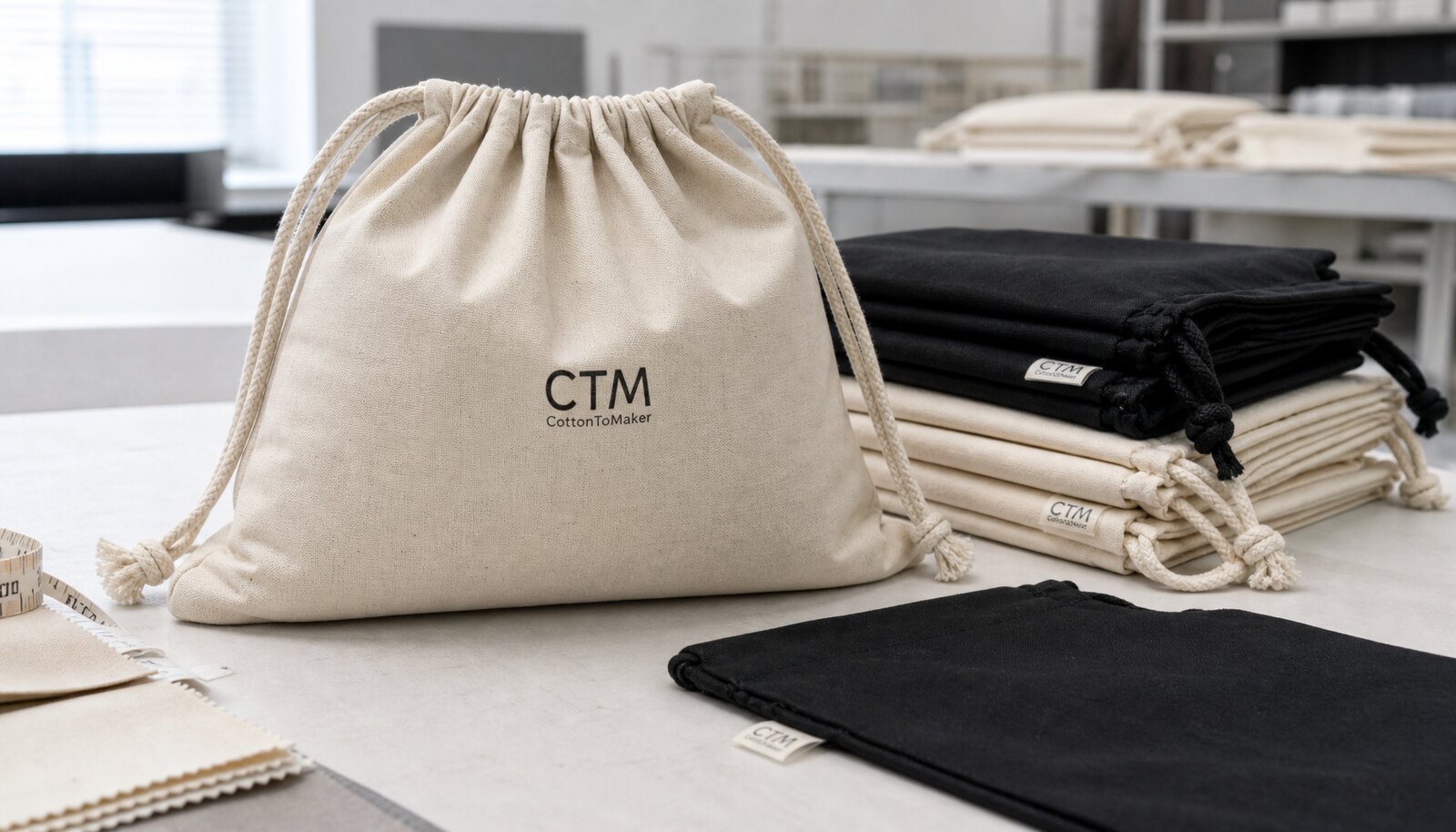
1) What procurement buyers actually need from this product category
Most sourcing teams do not lose money because a drawstring pouch is inherently expensive. They lose money when the bag specification is too loose for the intended use. A lightweight giveaway bag, a retail gift bag, and a protective pouch for a premium product can all look similar in a supplier’s catalogue, yet they demand very different fabric weight, stitch quality, logo treatment, and pack-out. If the order is written as a general description, the quote will usually be optimized for the supplier’s convenience rather than the buyer’s use case.
When you are buying customized drawstring bags with logo, start by asking what problem the bag must solve. Is it meant to support a product launch, act as secondary packaging, protect a finished product, or serve as a reusable customer carry bag? That answer determines how much you should pay for hand feel, whether the print must survive repeated handling, and whether closure strength matters more than decoration. The wrong spec can create a bag that looks fine on approval but fails in real distribution.
Procurement buyers should also think in terms of consequences. If the bag is too thin, contents may show through and the logo may appear cheap. If the bag is too heavy, freight cost rises and the finished product may exceed the target budget. If the closure is weak, the pouch loses functional value. The goal is not to make the thickest bag possible. The goal is to buy the right construction for the channel, load, and brand position.
- Define the use case first: giveaway, retail presentation, protective packaging, or repeated-use pouch.
- Set a budget target and a functional target at the same time; do not compare only unit price.
- Ask the supplier to quote against a written spec instead of a generic product name.
2) Size, usable capacity, and construction details that change the quote
Nominal bag size is only a starting point. A quoted 15 x 20 cm pouch does not automatically mean 15 x 20 cm of usable internal room after seam allowance, the top hem, and the drawstring channel are added. For product packaging, this difference matters because a box, bottle, or accessory set may fit on paper but refuse to enter the opening once the bag is sewn and pressed. Buyers should request finished dimensions, cut dimensions, and usable opening size, then confirm which measurement the factory uses on the sample sheet.
Construction also changes how the bag performs under load. A single-layer cotton bag with a simple turned hem may be suitable for a lightweight gift item. A heavier retail program, or a pouch carrying a rigid object with edges, may need a reinforced top channel, stronger side seams, or double-layer construction in the upper section. The extra sewing steps add cost, but they also reduce the risk of seam failure and improve how the bag hangs when displayed or held by the customer.
This is one reason two quotes can differ significantly even when the bag name looks identical. One supplier may be pricing a basic bag built for low-cost promotion. Another may be pricing a pouch intended to look more premium and withstand repeated opening. Before comparing cost, make sure the bags have the same body size, channel depth, seam allowance, and cord specification. Otherwise the lower quote may simply be the lighter and weaker product.
- Ask whether the listed dimensions include seam allowance and the drawstring channel or only the body panel.
- Request a drawing with measurements for body height, body width, opening depth, and cord channel depth.
- Check whether the top opening remains usable after sewing and light pressing, not just when the bag is flat-cut.
3) Fabric options: practical comparison for real buying decisions
Fabric choice affects not only the look and feel of the bag, but also print clarity, seam durability, and freight weight. Cotton is the most common base for logo drawstring bags because it offers a natural appearance, can carry simple branding cleanly, and is widely available in a range of weights. Within cotton, however, there are meaningful differences between a light promotional cloth and a denser canvas or twill. Buyers should not rely on phrases such as 'good quality cotton' because the term does not tell you how the fabric behaves in production or use.
For simple giveaways, a lighter cloth can be acceptable if the contents are small and the branding is limited to one color. For retail or gifting, a heavier, tighter weave usually produces cleaner print edges and a better tactile impression. If the bag is expected to be reused frequently, the stronger option generally gives a lower complaint rate even if the unit price is higher. The key is to match weave density and finish to the package contents and sales channel, not to the logo alone.
It is also worth asking whether the quoted GSM is for the base cloth or the finished material after dyeing, printing, washing, or pre-shrinking. A number on paper can be misleading if the supplier describes only raw fabric before finishing. For procurement control, request the cloth specification, the finished bag weight range, and, when possible, a reference swatch or mill document that shows the fabric source or lot standard.
- Use lighter cotton when the bag is a simple promotional pouch with low load and short use life.
- Use denser cotton, canvas, or twill when the bag must feel substantial, hide contents better, or carry more weight.
- Confirm whether the cloth is natural, bleached, dyed, pre-shrunk, or treated, because finish changes both appearance and shrink behavior.
4) Logo method and artwork fit: what prints cleanly, what needs caution
The logo method should be selected from artwork complexity and brand expectation, not from habit. A bold one-color logo is usually easiest to apply by screen printing and often offers the best balance of price, clarity, and repeatability. If the artwork includes fine text, small type, gradients, or multiple colors, the risk of registration issues increases. On textured textiles, these details can soften or fill in unless the supplier has strong print control.
For buyers who want a more premium perception, a woven label, side label, or embroidery may be a better fit than a simple ink application. These methods can create a more finished look, but they also introduce tradeoffs. Embroidery can distort lighter fabrics and may make the pouch behave differently when folded. Woven labels preserve detail better, but they add sewing steps and may affect the way the front panel lies flat. The correct answer depends on the product’s role in the customer journey, not just the artwork file.
When quoting, ask the supplier how the artwork will be positioned in relation to the side seams, top hem, and cord channel. A logo placed too close to a seam can warp visually after sewing. A design placed too high may be interrupted by the drawstring channel or hidden when the bag is tied. Buyers should also ask how the supplier handles color matching: whether they use Pantone references, physical color samples, or an approved strike-off. That simple question reveals how disciplined the print process really is.
- Use screen print for simple logos, strong brand marks, and better cost control.
- Use woven labels when sharp detail and a clean premium finish matter more than low cost.
- Use embroidery only when the fabric weight and artwork size can support it without puckering or distortion.
5) Quote structure: how to compare suppliers without comparing the wrong thing
A useful quote should separate the product into its actual cost drivers. If the supplier offers only a single price for 'custom drawstring bags with logo,' there is not enough information to determine whether the offer is competitive or simply incomplete. The buyer needs visibility into the fabric, printing, sewing, packing, and any extra setup charges. Without that breakdown, you cannot tell whether one supplier is using thinner cloth, a cheaper cord, or a simpler pack format to arrive at a lower price.
The best RFQ requests ask the supplier to quote the same bag in more than one version. For example, ask for stock cotton versus custom dyed cotton, one-color print versus two-color print, loose bulk versus individual polybag, and standard cord versus upgraded cord. This does two things. First, it shows which options are driving cost the most. Second, it helps the procurement team decide which upgrades are actually worth paying for in the final customer experience.
A quote also needs to reflect the real commercial route. If you are buying for retail distribution, ask for carton dimensions and gross weight so you can estimate freight and warehouse cost. If you are buying for a promotional campaign, ask whether the unit price assumes loose packing or branded pack-out. The goal is to compare complete offers, not just line-item prices that ignore logistics.
Table comparison only matters when the underlying assumptions are the same. Make sure the supplier names the same fabric weight, same logo placement, same cord type, same carton count, and same tolerance standard. If any one of those changes, the unit price must be read as a different product, not a better deal.
- Request line items for fabric, printing, sewing, packing, and carton charges.
- Ask for at least one alternate quote using stock materials so you can see the cost impact of customization.
- Compare gross weight and carton dimensions alongside unit price to understand landed cost pressure.
6) MOQ, color control, and when a trial order is actually worth it
MOQ is not a single universal number. It is usually the result of fabric availability, print setup, sewing efficiency, and whether the supplier must reserve special materials. A bag using stock natural cotton, one logo color, and standard cord can often be produced with a relatively low commitment because the factory does not need to book a special mill run. If the order needs custom dyed cloth, multiple print colors, or special finish details, the supplier may require a higher MOQ because each of those steps creates extra inventory risk.
For procurement buyers, the key question is not whether a small order is possible. The key question is whether the small order is commercially useful. A trial run is worthwhile when the buyer needs to verify print behavior, cord pull, packaging format, and customer reaction before scaling. However, a low quantity should not be mistaken for a standard price. Lower quantity usually means a higher unit cost because setup charges are spread over fewer bags.
Color control deserves special attention in repeat business. If your logo or body fabric must match an existing brand palette, ask the supplier how they confirm the color standard. For printing, that can mean Pantone targeting, physical approval samples, or a signed strike-off. For dyed fabric, ask whether they use a lab dip, bulk swatch, or mill reference. Buyers who do not define this early may find that the second order looks noticeably different from the first even when the spec text appears identical.
- Treat MOQ as a function of material booking and setup complexity, not only factory policy.
- Use a trial order to validate performance, not to assume the next unit price will stay the same.
- For repeat programs, lock color reference methods before the first production run.
7) Sampling and approval: what the pre-production sample must prove
A pre-production sample is the buyer’s best protection against avoidable rework, but only if it is made with production-intent materials. A flat artwork proof or a blank cloth sample cannot confirm how the final bag will behave after sewing. Buyers should request a sample that uses the actual fabric, actual cord, actual print method, and intended packing style. If any of those elements are substituted, the sample becomes less useful as a production control document.
During sample review, measure the finished size and compare it to the drawing. Then check the opening width, the drawstring channel depth, the cord pull action, and the distance from the logo to the seams. If the bag is intended for retail, inspect the hand feel, folding behavior, and whether the surface shows lint or visible contamination. If the bag is intended to contain a rigid product, place a representative item inside the sample and confirm that the closure still works without strain.
Approval should be recorded clearly. If the sample is revised, the change must be written into the order file or spec sheet, not left in email memory. A good sample only helps if the bulk order follows the same reference. Many supplier disputes begin when a buyer assumed the sample was 'obviously' the standard, while the factory treated it as a one-off exception. A signed or acknowledged golden sample closes that gap.
- Approve only after checking the sample with the same materials and construction intended for bulk order.
- Measure the sample and store the approved reference with artwork, dimensions, and packing notes.
- Write every correction into the PO or tech pack so the bulk line cannot drift from the approved sample.
8) Quality control: practical acceptance logic, tolerances, and defect checks
QC for drawstring bags should be more than a visual glance. The most common problems are dimensional drift, weak seam finishing, loose cord ends, and print misplacement. These defects can be subtle on a table but obvious when the customer uses the bag. A good inspection plan therefore combines measurement, workmanship checks, and functional testing. If the order is large enough to justify formal inspection, an AQL approach can be used, but the buyer should define the defect categories and tolerances in advance.
Start with dimensions. Decide what the acceptable tolerance is for width, height, opening position, and cord channel depth. Then check the finished bag after light pressing, because cotton products can change shape after handling and packing. For seams, the buyer should decide what counts as a major issue: visible skipped stitches, seam opening, loose seam allowance, or weak top reinforcement are all reasons to stop shipment if they exceed agreed limits. For prints, define whether minor edge softness is acceptable and what level of misregistration or smearing requires rejection.
A practical way to avoid disputes is to define critical, major, and minor defects before the inspection begins. Critical defects may include a bag that cannot close, a seam that opens under light load, or a print that is completely incorrect. Major defects may include misaligned logos, visible stains, or unstable cord knots. Minor defects may include a short loose thread that can be trimmed without damaging the item. The exact acceptance limit should be stated in the PO or quality plan rather than left to interpretation.
Inspection also needs sample logic. If the order is small, a random carton-open check may be enough. If the order is large or the product has multiple colorways, inspect across lots and cartons to avoid receiving one color or pack format that differs from the approved sample. Ask for a report that includes measured dimensions, defect counts by type, carton count verification, and photos of open cartons. That is the minimum documentation a serious procurement buyer should expect.
- Define dimensional tolerances before inspection starts; do not rely on a supplier’s generic standard.
- Classify defects as critical, major, and minor so acceptance is not subjective.
- Request measured samples, carton counts, and open-carton photos in the inspection report.
9) Packing, freight, and landed-cost decisions that change the real budget
Packing has a direct effect on total landed cost, not just warehouse convenience. A loose bulk pack is simple and economical, but it may be unsuitable if the bags are going to retail shelves, e-commerce fulfillment, or distributor warehouses that need clear size separation. Adding individual polybags, barcode stickers, folded insertion cards, or custom cartons increases cost, but it may also reduce receiving errors and improve sell-through. Procurement teams should evaluate the tradeoff on a route-by-route basis.
Carton planning deserves equal attention. Two quotes may have the same unit price, but if one supplier uses a larger carton size or heavier packing, the freight cost can change materially. This is especially important for soft goods, where volume can matter more than weight. Ask the supplier to quote carton dimensions, gross weight, and carton count per box so you can estimate cubic volume. If you ship by sea or consolidate into a mixed container, that information helps determine whether a slightly higher product price might still be the cheaper total option.
Warehouse handling should also be part of the conversation early. If the destination warehouse needs one size per carton, separate color cartons, or scan-ready labels, define that in the RFQ. The farther downstream the packing requirement appears, the more expensive it becomes to fix. A cheap unit price can disappear quickly if the buyer has to reopen cartons, sort mixed packs, or repack the goods on arrival.
- Specify inner pack quantity, master carton count, and outer label content before production.
- Compare carton size and gross weight along with the product price when estimating freight.
- Ask whether the bags can ship folded in a way that protects the logo and avoids deep crease marks.
10) Supplier vetting, documentation, and the final procurement checklist
Supplier selection should go beyond 'can you make this bag?' A capable factory should be able to explain the fabric source, the print method, the sewing process, and the packing sequence without improvising. If possible, verify whether they can share mill certificates, fabric traceability information, or at least the source and lot description of the cloth used in the sample. That does not guarantee perfect quality, but it gives the buyer more leverage if the bulk differs from the approved reference.
For printed bags, ask what color standard they use for approval and how they manage deviations. Buyers should also ask whether there is a sign-off step before bulk production and what happens if the print shifts during the run. For shipping, request the key export documents and confirm that the carton marks, PO number, and item description all align. Documentation problems are easy to overlook when the bag itself looks simple, but they can delay customs clearance or receiving.
Before issuing the PO, run a final checklist: dimensions, fabric GSM, logo method, cord details, approved sample reference, tolerance rules, packing plan, lead time, inspection method, and freight documents. When each of those items is locked, the order becomes easier to manage and the supplier is less likely to interpret the specification loosely. That is the real value of a procurement-ready brief: it reduces arguments later and makes replenishment much easier the next time you order.
For buyers comparing customized drawstring bags with logo across multiple vendors, the strongest signal is consistency. A factory that asks careful questions about artwork spacing, finishing, and carton marking is usually easier to work with than one that rushes to a low price without clarifying the details. A good quote is not the cheapest one on the page. It is the one that can be produced, inspected, shipped, and reordered without creating hidden cost.
- Ask for fabric traceability or mill documentation whenever the bag is part of a branded retail program.
- Confirm print color approval method, shipment documents, and carton marking details before production begins.
- Use a written tech pack or spec sheet so the next reorder can match the approved standard without re-briefing everything from scratch.
Specification comparison for buyers
| Decision area | Option A | Option B | What procurement buyers should compare | Primary risk to control |
|---|---|---|---|---|
| Fabric weight and feel | 90-110 GSM cotton | 120-140 GSM cotton | Hand feel, transparency, print sharpness, seam stress, and whether the bag will hold shape after folding | Thin fabric can show contents, wrinkle heavily, and weaken logo appearance |
| Fabric structure | Single-layer body | Double-layer or lined top section | Cost, stiffness, inner appearance, and whether the contents have sharp corners or heavier weight | Single-layer bags can tear at stress points if the contents are hard or heavy |
| Fabric type | Natural or bleached cotton | Canvas, twill, or blended textile | Brand positioning, surface smoothness, and print consistency | A rough weave can blur fine artwork and make small text less readable |
| Logo method | Screen print | Embroidery or woven label | Artwork detail, durability, unit cost, and the tactile impression the buyer wants | Embroidery can pucker thin fabric; printing can crack or misregister if the surface is uneven |
| Print complexity | 1 color, front only | 2+ colors or both sides | Setup charge, registration risk, production speed, and artwork readability | More colors increase the chance of alignment defects and color variation |
| Cord choice | Cotton cord | Polyester cord | Natural look, pull smoothness, abrasion resistance, and user experience | Weak cord ends, fraying, or uneven lengths can cause customer complaints |
| Closure detail | Standard hem channel | Reinforced channel with bartacks or stronger top seam | Frequency of opening/closing, load weight, and repeated-use expectation | The channel can tear if reinforcement is too light or stitch density is inconsistent |
| Packing format | Loose bulk pack | Inner pack plus labeled master carton | Warehouse handling, retail readiness, freight cube, and count control | Poor pack definition causes mixed lots, higher damage risk, and avoidable freight cost |
| Supplier route | Direct factory | Trading company or sourcing agent | Traceability, claim handling, communication speed, and ability to lock repeat specs | Intermediaries may hide the real factory, making QC follow-up harder |
Buyer checklist before sampling
- Confirm finished size, usable internal size, and whether the measurement includes seam allowance and the drawstring channel.
- State fabric GSM, weave type, and color standard; avoid vague wording such as 'thick cotton' or 'premium material.'
- Define logo method, print colors, artwork size, and safe area from seams and cord entry points.
- Specify cord material, cord diameter, cord length, knot finish, and whether metal tips, heat-sealed ends, or sewn ends are required.
- Request a pre-production sample made with the same fabric, cord, print method, and packing format as bulk production.
- Set acceptance criteria for stitch quality, seam allowance, print registration, color variation, odor, and visible stains or contamination.
- Agree carton pack count, inner pack format, carton size target, and outer label content before production begins.
- Ask for a lead-time breakdown covering material booking, sample approval, production, inspection, and shipping cut-off.
- Request a shipment photo set or inspection report showing random-open cartons, measured dimensions, and defect counts before balance payment.
Factory quote questions to send
- What is the finished bag size, and what tolerance do you quote for width, height, and drawstring channel depth after sewing?
- What fabric GSM and weave are you quoting, and is that the finished fabric weight or only the base cloth weight before printing and sewing?
- Which logo method do you recommend for this artwork, and what is the setup charge per color, plate, or embroidery run?
- What is your MOQ per size, per color, and per print version if we keep the same fabric and cord specification?
- Can you quote the same bag with stock materials and with custom-dyed materials so we can compare lead time and unit cost?
- What is included in the sample charge, and will the sample match bulk fabric, cord, print, stitching, and packing?
- What carton pack, master carton dimensions, and gross weight are you quoting, and how many cartons per pallet or cubic meter target?
- Which inspection points are covered before shipment, and can you share a simple QC report format with measurements, defect counts, and carton photos?
- Can you confirm the origin of the fabric or mill lot, and do you keep mill certificates or material traceability records on file?
- What print color standard do you use for approval: physical swatch, Pantone reference, or approved lab dip/strike-off, and how do you handle color deviation?
Quality-control points to confirm
- Finished dimensions should be checked after sewing and light pressing, not only against the cut panel or pattern size.
- Allow an agreed tolerance for width, height, and opening position; the buyer should define the tolerance before inspection rather than relying on factory norms.
- Top hem and cord channel must be reinforced with no skipped stitches, loose thread ends, or channel distortion that blocks the pull.
- Logo print should sit within the approved safe area, show the correct color reference, and remain legible without obvious smearing, ghosting, or misregistration.
- Use a simple rubbing check on the logo area to detect weak ink adhesion, especially for heavily handled retail or promotional bags.
- Cord pull test should confirm that the bag opens and closes smoothly, the knots hold, and the cord ends do not fray or unravel during handling.
- Inspect side seams and bottom corners for popped stitches, loose seam allowance, or weak stress points after a light load test.
- Lot-to-lot fabric consistency should be checked for shade variation, stains, oil marks, broken yarns, slubs, or uneven coating if treated fabric is used.
- If the order uses a specific color standard, compare production output against the approved sample or Pantone target under consistent light.
- Packing count should be verified by inner pack and carton; outer labels must match PO data, size breakdown, and color breakdown.