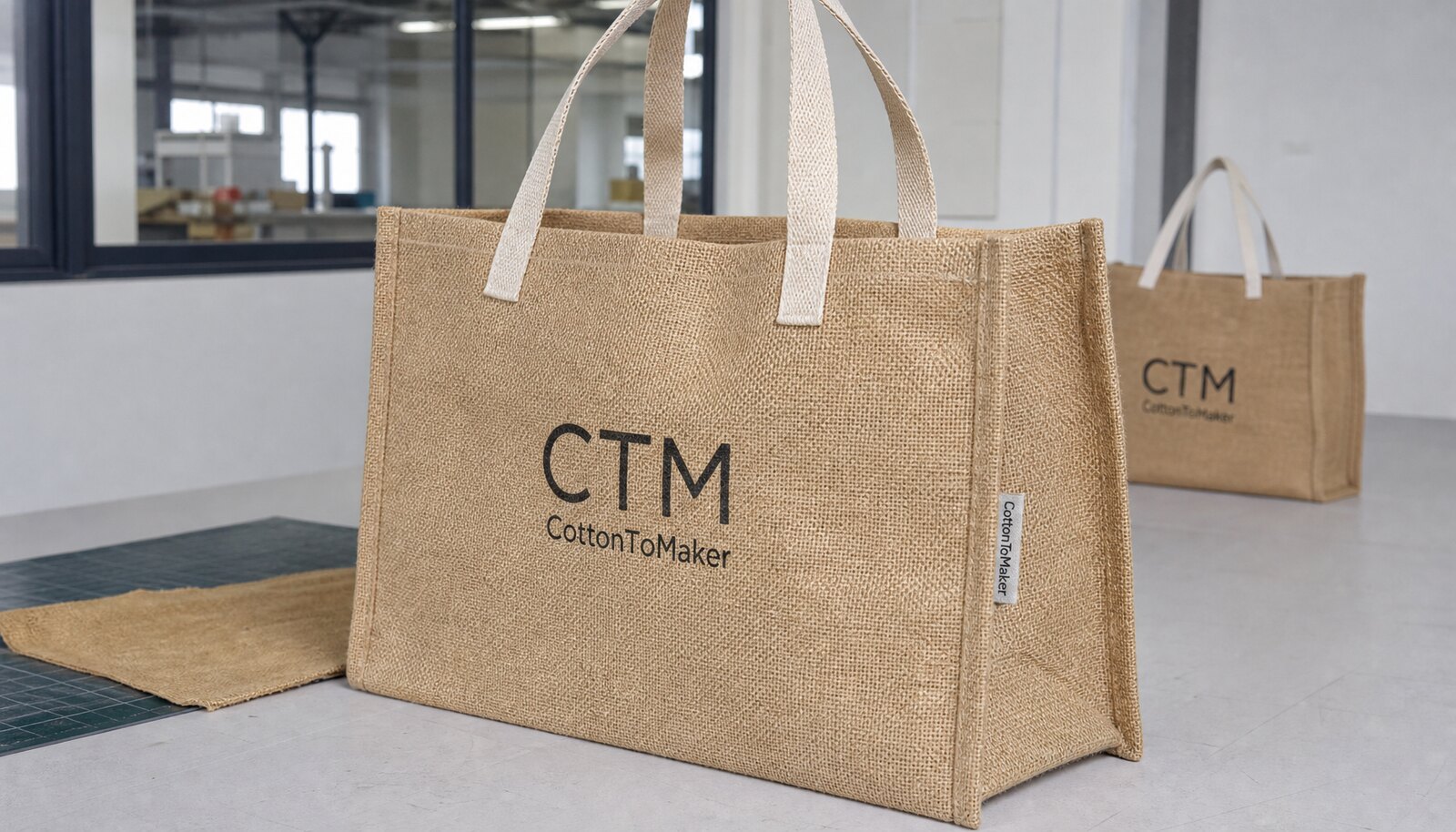
Start with the job to be done, not the bag style
A customised jute bag should be specified as a working product, not just a promotional item. The right construction depends on what the bag has to carry, how often it will be reused, how it will be displayed, and whether it needs to survive warehouse handling, retail shelving, or repeated customer use. A flat giveaway tote for an event, for example, is a very different buying decision from a gusseted retail bag with a lined interior and reinforced handles. If those use cases are not separated at the start, suppliers will quote different assumptions and the buyer will compare numbers that are not actually comparable.
Procurement teams usually save the most time by freezing the function first and the decoration second. Define the target load, the product type, the end market, and whether the bag is meant to look rustic, premium, eco-focused, or purely utilitarian. Then lock the dimensions and structure in a simple spec sheet. When the purpose is clear, the supplier can quote a relevant build instead of filling in missing details with whatever is easiest to manufacture. That is how a brief turns into a usable quotation rather than a polite guess.
The same rule applies to reorder programs. If the first order goes to stores, distributors, or event participants, the bag may become a recurring item in a purchasing calendar. In that case, it is worth documenting every design choice that affects repeatability: bag shape, handle material, print position, and any trim that could go out of stock later. The more the bag is treated like a controlled product, the easier it is to keep it consistent across replenishment cycles.
- Define the use case before asking for price: promo, retail, gift packaging, resale, or heavy carry.
- Set the target load and reuse expectation so fabric weight and handle construction can be judged correctly.
- Freeze the final dimensions and build type in writing before you invite supplier quotations.
- If the bag will be reordered, treat the first approval as the baseline for future batches.
Choose fabric weight, weave, and finish with the end use in mind
Fabric weight is one of the biggest drivers of both cost and feel in a customised jute bag. For standard shopping totes and promotional carry bags, 300 to 350 gsm is a common starting point because it balances cost, handleability, and basic durability. If the bag needs to support heavier goods, keep shape better on a shelf, or project a more premium finish, 400 gsm and above is often the safer route. Heavier fabric usually means better body and a more substantial hand feel, but it can also increase price, sewing difficulty, and lead time if the factory has to adjust its process.
The natural weave of jute adds another layer of decision-making. A more open weave can feel authentic and rustic, but it may also show irregularity in print absorption and appear less polished under close retail inspection. A tighter weave can improve visual consistency and print clarity, though the material may cost more or require a slightly different sewing method. Buyers should ask the supplier to state not only the gsm, but also whether the fabric is plain natural jute, dyed jute, laminated jute, or lined construction. Those are not cosmetic variations; they affect how the product behaves in production and in use.
Lamination and lining deserve particular attention because they change the bag beyond appearance. A lamination layer can improve structure and moisture resistance, but it can also change recyclability expectations and may alter the way the bag folds, prints, or smells when newly packed. A cotton lining can help with internal finish and reduce loose fibers, which is useful for retail programs or food-related packaging, but it adds sewing steps and can raise the MOQ. For procurement buyers, the practical question is not which version sounds better in theory; it is which version can be repeated reliably at the target price and delivery window.
- 300 to 350 gsm is a practical base range for many promo and retail totes.
- Move to 400 gsm plus when the bag must carry more weight or stand more upright.
- Ask the supplier to identify the exact weave, finish, and any lamination or lining in the quote.
- Do not change fabric weight between sample and bulk unless you want a different product.
Match print method to the artwork, not just to the logo
Most buyers get the best result on a customised jute bag with simple screen printing. That is because jute is a textured, absorbent substrate, and screen print handles bold logos, flat colors, and repeated production runs more predictably than more delicate decoration methods. For logos with clean edges and limited color counts, screen print is usually the most commercially efficient option. It can look strong, read well from a distance, and hold up across bulk production if the factory controls registration and ink coverage properly.
The limitation is artwork complexity. Fine lines, gradients, small legal text, and photo-like images are much harder to reproduce cleanly on jute than on smoother fabrics. A buyer who wants the print to carry a premium or design-led brand message should ask whether a sewn label, woven label, embroidered patch, or PU patch would communicate better than a dense print. Those options can increase perceived value, but they also add a second supply process or an extra sewing step. In other words, they improve presentation at the cost of more production coordination.
The best RFQ is explicit about decoration. State the Pantone reference if color matching matters, identify the number of print locations, and define the placement tolerance in millimeters or an agreed visual reference. If the logo sits near a seam, gusset, or handle attachment, mark that clearly on the artwork sheet. A supplier can only price registration accuracy and print consistency if the RFQ makes the print job visible. Otherwise, you are paying for artwork by assumption, which is where most avoidable disputes begin.
- Use screen print for bold, simple, repeatable branding.
- Use sewn or woven labels when you want a more refined finish than print alone can deliver.
- Avoid small text, gradients, and fine detail unless the supplier has already proven that the result is acceptable.
- Ask for a strike-off or decorated physical sample before bulk approval.
Specify handles, closures, and reinforcement like a load-bearing item
Handle design is not a cosmetic detail. On a jute tote, the handle is the main load-transfer point, so the wrong handle material or stitch pattern can turn a good-looking bag into a customer complaint. Cotton webbing is a common choice because it is comfortable in the hand and generally easier to control in production. Self-fabric handles may look more integrated with the body of the bag, but they can change the overall feel and may require better reinforcement if the bag is expected to carry heavier items. If the bag is intended for bottles, books, or grocery use, make the handle specification as explicit as the bag size.
Buyers should ask for handle width, handle drop, handle length, and reinforcement method in the RFQ. The same rule applies to closures such as zips, magnetic snaps, drawstrings, or top ties. Each added component affects sewing time and inspection risk. A closure can elevate the product for retail use, but it also creates more opportunities for inconsistency if the supplier has to source extra trims. If the bag is going into a promotional program, a simpler build may be more cost-effective and easier to repeat.
A practical sourcing habit is to ask the supplier how the handle is attached at the stress point. Look for bar-tacks, box-X stitching, or another clearly defined reinforcement method, and ask whether the stitch count is controlled by a standard machine setting or a manual operation. If the bag is meant to carry more weight, also ask whether the factory has a routine internal pull test for handle attachment. This is one of the easiest places to catch weak production before shipment.
- Lock handle width, handle length, and handle drop before pricing.
- Use reinforcement at all load points, especially where the handle meets the bag body.
- Specify closures only if they are functionally necessary or commercially justified.
- Ask the supplier how handle attachment is reinforced and whether it is checked in production.
Write an RFQ that produces comparable quotes, not just multiple numbers
A useful RFQ for a customised jute bag should function like a short manufacturing brief. It needs enough detail for the supplier to quote the same product every time, but not so much filler that important requirements get buried. At minimum, include finished dimensions, gusset depth, fabric gsm, weave or finish, handle material and length, closure type, decoration method, print colors, packaging method, carton count, and the preferred incoterm. If any of those are left open, suppliers will fill gaps in different ways and the resulting quotes will not be comparable.
It helps to split commercial and technical requirements. On the technical side, state the product build, print placement, size tolerance, and any special internal finish. On the commercial side, ask for unit price, print setup, sample fee, carton cost, label cost, packing cost, and freight basis. The buyer then sees where one supplier is genuinely better and where another is simply bundling costs differently. This is especially important when comparing a factory quote with a trading-company quote because the margin structure can be hidden inside the line items.
A good RFQ also includes what is not acceptable. If there is a prohibited substitute for the handle material, an unacceptable print shift, or a maximum tolerance for size variation, state it plainly. Quote clarity improves when suppliers know the failure points early. Procurement teams do not need a story; they need a quote that reflects the actual production job.
- List all technical specs and all commercial terms in the same RFQ packet.
- Request separate line items for setup, sample, packaging, and cartons.
- Name the incoterm so EXW, FOB, or delivered pricing is not mixed together.
- State what cannot be substituted without written approval.
Compare suppliers on landed cost and evidence, not on the lowest headline price
For procurement buyers, the unit price on a quote is only the starting point. Two suppliers can quote the same customised jute bag at similar prices and still create very different landed costs once setup fees, packing, cartons, inland charges, testing, or freight assumptions are added. One supplier may also be pricing a slightly thinner fabric or a simpler stitch detail without saying so clearly. A proper comparison starts with a controlled spec sheet and ends with a landed-cost view that includes what will actually reach the warehouse or the store.
The easiest way to normalize quotes is to ask every supplier to price the same base bag and the same options separately. If the program may need labels, hangtags, extra print colors, or retail cartons, have those items broken out line by line. This makes it easier to identify where one supplier is genuinely efficient and where another is simply omitting costs. It also reduces the risk of award decisions based on a quote that looks lower only because it is incomplete.
Evidence matters just as much as price. Ask for a current production sample, close-up photos of stitching and seam finishes, and clear carton images before award. If the program will be repeated, ask how the supplier controls versioning for artwork and sample approvals. A supplier that can explain the production route in plain terms is generally easier to manage than one that only offers a low number. In sourcing, predictability is part of value.
- Compare quotes on the same spec sheet and the same commercial terms.
- Ask for separate pricing for options such as labels, hangtags, extra colors, and retail cartons.
- Use a landed-cost view that includes setup, packing, and freight basis.
- Request current production evidence before award, not only a PDF quote.
Approve the sample as a production reference, not as a courtesy check
A pre-production sample should be treated as the control part for the entire order. It is not just a visual approval; it is the item against which the bulk shipment should be measured. The buyer should check the actual dimensions, handle placement, seam finish, print coverage, and overall structure using a ruler, not just a quick review in hand. Because jute is a natural fiber, some variation in weave and tone is normal. The important question is whether the variation stays within the agreed acceptance range and whether the bag still meets the intended use.
It is useful to sign the sample only after writing down the key acceptance points. For example, define the acceptable size tolerance, the print placement tolerance, the handle drop, and the expected load test result for the intended application. If the bag is going to be used for bottles, books, or bundled retail goods, ask the supplier to show how the handle and seam area respond to that kind of load. The approval note should be specific enough that another person in the team could use it as a reference during inspection.
Once approved, keep the sample as the golden sample with the purchase file. Mark the version, date, artwork revision, and any agreed exceptions. That record is valuable when a buyer needs to resolve a dispute with a factory, compare a reorder, or explain why a later shipment does not match the original approval. A sample that is not documented tends to become a memory; a sample that is documented becomes a control tool.
- Measure the sample, do not rely on visual approval alone.
- Record size tolerance, print placement tolerance, and handle drop in the approval note.
- Keep the signed sample as the golden reference for bulk inspection.
- Use the approved sample to explain any future reorder or dispute.
Build a QC plan with measurable checks, not generic assurances
Quality control for a customised jute bag should be defined in practical terms. A procurement team does not need broad claims such as 'good quality' or 'premium finish'; it needs checkpoints that can be verified during incoming inspection or pre-shipment inspection. The first layer is dimensional control: finished size, gusset depth, handle length, and print placement. The second layer is construction control: stitch density, seam security, handle reinforcement, and edge finishing. The third layer is appearance and hygiene: odor, stains, loose fibers, broken threads, print smearing, and packing condition.
Where possible, specify a measurable inspection method. Many buyers use a general AQL framework for visual defects, often with a tighter plan for critical issues such as wrong size, wrong artwork, or weak handle attachment. The actual acceptance number should be agreed with the supplier and aligned to the product risk, not copied blindly from another category. For load-related checks, define the target weight and duration based on how the bag will actually be used. If the bag is intended for everyday carry, a simple pull or hold test is more meaningful than a vague durability statement.
The most useful QC language is specific. For example, you can require that the handle attachment uses a defined stitch pattern, that the seam ends are secured, that the print is centered within a stated tolerance, and that no carton contains damp or odorous bags. If your packaging runs across long transit routes, also specify whether each bag needs to stay flat, clean, and dry after carton compression. That level of detail helps the supplier self-check before shipment and gives the buyer a clear basis for rejection if the standard is not met.
- Use a measured inspection plan with size, stitch, print, and packing checks.
- Define the acceptable load test for the bag’s real use case.
- State what counts as a critical defect: wrong artwork, weak handle, wrong size, or damaged packing.
- Ask the factory to show its in-process QC points, not just final inspection language.
Plan packing, labeling, and carton details before the bags are sewn
Packing is often treated as an afterthought, but for jute it can strongly influence the condition of the product on arrival. Jute absorbs moisture and can pick up warehouse odors if the bags are packed too loosely or stored in the wrong environment. For most programs, flat packing is the safest default because it reduces volume and helps maintain a cleaner appearance. If the bag is retail-facing and needs a more shaped presentation, that should be specified up front so the supplier can pack it accordingly instead of improvising at the last minute.
The purchase order should specify the number of pieces per inner bundle, the number of bundles per carton, carton dimensions, and whether moisture protection is required. If the route is long or the warehouse is humid, a polybag or other barrier may be worth the extra step. For retail distribution, add barcode location, country-of-origin label requirements, and any hangtag position rules. These details reduce receiving friction and prevent the factory from using a generic export packing approach that does not fit your market.
Carton marking matters as well. Ask for outer carton marks that match the purchase order, including style name, color, quantity, carton number, and destination if needed. If the bags are going to multiple stores or distribution centers, the packing plan should support easy receiving and traceability. The buyer should be able to open a carton and immediately see whether the content matches the order without re-counting every item by hand.
- Choose flat packing unless retail presentation requires something different.
- Specify inner bundle count, carton count, and carton dimensions in the PO.
- Use moisture protection when the route, season, or warehouse conditions make it sensible.
- Align barcodes, labels, and carton marks with the receiving process before production starts.
Create a realistic lead-time plan that includes the parts buyers often forget
A realistic lead time for a customised jute bag is more than the factory’s sewing time. It includes artwork confirmation, raw material booking, sample production, sample approval, bulk sewing, decoration, packing, inspection, and freight booking. If the supplier gives only a single number, ask whether that number starts after sample sign-off or from the day the inquiry was received. Those are not interchangeable. For procurement planning, the schedule that matters is the one that starts after the supplier has a signed specification and approved sample.
Lead time becomes even more important when the bag is tied to a launch date, exhibition, seasonal campaign, or retail promotion. If the deadline is fixed, build in a buffer for revisions, transport delays, or minor rework. Jute programs can move quickly when the spec is stable and the fabric is available, but delays often come from slow approvals, artwork changes, or missing carton instructions rather than from sewing itself. A strong supplier will give a calendar that shows where the risks are. That is usually more useful than a very short promise with no explanation.
It is also worth asking whether the supplier can stage production. For example, some buyers may want part shipment for an early launch and the balance later. If that is important, it should be discussed before award because it affects fabric booking, carton allocation, and dispatch planning. The more the schedule is mapped in advance, the fewer surprises at the end of the order cycle.
- Confirm whether the quoted lead time starts after sample approval.
- Add buffer for artwork sign-off, inspection, freight booking, and customs if relevant.
- Do not let a launch date compress the sample approval stage.
- Ask whether partial shipment or staged dispatch is possible if the program needs it.
Specification comparison for buyers
| Spec decision | Recommended option | When it fits | Buyer risk to check |
|---|---|---|---|
| Sourcing route | Direct factory for repeat programs; trading company for mixed SKUs, smaller programs, or faster coordination across multiple trims | You need a customised jute bag with stable artwork, a clear spec sheet, and repeatable production control | Hidden margin, unclear factory ownership, or one quote that mixes factory and trading-company assumptions |
| Fabric weight | 300 to 350 gsm for standard shopping or promo totes; 400 gsm plus for heavier loads, more body, or a more premium retail feel | The bag must carry product safely, stand up better on shelf, or survive frequent reuse | A quote that omits gsm, uses an unapproved fabric range, or quietly swaps weight between sample and bulk |
| Weave and finish | Natural jute weave for a rustic look; dyed jute, laminated jute, or lined construction when appearance, shape, or moisture resistance matters | You want a retail-ready finish, less fiber shedding, or a firmer hand feel | Finish changes can alter price, odor, print behavior, recyclability, and lead time; get them stated clearly |
| Print method | 1 to 2 color screen print for most logos; woven label, sewn patch, or embroidery only when the brand needs a more refined finish | Artwork is bold, the logo is simple, and the bag will be ordered repeatedly | Fine gradients, tiny text, and photo art may not reproduce cleanly on jute; ask for a strike-off |
| Handle construction | Cotton webbing or self-fabric handles with bar-tacks or reinforced stitching at stress points | The bag will carry books, bottles, groceries, or other heavier retail goods | Handle width, handle drop, and stitch count must be fixed or samples will vary from bulk |
| Sample route | Pre-production sample with signed artwork placement, stitch reference, and measured dimensions | You need approval before bulk and want a clear baseline for inspection | A digital proof does not show weave absorption, seam strength, or actual print registration |
| Packing route | Flat packed with carton count, inner bundle count, and moisture protection specified in the PO | You ship long distance, store bags before launch, or need clean retail presentation | Loose packing, no carton marks, or missing poly protection can cause wrinkles, odor, and receiving issues |
| Lead-time strategy | Book fabric and print capacity early; add buffer for sample approval, QC, and freight booking | You have a fixed in-store date, event date, or campaign launch | A quote that promises bulk lead time before sample sign-off is not a reliable schedule |
| Quote structure | Base bag price plus print setup, sample fee, packing, carton, testing, and FOB or EXW terms | You need a like-for-like supplier comparison | Missing line items make the cheapest quote look better than it is |
Buyer checklist before sampling
- Define the end use, target load, and whether the bag is promo, retail, gift packaging, or resale packaging.
- Lock finished size, gusset, handle length, closure, and print area before requesting quotes.
- Choose the fabric weight in gsm and decide whether lining or lamination is required.
- Approve the logo file, print method, color standard, and placement tolerance in writing.
- Specify packing format, units per carton, carton marks, and any moisture protection.
- Request a pre-production sample and name the approval criteria, including dimensional tolerance and print acceptance.
- Confirm incoterms, lead time after sample approval, and the expected reorder plan.
- Compare quotes on the same spec sheet and the same commercial terms, not on headline unit price alone.
Factory quote questions to send
- What jute gsm, weave type, and finish are included in the quoted price?
- Is the print setup charge separate, and what is the cost per extra color or print location?
- What is the MOQ for the exact spec, including lining, lamination, handle type, and packing method?
- Can you provide a pre-production sample timeline and identify what changes after sample approval?
- What are the carton size, units per carton, gross weight, and moisture protection method?
- Which QC checks are included at factory level, and what inspection standard do you use?
- What is included in the unit price, and which items are extra such as labels, hangtags, or export cartons?
- What lead time applies after sample approval, and what would extend it?
- Can you share recent photos or a current production sample with the exact fabric and stitch construction?
- What documents do you provide for export, including carton marks, packing list, and origin details if required?
Quality-control points to confirm
- Fabric weight, weave density, and hand feel match the approved sample and the quoted gsm range.
- Finished size, gusset, handle drop, and closure alignment stay within the agreed tolerance for the program.
- Stitch quality is even, seam ends are secured, and stress points have bar-tacks or reinforced stitching.
- Print placement, color, opacity, and edge sharpness match the signed sample under normal viewing light.
- No strong odor, excessive fiber shedding, stains, broken threads, oil marks, or damaged edges appear in packed cartons.
- Load performance is checked with the agreed test method for the intended use case, and the result is recorded.
- Carton counts, carton marks, product labels, and bundle count match the purchase order.
- Packed bags remain flat, dry, clean, and free of compression damage after carton sealing and before shipment.