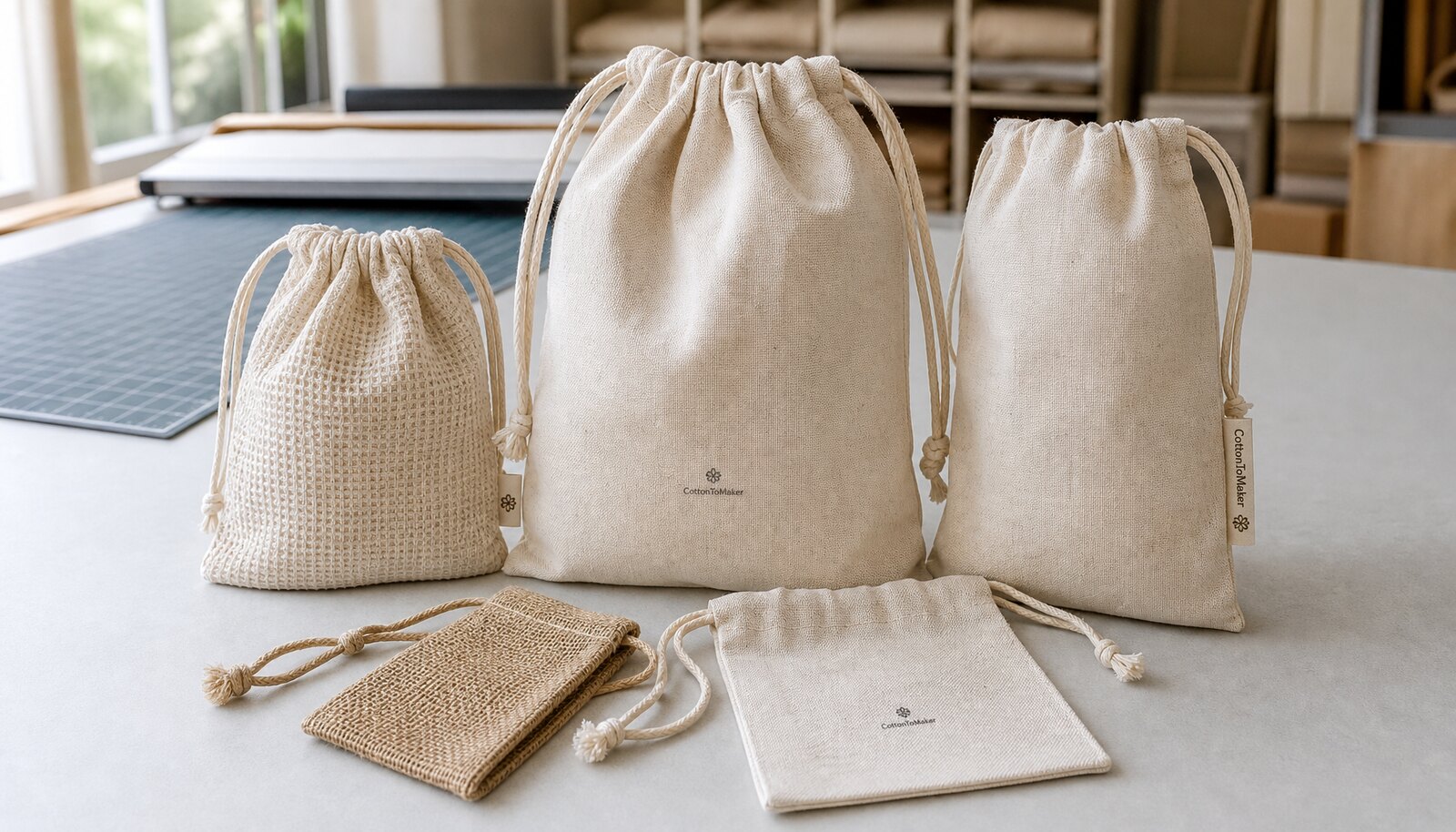
What buyers are actually buying
A customised drawstring pouch is not just a blank bag with a logo. It is a finished pack item with a defined size, fabric weight, construction method, closure behavior, print zone, packing format, and shipping profile. Two suppliers can quote the same outer dimensions and still deliver very different results if one uses lighter cloth, a narrower seam allowance, a thinner cord, or a looser packing standard.
That is why a buyer should write the specification as a product definition, not as a decoration request. If the RFQ only includes a logo and an approximate size, the quotes will be hard to compare and the sample approval will be unclear. If the RFQ defines how the pouch will be used, what failure modes matter, and what counts as acceptable quality, the procurement process becomes much more controllable.
- State the finished size, not only the cut size.
- Define the end use: packaging, retail accessory, sample pack, or giveaway.
- Say what you are trying to avoid: see-through fabric, weak seams, poor print durability, or slow pack-out.
Fabric and construction set the real commercial baseline
Fabric choice usually drives the first meaningful split in price and performance. On cotton pouches, 100-120gsm is often the lowest-cost route, but it can feel thin, show contents, and lose structure once the pouch is filled. A 140-160gsm range usually gives a better balance of opacity, body, and print appearance for retail-facing programs. Heavier fabric can improve presentation and reduce visibility through the pouch, but it also increases material cost, sewing effort, and freight weight.
Construction details matter just as much as GSM. Ask how the side seams are finished, how wide the cord channel is, what stitch density is used, whether the opening is reinforced, and whether the pouch uses a single or double cord. These details influence jamming, closure symmetry, and failure risk in real use. A cord that is too thin for the channel will move badly. A channel that is too tight can pucker or tear. For buyers, those are not small details; they are the difference between a pouch that looks acceptable on arrival and a pouch that generates complaints.
- 100-120gsm: useful for low-cost inserts and short-life promotions.
- 140-160gsm: usually the best general-purpose choice for branded packaging and repeat use.
- 160gsm+: consider when the contents are heavier, the brand position is premium, or opacity is critical.
Branding should follow the artwork, not the other way around
The cheapest decoration method is not always the best commercial decision. Screen printing is usually the most efficient option for a simple one-color logo or a stable repeat program. It tends to offer a strong balance of cost and durability when the artwork is fixed and the volume is high enough to spread setup cost. Heat transfer can be useful for small runs, multi-color logos, or designs that change often, but the unit economics change quickly once volume grows. Embroidery can raise perceived value on thicker pouches, but it needs enough fabric body to hold stitches cleanly without distortion.
Placement is just as important as process. Artwork too close to the top channel, side seam, or drawstring path can distort after sewing or fold poorly when the pouch is closed. Buyers should define a safe zone and ask the factory to show the print position on the sample before bulk approval. If the quote does not state print size, print position, and print method, it is not yet a usable procurement comparison.
- Screen print: best for simple logos and repeat orders.
- Heat transfer: better for short runs, fine detail, or frequent design changes.
- Embroidery: useful for premium programs, but only when the fabric can support the stitch cleanly.
Comparison table: what changes price, lead time, and landed cost
A useful quote comparison has to go beyond fabric and logo. The landing cost depends on print durability, fabric behavior after sewing, closure reliability, carton efficiency, and the amount of packing labor required at the factory. A quote that looks cheaper on paper can become the most expensive option once freight, rework, and receiving labor are added.
For procurement teams, the right question is not only which quote is lowest. It is which quote best fits the order purpose, the usage environment, and the acceptable risk level. If the pouch is part of a retail presentation or a customer-facing kit, the safer route is often the one that improves consistency and reduces complaints, even if the unit price is slightly higher.
- Normalize quotes to the same fabric weight, print area, packing format, and shipment basis.
- Ask for repeat-run charges and setup fees separately.
- Request carton data before commercial approval so freight can be estimated correctly.
MOQ, samples, and repeat orders need separate logic
MOQ is not one number for every pouch. It changes with size, fabric color, print color count, cord color, and packing format. A factory may offer a low MOQ for stock fabric and a standard size, then move to a much higher threshold for custom dyeing or a special cord color. Buyers should treat MOQ as a reflection of material booking and production setup, not as a sales talking point.
Sampling should be treated as a production rehearsal. The pre-production sample should prove the finished size, print position, cord action, closure behavior, and packing format. If the pouch will be reordered later, ask whether the same fabric, cord, and print method can be repeated without changing the appearance or the lead time. A cheap first order is not very useful if the second order becomes difficult to reproduce.
- Stock size and stock fabric reduce launch risk.
- Custom dye or custom cord color usually raises MOQ and lead time.
- Ask whether the factory can repeat the same spec six months later without a fresh approval cycle.
How to compare supplier quotes line by line
The easiest way to misread a pouch quote is to compare only the unit price. One supplier may include print setup and a basic polybag, while another excludes both. One may quote FOB only, while another quietly assumes extra packing labor, an inspection fee, or a different carton count. Unless the quote is normalized, the buyer is not comparing real alternatives.
Ask every supplier to break the offer into the same line items: fabric spec, print method, setup charge, sample cost, packing format, carton data, and shipment term. If the supplier cannot do that, the buyer will have less visibility later when something changes. A slightly higher quote with clear assumptions is usually safer than a lower quote that hides the real cost structure.
- Confirm whether the price includes print setup, sample approval, and packing materials.
- Ask for carton dimensions, gross weight, and pieces per carton.
- Check whether the quotation assumes the same spec version as the sample.
How to vet factories beyond the sales pitch
A good factory should be able to show more than a price and a handful of product photos. For customised drawstring pouches, ask for evidence that ties the quote to an actual production process. That can include a specification sheet, approved artwork proof, material swatches, a sample reference photo, and a packing plan that shows carton count and label format. If the factory claims it can handle a special fabric, a complex print, or a retailer-specific packout, ask for proof of similar process control rather than verbal assurance.
The most useful supplier evidence is practical. Request a pre-production sample workflow, a record of what gets checked at cutting and sewing, a final inspection checklist, and examples of carton markings or barcode labels they have used before. If you are placing a meaningful order, ask who signs off the sample internally, who approves the first bulk output, and what happens if the approved sample and the bulk piece do not match. That gives you a clearer picture of the supplier's actual control system, not just their sales process.
- Ask for the current spec sheet with revision number and approval date.
- Request photos of the sample stage, the packing stage, and the carton label format.
- Confirm whether the factory can provide inspection reports, count sheets, or pre-shipment photos before release.
Sample approval should follow a fixed workflow
A clean sample workflow prevents most production disputes. Start with artwork approval, then confirm material and construction, then approve the physical sample, and only then freeze carton markings and packout. If the buyer keeps changing print size, cord color, or packaging after the sample is approved, the timeline will slip even if the factory has capacity. For short runs, that may only delay shipment. For larger programs, it can change the whole buying window.
The sample should be reviewed under the same conditions the final order will face. Check the pouch with the real contents if the pouch is carrying products. Compare the sample to a retained approval reference, not only to memory. If there is a revision, mark it clearly with a date and version number so the bulk order cannot drift. The point of sample approval is not to make the pouch look nice in isolation. It is to lock the commercial and quality baseline before the factory books bulk production.
- Approve artwork first, then the sample, then the carton and label details.
- Use version numbers on every revision so the factory and buyer are working from the same reference.
- Test the pouch with actual contents whenever the pouch has to carry a real product.
QC standards should be measurable, not descriptive
For procurement, words like neat, clean, or good quality are too vague to manage. Quality control should be written as measurable acceptance defaults that the buyer can apply consistently. The idea is not to create a laboratory test for a simple pouch. The idea is to prevent common failures such as size drift, weak seams, poor print placement, cord jamming, and bad pack counts. If the buyer sets the threshold clearly, the factory knows what to build and the receiving team knows what to inspect.
The practical way to write QC is to define the failure points. Reject a pouch if the seam opens under a firm pull, if the cord jams, if the logo is visibly off-center, if the print rubs off too easily, or if carton counts do not match the purchase order. The thresholds below are intended as buyer-side acceptance defaults unless you have a category-specific standard that requires tighter control.
- Size: set a millimeter tolerance and say whether opening width is included.
- Seams: reject open stitches, skipped stitches, and loose thread tails longer than about 3 mm on visible surfaces.
- Print: check placement, clarity, and color against the signed sample or approved proof.
- Cord: test smooth closure and no visible slippage during a filled-sample pull screen.
- Packing: verify inner counts, carton counts, labels, and barcode readability before release.
Packing and carton planning affect freight more than many buyers expect
Packing is not a minor detail. It changes factory labor cost, carton cube, receiving speed, and freight efficiency. Bulk-packed pouches are usually the lowest-cost option when the buyer will do final kitting or redistribution. Individual polybags make more sense when the pouch must arrive shelf-ready, when the customer requires unit protection, or when the receiving team needs easy count verification.
Carton data should be part of the quote, not a follow-up question. Ask for master carton dimensions, estimated gross weight, and pieces per carton. For air and courier shipments, a small change in carton size can move freight materially. For sea freight, improved carton packing can raise cube efficiency and lower landed cost without changing the product itself. The pouch may be simple, but the carton plan is often where the real logistics savings sit.
- Bulk pack: best for B2B redistribution and lower factory handling cost.
- Individual polybag: best for retail or ecommerce programs that need unit protection.
- Barcode and label requirements should be confirmed before production starts, not after packing begins.
Specification comparison for buyers
| Buyer decision | Lower-cost route | Durability and quality tradeoff | Production and freight tradeoff | Best-fit use case |
|---|---|---|---|---|
| Fabric weight | 100-120gsm cotton | Lowest material cost, but higher risk of see-through fabric, softer structure, and a lighter hand feel | Usually fast if the factory has stock cloth; lower piece weight helps freight, but the pouch may need more inspection for opacity and shape | Short-life giveaways, sample inserts, and light promotional kits where presentation risk is limited |
| Fabric weight | 140-160gsm cotton | Better body, improved opacity, and less collapse in the hand; usually the safest middle ground for branded pouches | Slightly higher unit cost and freight weight, but often lower complaint risk and better pack-out consistency | Retail packaging, premium kits, and repeat orders where appearance and reuse matter |
| Print method | 1-color screen print | Low setup cost and efficient for stable artwork; usually the strongest value for simple logos | Good print durability when the ink is properly cured; the main risk is registration or rubbing if the process is rushed | High-volume repeat runs with one logo and limited artwork changes |
| Print method | Heat transfer or digital transfer | Higher per-piece cost, but better for small runs, fine detail, or frequent artwork changes | Print durability depends on film, adhesive, and cure control; may be less breathable and more sensitive to folding or abrasion than a direct print | Short launches, multi-color graphics, or low MOQ programs |
| Closure style | Single cord channel | Lowest sewing complexity and usually a simpler quote | Higher cord-failure risk if the channel is too tight or the cord is underspecified; may close less evenly if the load is unbalanced | Light contents, low-cost packaging, and simple internal distribution |
| Closure style | Double cord with balanced pull | Slightly higher sewing and material cost | Typically better closing symmetry and lower jam risk if the cord and channel are matched properly | Retail-facing pouches and programs where user experience matters |
| Packing format | Bulk packed | Lowest pack labor and lowest packaging material cost | Less shelf-ready, but efficient for warehouse kitting; requires good carton count control to avoid shortages | B2B redistribution, co-packing, and internal fulfilment programs |
| Packing format | Individual polybag with barcode label | More handling cost and more material use | Better unit protection and easier retail/ecommerce receiving; adds count accuracy and scanning convenience | Shelf-ready retail, ecommerce, and programs with retailer packout rules |
| Sourcing route | Direct factory | Cleaner pricing and fewer intermediary charges | Usually better for repeatability and spec control, but the buyer must manage the approval trail and supplier communication well | Repeat programs with stable artwork, clear forecasts, and an internal buyer who can manage specifications |
Buyer checklist before sampling
- Finished pouch size in mm, including usable opening width and the internal depth after sewing and pressing.
- Intended use case: gift packaging, retail accessory, sample pack, event giveaway, or product protection.
- Fabric type, target GSM, color standard, and whether natural shade variation or batch variation is acceptable.
- Drawstring specification: single cord or double cord, cord diameter, cord color, tip finish, and whether knots are acceptable.
- Print specification: artwork file format, print size, print position, number of colors, and any safe-zone requirement away from seams and the cord channel.
- Packing specification: bulk packed, inner polybag count, individual polybag, barcode label, insert card, carton marking, or retail hangtag.
- Commercial target: target MOQ, annual forecast, preferred shipment term, and whether you need a test order before the main run.
- Destination requirements: carton limits, barcode format, country-of-origin label, and any retailer packout rules that apply at receiving.
Factory quote questions to send
- Is the quoted GSM based on finished pouch fabric or raw fabric before cutting and sewing?
- Which print method is included, what setup fee applies, and how many colors are covered in the quoted price?
- What is the exact MOQ by size, fabric color, and print version, and can different sizes share the same material booking?
- What sample do you provide before bulk production, what does it cost, and is the sample charge refundable if I place the order?
- What packing is included by default, how many pieces go into each inner pack and master carton, and are barcode labels extra?
- Can you share the carton dimensions, estimated gross weight, and piece count per carton for freight planning?
- What QC checks do you perform at cutting, printing, sewing, and final packing?
- Which documents can you provide to prove the approved material, print proof, and final pack count before shipment?
- If I approve artwork today, what are the critical milestones that could still delay shipment?
Quality-control points to confirm
- Use the following as buyer-side acceptance defaults unless your category spec requires tighter limits: finished size within plus or minus 5 mm for small pouches and plus or minus 10 mm for larger pouches.
- Check seam quality for even stitch lines, no open stitches, no skipped stitches, and no loose thread tails longer than about 3 mm on visible surfaces.
- Confirm the cord runs smoothly on both sides, closes evenly, and does not jam or slip during a normal open-close cycle.
- Treat the pull screen as a buyer acceptance default, not a universal industry standard: fill a sample to a realistic load, hold the pouch by the cord or channel, and apply a firm manual pull for about 10 seconds; reject if the channel tears, stitches open, or the cord slips visibly.
- Review print placement against the signed sample or artwork proof, with no obvious offset into the seam line, no ghosting, and no heavy bleed into the weave.
- Treat the rub check as a buyer-side durability screen unless you have a formal lab standard: rub the printed area with a white cloth for 10 firm passes; reject if there is visible color transfer, cracking, or distortion beyond the approved sample.
- Check color against the approved sample or swatch card, while allowing for the natural shade variation that can occur in cotton lots or dyed-fabric batches.
- Verify packing counts at the inner pack and master carton level, and confirm that carton labels, barcode labels, and carton markings match the purchase order exactly.