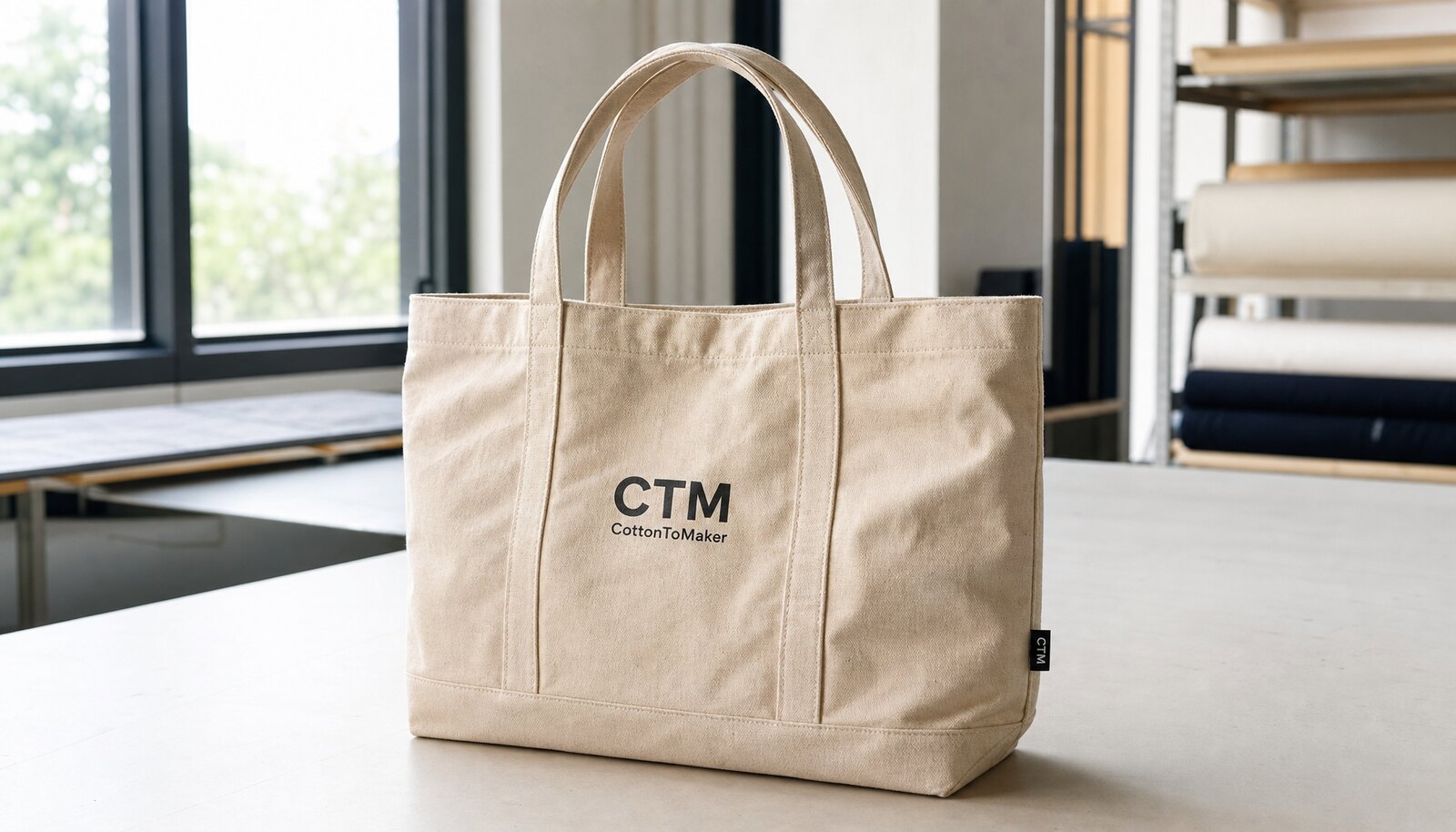
Start With the Use Case, Not the Artwork
A customised canvas bag quote only becomes useful when the supplier understands the bag's job. A giveaway tote for a trade show, a retail shopper, and a subscription insert bag all need different fabric weight, handle strength, packing format, and finishing. If you lead with the logo alone, you usually get a quote that looks cheap but misses the real requirement: whether the bag survives the intended load, fits the channel, and arrives without avoidable rework.
Write the job in one sentence before you request pricing. State what the bag will carry, how often it will be used, the channel, and whether it is a one-time campaign item or a recurring SKU. A bag that only holds brochures can tolerate a simpler build. A bag sold at retail or handed to customers as a branded product needs tighter control on dimensions, stitching, print placement, and carton presentation because the defect cost is higher and the visual standard is less forgiving.
The practical service level is the first decision. If the bag must fold flat for mailing, stand upright on shelf, or feel premium in a customer handoff, that changes the fabric, gusset, and closure choice. For procurement, that is more important than deciding the logo color first, because the wrong base build cannot be corrected with artwork alone.
- State the contents in plain terms, such as brochures, sample packs, books, groceries, or event materials.
- State the channel clearly: promo giveaway, retail shelf, e-commerce insert, or distributor program.
- Decide early whether the bag must fold flat, stand upright, or present like a retail product on arrival.
Specify the Canvas Body Like a Production Buyer
Fabric weight is one of the biggest cost and quality drivers in a custom canvas tote bag. For many promo uses, 8-10 oz canvas is enough if the contents are light and the bag is not expected to keep its shape. Around 12-14 oz is a more balanced retail or general-purpose range because it improves structure, helps the print sit cleaner, and feels less flimsy in hand. Once you move beyond that, the unit cost and freight weight rise quickly, so the improvement needs to justify itself in the end use.
Do not treat gsm or oz as the only fabric spec. Weave density, yarn quality, and finish matter just as much. A dense mid-weight canvas with consistent finishing can outperform a nominally heavier cloth that cuts poorly, frays at the edge, or shrinks after sewing. If the bag will be folded for packing or shipped flat, ask whether the cloth is pre-shrunk and how much shrink allowance the factory is building into the cut size. If the supplier cannot explain the finish, you are comparing numbers, not materials.
Natural, bleached, dyed, washed, and pre-shrunk canvas all behave differently in production. Natural cloth is usually the most economical and can have more visible fibre variation. Bleached cloth gives a cleaner background for brand colours. Dyed cloth can complicate colour control and rub performance. Washed or softened cloth may look more premium, but that finish can also change the hand feel and size stability. The right choice depends on the brand positioning and the risk you are willing to carry on shade consistency.
- Ask for the cloth spec in both oz and gsm if the supplier can provide it, so comparisons are easier across factories.
- Confirm whether the cloth is greige, bleached, dyed, washed, or pre-shrunk before comparing unit prices.
- If the bag must keep shape, ask for the finish and shrink allowance rather than assuming a higher gsm alone will solve it.
Lock Down Construction Details That Change Durability
Canvas bags fail at stress points, not in the middle of the panel. The construction details that matter are seam type, seam allowance, handle attachment, and base reinforcement. A bag can look clean in a photo and still be weak if the handles are stitched once, the seam allowance is too narrow, or the load path concentrates force at one point instead of spreading it through a reinforcement zone.
Ask the factory to describe the seam construction in plain language. A basic build may use single-needle seams with overlock finishing, which is adequate for low-cost promo use. A stronger build usually combines double-needle topstitching with reinforcement at the handles and corners, which is better for retail or heavier contents. If the supplier says reinforced, push for the actual method: handle attachment layout, bar tack placement, patch size, and any extra stitch rows.
Dimensions also need tighter control than many teams expect. For a promo bag, a wider tolerance may be acceptable if the price and print are right. For retail or e-commerce, buyers usually need tighter control on flat width, height, gusset, and handle drop because the bag must pack consistently and present the same way in store or on camera. A practical approach is to set a tighter band on the opening width and handle drop than on non-critical edges, then make that tolerance visible in the PO rather than leaving it implied.
- Require the seam construction to be named, not described with generic phrases such as strong stitching.
- Ask for reinforcement dimensions in millimetres and a photo or sketch of the stitch layout.
- Set separate tolerances for flat width, height, gusset depth, and handle drop if the bag will be retail packed.
Choose the Decoration Method for the Channel, Not the Sample Room
Print method changes both price and risk. Screen printing is often the best fit for simple logos, solid fills, and repeat orders because setup is predictable and the result on canvas is usually clean. Heat transfer can help with detailed graphics, small text, or shorter runs, but it adds another failure point if application temperature, pressure, or timing is inconsistent. Embroidery and woven labels can raise the perceived value, but they are not always appropriate for thin canvas, tiny text, or price-sensitive runs.
Treat the artwork as a production input, not just a design file. The factory needs the print area, Pantone references, line-thickness limits, and any required underbase or outline treatment before it can quote accurately. If the logo has fine type, tight registration, or a large coverage area, ask how that affects yield and reject risk. A one-colour mark on natural canvas is a different job from a multi-colour graphic on dyed cloth, even if both are called the same product.
If the bag will be handled often or contact clothing, ask for a durability expectation on the print finish. For dark ink or dark cloth, agree on rub expectations before production rather than after shipment. The useful question is not which decoration method sounds premium in a vacuum. It is which one survives the use case with the least production noise and the fewest surprises in inspection.
- Use screen print for simple marks and repeat programs where consistency matters.
- Use heat transfer only when the artwork needs detail or the run is too small to justify full screen setup.
- Use embroidery or woven labels when the brand wants a more premium finish and the canvas weight can support it.
Build the RFQ So Suppliers Quote the Same Job
A usable RFQ makes the supplier quote a specific product rather than a vague idea. If the request only says customised canvas bag, the factory has to guess the body size, weight, handle length, print method, reinforcement, and packing format. That is how quote gaps appear later. A procurement-grade RFQ includes the dimensions, fabric spec, artwork file, print count, reinforcement requirement, packing method, incoterm, and delivery destination.
The most common mistake is sending one line of text and hoping the factory fills in the blanks. That gives you prices that cannot be compared. If you want a serious comparison, send the same tech pack and artwork file to every supplier, and make sure the RFQ states what is included and excluded. Screen charges, label costs, carton marks, packing configuration, and sample costs are often where hidden differences sit. If the supplier is quoting from a different assumption, it is better to see that before sampling than after award.
Normalize each offer to the same basis before you compare it. If one supplier is quoting FOB and another is quoting DDP, those numbers are not directly comparable until you separate the product price from freight, duty, brokerage, and inland delivery. The simplest way to reduce quote noise is to fix the spec first, then ask for optional pricing on upgrades such as pre-shrink, heavier cloth, retail packing, or stronger handles. That shows you what the bag really costs, not just what a discounted headline unit price suggests.
- Send one specification sheet and one artwork pack to every supplier being compared.
- Require a clear included/excluded list for the quote, not only a single unit price.
- Keep optional items separate so you can see what is driving the cost.
Compare Quotes by Cost Drivers, Not by Headline Price
A low unit price can hide expensive assumptions. The factory may be quoting lighter cloth, a simpler seam, fewer print colours, a looser tolerance, or a packing method that does not fit your channel. If the bag is for retail, the cheapest quote often becomes the most expensive one once samples, rework, and delayed shipments are counted. Procurement should compare the build, not just the price.
Read the quote like a production document. Ask what happens if the colour changes, if the artwork gains one extra print colour, or if the handle reinforcement needs to be upgraded. Many suppliers quote the base bag cheaply and recover margin through setup fees, screens, labels, test charges, or freight assumptions. That is not a problem if it is visible. It becomes a problem when those costs appear after approval and the buyer has already committed to the launch schedule.
A useful comparison method is to normalize every offer to the same basis. Put the same fabric weight, same print count, same packaging, and same incoterm side by side. Then ask for a second line showing any upgrade cost. That makes it easier to see whether a higher quote is actually better value because it includes stronger construction, tighter tolerances, or cleaner packing for your channel. It also helps separate a real cost advantage from a quote that is simply leaving out work you will need later.
- Check whether the quote assumes stock cloth or a special batch that must be sourced first.
- Ask whether setup charges are one-time or repeated across artwork variants.
- Normalize every offer to the same incoterm before deciding which supplier is truly cheaper.
Treat Sampling as a Control Gate, Not a Courtesy Step
A sample is not just for visual approval. It is the point where you test whether the factory understood the spec. Measure the bag, inspect the stitching, check the handle spacing, review the print position, and confirm the packing format. If the sample differs from the brief, that is not a minor issue to fix later. It is the only moment where correction is cheap.
There is a useful distinction between a concept sample, a size sample, and the approved pre-production sample. The first can help you see the look and feel. The second verifies the dimensions and general construction. The approved production sample is the one that controls the bulk order. Keep one sealed copy with the final revision number, and make sure the supplier knows exactly which sample is controlling production. If the order changes after approval, the new version needs to be clearly labelled or the line will drift back to the old one.
For branded programs, sample approval should also cover the details that often get ignored: label placement, barcode position, thread colour, folding method, and whether the bag sits flat or stands the way the business expects. If the order goes to multiple markets, this is the time to confirm whether each destination needs a different label or carton mark. That is easier to correct on a single sample than after dozens of cartons are packed.
- Approve only after the sample matches the final spec, not just the overall look.
- Archive the approved sample as the production reference for QC and claims handling.
- Label every revision so the factory does not follow an obsolete sample.
Set QC Thresholds the Factory Can Inspect Without Guesswork
An AQL number by itself is not enough. The factory needs a defect list that explains what counts as major, minor, or critical. For a canvas bag, wrong size, open seam, missing reinforcement, wrong artwork placement, and missing labels are usually major issues because they affect use or brand presentation. Cosmetic issues such as a small loose thread may be minor, but only if they do not affect function or the customer-facing appearance of the bag.
A practical starting point for many promo programs is an AQL 2.5 style inspection for major defects and 4.0 for minor defects. Retail or branded programs often tighten that to 1.0 or 1.5 for major defects and 2.5 for minor defects, but the important point is consistency. Put the standard in the PO and inspection plan before production starts. If your customer complaint environment is strict, the inspection method should be tighter than a generic factory standard that has never been challenged.
The QC plan should also include a load test or handle pull test that matches the intended use case. Do not ask for a vague strong bag. Ask for a specific load target or handle pull target and define how the test is performed. If the bag is meant to carry catalogues, samples, or groceries, the test should reflect that reality rather than a lab number that no one in production can interpret consistently. For many buyers, a sensible internal target is enough if it is written clearly and verified the same way every time.
- Write major and minor defect examples into the QC document before the order starts.
- Use an AQL standard that matches the channel, then keep it consistent across lots.
- Tie load or pull testing to the actual contents the bag is expected to carry.
Account for Country of Origin and Compliance Early
Country of origin is not just a customs label. It changes how the bag is made, how long it takes to move through the supply chain, and how many handoffs sit between the fabric mill and the finished carton. In some cases the cloth is woven in one place, dyed in another, printed somewhere else, and finally sewn by a separate factory. Every extra handoff increases the chance of shade variation, delayed material release, or a sample that does not match bulk. The buyer should know where the cloth comes from and where the final cut-and-sew step happens before award.
Origin also affects what evidence you need in the file. If the bag will enter a market with specific product requirements, build those into the RFQ instead of treating them as a post-quote surprise. Depending on destination, that may include REACH-related documentation, azo dye controls, lead restrictions, food-contact concerns for certain uses, or other market-specific testing. The point is not to turn the RFQ into a legal memo. The point is to prevent a factory from quoting a bag that cannot be sold into your market without rework or extra testing.
There is also a sourcing-risk angle beyond compliance. A factory that controls fabric, sewing, and print in one facility can be easier to manage than one that depends on multiple subcontractors with unclear handoffs. That does not automatically make it the right supplier, but it is a relevant variable when lead time is tight or the order has many variants. If the program is time-sensitive, ask who owns each step, where the bottleneck is likely to appear, and what proof the supplier can provide if a sub-supplier changes cloth lot or finish mid-order.
- Ask where the cloth is made, where it is finished, and where the bag is sewn.
- Build any market-specific testing or documentation into the RFQ before price comparison.
- Treat multi-step sourcing as a risk factor when the launch date is fixed or the order has many variants.
Get Packing and Logistics Right Before Production Starts
Packing is not a warehouse detail. It affects freight cost, carton damage, presentation, and receiving labour. Bulk-packed canvas bags are usually better for promotions and lower-cost programs. Individual polybags, insert cards, or hang tags make more sense when the bag is retail facing or part of an e-commerce order. If the bags go to a distributor or retail chain, the carton format should be agreed before sewing begins so the factory can pack to the right count and pallet pattern.
Ask for carton quantity, carton dimensions, and gross weight early because they affect the freight booking and landed cost. A badly folded bag can arrive creased and hard to present, while overpacking can waste cubic space and increase freight. If the product needs barcode labels, retailer routing labels, or specific carton marks, those should be part of the quote rather than a last-minute instruction. That is where many hidden costs appear, because the factory may quote the bag correctly and still miss the packing requirement.
Lead time should be planned backward from the delivery date, not forward from the order date. Sampling, artwork approval, material sourcing, sewing, print curing, packing, booking, and transit each consume time. If the launch date is fixed, build in correction time for sampling and inspection, and decide in advance whether a partial shipment is acceptable. That one decision can prevent a rushed and expensive freight change later.
- Confirm bulk pack or retail pack before the order is placed.
- Ask for carton size and gross weight before freight is booked.
- Define whether partial shipment is acceptable if the full order cannot make the launch date.
Specification comparison for buyers
| Build decision | Option A / Option B | Tradeoff | Quote line to verify |
|---|---|---|---|
| Fabric weight | 8-10 oz / 220-340 gsm promo canvas vs 12-14 oz / 340-470 gsm retail canvas | Lighter cloth lowers cost and freight, but it shows structure less clearly and is more likely to sag with books, files, or sample packs. Heavier cloth improves hand feel, print stability, and resale value, but adds material cost and sewing load. | Ask for gsm or oz, weave density if known, finish type, shrink allowance, and whether the quote is based on greige, bleached, dyed, or pre-shrunk cloth |
| Bag size and gusset | 38 x 42 x 8 cm standard tote vs 40 x 45 x 12 cm shopper format | A slimmer bag is cheaper and better for flat collateral. A wider gusset is better for groceries, boxed sets, or anything with volume, but it increases fabric consumption and sewing complexity. | Confirm finished flat width, height, gusset depth, and the tolerance after sewing and after packing |
| Handle construction | Folded self-fabric handles vs reinforced handles with webbing, patch backing, or bar tacks | Simple handles are fine for giveaways with light contents. Reinforced handles survive repeated use, reduce seam stress, and matter more if the bag is sold retail or expected to carry weight. | Request handle width, handle drop, attachment length, bar tack count, and reinforcement dimensions in millimetres |
| Decoration method | Single-colour screen print vs multi-colour heat transfer or woven/embroidered branding | Screen print is usually the most efficient option for simple logos and repeat orders. Heat transfer suits finer detail or shorter runs, while embroidery and woven labels add perceived value but raise cost and can limit artwork detail. | Verify print area, number of colours, Pantone references, underbase needs, curing method, and any rub or wash expectation |
| Finishing | Natural canvas vs bleached canvas vs dyed canvas vs washed or pre-shrunk canvas | Natural cloth is usually more economical, bleached cloth gives a cleaner background for colour matching, dyed cloth can complicate colour control, and washed/pre-shrunk cloth is useful when consistent appearance matters after handling. | Ask what finish is included, whether the cloth has been pre-shrunk, and whether shade variation is expected between lots |
| QC standard | AQL 2.5 / 4.0 promo standard vs tighter AQL 1.0-1.5 / 2.5 retail standard | A looser inspection standard may be acceptable for free giveaways, but customer-facing retail or branded programs usually need stricter major-defect control and better documentation. | Require the factory to state the AQL level, defect classification, sample size, and inspection scope before production starts |
| Shipping basis | FOB vs DDP | FOB makes product pricing easier to compare, while DDP is simpler operationally but can hide duty, brokerage, and local delivery assumptions. The lowest quote is not always the lowest landed cost. | Confirm the port or destination included, excluded charges, who owns customs clearance, and whether carton pickup or delivery is inside the price |
Buyer checklist before sampling
- Final bag size with flat width, height, gusset depth, handle length, and the acceptable tolerance band for each critical dimension
- Fabric spec in oz or gsm, weave density if available, finish type, and whether the cloth is greige, bleached, dyed, washed, or pre-shrunk
- Construction details: seam type, seam allowance, handle attachment method, base reinforcement, and any lining, zipper, or closure
- Artwork file format, Pantone references, print area, number of print colours, and whether an underbase or outline treatment is needed
- Required durability target, such as a load target, handle pull target, or reuse expectation based on the bag's intended contents
- Packing spec: bulk pack or individual polybag, carton quantity, carton dimensions, carton marks, barcode, and retail label needs
- Sample approval rule, including which revision is final, who signs off, and how the approved sample is archived
- Incoterm, destination port or delivery address, required ship date, and any compliance documents, test reports, or market-specific labelling requirements
Factory quote questions to send
- What exact fabric are you quoting: greige, bleached, dyed, washed, or pre-shrunk canvas, and what is the gsm or oz weight?
- What seam construction is included, and are raw edges overlocked, bound, or left unfinished anywhere in the bag?
- How are the handles reinforced: bar tacks, reinforcement patches, folded ends, or another method, and what are the reinforcement dimensions?
- Which print method is included, how many colours are covered, and what are the setup or screen charges?
- What is the minimum order quantity for the base bag, for each artwork version, and for any colour change, label change, or special finish?
- What sample cost applies, how many revision rounds are included, and what is the sample lead time?
- What dimensional tolerance do you hold after sewing and after packing for flat width, height, gusset, and handle drop?
- What load or pull-test target do you use for this bag, and how do you verify it during production or final inspection?
- What inspection standard do you use, such as AQL level and defect classification, and can you share the defect list?
- What is included in the quoted price, what is excluded, and which incoterm, port, or delivery point is assumed?
Quality-control points to confirm
- Measure the finished bag against the approved sample for flat width, height, gusset depth, and handle drop, and use a tighter tolerance for dimensions that affect retail packing or fit in the end use
- Check that the canvas weight, hand feel, and visual density match the approved spec, especially if the buyer approved a lighter sample and the bulk run uses a different lot
- Inspect seam quality at the side seams, bottom seams, and handle joins for skipped stitches, puckering, frayed edges, broken stitches, or exposed raw edges
- Verify handle reinforcement in the exact location shown on the sample, including patch size, bar tack placement, stitch count, and whether the same pattern appears on every unit
- Check print placement, registration, opacity, and curing; for dark ink or dyed cloth, require rub performance expectations to be agreed before production starts
- Confirm colour consistency between lots, including the base canvas shade and print shade, and ask the factory to flag any dye-lot variation before cutting
- If the bag has to carry weight, require a load test or handle pull test aligned to the intended use case, with the target written into the PO and inspection plan
- Set an AQL standard before production starts, and define which defects are major, minor, or critical; wrong size, open seam, missing reinforcement, and wrong artwork should not be treated as minor defects
- Check for stains, oil marks, loose threads, broken needles, fabric holes, odor issues, and packing damage before cartons are sealed
- Verify carton counts, carton marks, barcode format, and packing configuration against the purchase order and shipping documents