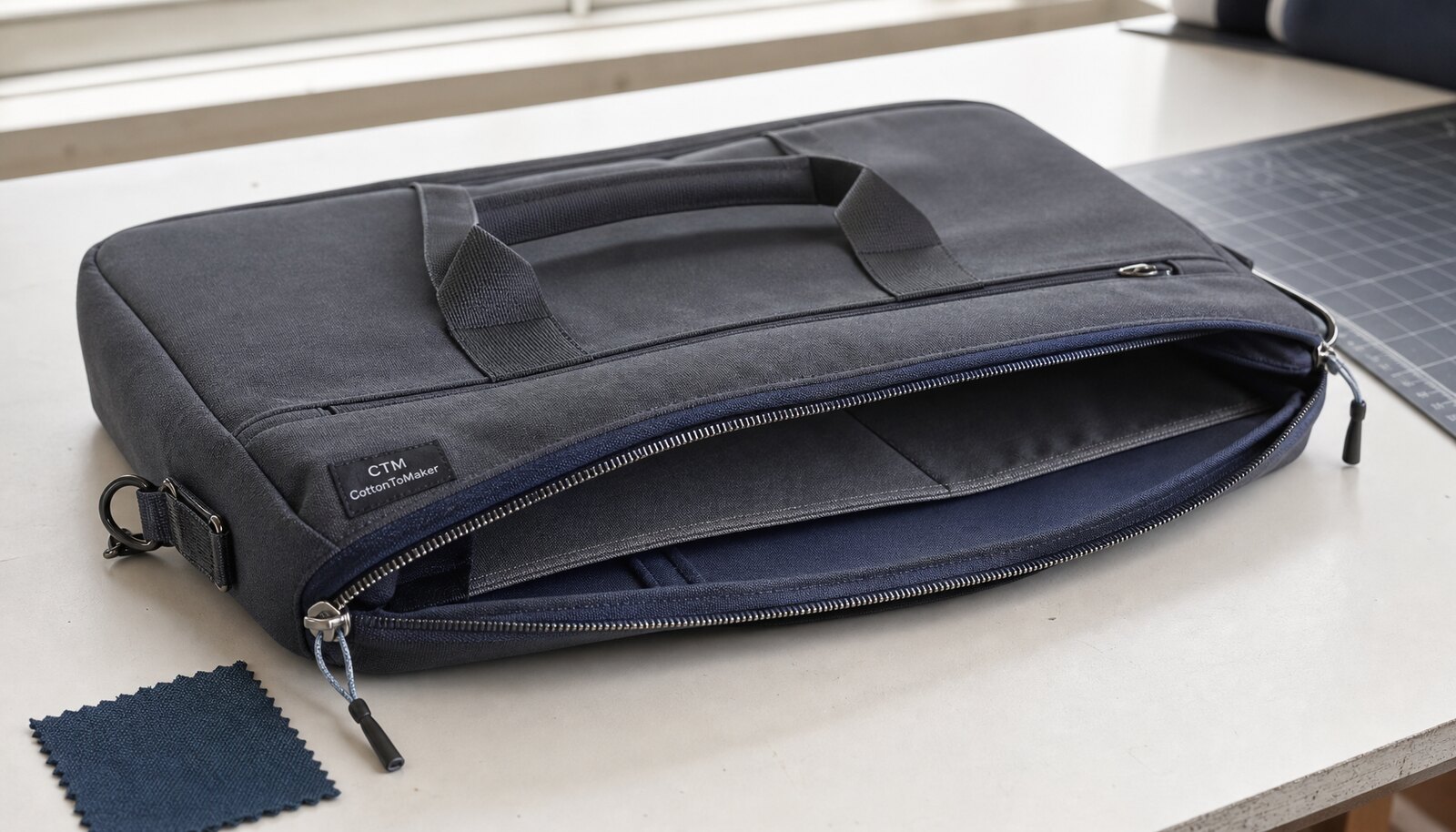
Why retail zipper business bags fail at the quote stage
Most problems with custom zipper business bags for retail start before production. Buyers often request a “zipper business bag” and receive quotes for completely different constructions: thin document pouches, soft laptop sleeves, framed organizer bags, or promotional cases with no internal structure. The factory is not always wrong; the request was too loose to price correctly. For retail, loose wording creates cost gaps, sample delays, and bad comparisons across suppliers.
A useful RFQ for this category has to define the bag’s job in the store, not just its shape. Is it meant to hold files, tablets, stationery, charging cables, or light daily carry items? That answer changes the fabric weight, zipper choice, lining, gusset depth, stitching method, and packaging. If the bag will sit on a shelf and be handled by shoppers, the finish standard has to be better than a one-color promotional pouch. The quote should reflect that from the start.
- Retail bags need a clearer finish standard than giveaway bags.
- Small construction changes can swing cost more than the print method.
- A quote without fabric weight, zipper spec, and packing detail is not comparable.
Choose the right construction for the retail price point
For retail programs, the most practical body materials are usually 300D to 600D polyester, 12oz to 16oz canvas, or 10oz to 14oz cotton canvas. Polyester usually gives the best balance of price stability, sharper print reproduction, and lower risk of shade variation. Canvas and cotton canvas feel more premium, but they need better cutting discipline and can move more in sewing if the fabric is not pre-shrunk or properly handled. If the bag is meant to look like a real merchandise item rather than a promo carry bag, fabric hand feel matters as much as logo placement.
The lining decision is where many buyers lose margin. Unlined bags are cheaper, but the interior finish looks basic and may not support products with sharp corners or loose items. A 190T or 210D lining makes the bag cleaner, improves perceived value, and helps the retail buyer justify a higher shelf price. If the bag includes pockets, document sleeves, pen loops, or a padded base, those details should be intentional, not added late because the first sample looked too plain.
- 300D polyester: good for controlled cost and repeat color consistency.
- 12oz to 16oz canvas: better retail feel, but sewing and shrink control matter.
- Lined construction: stronger retail presentation, higher labor and material cost.
What fabric weight and GSM mean in quote comparison
Buyers often compare only the fabric name and miss the weight. That leads to apples-to-oranges pricing. A supplier quoting “canvas” could be using a light 10oz fabric while another is quoting 16oz heavy canvas. For retail zipper business bags, ask for the exact fabric weight or GSM range, plus whether the fabric has coating, lamination, or a backing layer. If the product needs body, the factory may also add insert sheets or foam; those should be priced separately so the quote stays readable.
Use the sample to confirm whether the fabric weight is actually visible in the hand. A bag that looks premium on paper may collapse in the store if the fabric is too soft. On the other hand, a very heavy fabric may make the bag bulky, increase stitching time, and lift freight cost. In this category, the best choice is not the heaviest material; it is the lightest material that still holds shape, protects contents, and meets shelf expectations.
- Ask for fabric weight in GSM or oz, not material name only.
- Confirm coating, backing, or lamination if the bag needs body.
- Review how the fabric behaves at corners, gussets, and zipper seams.
Print and branding options that hold up in retail
For custom zipper business bags for retail, print method should follow artwork complexity and target unit price. Screen print is still the best option for simple logos, one- to three-color artwork, and larger runs where registration can be controlled. Heat transfer is useful when the design includes fine detail, gradients, or multiple colors, but the buyer should be realistic about hand feel and wash or rub durability. Embroidery and woven labels read more premium, especially on canvas or structured polyester bags, but they add labor and can distort if the panel is too light or the logo area is too small.
The right question is not “which print looks best” but “which print survives normal retail handling at the target price.” A front print that cracks after folding, a woven label that puckers near the zipper, or an embroidered logo that pulls the fabric out of square will create a retail quality issue even if the first photo looked good. For retail programs, logo size, placement, and stitch density should be part of the approval sample, not left for the factory to interpret.
- Screen print: lowest cost for simple logos and higher volumes.
- Heat transfer: better for complex artwork, but durability must be reviewed.
- Embroidery or woven label: stronger premium signal on retail-facing bags.
MOQ logic and how it changes your real unit cost
MOQ is not just a factory policy; it is a cost structure. The more custom elements you add, the more the factory needs to spread setup time, cutting waste, and trim purchasing across the order. A single-color bag in one body fabric with one print position usually gets the cleanest MOQ. Add custom zipper color, lining color, woven label, hangtag, barcode sticker, and retail polybag, and the MOQ often becomes higher because each added step creates a separate material and labor flow. Buyers should compare the true MOQ by version, not just by total order size.
For retail launches, the best sourcing route is often to keep the first order simple and reserve premium details for the second run. That could mean one standard body color, one logo position, and one packing format for launch inventory. If the product proves out, the next order can add custom zipper pullers, contrast piping, or upgraded interior labeling. This is usually more efficient than trying to build the final version on the first buy and paying for the learning curve in both cost and time.
- One fabric stack and one print position usually keeps MOQ more manageable.
- Custom zipper colors, labels, and cartons often raise MOQ more than expected.
- Launch with the simplest retail-acceptable build if speed matters.
Supplier comparison table: direct factory, trading company, or hybrid sourcing
Retail buyers rarely source zipper business bags from just one route. The quote may come from a direct factory, a trading company, or a hybrid supplier that outsources sewing but keeps sampling and packing control in-house. The cheapest unit price is not always the best sourcing route if the bag has custom trim, barcode labeling, or strict finish requirements. Compare the route, not just the invoice.
For this product type, direct factory sourcing tends to be stronger when the buyer has stable artwork and repeat orders. Trading companies can help with communication and consolidation, but they may add margin and reduce transparency on the actual sewing line. If the bag needs multiple retail-ready details, ask who is responsible for trim sourcing, sample approval, and final packing. That accountability matters more than a low first quote.
Sample approval should be based on retail handling, not just appearance
A good sample for zipper business bags is one that behaves like the production piece. The zipper should glide cleanly from end to end, the bag should sit flat or stand as intended, and the logo should be positioned in the same place the factory plans to use in bulk. If the sample has hand-finished details that cannot be repeated at scale, it is not a reliable approval sample. The buyer should use the sample to lock the construction and the acceptable tolerance, not to chase perfection that the production line cannot replicate.
Sample review should include tactile and functional points: zipper pull force, seam tension, pocket depth, interior thread trimming, and the hand feel of the body fabric. If the design includes a gusset, board insert, or padded layer, confirm that the bag still closes cleanly and does not force the zipper track. That one issue often becomes the hidden return reason in retail because the bag looks fine until the customer fills it.
- Approve the sample only after zipper travel, seam finish, and logo placement match the intended production method.
- Test the bag with realistic contents, not an empty inspection only.
- Seal the approved sample or keep a signed reference photo set.
Packing and barcode details affect retail receiving and damage rate
Packing is part of product quality in retail. A zipper business bag that arrives loose in a carton may look acceptable from a factory standpoint but still fail inbound inspection because corners get crushed, labels detach, or prints rub against each other. If the product goes to retail distribution centers, the carton and inner pack should match the receiving workflow. That usually means individual polybags, barcode stickers in a fixed location, and master cartons marked by SKU, color, and quantity. If the bag has insert boards or stiffeners, they should be packaged consistently so the bag shape is not distorted.
Use the packing spec to protect the shelf appearance. If the product will be hung, flat-packed, or displayed upright, the packing should support that outcome. Buyers often forget that bulky retail packaging increases carton volume and freight cost. A modest improvement in appearance may be worth it, but it should be a conscious decision. Ask the factory to quote at least two packing routes if you are balancing warehouse efficiency against retail presentation.
- Individual polybag protects print and surface finish.
- Barcode and SKU marking reduce warehouse intake errors.
- Insert boards or stiffeners should be counted in the landed-cost calculation.
Lead time risks and the schedule points that slip first
The first delay in custom zipper business bags is usually material confirmation, not sewing. Zippers, pullers, lining, and custom labels often need separate sourcing windows. If the body fabric is in stock but the puller finish or woven label is not, the production date moves even when the factory says the order is “confirmed.” Buyers should build time around sample approval, trim approval, bulk material purchase, pre-production sample, and line booking. The more custom the build, the less useful a simple factory calendar becomes.
A workable lead-time plan includes a realistic buffer for revisions. If the bag design is new, sample corrections often take longer than expected because a small change to zipper position or side gusset width can affect the entire sewing sequence. The best way to protect the schedule is to lock the spec early, approve the sample quickly, and avoid mid-order changes to color, label, or packing. Late changes are where retail launches lose margin.
- Material sourcing can delay the order before sewing starts.
- Sample revisions often affect the sewing sequence and add days.
- Custom labels and zipper hardware should be treated as schedule-critical items.
Landed-cost comparison: where the real money moves
A unit price alone will not tell you whether the bag works for retail. The landed cost is shaped by fabric weight, zipper quality, print method, packing volume, carton size, and whether the bag needs inserts or retail labels. A lighter fabric may look cheaper, but if it creates returns or looks too flimsy on shelf, it is not a saving. A slightly higher factory price may still win if the bag packs tighter, ships more efficiently, and needs fewer reworks.
The most practical way to compare quotes is to break them into body material, lining, print, zipper, label, packaging, and carton size. This reveals why one quote is higher even when the bag size looks identical. It also helps buyers negotiate intelligently. If the factory price is too high, reduce complexity where it does not affect the shelf result: simplify the inner pocket count, standardize the zipper color, or switch from embroidered branding to woven label. That kind of adjustment protects the retail value while improving margin.
- Compare unit price together with carton volume and packing method.
- Identify which line items are driving cost before negotiating.
- Remove complexity from hidden parts, not from visible retail finish.
Specification comparison for buyers
| Spec decision | Recommended option | When it fits | Buyer risk to check |
|---|---|---|---|
| Supplier route | Direct factory with zipper bag experience and in-house sampling | Retail programs with repeat orders, custom trims, and tight control on colors or logo placement | Factories that only sew simple pouches may miss reinforcement, zipper alignment, or packaging requirements |
| Main fabric | 300D to 600D polyester, 12oz to 16oz canvas, or 10oz to 14oz cotton canvas | Retail bags needing a better hand feel, stable structure, and acceptable print surface | Too-light fabric can show print distortion and weak body; too-heavy fabric can raise cost and slow sewing |
| Lining choice | Unlined for low-cost utility or 210D/190T lining for a cleaner retail finish | Retail channels where buyers open and inspect the interior, or where small items need smoother inside protection | Lining can trap cost if pockets, binding, or corner finishing are not clearly defined |
| Print method | Screen print for simple logos, heat transfer for more colors, embroidery or woven label for premium positioning | Retail SKUs with stable artwork and known volume by colorway | Overly detailed artwork can fail on screen print; embroidery can distort on thin panels |
| Closure hardware | Nylon coil zipper with matching puller, optional metal puller only if tested for rust resistance | Everyday retail bags that need reliable opening and closing with reasonable cost | Cheap zipper tape, poor slider quality, or mixed metal parts can cause returns |
| Structure and inserts | Light PVC board, foam sheet, or cardboard base only where the bag must stand or protect contents | Display-ready retail bags, laptop-style business bags, or document organizers | Too much insert weight increases freight and may make the bag feel overbuilt for the target price |
| MOQ route | Single-color standard material stack with one print location to keep MOQ lower | Launch orders, SKU tests, or mixed retail assortments with limited risk | Adding multiple colors, pockets, zipper pulls, and packaging versions can multiply MOQ and sampling time |
| Packing spec | Individual polybag with barcode sticker, master carton by SKU, 5- to 10-piece inner pack if retail requires it | Retail distribution, warehouse picking, and barcode-based receiving | Loose packing leads to damaged corners, missing inserts, and labeling errors at inbound inspection |
| Sourcing route | Factory-direct with quote based on confirmed spec sheet and approved sample | When retail margin depends on controlling unit cost and rework | Trading routes can be easier but may hide the true production factory and weaken QC accountability |
Buyer checklist before sampling
- Define the retail use case before price shopping: document bag, laptop bag, conference bag, carryall, or premium promo bag.
- Lock the bag size, zipper length, pocket count, lining requirement, and bottom structure in one spec sheet.
- Set the target fabric weight or GSM and allow an acceptable range, not a vague material name only.
- Confirm logo method, print size, color count, and whether the artwork sits on fabric, zipper pull, woven label, or side panel.
- Ask for a pre-production sample or sealed approval sample after the factory confirms fabric, zipper, and print trim.
- Specify packing format, barcode placement, carton count, and any retail hanger or insert requirement.
- Compare landed cost, not only EXW price, especially when cartons are bulky or inserts increase shipping volume.
Factory quote questions to send
- What exact fabric construction, GSM, and coating or backing are you quoting for the bag body and lining?
- Which zipper brand, tape width, slider type, and puller finish are included in the base price?
- What is the MOQ by color, by print method, and by packaging style?
- Is the quote based on pre-production sampling, and what is the sample lead time and sample charge policy?
- What carton size, carton weight, and inner pack count did you use for the quote?
- Can you separate unit cost for bag body, print, zipper, lining, label, and packing to show the main cost drivers?
- What QC standard do you use for stitching, print registration, zipper function, and size tolerance?
- What lead time changes if we add a second logo position or a custom woven label?
Quality-control points to confirm
- Bag dimensions within agreed tolerance, typically plus or minus 0.5 cm to 1.0 cm depending on construction.
- Zipper runs smoothly through full open-close cycles without catching fabric, waviness, or misaligned teeth.
- Print registration stays centered and does not crack, bleed, or peel after normal flexing.
- Stitch density is even, seams do not skip, and stress points at zipper ends and handles are reinforced.
- No broken threads, oil stains, fabric snags, or color shade mismatch within the same carton.
- Labels, barcodes, and carton marks match the approved SKU and retail order details.
- Packing count is accurate and inner packs are consistent with the retailer’s receiving method.