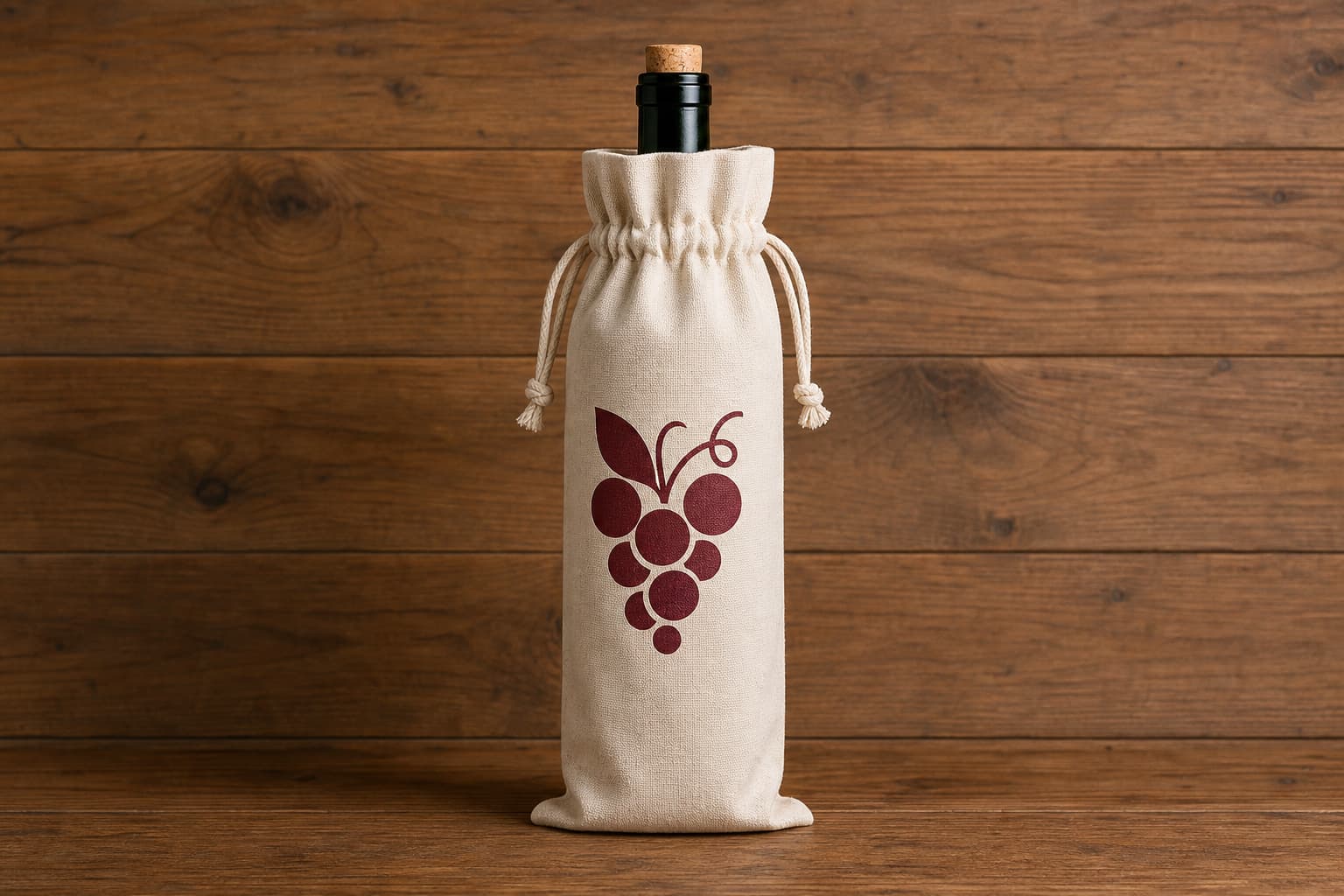
Start the RFQ With the Bottle, Not the Bag
For custom wine bottle bag wholesale orders, the most common quoting mistake is asking for a generic wine bag without defining the bottle. A 750 ml Bordeaux bottle, Burgundy bottle, Champagne bottle, and spirits bottle do not share the same shoulder diameter or height. If the supplier guesses the fit, the sample may look correct when flat but become tight, short, or unstable after the bottle is inserted.
Procurement teams should provide the bottle height, base diameter, shoulder width, and whether the bag needs to close fully above the cork. If the buyer will use the same bag for mixed bottles, state the largest bottle dimension and acceptable extra space for smaller bottles.
- For standard 750 ml wine, many single-bottle bags are specified around 15 x 35 cm, but the exact fit depends on seam allowance and closure style.
- For Champagne or sparkling wine, allow more width and bottom support because the bottle diameter is larger.
- For two-bottle bags, specify center divider requirements; do not assume the factory will add one automatically.
- For retail shelves, confirm whether the bag must stand upright when filled or only function as a gift sleeve.
Choose Fabric Weight Based on Use, Not Only Price
Fabric GSM directly affects hand feel, print performance, bottle support, and freight weight. A low-cost cotton wine bag can work for giveaway use, but it may look weak for a premium winery gift set. On the other side, heavy canvas gives a strong retail feel but increases carton weight and may need stronger sewing control.
For cotton wine bottle bags, buyers often compare 5 oz, 6 oz, 8 oz, 10 oz, and 12 oz fabric. The quote should show the exact material and approximate GSM, because different suppliers may describe the same fabric differently. If the supplier only says cotton or canvas, the quotation is not specific enough for fair comparison.
- 5 oz cotton, around 140-170 GSM, is mainly for light promotional packaging where low cost is the priority.
- 6 oz to 8 oz cotton, around 180-270 GSM, is a practical range for many branded wine gift bags.
- 10 oz to 12 oz canvas, around 340-410 GSM, is better for reusable wine totes with handles.
- Jute can look stronger than it measures; check weave density, lamination, and seam binding before approving.
Match the Print Method to the Fabric Surface
Wine bottle bags often carry a winery logo, holiday artwork, distributor mark, or corporate gift branding. The print method should be chosen according to fabric texture, artwork detail, order quantity, and color requirements. A clean one-color logo on cotton is usually suitable for screen printing, while fine gradients or full-color art may need heat transfer or digital transfer depending on the fabric.
Jute and burlap require more caution. The uneven weave can break thin lines and small text. If the buyer needs a refined logo on jute, a sewn label, leather patch, or cotton panel may be more reliable than direct printing.
- Screen print works well for bold logos, simple text, and larger wholesale runs.
- Heat transfer can handle more colors but needs testing for adhesion, edge feel, and wash or rub resistance.
- Embroidery is possible on heavier canvas, but small lettering may distort and cost more than print.
- Woven labels or side tags are useful when the bag surface is rough or the brand wants a cleaner retail finish.
Specify Construction Details That Affect Bottle Safety
A wine bag carries concentrated weight. The buyer should treat stitching, gusset, handle, and drawcord details as functional specifications, not decoration. Weak bottom seams or narrow handles may pass a flat inspection but fail during store handling or gifting.
If the wine bag has handles, request reinforced stitching at the handle attachment area. If it uses a drawstring, confirm the cord channel width and cord type. For jute bags, bound seams can reduce fraying and improve the appearance at the top edge.
- Bottom gusset improves standing shape and gives the bottle a more stable base.
- Box stitching or bar tack reinforcement is recommended for canvas wine totes with handles.
- Cotton cord, polyester cord, jute rope, or ribbon all create different costs and brand impressions.
- Side seams should be checked after bottle insertion, not only when the bag is flat on the inspection table.
Understand MOQ Logic Before Comparing Quotes
MOQ for custom wine bottle bags is not only about quantity. It is affected by fabric availability, dyeing, cutting efficiency, print setup, logo colors, special labels, and packing requirements. A supplier may quote a low MOQ for natural cotton but require a higher MOQ for custom dyed canvas or laminated jute.
When comparing custom wine bottle bag wholesale quotes, buyers should ask what is included at the stated MOQ. A quote for 1,000 pieces with one-color one-side print is not equal to a quote for 1,000 pieces with two-side print, custom cord color, woven label, and individual barcode packing.
- Natural cotton and standard black canvas usually have easier MOQ than custom dyed fabric.
- More print colors can increase setup cost even when the bag quantity stays the same.
- Custom woven labels, hangtags, and retail barcode stickers may have their own MOQ.
- Split shipments, mixed designs, and multiple logo versions should be declared before pricing.
Approve Samples With Real Bottle Testing
A wine bag sample should be tested with a real bottle or an accurate substitute. Flat size approval is not enough because the usable capacity changes after stitching, gusset formation, and closure. The buyer should check whether the bottle enters smoothly, whether the drawstring closes properly, and whether the bag hangs straight when lifted.
For printed samples, inspect the logo under normal retail lighting and after light rubbing. Dark canvas may need an underbase print to keep the logo color bright. Natural cotton can show small seed flecks, which may be acceptable for eco-style packaging but should be confirmed before bulk production.
- Check bottle fit, top closure, standing balance, and handle comfort with a filled bottle.
- Compare fabric hand feel against the approved swatch, not only against the photo.
- Confirm logo size, position, color, opacity, and edge sharpness before bulk printing.
- Keep one signed or sealed approved sample for factory reference and one for buyer-side inspection.
Define Packing So Bags Arrive Retail-Ready
Packing is often treated as an afterthought, but it can affect the final presentation more than buyers expect. Cotton wine bags can crease, jute can shed fibers, and printed surfaces can mark each other if packed too tightly before ink is fully cured. Retail buyers should also confirm whether individual polybags, paper bands, hangtags, or barcode labels are required.
For ecommerce or retail distribution, carton quantity and carton weight should be practical for warehouse handling. If the bags must go directly to a gift packing line, the orientation and bundle count should match the buyer's packing process.
- Flat bulk packing is cost-efficient, but confirm acceptable crease level for the retail channel.
- Individual polybags protect the surface but add material and labor cost.
- Interleaving may be needed for heavy ink coverage or dark prints.
- Carton marks should include item number, color, quantity, gross weight, net weight, and destination details if required.
Quote Data Buyers Should Require From Every Supplier
A useful supplier quote should allow the buyer to compare the same product across factories. If one supplier lists only a unit price and another lists fabric, GSM, size, logo method, packing, and lead time, the cheaper number may hide missing specifications. Procurement teams should standardize the RFQ template before collecting prices.
Ask suppliers to quote based on the same artwork, same finished size, same fabric weight, same packing method, and same delivery term. If substitutions are offered, they should be shown as alternatives, not quietly included in the main price.
- Finished size with tolerance, fabric type, fabric weight, and color standard.
- Logo method, logo size, print position, number of colors, and setup assumptions.
- MOQ, price breaks, sample cost, sample time, and bulk lead time after approval.
- Packing method, carton size, carton quantity, estimated gross weight, and shipment volume.
- Payment term, delivery term, validity period, and whether any tooling or setup fees are included.
Specification comparison for buyers
| Spec decision | Recommended option | When it fits | Buyer risk to check |
|---|---|---|---|
| Fabric weight for cotton wine bag | 6 oz to 8 oz cotton, approximately 180-270 GSM | Promotional wine gifts, tasting events, subscription packaging, mid-range retail use | Too light may show bottle outline, wrinkle easily, or feel thin after printing |
| Fabric weight for canvas wine tote | 10 oz to 12 oz canvas, approximately 340-410 GSM | Retail gift packaging, reusable bottle carrier, premium brand presentation | Heavier fabric increases freight weight and may need stronger handle stitching |
| Jute or burlap structure | Laminated jute or jute-cotton blend with bound seams | Natural wine packaging, organic product lines, rustic retail displays | Loose weave can distort fine logo details and may shed fibers if not specified |
| Closure style | Cotton drawcord, ribbon tie, or open-top handle tote | Drawcord for single-bottle gift bags; open-top tote for fast retail packing | Cord color, cord thickness, and knot security must be approved in sample |
| Logo method | Screen print for solid logos; heat transfer for multi-color artwork; woven label for premium detail | Screen print fits most wholesale wine bag orders with simple branding | Ink coverage can crack on rough jute or bleed on loose cotton if artwork is not tested |
| Packing format | Flat packed in inner polybags or carton bulk pack with dividers if structured | Flat packing reduces freight; structured bags need shape protection | Over-compression can create hard creases, especially on laminated jute and dark canvas |
Buyer checklist before sampling
- Confirm the bottle type: 750 ml Bordeaux, Burgundy, Champagne, slim wine, spirits bottle, or mixed assortment.
- Provide finished bag size with tolerance, not only bottle capacity; include height, width, gusset, and drawcord position.
- State fabric type and weight in oz or GSM, plus whether the fabric is natural, dyed, bleached, laminated, or washed.
- Send logo artwork in vector format and specify print size, print position, Pantone colors, and whether both sides need branding.
- Define construction details: seam type, bottom gusset, handle length, drawcord material, label position, and reinforcement points.
- Confirm packing method, carton quantity, carton marks, barcode or retail tag requirements, and whether bags must be crease-controlled.
- Request pre-production sample approval before bulk cutting, especially for dark fabric, jute texture, or multi-color artwork.
- Ask the supplier to separate mold, setup, sample, unit, packing, and freight-related costs in the quote.
Factory quote questions to send
- What fabric weight and material composition are you quoting, and can you provide a swatch or previous production reference?
- Is the quoted size the flat bag size or the usable bottle-fit size after stitching and gusset formation?
- Which print method is included in the price, and how many colors, print positions, and logo sizes are covered?
- What is the MOQ for this exact fabric color, bag size, and print method, not just the general MOQ for wine bags?
- Can you make a fit sample using the buyer's target bottle shape or a standard 750 ml bottle with similar dimensions?
- What tolerance will you control for finished size, fabric GSM, print position, and handle or drawcord length?
- How will the bags be packed to avoid creasing, ink transfer, odor, moisture, or crushed handles during shipment?
- What is the sample lead time, bulk lead time after sample approval, and latest artwork approval date needed to keep the schedule?
Quality-control points to confirm
- Check finished size against the approved sample and confirm the intended bottle slides in without forcing the seams.
- Measure fabric weight or compare against approved swatch, especially when changing from natural cotton to dyed cotton or canvas.
- Inspect logo position, print sharpness, ink opacity, color matching, and rub resistance before bulk packing.
- Pull-test handles, drawcord channels, bottom seams, and side seams because wine bottles create concentrated weight at the base.
- Check odor, moisture, loose fibers, stains, and lint, especially on jute, dyed canvas, and laminated materials.
- Review packing compression, carton strength, carton marks, inner bag count, and whether retail-facing surfaces remain clean.