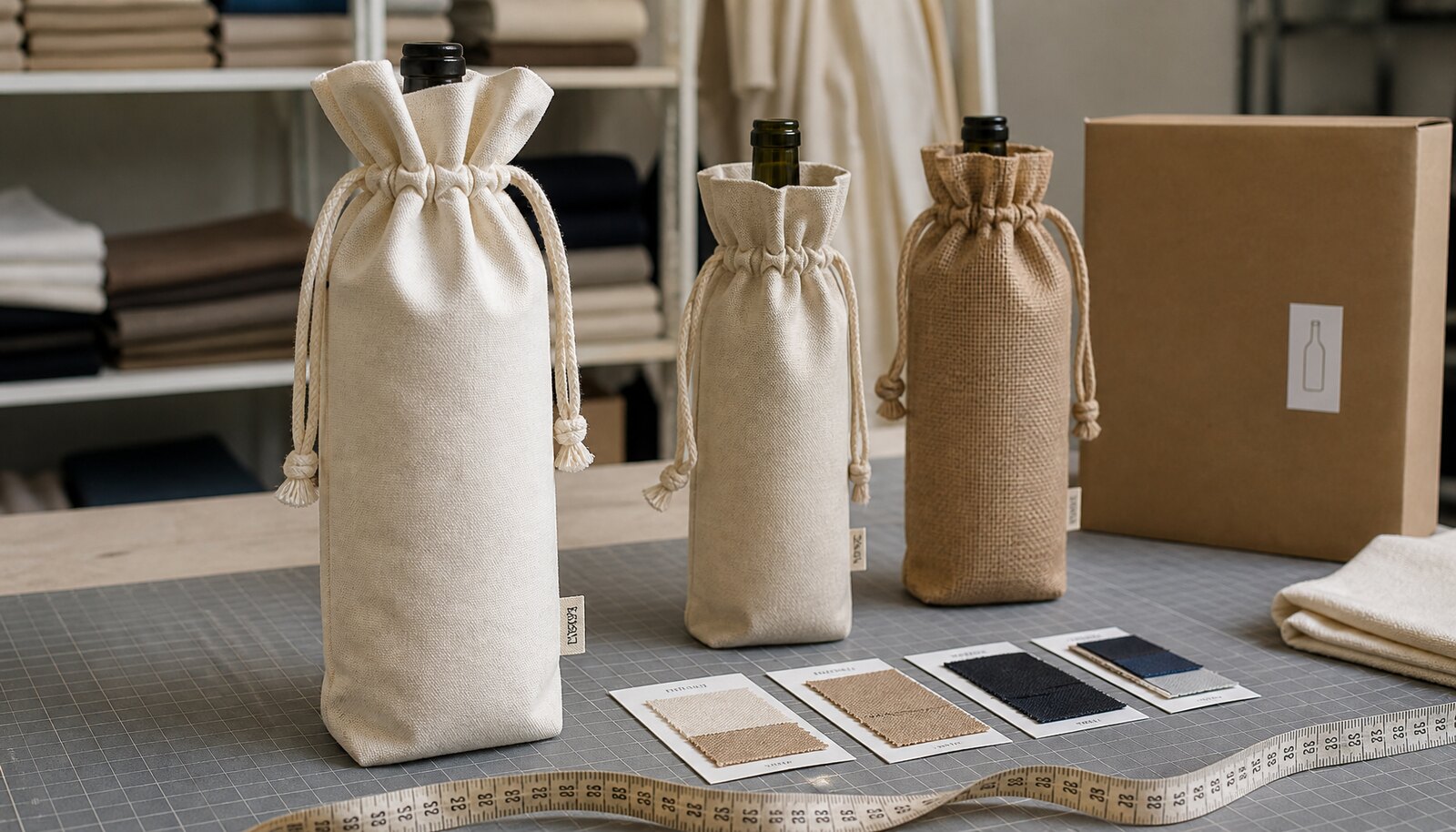
Why hotels source wine bags differently from consumer brands
Hotels do not buy bottle bags only as packaging. They use them operationally. A bag may be placed in a minibar basket, dropped into a guest room before arrival, attached to a banquet gift, handed out at a wedding, or stocked in a gift shop for resale. Each use case changes the requirements for appearance, durability, packing, and replenishment speed.
That is why procurement teams should start with the workflow, not the logo. A room-drop pack needs a clean look, easy handling, and predictable carton counts for housekeeping or concierge teams. A banquet or event program needs faster fulfillment and a price point that survives large quantities. A resale item needs stronger presentation, consistent repeatability, and a better finish because guests will compare it with other retail goods on the shelf.
Hotels also face a different failure pattern than consumer brands. If one batch arrives short by a few millimeters, the issue may not appear on the factory line, but it shows up in operations when bottles do not fit neatly into trays or the drawstring bunches at the neck. If carton labels are inconsistent, the warehouse can misroute product to the wrong property. For procurement buyers, those are not minor defects; they are service failures.
The best buying approach is to define the use case first and then build the spec around the bottle, the handling method, and the presentation standard. Once that is clear, comparing suppliers becomes much easier because the discussion moves from vague quality claims to measurable requirements.
Hotel-specific buying scenarios often fall into four buckets: minibar presentation for a bottle that stays on property; room-drop gifts that need premium unboxing; banquet or conference giveaways that prioritize cost and speed; and retail resale that needs shelf appeal plus barcode control. A supplier that can serve one bucket well may not be suitable for the others unless the spec is adjusted accordingly.
- Room-drop and VIP gifting: prioritize presentation, bottle fit, and neat carton packing.
- Banquet or event use: prioritize stable pricing, replenishment speed, and simple branding.
- Retail resale: prioritize finish quality, repeat consistency, and barcode or hangtag control.
- Minibar or in-room presentation: prioritize shape retention and a clean look after handling.
Material choices: compare cost, appearance, and performance before you negotiate
The material choice drives far more than appearance. It affects bottle support, print quality, storage behavior, and guest perception. Cotton canvas is the most common premium route because it balances structure and branding performance. A heavier canvas typically stands better, hides small wrinkles, and gives a more substantial hand feel. For hotel use, that matters because the bag is often judged at first glance in a guest room or on a banquet table.
Cotton twill is a practical mid-tier option when cost needs to stay controlled. It has a softer drape and can look neat if the bottle is standard size, but it does not automatically provide enough structure for a heavier bottle or a display-oriented presentation. That is why material should never be selected by GSM alone. The weave density, finishing, and stitch quality all change how the bag behaves in real use.
Jute is visually strong for rustic or winery-inspired branding, but it introduces more risk. Natural fiber shedding, rough touch, and uneven weave can be acceptable in some hotel themes and unacceptable in others. If the bag is for guest gifting or resale, lined jute or carefully bound seams usually create a more controlled finish. Non-woven PP sits at the low end of the cost spectrum and can work for promotional programs, but it is generally unsuitable where the hotel wants guests to keep the item.
When buyers ask for a GSM number without considering use case, the quote comparison becomes noisy. A quote for 180 GSM with a tight weave and reinforced seam may outperform a looser 220 GSM fabric in actual hotel handling. Ask the factory what the fabric feels like, how it holds shape, and what bottle weight it was developed around. In procurement terms, the real question is not “what GSM?” but “what performance do we get at this price point?”
- Cotton canvas: best overall balance for premium and reusable hotel use.
- Cotton twill: useful for mid-cost programs that still need a clean guest-facing look.
- Jute: best when the brand wants a rustic appearance and accepts texture variation.
- Non-woven PP: suitable only when presentation requirements are modest.
- Do not buy by GSM alone; request weave, finish, and bottle-fit examples.
Material and closure options side by side: what changes the guest experience
Procurement teams often focus on the logo and forget that the bag’s tactile experience is part of the hotel brand. The body fabric, closure, and interior finish decide whether the product feels like a gift or a disposable sleeve. They also affect packing labor and defect risk. A drawstring can create a polished presentation, but if the cord channel is weak or the cord length is inconsistent, the bag looks sloppy even if the fabric is good.
For hotels, the closure choice should match the moment of use. A drawstring works well when the bag will be opened and closed by staff or guests. A ribbon tie can look more decorative in a gifting setting but is less robust for repeated handling. An open-top sleeve is simple and cheap but usually too plain for premium room amenities or resale. If the bag will be displayed upright, the closure should not collapse the neck or distort the logo area.
Interior finishing matters more than many buyers expect. Unbound raw edges can be acceptable on a low-cost bag if the bag is not handled much, but they become a problem in premium use because fibers shed and the inside looks unfinished when guests open the top. Bound seams or a lining add cost, yet they also reduce scratch risk for bottle labels and improve the bag’s life in reuse scenarios. Hotels sourcing for guest takeaway should ask whether the bag touches the bottle label and whether the interior finish could scuff a foil neck or paper label.
- Drawstring: best all-around closure for reusable hotel presentation.
- Ribbon tie: more decorative, less durable for frequent handling.
- Open-top sleeve: low cost, low brand impact.
- Lined or bound interiors: reduce scratch risk and improve premium perception.
- Ask for closure pull tests and repeat-open tests on the actual bag sample.
Printing, labels, and decoration: choose the method that matches the artwork and the budget
On small textile items, the decoration method is often the largest hidden cost driver after material. A one-color screen print is the standard starting point for hotel wine bags because it is simple, repeatable, and economical. It works best when the logo is bold, the text is not too fine, and the brand can accept slight variation in ink density across natural fabrics. For many hospitality groups, that is enough if the bag is supporting the guest experience rather than acting as the main retail product.
A woven label or side label can raise the perceived value quickly. It is especially useful when the hotel’s logo has smaller text or when the bag is sold in a shop where the guest may inspect it closely. However, labels need exact placement rules. If the label sits too close to the seam, it can wrinkle, interfere with the closure, or create a visual imbalance. The buyer should ask for a placement mockup with measurements, not just a drawing.
Embroidery can work on heavier canvas, but it is not a default choice. It adds thread cost, machine time, and the risk of fabric puckering. For bags with lighter bodies, embroidery can pull the shape out of line. Heat transfer is best reserved for cases where the art has multiple colors or fine detail that screen print cannot reproduce cleanly. Even then, the buyer should approve the transfer on the actual fabric because adhesion, cracking, and edge lift can vary by material finish.
A practical hotel approach is often one-color print plus a woven or fabric label. That combination gives enough brand presence without overcomplicating the bag. If the hotel needs a more luxurious pack for VIP arrival, the decoration can be paired with a custom hangtag or a refined carton label rather than turning the bag itself into a high-cost decoration project. That usually creates a better cost-performance ratio.
- Screen print: strongest default choice for simple hotel logos.
- Woven label: better for premium presentation and small-text readability.
- Embroidery: use selectively on heavier fabrics only.
- Heat transfer: useful for complex art, but test for cracking and lift.
- Request artwork scaling limits so the factory cannot silently enlarge or shrink the logo.
Supplier comparison: direct factory, trading company, or local decorator
Not every sourcing route gives the same control. A direct factory is often the strongest option when the hotel wants repeatable specs, traceability, and the ability to lock in details like fabric source, seam construction, and carton packing. But direct factory sourcing only works if the factory is real and actually controls the process. Buyers should verify that the supplier is not just a sales office passing the order to another workshop.
A trading company can be useful when the buyer lacks time, needs multiple product categories in one shipment, or is testing a new program and wants broader sourcing support. The tradeoff is transparency. The hotel buyer may get less visibility into where the fabric came from, who did the sewing, or how the QC was performed. If the project is small and the supply chain is simple, that may be acceptable. For a multi-property program, it is a bigger risk.
A local decorator or print shop can be useful for very small quantities or urgent turnaround, especially when the artwork is still changing. The limitation is process control. These vendors often excel at decoration but are less reliable on repeat dimensions, fabric consistency, and carton configuration. That matters if the bags will be distributed across several hotels and need consistent shelf or room presentation.
For procurement decisions, the right question is not which route is cheapest at quote stage. It is which route can keep the same result on order two, order three, and the seasonal replenishment cycle. A lower unit price loses value fast if the second order needs re-approval, rework, or manual repacking at the hotel distribution center.
- Direct factory: strongest for repeatable specs and traceability.
- Trading company: helpful for mixed-category buying, but verify the real maker.
- Local decorator: good for very small runs and urgent jobs, weaker on repeat control.
- Ask every supplier to state who cuts, sews, decorates, inspects, and packs the goods.
RFQ specs: what to define so quotes are actually comparable
A good RFQ for wine bags should read like a manufacturing brief, not a shopping list. If you only ask for size and logo, suppliers will fill in the missing details differently, and the quote comparison becomes meaningless. Hotels should give the bottle dimensions, the intended use case, the material target, the decoration method, and the packing format. The more ambiguous the brief, the more the quote will hide risk.
A useful pattern brief includes the bottle type, the exact bag opening, the body width and height, the closure style, and the bottom shape. If the hotel uses multiple bottle shapes, the spec should identify the widest and tallest reference bottle. That avoids the common problem where a bag fits one bottle but fails on another from the same beverage program. Buyers should also state whether the bag must stand upright on a tray or in a minibar display; that requirement affects the base construction.
Dimension tolerance should be written down. Even a small variation matters on a close-fit bottle bag. If the approved sample measures 120 mm wide, do not rely on informal phrases like “about the same size.” Set the acceptable range for width, height, and opening. That gives the factory a clear production target and gives the buyer a basis for rejection if bulk goods drift too far from the sample. In hotel procurement, vague size language is one of the fastest ways to create receiving disputes.
If the program includes multiple property logos or multilingual tags, break them into separate line items in the RFQ. That keeps the quote readable and prevents one property version from subsidizing another. It also helps finance and operations understand exactly what is being bought. A strong RFQ reduces back-and-forth, shortens sample time, and makes supplier comparison more honest.
- List bottle dimensions and the reference bottle family.
- State body width, height, opening width, and closure style.
- Define tolerance ranges for size and logo placement.
- Separate each logo version, colorway, and property code in the RFQ.
- Ask for itemized pricing by material, decoration, packing, and freight assumptions.
Samples and approval: inspect function before approving appearance
Sampling should begin with function. A blank sample tells you whether the fabric, stitching, and bottle fit are acceptable before the supplier spends time decorating it. That helps you avoid a common mistake: approving a pretty printed sample that later turns out to be too narrow, too soft, or too weak at the seam. For hotel buyers, the blank sample should always be evaluated against the real bottle and the real handling method.
The second step is the decorated pre-production sample. At this stage, the buyer checks logo size, placement, color tone, label alignment, and any trim or closure details. If the project includes embroidery or a woven label, inspect whether the decoration warps the fabric. If the bag has a drawstring, make sure the closure remains smooth after repeated opening and closing. If the logo sits near a seam or fold line, test whether it remains readable when the bag is filled.
A third proof is often worth the effort: a photo or video of the bulk packed cartons before shipment. That proof helps verify carton count, label correctness, pack orientation, and whether the goods were folded the same way the hotel expects to receive them. For multi-property programs, this step prevents accidental mixing of versions. It also gives the buyer a last chance to correct packing mistakes before cargo leaves the factory.
If the hotel uses a purchasing approval chain, insist that the approver signs off on the same sample set the factory will use as the production reference. If the approved sample is not tied to a marked reference, disputes later become hard to resolve. Put the sample code, date, and version in writing and keep one approved unit at procurement and one at the factory.
- Blank sample: confirm material, fit, and construction.
- Decorated sample: confirm logo, color, and trim details.
- Bulk pack proof: confirm carton count and labeling.
- Tie the approved sample to a reference code and dated sign-off.
- Test the sample with the real bottle and handling method, not a generic dummy bottle only.
QC standards: set measurable acceptance criteria before bulk production starts
For hotel procurement, quality control has to be operational. General language such as “good quality” or “clean finish” is not enough. Define what the factory should inspect and what you will reject. Start with the obvious points: size, print placement, seam quality, cord function, and carton count. Then define how much variation is acceptable for natural fabrics. Cotton and jute will have texture variation, but they should not have stains, holes, or unfinished edges that affect use.
A practical control plan should include in-line inspection and final inspection. During production, the factory should check cut dimensions, stitching consistency, and print registration. At the end, the inspector should verify that the carton count matches the PO, the labels are correct, and the packed bags have no obvious damage or contamination. If the order is large enough, request an AQL-based inspection. A common starting point for hotel textile accessories is general inspection at AQL 2.5 for major defects and AQL 4.0 for minor defects, but the exact standard should be agreed with the supplier and buyer quality team before production begins.
Pass/fail examples help prevent arguments. A pass might be: logo centered within the agreed tolerance, seams straight and secure, drawstring pulls evenly, and bottle inserts without force. A fail might be: print shifted visibly off center, loose thread tails hanging from the seam, closure jams, or a bag that cannot hold the hotel’s standard bottle upright. Those examples are more useful than generic language because the factory can train operators and inspectors against them.
Testing methods should also be practical. A cord pull test does not need laboratory complexity to be useful; the buyer can ask the factory to confirm that the closure holds under repeated pull without tearing the channel. For print durability, a light rub test on the logo area can reveal weak adhesion or smudging. For seam integrity, the buyer can ask for sample pull checks at the side seam and bottom seam. If the product is intended for resale or repeated guest use, those checks are not optional; they are the difference between a usable amenity and a complaint item.
- Use AQL-based inspection for larger orders; agree the level in advance.
- Check size, seam, print, cord, and carton counts as separate QC items.
- Define pass/fail examples for off-center print, loose threads, and poor fit.
- Ask for in-line and final inspection records, not just a supplier statement.
- Require one approved sample to be retained as the production master.
Packing, labeling, and warehouse handling: reduce labor after the shipment lands
Packing details can create hidden labor costs in hotel operations. A bulk-packed bag is inexpensive to ship and easy for the factory to assemble, but the hotel may spend time repacking it into property sets or amenity kits. Individual polybags cost more but protect the finish and reduce handling damage. For retail resale, an individual pack with a barcode sticker, hangtag, or shelf-ready label is usually worth the extra cost because it shortens receiving and merchandising time.
Carton planning matters as much as the bag itself. A carton that is too full can crush the product and distort the shape. A carton that is too loose wastes freight space and may cause the bags to shift and wrinkle. Hotels with central distribution centers should ask for carton counts that align with their internal pick-and-pack processes. If one carton holds a convenient count for housekeeping and another is better for retail, those should be treated as separate SKUs.
Labeling should be specified before production, not after. The outer carton label may need property code, item code, country of origin, quantity, and version. If the hotel uses barcode-based inventory, the factory should confirm the label format and print quality before shipment. Mixed packaging is another risk point: if the order includes multiple colors or property versions, each carton should be marked clearly so warehouse teams do not open the boxes to identify contents.
For hotel buyers, the best packaging choice is the one that reduces later touchpoints. If the bag will be passed from receiving to housekeeping to guest rooms, minimize extra repacking. If it will be sold in a shop, invest in the presentation layer. Packaging should support the hotel workflow, not create one more internal task.
- Bulk pack lowers cost but shifts labor to the hotel.
- Individual polybags improve protection and shelf presentation.
- Carton count should match warehouse handling and property allocation.
- Specify carton labels, barcodes, and version codes before PO release.
- Avoid overpacked cartons that crush the bag or deform the closure area.
Lead time planning: separate material booking, decoration, and packing
Lead time is often quoted too loosely. For bottle bags, the schedule depends on whether the supplier is using existing fabric, whether the decoration is simple or complex, and whether packaging is standard or hotel-specific. A repeat order on an existing specification is the fastest path. A new fabric, new color, or new label introduces more steps and makes the schedule less predictable. Buyers should not assume that sewing capacity alone determines delivery date.
Material booking is one timeline, and decoration is another. The factory may be able to cut and sew quickly but still be waiting on yarn-dyed fabric, woven labels, or printed cartons. Those dependencies are where delays happen. If the hotel is planning a seasonal launch or a banquet event, the schedule should include sample approval, material confirmation, production, inspection, and freight booking. A late artwork change is one of the most common reasons a program slips.
There is no honest universal lead time for these products because the route changes the timing. A supplier with stock base material and simple print can often move faster than a fully custom packaging program. But if the buyer demands exact color matching, multiple labels, and retail-ready cartons, the schedule should include extra buffer. The safest procurement practice is to ask the supplier to show the critical path rather than accepting one short promise with no breakdown.
Hotels should also plan for replenishment. The first order may be on time, but a repeat order can be delayed if the supplier no longer holds the same fabric lot or if a label version changed. Keep a reference spec file, approved sample, artwork file, and carton artwork together so the next PO does not restart from zero. That is especially important when multiple properties are ordering from a shared procurement team.
- Repeat order on locked spec: fastest and most predictable.
- New fabric, new label, or new carton artwork: longer critical path.
- Late artwork changes are a common schedule risk.
- Keep the approved spec package ready for replenishment orders.
- Ask suppliers to separate material, production, inspection, and freight timing.
Specification comparison for buyers
| Decision area | Option | Strengths for hotel programs | Tradeoffs / buyer risk | Typical cost-performance use case |
|---|---|---|---|---|
| Base material | Cotton canvas 220–280 GSM | Best balance of structure, print clarity, and reusable feel; holds a bottle upright better than light fabrics | Heavier fabric can increase unit price and sewing time; confirm it does not make the bag bulky in room-drop kits | Premium guest gifting, minibar presentation, VIP arrival packs, gift-shop resale |
| Base material | Cotton twill 160–200 GSM | Lower cost than heavy canvas; softer drape and easier packing | Can look thin if the bottle is heavy or the bag needs to stand on display; seams need reinforcement | Large promotional orders, banquet giveaways, short-use amenity packs |
| Base material | Jute with cotton lining or bound seams | Rustic, winery-style appearance; good for higher-visibility gifting when finished well | Raw jute sheds fiber, can feel rough, and can scratch labels if unlined; texture variation is common | Upscale rustic properties, wine-cellar branding, seasonal campaigns |
| Base material | Non-woven PP | Lowest cost and lightest weight; easy to source for promotional programs | Less premium hand feel; can crease or look disposable; not ideal for retail resale or VIP gifting | Budget events, mass giveaways, short-life amenity use |
| Print method | 1-color screen print | Low setup cost, durable on simple logos, strong contrast on plain fabrics | Fine lines and tiny text can fill in; multi-color art adds setup complexity | Most hotel logos, repeat orders, brand marks on front panel |
| Print method | Woven side label / neck label | Cleaner premium look; better for small text and repeat branding consistency | Higher unit cost than a simple print; label placement must not interfere with closure or bottle insertion | Upscale room-drop packs, resale packaging, branded gifts |
| Print method | Embroidery | High perceived value on heavier fabrics; durable if the stitch count is right | Costly, can pucker lighter fabrics, and may distort thin areas near seams | Premium canvas bags, limited runs, executive gifting |
| Print method | Heat transfer | Useful for complex artwork or short runs with multiple colors | Can crack, lift, or abrade if the transfer quality is poor; must be tested on the actual fabric | Short runs, detailed artwork, prototype programs |
| Closure style | Drawstring top with cotton cord | Fast to open/close; good for presentation and reuse | Cord length, knot security, and channel construction must be tested so the bag does not gape or snag | Room-drop packs, minibar wine presentation, guest takeaway |
Buyer checklist before sampling
- Define the exact use case first: room-drop gift, minibar display, banquet giveaway, guest takeaway, or retail resale.
- Specify the bottle family, not only the bag size: standard 750 ml, Burgundy, Champagne, or magnum; include bottle diameter, shoulder width, and neck height if the shape is tight.
- State the target fabric, finish, and acceptable feel: cotton canvas, cotton twill, jute, or non-woven PP; include target GSM only if you also define weave, finish, and intended bottle weight.
- Confirm closure style: drawstring, ribbon tie, open-top sleeve, or no closure; specify cord material, cord length, and whether a stopper is required.
- Set decoration rules: print method, print size, number of colors, logo placement tolerance, and whether small text is allowed.
- Ask for packaging format in writing: bulk pack, inner polybag, individual polybag, hangtag, barcode sticker, or retail-ready carton.
- Request carton requirements: carton count, carton dimensions, gross weight limit, pallet pattern, and whether the factory must apply hotel-specific labels or barcodes.
- Require a pre-production sample, a photo or video of bulk packing, and a final shipment inspection report before PO release or balance payment.
- For multi-property programs, list each bag version separately by size, color, print file, and carton label to avoid mixed-shipment errors.
- Ask the supplier to state which parts are standard and which are custom so you can identify setup fees, change fees, and repeat-order savings.
Factory quote questions to send
- What exact fabric composition, weave, finish, and target GSM are you quoting for the bag body, and what tolerance do you hold on incoming material?
- What bottle dimensions were used to draft the pattern, and is the quoted price based on a standard 750 ml bottle, Burgundy, Champagne, or another shape?
- What is the MOQ per color, per size, and per artwork version? If we change print color or label type, what fee changes?
- Which decoration method is included in the unit price, and what are the setup costs for additional colors, woven labels, embroidery, or hangtags?
- Can you provide a blank sample, a decorated pre-production sample, and a video or photo record of the final packed cartons?
- What documents can you share to prove the material source and factory capability: business license, recent audit summary, material test report, or previous similar-product photos?
- What is your in-line QC process, final inspection process, and acceptance standard? Do you use AQL, and if yes, which level?
- What is the packed carton count, carton size, gross weight, and outer carton label format? Can you follow hotel barcodes, property codes, or distribution labels?
- What lead time applies after sample approval, and what changes it if we add custom packaging, mixed sizes, or a second decoration method?
- What are the payment milestones, and what triggers balance payment release: final inspection pass, shipment booking, or bill of lading issuance?
Quality-control points to confirm
- Finished dimensions must match the approved sample within agreed tolerance; define separate tolerances for width, height, gusset, and opening width rather than one blanket number.
- Bottle fit must be verified using the hotel’s actual bottle or a representative equivalent; the bottle should slide in without force, and the bag should close without bunching at the neck.
- Seams should be straight, secure, and consistent at side seams, bottom seams, and cord channel; loose ends, skipped stitches, and popped threads are not acceptable.
- Print placement should stay within the approved centering window, and the logo should remain readable at normal viewing distance without smearing, fill-in, or major color variation.
- Fabric should be free from oil marks, dye stains, holes, snagging, and obvious weave defects beyond natural texture variation.
- Cord action should be smooth and functional; the drawstring should not jam, fray heavily, or pull out under normal use.
- Carton counts, carton labeling, inner pack counts, and artwork version codes must match the PO and distribution plan exactly.
- If the order is for repeated handling or resale, test rub resistance on the logo area and check whether flexing creates cracks, edge lift, or loss of ink adhesion.
- For premium programs, inspect presentation details such as tag alignment, folding direction, polybag clarity, and any visible glue or trim marks.
- Reject samples or production units that look acceptable from a distance but fail functional use: loose closures, poor opening width, unstable standing shape, or inconsistent bottle fit.