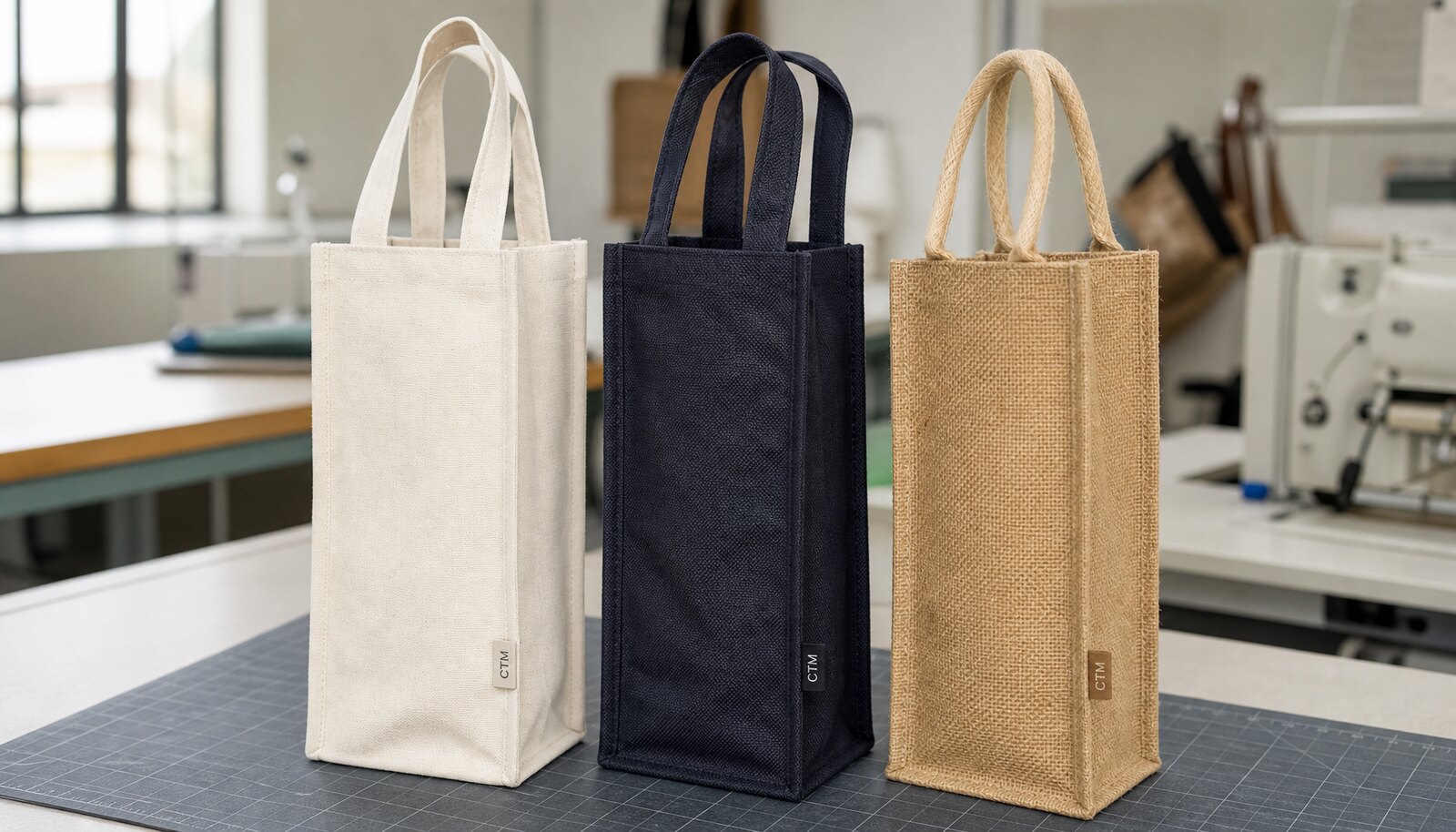
Why corporate wine bags fail when the spec is too vague
Most sourcing problems start before the quote. Buyers say they need custom wine bags for corporate gifts, but the factory is left guessing the bottle size, the visual standard, and whether the bag must survive distribution through HR, event teams, or retail partners. The result is usually one of three problems: the bag fits too tightly, the decoration looks weak, or the finished piece feels too cheap for a gift program.
Treat the wine bag as a packaging component, not a simple tote. A corporate gift bag has to carry a bottle securely, look polished enough for presentation, and stay cost-controlled across volume. That means your RFQ should define the bottle profile, material, decoration, and packing route before you compare prices.
- State the bottle type: standard 750 ml Bordeaux, Burgundy, Champagne-style, or a boxed wine accessory set.
- Set the usage scenario: event handout, client appreciation gift, distributor promotion, or retail add-on.
- Clarify whether the bag is single-use presentation packaging or a reusable carry bag.
Choose the right material for the gift level and the budget
For corporate gifts, the material choice controls both the perceived value and the quote structure. Cotton canvas is the most balanced option when the bag needs to feel substantial and photograph well. A practical spec is 8–12 oz, or roughly 280–400 GSM, depending on whether the bag is unlined or lined. Lighter cotton can work for short-term giveaways, but once the bag carries a full bottle, thin fabric shows wrinkles and poor structure.
Jute gives a natural, premium look and often fits sustainability-led programs, but it is more variable in texture and can shed fibers. Nonwoven is the cheapest route and is fine for high-volume promotions, but it rarely reads as a premium corporate gift unless the artwork is simple and the overall program is budget-first. If the gift needs to feel intentional, cotton canvas or a cotton-jute blend is usually the safer commercial choice.
- Cotton canvas: best balance of presentation, print clarity, and reuse value.
- Jute: premium-natural appearance, but require fiber and color consistency checks.
- Nonwoven: low cost, fast production, but weaker brand perception.
- For heavier bottles, consider reinforced base seams or a bottom insert.
How to compare quote routes without comparing apples to oranges
A good wine bag quote should separate fabric, decoration, packing, and freight assumptions. If one supplier includes 300 GSM cotton, woven labels, and individual polybags while another quotes thin canvas with no packing, the lower price is not a real comparison. Ask for each line item to be clear so your team can calculate landed cost instead of unit price only.
The most useful comparison is not just factory A versus factory B. Compare sourcing routes. A stock-bag base with custom print is faster and cheaper but limited in shape and branding. A full custom build gives better fit and presentation, but MOQ and lead time rise. For a corporate gift program, the best route depends on whether the bag is a one-time event item or part of an ongoing brand kit.
- Separate base bag cost, print setup, packaging, and carton cost in the quote.
- Ask for pricing at multiple quantities so the MOQ curve is visible.
- Clarify whether quote includes sample approval and revision cycles.
Supplier route comparison: which sourcing path fits your program
Different supplier routes solve different problems. If your team needs speed, a trading company or stock-line supplier may be acceptable, but you lose control over fabric lot consistency and stitch detail. A direct factory gives better control on weight, print, and seam reinforcement, especially when the bag must match a wider corporate gifting kit. A hybrid route, where a factory handles production and an experienced merchandiser manages artwork and packing, can reduce mistakes for multi-market buyers.
The right route depends on your risk tolerance. If the bags go to clients and executives, the tolerance for uneven stitching or weak print is low, so a direct factory with sample approval is usually better. If you are buying for a seasonal promotion with broad distribution, speed and cost may matter more than premium finishing.
- Direct factory: best for stable quality, repeat orders, and clearer process control.
- Trading company: useful for mixed SKU consolidation and flexible communication.
- Stock bag with custom branding: fastest route, but limited in structure and exact fit.
- Hybrid merchandised sourcing: useful when you need coordinated packing, labeling, and export documents.
Comparison table: sourcing options for custom wine bags
Use the table below to compare supplier routes by risk, not just by quoted unit price. The cheapest line is often not the cheapest landed result once rework, packing damage, or late delivery are added.
If your project includes multiple bottle styles or multiple brands, the best route may change by SKU. A premium client gift can justify a direct factory build, while a distributor launch may work better with a stock-base customization route.
- Write decisions in measurable language, not only descriptive wording.
- Ask for sample photos plus one physical approval sample for important orders.
- Keep quotation, sample approval, and inspection notes tied to the same spec version.
Sampling should prove fit, print clarity, and handling
Never approve a wine bag based on artwork alone. A flat artwork proof does not show how the bottle sits, whether the neck area looks balanced, or whether the handle reinforcement can handle the intended use. Ask for a pre-production sample with the actual bottle dimensions, even if it is only a plain sample with one-color marking.
The sample should answer practical questions: can the bottle slide in without force, does the top opening sit straight, and does the bag keep its shape after the bottle is placed inside? If the bag is for premium gifting, the sample should also show the final surface texture and print opacity under normal lighting, not just a close-up photo.
- Measure internal width, depth, and usable height with the intended bottle inserted.
- Review print registration and logo placement at arm’s length, not only in macro photos.
- Confirm handle length on the shoulder or hand, depending on the gift presentation method.
- Approve sample stitching at seams, handle anchors, and closure points before mass production.
Print and decoration choices that change cost and appearance
Screen print is the common choice for simple logos because it is stable, readable, and efficient for larger volumes. It works best when the design uses one to three solid colors and the brand can accept a slightly tactile print layer. Heat transfer is better for more detailed logos or gradients, but the finish can feel less textile-like and may crack if the carrier or adhesive is weak. Woven or sewn labels create a premium look but add cost and require a more planned placement area.
Embossing or debossing is less common on soft wine bags unless there is a synthetic patch or PU label area. For corporate gift programs, decoration should support the bag, not overwhelm it. A small, well-placed logo often looks more expensive than a large full-panel print, especially on natural fabrics like jute or canvas.
- 1-color screen print: best for cost control and clear corporate branding.
- 2–3 color print: good balance when the logo needs moderate detail.
- Heat transfer: suitable for gradients, fine text, or small runs.
- Woven/sewn label: better for premium perception and repeat-use gifts.
MOQ logic, lead time, and what actually slows production
MOQ is not only a factory rule; it is often tied to fabric width, print setup, and packing efficiency. A custom wine bag with one logo and one size may start at 1,000 to 3,000 pieces per style for a workable price. Once you add multiple colors, mixed bottle sizes, or special trims, the effective MOQ rises because each variation creates waste in cutting, printing, or assembly. If a supplier offers a very low MOQ, compare the hidden cost in higher unit pricing or reduced spec flexibility.
Lead time depends on when the material is booked and whether artwork approval is final. A standard schedule might look like 7 to 10 days for sample development, then 20 to 35 days for production after approval, depending on order size and season. Packing into individual polybags, adding inserts, or labeling for retail distribution adds time. The biggest delay is often not sewing; it is waiting for final artwork sign-off or a corrected sample.
- State whether MOQ applies per artwork, per color, or per size.
- Ask if lead time starts from deposit, artwork approval, or sample approval.
- Confirm whether pre-production sample time is included in the delivery window.
- Ask how peak season affects material booking and production queue position.
Packing decisions affect damage rates and warehouse speed
Packing is usually ignored until the first shipment arrives with crushed handles, scuffed print, or mixed labels. For corporate gifts, the bag should arrive in a condition that supports immediate distribution. If bags are packed loose in master cartons, you may save on packing labor but lose presentation quality and make warehouse picking slower. Individual polybags protect surface finish but add material and labor cost, so use them only when the gift is going direct to end recipients or retail shelves.
Carton strength matters when the bags are stacked with other gifts or shipped long distance. Ask for carton dimensions, gross weight, and carton count per export case so your freight forwarder can estimate volumetric cost. If the bags include rigid bottle inserts, cardboards, or hangtags, the internal pack must prevent movement. Loose internal movement is a common reason for bent neck areas and wrinkled fronts.
- Define inner pack count and outer carton count clearly.
- Specify whether bags must be folded a certain way to preserve logo visibility.
- Use master cartons strong enough for stacking if the goods move through multiple warehouses.
- Request a packed sample photo before bulk shipment if the order is presentation-critical.
QC thresholds that prevent avoidable claims
For this product, QC should focus on fit, strength, and appearance. A wine bag can be sewn correctly and still fail if the bottle sits crooked or the top opening collapses. Use a physical sample bottle and define acceptable tolerances for dimensions, print placement, and handle strength. If the order will be distributed as a branded gift, the visible face should be clean under normal office lighting, not just under a production lamp.
Good QC also means consistency across cartons. Jute and natural cotton can show shade variation, but the variation should stay within an acceptable range for the same shipment. For printed logos, set a rejection rule for blurred edges, off-center placement, or ink cracks. If the supplier cannot state their internal inspection method, the buyer should add an incoming inspection step at destination.
- Dimension tolerance: set a realistic allowance for cutting and sewing variation.
- Stitching: no skipped stitches, open seams, or loose thread clusters at stress points.
- Logo: no visible bleeding, double imaging, or off-center placement beyond agreed tolerance.
- Load test: confirm the bag holds the intended bottle without seam stretch or handle pullout.
Specification comparison for buyers
| Spec decision | Recommended option | When it fits | Buyer risk to check |
|---|---|---|---|
| Material route | Cotton canvas 8–12 oz / 280–400 GSM | Premium corporate gifting, repeated handling, better brand value | Thin fabric collapses bottle shape; confirm GSM and shrinkage after washing |
| Lower-cost route | Nonwoven 80–120 GSM | Large-volume seasonal giveaways and short budget campaigns | Print wear, weak handle attachment, and lower shelf appeal |
| Eco/premium natural look | Jute 300–450 GSM with cotton lamination or binding | Executive gifting and natural-brand programs | Rough hand-feel, fiber shedding, and inconsistent shade between lots |
| Print method | Screen print for 1–3 solid colors | Simple logos, clear brand marks, controlled cost | Fine lines may fill in; ask for mesh count and registration tolerance |
| Premium decoration | Heat transfer or woven/sewn label | Small logos, multi-color artwork, retail-quality presentation | Transfer cracking or label fray if adhesive and stitching are weak |
| Handle style | Self-fabric or reinforced webbing handles | Heavier bottles, shipping-safe corporate kits | Short handles can fail at stitch points; require load test criteria |
| Closure choice | Top drawstring or open-top with padded bottle neck protection | Gift sets where presentation matters and bag must stay closed | Drawstring cord can cut into fabric if eyelets are weak |
| MOQ route | 1,000–3,000 pcs per style for custom fabric/print builds | Standard corporate programs with one logo and one bag size | Low MOQ often raises unit cost and limits color options |
| Packing route | Bulk packed with divider cartons or individual polybag + master carton | Depends on distribution model and warehouse handling | Loose packing scratches bottles or slows fulfillment; confirm carton count and inner protection |
Buyer checklist before sampling
- Confirm final bag size, gusset, handle drop, and usable loading weight.
- Specify fabric type, GSM/oz weight, color tolerance, and shrinkage expectations.
- Send vector artwork and define logo size, print position, and Pantone references.
- Ask for sample photos plus one physical pre-production sample before bulk approval.
- Agree carton packing, barcode or hangtag needs, and shipment marks before production.
- Record inspection checkpoints for stitching, print adhesion, stains, and quantity count.
Factory quote questions to send
- What exact material and GSM do you propose, and what is the acceptable tolerance on that weight?
- Which print method are you quoting, and what is the setup charge, plate cost, or color-change cost by artwork version?
- What is your MOQ per color and per artwork, and how does the unit price change at 1,000, 3,000, and 5,000 pieces?
- Can you share a pre-production sample photo or physical sample policy showing stitching, handle reinforcement, and logo placement?
- What is the expected lead time after sample approval, and how many days are needed for raw material booking and packing?
- How will the goods be packed per carton, what is the carton size and gross weight, and can you provide a packing list template?
- What QC standard do you use for stitch strength, print alignment, and dimension tolerance, and can you note it on the quote?
- If we need mixed bottle sizes or mixed logo versions, how will that affect MOQ, tooling, and carton packing efficiency?
Quality-control points to confirm
- Fabric weight should match the agreed GSM/oz within a practical tolerance, and the fabric should not feel see-through or flimsy under a standard bottle load.
- Stitching at handle anchors and side seams must be even, with no skipped stitches, loose threads, or pulled seams after a simple manual tug test.
- Print should sit within agreed position tolerance; for multi-color logos, verify registration, edge sharpness, and no ink bleeding into fabric weave.
- Bag opening and internal width must fit the target bottle without excessive tightness; include a sample bottle in approval, not just a flat pattern check.
- Cartons should survive transport without crushing handles or deforming jute corners; confirm carton drop resistance with at least one packed sample.
- If using drawstrings or closures, test sliding function several times and confirm knots, eyelets, or cord stops do not loosen during handling.