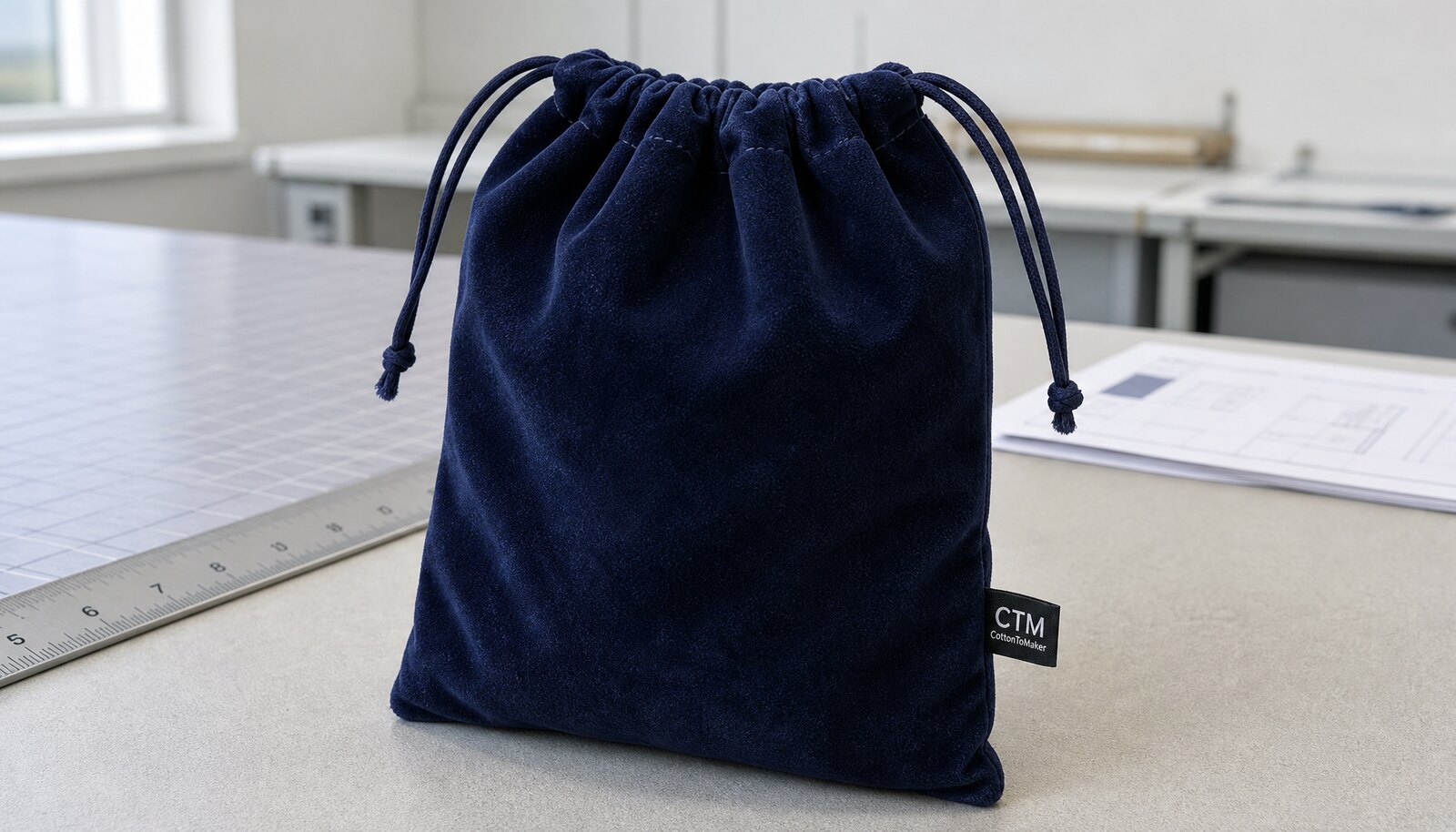
What changes the buying decision on a velvet pouch
A custom velvet drawstring pouch is not a generic pouch with a softer face. Velvet changes how the logo reads, how the seam looks, and how the bag behaves in packing. Buyers usually run into trouble when they approve a photo sample without pinning down the fabric weight, the pile direction, or the exact cord treatment. A pouch that looks premium in a single hand-held sample can turn inconsistent once the factory cuts a larger batch from multiple fabric rolls.
The first decision is what the pouch is protecting. Jewelry, cosmetics, candles, gifting sets, and premium retail inserts all need different internal finishes. A jewelry pouch can usually stay unlined if the velvet is dense and the seams are clean. A pouch for glass or coated items often needs a lining and a tighter top hem so the contents do not catch on raw fibers. If you do not define the use case, the factory will quote the cheapest build that still looks acceptable in a photo.
- State the product to be packed, not just the pouch size.
- Lock the visual target: matte premium, soft plush, or denser high-end velvet.
- Treat the approved sample as a production standard, not a marketing prop.
Choose the right velvet construction
For sourcing, velvet needs to be described in more than color. Buyers should ask for fiber content, GSM, pile height, and whether the material is woven or knitted. Polyester velvet in the 220-280 GSM range is often the practical choice for drawstring pouches because it balances handfeel, cost, and shape retention. Cotton velvet or higher-GSM blends can feel richer, but they are more sensitive to shrink, shade variation, and price swings. Crushed velvet may look attractive in a photo, yet it is harder to control from batch to batch and can make the pouch look uneven once folded or packed.
The back side matters too. Some suppliers quote a velvet face with little attention to the reverse side, but that can affect both cost and structure. For gift pouches, an unlined build is acceptable when the inside will not be seen much and the item being packed is light. For retail use, a thin lining can reduce fiber shedding and improve the drape of the pouch. If the pouch will carry heavier contents, ask whether the factory can reinforce the bottom seam or add a double-layer base without making the pouch bulky.
- Polyester velvet around 220-280 GSM is the common working range for repeat orders.
- Cotton velvet usually increases cost and shade-management risk.
- A lining is useful when loose fibers, shine-through, or heavier contents are a concern.
Construction details that change appearance and cost
The most expensive mistakes on velvet pouches are usually not in the fabric itself. They come from poor top finishing, weak cord channels, or inconsistent seam allowances. A narrow top hem can twist the opening; a loose channel can distort the shape after repeated use; and a sloppy seam allowance can leave one side longer than the other. Buyers should specify the opening width, the finished body depth, and the tolerance they will accept after the cord is installed. For smaller pouches, a tolerance of plus or minus 0.5 cm is a reasonable target if the factory is organized. Larger decorative pouches can allow slightly more, but the measurement should still be stated.
Cord choice also matters. Polyester round cord is usually the least risky for bulk orders because it runs smoothly and resists fraying better than low-grade cotton cord. Cotton cord can look more premium, but it may fuzz, knot, or vary in thickness if the supplier is buying from an uncertain trim source. If the pouch is intended for jewelry or cosmetic gifting, consider whether the end finish needs a knot, heat-cut tip, or a small aglet. Those details affect labor time and packaging consistency more than buyers expect.
- Specify finished size and tolerance, not just nominal size.
- Ask for seam allowance details and top-hem construction in the sample photo.
- Decide whether the cord ends need knotting, heat sealing, or metal aglets.
Logo methods that work on velvet
Velvet is more sensitive to decoration than flat fabrics. The pile can hide detail, blur fine lines, or make a transfer look uneven if the art is too small. For that reason, embroidery and woven labels are often the safest options for premium velvet pouches. Embroidery gives dimension and reads well on darker shades, but dense stitching can pucker the panel if the backing is weak. Woven side labels are cleaner when the buyer wants restraint rather than a large visible logo. Screen print can work if the pile is low and the artwork is simple, but the print area needs to be large enough to survive the texture. Heat transfer should be treated as a backup, not the default, because it can crack or sit awkwardly on a plush surface.
The right decoration depends on brand position and reorder behavior. If the pouch is part of a gift set or retail presentation, a woven label plus a clean inside print line may be enough. If the logo is the main selling point, embroidery or a stitched patch usually gives better perceived value. Buyers should send vector art, define the exact placement from the edge, and set an approved size in millimeters. A common failure point is logo scaling: the supplier reduces the art to fit the pouch and suddenly the text is too thin to read after sewing. That is not a design problem. It is a quotation problem.
- Best repeatable choices: embroidery and woven labels.
- Use screen print only when the art is simple and the pile is low and stable.
- Set logo size and placement in millimeters, not vague relative terms.
How MOQ and quote structure really work
MOQ on a velvet drawstring pouch is not just a factory preference. It reflects how many fabric rolls the supplier must cut, how many logo setups are required, and whether the order can be packed in one production run. A standard-size pouch in stock velvet with one-color embroidery may be available at a lower MOQ than a custom-dyed pouch with two logo placements and labeled inner packaging. Buyers who ask only for a total quantity often get a weak quote, because the factory cannot separate the cost of cutting, decoration, and packing labor. A better RFQ asks for pricing at clear break points, such as 500, 1,000, 3,000, and 5,000 pieces.
The quote should show where the money is going. For this product category, the useful line items are fabric, lining if any, cord, decoration, sewing, inner packing, master carton, and any special label work. If the supplier gives only one all-in number, compare that number against the spec sheet by line item. A cheap quote with no detail can hide a thinner fabric, a simpler cord, or a lower-cost print method. The buyer does not need a thesis; the buyer needs enough structure to know why one quote is 12 percent higher and whether that difference is defensible.
- Request unit pricing at multiple quantity breaks.
- Separate fabric, sewing, decoration, and packing in the quote.
- Use MOQ as a function of fabric, color, and decoration complexity.
Compare sourcing routes before you compare prices
The cheapest quote often comes from the source that controls the fewest steps. That is not always the lowest-risk source. A direct factory is usually the best choice when the order is repeatable, the logo is stable, and the buyer wants the same pouch across multiple seasons. A trading company can be useful if the buyer needs mixed products, but the price needs to be decomposed so the margin is visible. A local decorator is worth considering when the brand needs fast turnaround or late artwork changes, but the blank pouch quality becomes a new risk that the decorator may not control.
If velvet is central to the product story, do not use a supplier whose main business is boxes, paper packaging, or low-spec promotional bags unless they can prove velvet handling. Velvet rewards factories that understand pile direction, compression protection, and the way stitched labels behave at the seam. The sourcing route should match the buying problem. A launch order for a new retail line may justify a more hands-on maker. A replenishment order for a stable SKU should go to the factory that can repeat the same result without heavy supervision.
- Direct factory: best for repeatability and lower long-term cost.
- Trading company: useful for coordination, but insist on line-item transparency.
- Local decoration on imported blanks: useful for speed, not for cost control.
Sample approval and QC should be done like a production gate
Sample approval is where most velvet pouch problems can be stopped early. The first sample should be judged on fabric handfeel, shade, logo readability, seam symmetry, cord action, and the way the pouch closes when empty and when lightly loaded. Do not approve only from photos. Ask for a physical sample and compare it against a written spec sheet. If the factory plans to switch to bulk materials later, ask what will change and whether the approved sample will remain the standard. A sample that is made from better material than the bulk order is not a sample; it is a sales tool.
A production-ready approval should include practical thresholds. For example, the pouch should open and close smoothly without snagging, the seams should stay straight under light tension, and the logo should remain legible when the pile is brushed in different directions. If the product is for retail, inspect a packed sample as well, because velvet can crush during folding or over-compression. The check should also include the inside finish. Loose threads, uneven channel stitching, or exposed cuts can create returns even when the front view looks clean.
- Approve a physical sample, not only images or videos.
- Tie bulk approval to the same material and decoration method used in sampling.
- Inspect the pouch after light loading and after packing, not only empty.
Packing details that protect the velvet pile
Packing is often underpriced and under-specified. Velvet crushes if it is folded tightly, stacked too high, or left in a carton without internal separation. For most retail programs, each pouch should be folded in a repeatable way, lightly stuffed or supported if needed, and packed so the pile is not flattened against the carton wall. A simple polybag can be acceptable, but it should not trap moisture or permanently crease the velvet. If the buyer wants a premium unboxing experience, tissue wrap or a small insert card may be useful, but those additions need to be quoted separately and tested for fit.
Carton planning matters because soft goods can shift in transit. A carton that is too full will flatten the pile and distort the pouch shape. A carton that is too loose increases movement and can abrade the decoration. Ask the factory for carton dimensions, pack count, and gross weight, then compare those numbers to your warehouse receiving limits. If barcodes, SKU labels, or country-of-origin marks are required, make sure the factory shows the label position on the packed unit and the outer carton. Label mistakes are expensive because they usually show up after the goods have already cleared export inspection.
- Avoid over-compression of the velvet pile in carton packing.
- Quote tissue, polybag, insert cards, and barcode labels separately if they matter.
- Confirm both unit labels and master carton marks before bulk packing begins.
Lead time and landed cost are where margin gets lost
A realistic lead time for a standard custom velvet drawstring pouch is usually driven by material availability and decoration complexity. If the factory uses stock velvet and one simple logo method, bulk production can often start after sample approval and finish within a few weeks. Custom-dyed velvet, embroidery, or mixed packing instructions extend the schedule because the factory has more points to align before cutting. Buyers should also separate sample lead time from bulk lead time. A fast sample does not mean the factory can hold the same speed in production, especially if the order needs new trim or a revised label.
Landed cost should include more than factory price and freight. Velvet pouches often need extra care in packing, which adds labor and carton volume. A cheap ex-works quote can still lose if it requires relabeling, rebagging, or repacking at destination. For comparison, ask each supplier to quote the same quantities, the same packing format, and the same decoration method. Then compare not only unit price but also setup cost, sampling cost, carton count, and the risk of rework. The right supplier is the one that gives the lowest acceptable landed cost, not the lowest line on the quote.
- Separate sample lead time from bulk production lead time.
- Compare landed cost, not only ex-works unit price.
- Watch for hidden costs in repacking, relabeling, and freight volume.
Use an RFQ pack that forces a useful answer
The cleanest RFQ for a custom velvet drawstring pouch is short but specific. It should include a dimensioned sketch, fabric spec, logo artwork, packing requirement, quantity break, and target ship date. That is enough for a factory to quote responsibly without forcing the buyer into endless clarification loops. If the supplier cannot quote from that package, they are not ready for production. Buyers should avoid vague language like premium velvet or high-quality cord because those phrases invite a polished answer, not a reliable one.
The best RFQ also asks for evidence. Request photos of a similar pouch, a recent production run, and the factory's in-process QC points. If the supplier can show how they handle pile direction, stitch alignment, and carton protection, the quote becomes far more useful. For a procurement team, the value is not just a lower number. It is fewer revisions after sample approval, fewer packing disputes, and fewer surprises when the shipment arrives at the warehouse.
- Send a dimensioned sketch, not only a verbal size note.
- Include artwork, quantity breaks, packing format, and target ship date.
- Ask for evidence of similar velvet work before shortlisting the supplier.
Specification comparison for buyers
| Spec decision | Recommended option | When it fits | Buyer risk to check |
|---|---|---|---|
| Direct velvet pouch factory | Use a cut-and-sew supplier that handles velvet, cord insertion, and logo finishing in one line | Best for repeat programs, color control, and lower per-unit cost at scale | Confirm they actually sew velvet in-house, not just source finished pouches from a broker |
| General drawstring bag factory with velvet capability | Choose only if the factory can show velvet samples and production photos | Good when your order shares trims, labels, or packing with other pouch programs | Risk of rough handfeel, crushed pile, or weak top hems if velvet is treated like cotton canvas |
| Trading company | Use when you need multi-supplier coordination or mixed products in one shipment | Fits buyers who value coordination over factory-direct pricing | Check if the quote hides subcontracting, margin stacking, or unclear responsibility for defects |
| Local decorator applying logos to imported blanks | Source blank velvet pouches and decorate domestically | Useful for very small runs, urgent promotions, or late-stage artwork changes | Risk of inconsistent pouch size, mismatched dye lots, and higher landed cost after decoration |
| Small workshop or sample-room maker | Use for development, prototypes, and very low MOQ tests | Fits limited editions or premium gifting when timeline is flexible | Production repeatability can be weak, especially on seam symmetry and packing consistency |
| Packaging supplier with garment-adjacent sewing | Select only if they can prove needle control, pile handling, and labeling discipline | Works when pouch is part of a larger gift or cosmetics packaging program | Do not assume a carton or box supplier understands velvet sewing tolerances |
| Private-label e-commerce supplier | Buy from an exporter with standard size runs and stock trim options | Good for fast launch programs with simple logo needs | Inspect whether they can hold shade consistency across reorders and seasonal batches |
| Hybrid route: fabric mill plus cut-and-sew partner | Use for custom colors, custom GSM, and tighter fabric control | Best when velvet handfeel and shade are the main selling points | More handoffs mean more schedule risk unless one party owns final QC and packing |
Buyer checklist before sampling
- Confirm pouch size, tolerance, and usable internal opening after the top hem and cord are installed.
- State velvet type, face weight or GSM, pile direction, and whether the fabric must be brushed or crushed.
- Specify lining requirement, cord material, cord thickness, and whether cord tips or metal aglets are needed.
- Define logo method by placement, size, color count, and whether artwork can tolerate velvet pile distortion.
- Request unit pricing by quantity break and separate the cost of pouch, logo, packaging, and carton work.
- Ask for pre-production sample photos and a sealed approval sample before bulk cutting begins.
- Set acceptance criteria for seam strength, top-edge finish, cord pull smoothness, and color consistency.
- Confirm inner packing method to protect the velvet pile from crushing during transit.
- Review carton count, master carton dimensions, and whether the shipment needs barcode or outer label application.
- Build a production buffer for custom-dyed velvet, embroidery, or peak-season freight delays.
Factory quote questions to send
- What exact velvet construction are you quoting, including fiber content, GSM, pile height, and finish?
- Is the pouch sewn in-house on a dedicated line, or does any part of the order move to a subcontractor?
- What is your MOQ by size, color, and logo method, and how does the price change at 500, 1,000, and 3,000 pcs?
- What logo methods can you execute on velvet without pile collapse, and what file format do you need for approval?
- Will you quote the pouch, decoration, inner packing, master carton, and outer labels as separate line items?
- What tolerance do you hold on finished size, seam alignment, and cord length after final trimming?
- Can you provide a pre-production sample and a bulk reference sample from a previous velvet order?
- What is your standard lead time after sample approval, and what changes it during peak season?
- How do you protect velvet pile in packing, and do you use tissue, polybags, or compression limits?
- What inspection standard do you follow before shipment, and can you share defect photos from a recent order?
Quality-control points to confirm
- Measure finished size after the pouch is fully assembled, not only before hem and cord insertion.
- Check that the velvet pile direction is consistent across front, back, and repeat cartons.
- Inspect seam straightness, top hem symmetry, and whether any raw edge is visible inside the opening.
- Pull the cord repeatedly to confirm smooth movement, even gather, and no snag at the channel entry.
- Verify logo placement against the approved artwork and compare the sample under daylight or D65 light.
- Rub the decorated area lightly to test for flaking, cracking, loose threads, or pile damage around the logo.
- Check for crushed pile, shine marks, or crease lines caused by overpacking or poor folding.
- Confirm carton pack count, inner polybag count, and outer label accuracy before shipment release.