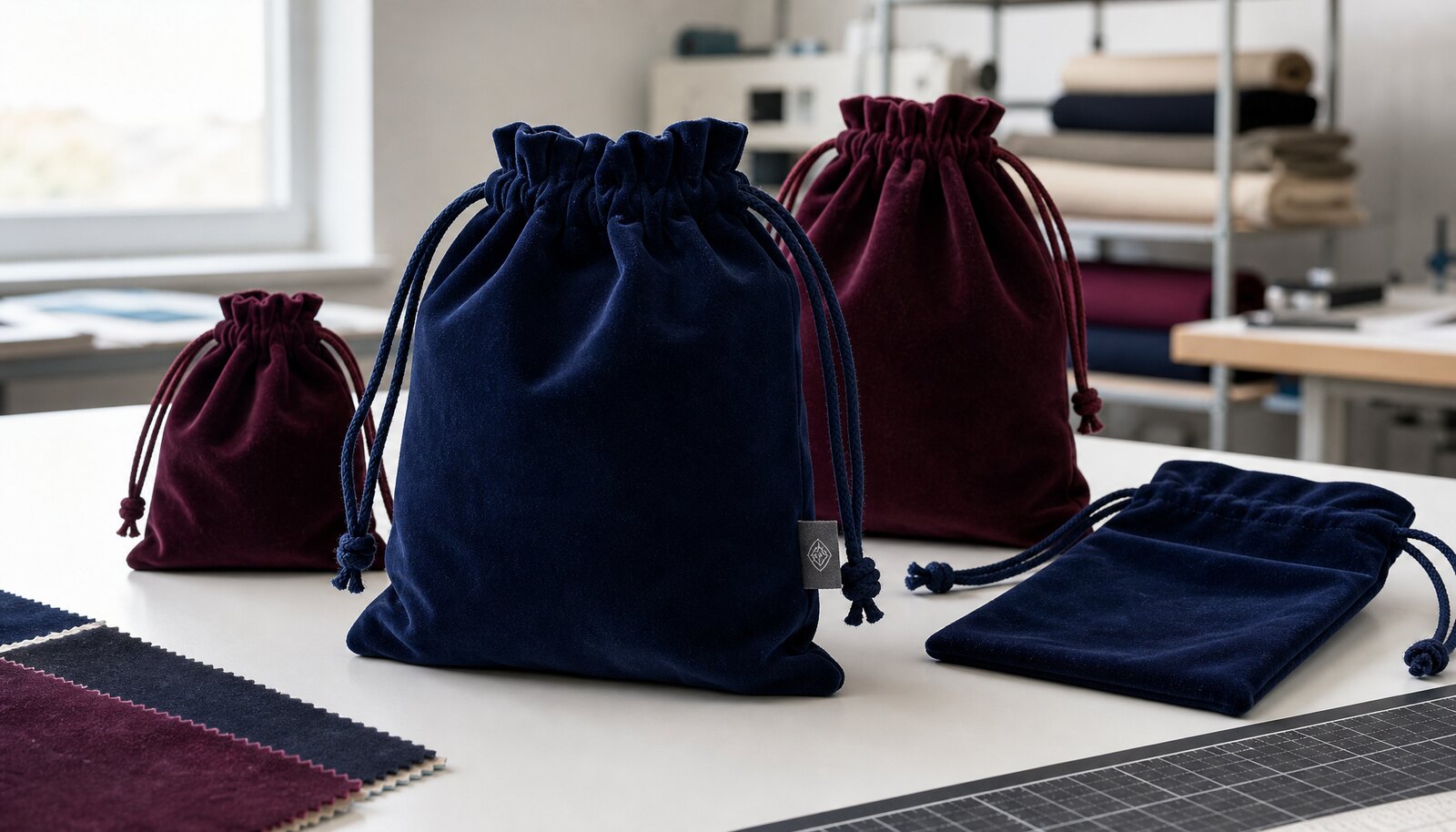
Why velvet pouches need a tighter RFQ than a normal drawstring bag
Custom velvet drawstring bags look straightforward until the first quote comes back with three very different prices for what seems like the same product. That gap usually comes from details the buyer did not specify: the velvet type, the fabric weight, the backing, the closure build, the logo method, and whether the bags are packed flat or pre-folded. Velvet also changes appearance under light and with handling, so a sample that looks fine on a desk can look off in a warehouse or store display if the pile direction, dye lot, or finishing is inconsistent.
For procurement teams, the right starting point is not the decoration. It is the use case. A jewelry pouch, a gift bag, and a retail product sleeve all need different structure, different feel, and different QC thresholds. If you write the RFQ around the final packed item, the number of supplier surprises drops fast. If you leave the size loose and only say velvet drawstring bag, you invite quote comparisons that are not comparable at all.
- State the item that will go inside the bag and the acceptable ease around it.
- Define whether the bag is meant to look premium, protect a product, or both.
- Separate must-have features from nice-to-have features before sending the RFQ.
Choose the velvet construction before you talk about price
Most buyers will get a cleaner result with polyester velvet than with cotton velvet. Polyester velvet in the 180-220 GSM range is usually enough for standard retail pouches, gift bags, and cosmetic sets. It has a softer hand than plain woven fabric, holds color well, and is easier for a factory to cut and sew consistently. If you want a heavier, more structured look, move up into the 240-300 GSM range and expect the bag to feel fuller, cost more, and take more care in cutting and seam finishing.
Cotton velvet can work when the brand wants a more natural handfeel or a less synthetic surface, but it often introduces more variability in shrinkage, pile behavior, and cost. Crushed velvet is visually strong but can be a poor choice when the logo needs a flat, readable surface. The buyer should also pay attention to pile direction. A bag cut with mixed pile direction can look like two different colors when the carton is opened, which is a common avoidable complaint on bulk inspection.
- For standard gift or retail pouches, start with polyester velvet around 180-220 GSM.
- For higher perceived value, use heavier velvet and plan for a larger seam bulk.
- Specify pile direction and approve the same direction across the whole lot.
- If the bag will hold sharp or heavy items, ask whether lining is needed to support the shape.
Logo method matters more on velvet than on flat woven fabric
Velvet is not forgiving when the decoration method is wrong. Fine screen print can work on a flat panel, but if the pile is too deep or the ink is too heavy, the logo can look fuzzy or pressed down. Embroidery gives a premium signal, yet it can distort the fabric if the patch is too dense or too large. A woven label, sewn into the side seam or hem, is often the cleanest option when the buyer wants durability without overworking the surface of the bag.
Heat transfer, foil, and deboss-style approaches can be useful for short runs or a fashion look, but they need real sampling. What matters is not whether the logo can be applied in theory. It is whether it survives handling, folding, and carton compression. The approval should be on actual velvet, not on a print file or on another bag material. A production-ready sample should show the final logo size, exact placement, and any surface change caused by the decoration.
- Use screen print for simpler logos on flatter velvet surfaces.
- Use embroidery or a woven label when durability and premium perception matter.
- Test the decoration for rub resistance and visible distortion before bulk approval.
- If the artwork has fine lines, confirm the minimum line thickness the factory can hold on velvet.
Dimensions, cord build, and seam allowance are where quote gaps hide
A common sourcing error is to give only a nominal size like 10 by 15 cm and assume the factory will fill in the rest. That is not enough. The buyer should define the finished size, the usable internal opening, and whether the bag must comfortably fit the product without stretching the seams or flattening the pile. The right allowance depends on the item being packed. A jewelry pouch can be tight and still look right. A cosmetics pouch or small gift bag usually needs a little more ease so the content can slide in without resistance.
The closure build should be specified with the same care. A 3-4 mm polyester cord is a common starting point, but the exact choice affects both appearance and function. If the top hem is too narrow, the cord tunnels twist. If the cord is too stiff, the opening feels awkward. If the seam allowance is too small, bulk sewing becomes inconsistent. Buyers should also define whether metal tips, knotted ends, or heat-sealed ends are required, because those details affect labor and the final retail impression.
- Give the factory the packed product size, not just the external bag size.
- State the target opening width and how easily the product must fit in and out.
- Specify cord diameter, finish, and whether the ends are decorated or sealed.
- Agree on finished size tolerance before the PP sample is approved.
How MOQ logic changes when you add color, size, and branding variables
Velvet bag pricing is rarely driven by fabric alone. The biggest cost driver is usually SKU complexity. One size in one color with one logo position is manageable. Add a second size, a second color, and two logo placements, and the factory may need separate material planning, more setup time, and a different production sequence. That is why two quotes that look close on paper can diverge sharply when the buyer finally aligns the specs line by line.
A useful RFQ should separate the base bag from the add-ons. Ask for the blank bag cost, the branding cost, the lining cost, the packaging cost, and any setup or sample charges. If the supplier only gives a single unit price, the quote hides the real cost structure and makes future reorders harder to compare. Buyers managing inventory across channels should also ask where the price breaks begin, because a small increase in volume may reduce the cost less than expected if the fabric lot or print setup does not change.
- Keep color count low if the project is still at the cost-testing stage.
- Treat each size and each artwork version as a separate cost driver.
- Ask for pricing by blank bag, branding, lining, and packaging instead of one merged unit price.
- Check whether the MOQ is per color, per size, or per total order.
Compare supplier routes on capability, not just on unit price
For custom velvet drawstring bags, the supplier route often matters as much as the factory itself. A direct factory with velvet experience usually gives the best control over fabric matching, seam construction, and packing discipline. A trading company can still be useful if it has a reliable factory base and can coordinate multiple packaging items, but the buyer needs more proof that the source is stable. If the seller is only a middle layer buying from different workshops, bulk quality can drift from sample to sample.
The most practical way to compare suppliers is to ask the same questions of each one: who cuts the velvet, who applies the logo, where the bags are packed, and how they control pile direction and shade variation. Ask for similar production photos, not generic catalog images. A real quote should also show whether the seller has handled lined pouches, multiple sizes, or retail packaging before. If they cannot explain the process clearly, the price is not low enough to justify the risk.
- Request recent production photos of actual velvet bags, not stock images.
- Ask who owns each process step: fabric sourcing, cutting, sewing, decoration, packing.
- Compare suppliers on quote transparency, sample speed, and consistency of answers.
- Treat unusually low prices as a risk flag until the spec exclusions are fully explained.
Sample approval should test appearance, not just dimensions
A good sample process for velvet bags usually has three checkpoints: fabric approval, pre-production sample, and final golden sample. The first check is about color and handfeel. The second is about construction, logo placement, and finished size. The third becomes the reference for bulk production. If the buyer skips a stage, it is easy for the factory to interpret the spec in a way that looks acceptable on paper but fails when the bags are filled, folded, or displayed under retail lighting.
During sample review, inspect the pile direction, seam straightness, opening symmetry, and how the drawcord sits after the bag is closed. Open and close the sample several times. Check whether the logo stays legible after rubbing, whether the cord tunnel twists, and whether the top edge lays flat. If the bag has a lining, inspect the inside for exposed raw edges or trapped threads. The sample should be treated as a manufacturing contract, not as a general reference photo.
- Approve the sample under the same lighting you expect for merchandising or warehouse inspection.
- Test opening and closing several times to see how the structure behaves under use.
- Keep a signed golden sample at both buyer and factory sides before bulk starts.
- If the color is critical, compare the sample against an approved swatch rather than a screen image.
QC thresholds that prevent expensive rework after bulk production
For velvet pouches, QC must cover appearance and function together. A bag can meet size on paper and still fail visually if the pile is crushed, the seam is crooked, or the logo looks smudged. Buyers should define the tolerances in plain terms before mass production starts. For small pouches, a tight size tolerance makes sense, but it should still be realistic for sewn velvet. More important is consistency across the carton: one bag should not look like it came from a different dye lot or a different cutting direction.
The most useful bulk inspection points are also the simplest: stitching quality, cord movement, label placement, shade consistency, and pack count accuracy. Do not rely on a general good-quality statement. State what is not acceptable. Loose threads, open seams, off-center logos, crushed pile, and dirty inner packing should all be rejected. If the bags are for retail or gifting, the condition of the top fold and the carton presentation matter because the first touch point is often the unpacking experience.
- Agree on acceptable tolerance for finished size before the factory starts cutting.
- Reject visible shade mismatch between bags from different fabric sections or batches.
- Reject logos that shift, blur, or distort when the bag is closed and filled.
- Inspect carton count and pack cleanliness on every shipment, not only the goods themselves.
Packing and handling can make a good velvet bag look cheap
Velvet does not behave like plain cotton or nonwoven fabric in packing. If the carton is compressed too hard, the pile can hold marks that are difficult to remove. That matters when the bag is intended for retail display or for a gift presentation. The packing spec should say whether the bags are folded once, folded twice, or packed flat, and whether each piece goes into an individual polybag. For some programs, a simple inner bag and a clean master carton are enough. For others, the buyer may need a barcode label, size sticker, and carton mark that matches the distribution center standard.
If the program includes fulfillment or store-ready delivery, the factory should also confirm carton count, carton dimensions, gross weight target, and pallet plan if needed. A seller who cannot provide orderly packing data often creates hidden labor for the buyer after arrival. That is a cost, not just an inconvenience. It is cheaper to define the pack structure up front than to correct mixed counts, missing labels, or crushed pile after the shipment lands.
- Specify fold direction, inner polybag use, and master carton count.
- Use labels that match the buyer’s warehouse or retail receiving format.
- Avoid over-compression that leaves visible pile marks on arrival.
- Ask for carton dimensions early so freight estimates are not based on guesswork.
Lead time and landed cost are driven by fabric sourcing and approval delays
Lead time for custom velvet drawstring bags should be separated into steps: sample making, color approval, bulk material sourcing, production, inspection, and shipment booking. The weakest projects are the ones where the buyer expects all of those to happen inside one vague date. Velvet often needs more control than a simple cotton pouch because fabric shade, pile direction, and decoration all need to be aligned before bulk starts. If the fabric is custom dyed or the logo method needs a test run, the schedule should already include a buffer for one corrective round.
Landed cost should be compared on the same basis across suppliers. That means the same fabric weight, the same logo method, the same packing method, and the same incoterm or freight assumption. A lower ex-works quote can become the higher landed cost if it excludes packing labor, sample fees, special trimming, or a longer lead time that forces expensive shipping. Buyers should ask for a clean quote structure so the real commercial comparison is visible before the purchase order is issued.
- Break the schedule into sample, approval, bulk, inspection, and freight booking.
- Keep a buffer for custom dye, trim sourcing, and one correction cycle.
- Compare landed cost only after packing, setup, and freight assumptions are aligned.
- Do not approve a cheap quote that hides work in packaging or decoration add-ons.
Specification comparison for buyers
| Spec decision | Recommended option | When it fits | Buyer risk to check |
|---|---|---|---|
| Sourcing route | Direct factory with velvet bag experience | Repeat programs, private label retail, and buyers who need control over fabric, trim, and packing | Verify the factory actually cuts, sews, and finishes velvet bags in-house, not just trading them |
| Velvet construction | Polyester velvet around 180-220 GSM for standard retail pouches | Gift sets, cosmetics, jewelry, and promotional programs that need a soft premium look without high cost | Check pile direction, backing stability, and whether the sample matches the bulk fabric |
| Premium feel level | Heavier velvet around 240-300 GSM with lining | Luxury packaging, higher perceived value, and product bundles that sit on shelf or in a gift box | Heavier fabric can change size, seam bulk, and closure performance, so recheck finished dimensions |
| Branding method | Woven label, embroidery patch, or clean screen print on a flat panel | When the logo must survive handling and shipping without becoming fuzzy or cracking | Do not approve decoration on velvet without a rub test and placement sample |
| Closure build | Polyester cord 3-4 mm with reinforced top hem and clean cord exit | Retail pouches that are opened and closed often, or sets where presentation matters | Watch for fraying, uneven cord length, and top tunnel distortion after filling |
| Lining choice | Unlined for lower cost or lightweight items; lined when the bag must hold shape | Jewelry, fragrance, premium gifts, and products with sharp edges that should not show through | Lining changes MOQ, cost, and lead time, so compare quotes on the same construction |
| Size strategy | Finished size based on the packed product plus practical ease allowance | Programs where the item must slide in cleanly without stretching the seam or crushing the pile | If the buyer only gives a nominal size, the factory may quote a bag that is too tight in bulk |
| Packing route | Flat folded with inner polybag and carton count clearly labeled | Export orders, e-commerce fulfillment, and retail distribution where carton control matters | Too much compression can leave permanent pile marks and create a dirty appearance on arrival |
| MOQ logic | One color and one artwork set per SKU where possible | Smaller buyers who need manageable inventory and simpler approval cycles | Each extra color, size, or logo position can raise the MOQ and distort the true unit cost |
Buyer checklist before sampling
- Define the end use first: jewelry, cosmetics, fragrance samples, gift sets, retail packaging, or promotional giveaway.
- Lock the finished size using the actual packed product, not a guessed flat dimension.
- Specify velvet type, target GSM, pile direction, backing, and whether lining is required.
- State the logo method, exact placement, and whether the artwork must survive rub handling.
- Confirm cord type, cord diameter, cord length, and whether metal tips or knots are required.
- Set a tolerance for finished size, seam appearance, and color deviation before sampling starts.
- Request a pre-production sample or approved golden sample before bulk cutting.
- Ask for packing details: inner polybag, fold method, carton count, and carton marks.
- Compare quotes only when the same fabric, same logo method, same packing, and same MOQ are used.
- Leave room in the schedule for fabric approval, trim sourcing, and one round of sample correction.
Factory quote questions to send
- What exact velvet construction is quoted, including face weight, backing, and any lining material?
- Is the quote based on stock color fabric, custom-dyed fabric, or a special shade match?
- What logo method is included, and what setup cost or tooling cost is separate?
- What is the MOQ per color, per size, and per artwork version?
- What sample stages do you offer, and how long does each sample stage usually take?
- What finished size tolerance do you work to, and how do you handle pile direction during cutting?
- How are the bags packed for export, including inner polybag, carton quantity, and outer carton marks?
- What inspection standard do you use for bulk production, and what defect levels are not acceptable?
- Can you show recent production photos or a similar bag you have already made in velvet?
- Which quote items are excluded, such as freight, testing, labeling, or special packaging?
Quality-control points to confirm
- Approve the bulk fabric against a physical swatch or lab dip under daylight, not only on screen.
- Check that pile direction is consistent across the order so the bags do not read as two different shades.
- Measure finished size after pressing and cooling, and agree the tolerance before production starts.
- Inspect the top hem, cord tunnel, side seams, and bottom corners for skipped stitches or twisting.
- Pull-test the cord to make sure it slides smoothly and does not fray, knot loose, or snag inside the tunnel.
- Verify logo placement, size, and color on actual velvet because pile can blur fine detail.
- Open and close random samples after packing to see whether the bag retains shape and the closure still works.
- Check carton count, carton marks, and inner pack method so the goods arrive ready for distribution.