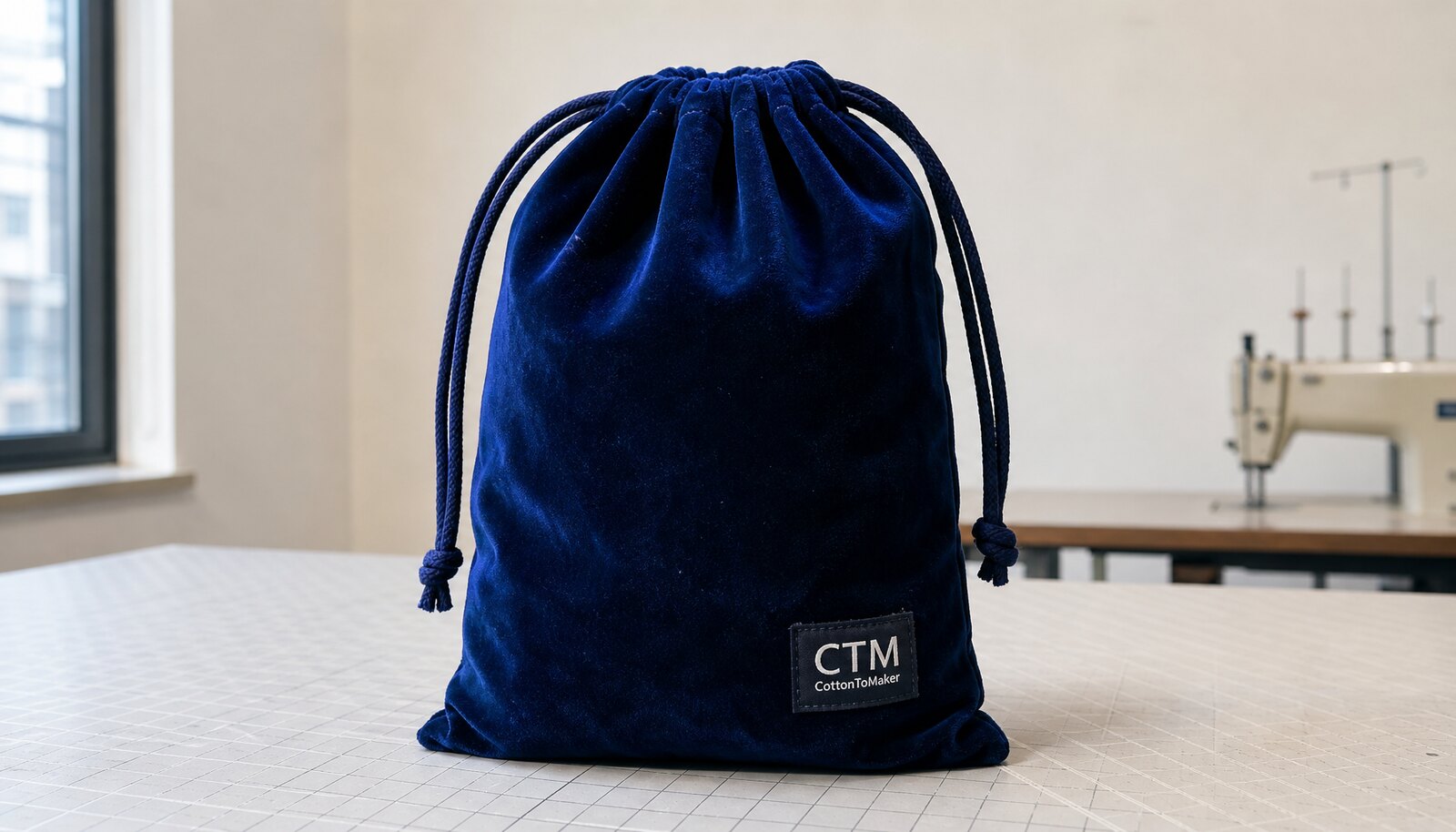
1. Start with the use case, not the velvet
A custom velvet drawstring bag can look like a small sourcing item, but procurement teams usually discover that the material choice affects almost every other decision in the program. The same bag name can cover very different products: a jewelry pouch that needs a soft interior, a fragrance gift bag that must look rich under store lighting, a cosmetics pouch that travels in a tote, or a presentation bag that is opened in front of a customer. Each use case changes what matters most. For a display item, surface appearance and pile consistency may outweigh raw cost. For a protective pouch, lining and seam finish may matter more than decoration.
That is why the first useful question is not “which velvet?” but “what job is this bag doing?” A supplier can quote a low price if the brief is loose because the factory is free to choose lighter fabric, a thinner cord, a simple hem, and a basic print method. That may be acceptable for an event giveaway. It is not acceptable when the bag is part of the customer-facing product story or when it sits beside a premium item in a retail set. Procurement buyers should specify the contents, how the bag will be handled, and whether the bag must stand up on shelf, protect a product from abrasion, or simply close neatly around a soft insert.
It also helps to decide what failure would cost more than the material itself. If a bag will be used to package jewelry or cosmetics, the hidden cost is often not the unit price but customer perception. A crushed pile, crooked label, or uneven cord channel can make the whole item appear lower in value. In that setting, the buyer should write the RFQ around appearance control and repeatability, not just size. If the bag is purely promotional, the buyer can tolerate a wider finish range and save money by simplifying the build. The right spec is not always the most expensive one; it is the one that matches the route to market.
- Write the product role into the RFQ: retail packaging, gift set insert, protective pouch, or giveaway.
- State the expected contents or fill dimensions so the bag is sized to use, not guessed from a sketch.
- Decide whether the bag must stand upright or only close securely around contents.
- Define the level of visual polish you need: premium, mid-tier, or functional promotional.
2. Choose the velvet construction before you compare prices
Price comparisons on velvet bags are often misleading because the fabric description is too broad. Velvet is not a single construction. For bulk sourcing, buyers usually see polyester velvet, cotton velvet, or blended pile fabrics, and each behaves differently in cutting, sewing, and decoration. Polyester velvet is common in commercial packaging because it is generally easier to source consistently, gives acceptable color depth, and usually comes with better price stability. Cotton velvet can feel richer and may suit brands that want a softer, more natural story, but the sourcing cost and variability can be less convenient for high-volume procurement. What matters most is not the label but the actual face fabric, backing, and pile behavior.
GSM is useful, but only as one part of the decision. Two fabrics with the same GSM can have very different visual results if the pile length, backing, and finish differ. A denser fabric can still appear visually thin if the pile is short or if the backing is weak and lets the fabric drape too much. Buyers should ask suppliers to identify the face GSM, the backing structure, and whether the cloth is intended for apparel-style velvet or a more utility-oriented pouch construction. If the factory cannot describe the fabric clearly, the quote is not ready to compare.
The other decision is structure. Many velvet drawstring bags are unlined, but unlined should be a conscious choice rather than the default. Unlined construction is suitable for soft inserts, giveaways, and some low-cost retail packaging. Light lining improves opacity and reduces the chance that stitch shadows, seam allowances, or raw internal edges show through the velvet face. Full lining is better when the product is premium, scratch-sensitive, or repeatedly handled. If the bag needs a crisp mouth opening, do not assume extra fabric weight will solve it. A reinforced channel, interfacing, or a stronger top edge can do more for usability than a heavier body fabric.
3. Decoration has to work with the pile, not fight it
Velvet is less forgiving than flat woven fabric when it comes to decoration. The pile catches light, swallows detail, and changes appearance when the nap is brushed one way or the other. That means a logo that looks crisp on a screen can look soft, uneven, or partly lost when it reaches the actual bag. Buyers should not leave decoration as an afterthought. It should be chosen with the fabric. For many procurement programs, a woven label, sewn patch, or restrained embroidery is a safer route than a large print because these options are less dependent on the pile surface to hold sharp edges.
That said, printing can work if the artwork and process are matched to the fabric. Simple screen print is usually better than a complex multi-color image when the target is durability and clean edges. Heat transfer or digital transfer may be practical for small runs or versioned artwork, but the buyer should test for adhesion, hand feel, and the way the transfer sits over the pile after folding. Embroidery gives a premium tactile effect, yet it can compress the pile around the stitch area and change the way the surface reflects light. On a small pouch, too much embroidery can also make the front panel stiff or distort the logo shape.
The practical rule is to keep the artwork simple enough that the velvet does not absorb it. Thin serif text, tiny registration marks, and large solid fills are all riskier on pile fabric than on a smooth textile. If the brand wants a luxury look, a tonal label, a small woven side tab, or a discreet logo placement near the seam may be more durable and more elegant than a large front-panel print. The supplier should be asked to show decoration on the actual production fabric, not on a generic substitute. A digital mockup is useful for layout; it is not enough to approve final appearance.
A good RFQ also defines what counts as acceptable after handling. Velvet bags are often folded, packed, unpacked, and displayed before the customer sees them. The logo should still look clean after a light rub, and printed areas should not crack, flake, or pick up obvious shine from heat damage. If a supplier cannot explain how their decoration method behaves on velvet, that supplier is not ready for a premium order.
- Keep artwork simple and avoid very fine text on small pouch sizes.
- Approve decoration on the actual velvet, not only on a mockup or paper proof.
- For premium presentation, consider woven labels, sewn patches, or restrained embroidery.
- Set a handling standard: the logo must still look acceptable after light rubbing and folding.
4. Build the RFQ around measurable details, not product names
The fastest way to get comparable quotes is to write the RFQ so that the supplier does not have room to reinterpret it. Many sourcing problems begin with a line like custom velvet drawstring bag, because the supplier must then guess the fabric weight, lining, cord material, artwork position, and packing method. If one factory quotes an unlined shell and another quotes a fully lined pouch with tissue and individual polybags, the lower quote is not useful. Procurement teams need a spec sheet that can survive the quote round without becoming a back-and-forth clarification exercise.
A solid RFQ should cover the finished dimensions and how those dimensions are measured, the exact velvet description, the lining choice, the drawcord material and finish, the decoration method, and the final packaging requirement. It should also show what must be matched from the approved sample and what may be changed without reapproval. That distinction matters because velvet programs often drift when a factory swaps a fabric lot, changes cord diameter, or chooses a different backing after sample approval. If the buyer does not lock these items in writing, the bulk order may still pass a basic inspection while missing the brand feel that justified the bag in the first place.
For quote control, ask the supplier to break out one-time and recurring costs. Sampling, screen setup, embroidery digitizing, label tooling, and custom packing all affect the first order differently from a reorder. If those charges are buried inside the unit price, the buyer cannot tell whether the supplier is efficient or simply hiding setup cost. It is also useful to ask for several quantity tiers. That shows where the price curve improves and whether a small pilot order is actually economical compared with a larger launch run.
Procurement buyers should also ask whether the factory can keep the same material lot or shade standard for a future reorder. Velvet is a pile fabric, so color perception changes with nap direction and light. A supplier who says yes without explaining how they control the shade standard may be overpromising. The better answer is a clear process: master sample, approved swatch, lot tracking, and written replacement rules if the original fabric is no longer available.
- Ask for separate pricing of sampling, setup, unit cost, and packing so hidden cost does not blur the comparison.
- State the finished dimensions, tolerance, and measurement method in the RFQ.
- Require the supplier to confirm whether a future reorder can match the same fabric lot or shade standard.
- Request price tiers at several quantities so you can see where the unit price really improves.
5. MOQ, sample cost, and the real first-order economics
MOQ is often discussed as if it were a single number, but for a custom velvet drawstring bag the minimum depends on the combination of color, decoration, and fabric sourcing. A stock-color bag with a standard drawcord can often run at a lower quantity than a custom-dyed bag with a lined interior, woven label, and retail packaging. The more custom inputs you add, the more setup the supplier must carry across the order. That is why the question should not be “what is your MOQ?” but “what MOQ applies to this exact construction and decoration method?”
Buyers should also treat sample cost as part of program planning rather than a nuisance fee. For velvet, it is normal to have more than one sample stage if the order is appearance-sensitive. A fabric swatch or shade card may be needed before sewing starts, followed by a sewn sample that uses final materials, and then a pre-production sample that reflects the actual bulk process. If the supplier is unwilling to distinguish these stages, the quote may look convenient but can expose the buyer to more rework later. Sample-stage spending is often the cheapest way to avoid production loss.
The hidden cost to watch is not just the sample charge itself but the time cost of a weak sample process. If the first sample is approved too quickly, the bulk may still fail on shade, pile direction, or decoration quality. If the sample is too heavily revised, the schedule slips and the buyer may need expedited freight or a partial shipment. That makes the landed cost far more expensive than the initial quote suggested. In practice, the right question is not how low the sample fee is, but whether the sample process is disciplined enough to reduce rework.
For a launch program, it is often useful to ask the supplier for three quantity tiers: a test run, a realistic launch volume, and a reorder volume. This helps the buyer see whether the first order is absorbing too much setup cost and whether the factory pricing is consistent. It also gives the procurement team a better basis for business planning, because some velvet programs only make sense when the buyer understands the scale threshold where the quote becomes efficient.
6. Compare supplier routes by control, not by headline price
A useful procurement comparison starts by asking who actually controls the product. A direct factory that cuts, sews, decorates, and packs in one place is often the most accountable option for a repeat program. When one team owns the fabric, the sewing line, and the final packing, there are fewer handoff points where spec drift can enter. That does not automatically make the price lowest, but it usually makes the program easier to manage once the order is approved. For a buyer who wants consistent reorders, that control is valuable.
A trading company can be attractive when the program includes multiple components or when the buyer wants one contact to coordinate different factories. The tradeoff is that the buyer may see less of the real production step, and the risk of specification drift rises if the trading company does not maintain a strict bill of materials and a single approval sample. In a small or fragmented project, that can still be a practical route. In a premium velvet program, it requires more discipline from the buyer because the margin between acceptable and disappointing finish is thin.
Stock decorators offer the fastest path to market, but their speed comes from limited variation. If the buyer needs a near-term shipment, a stock route may be the only realistic option. The constraint is that the cloth shade, pile direction, and decoration placement are often tied to what the stock program already uses. Buyers should review whether the stock product can be re-ordered exactly or whether it is effectively a one-off batch. If the business needs continuity, a stock route should be treated as a bridge, not a long-term supply plan.
The best procurement decision is not always the cheapest route on paper. It is the route that gives the buyer enough control for the product’s risk level. A velvet specialist factory is often worth the additional quote when the bag is part of the premium brand experience. A general pouch factory may be fine for a simple insert if the buyer provides a hard spec and insists on inspection. For launch risk, many buyers use a two-step model: source the first run from the strongest production partner, then qualify a second source once the spec and sample are stable. That reduces dependency without asking two factories to improvise the same product from scratch.
- Match the supplier route to the stage of the program: prototype, launch, or reorder.
- Ask who owns fabric sourcing, decoration, and final packing at each supplier.
- Do not compare a premium lined quote against a simpler unlined quote and call it a price check.
- If you dual-source, make both suppliers build against the same sealed approval sample.
7. Sample in stages and keep the approval sample as the reference
For velvet, sample management is not optional. The fabric reacts to pressure, light, and handling, so a sample made from a substitute cloth can be misleading even if the color looks close in photos. A better process is to move through stages: first a shade or fabric reference if the order uses custom color, then a sewn sample with the final decoration method, and finally a pre-production sample made with the actual production materials and packing. This gives the buyer a chance to catch issues before the factory commits to bulk cutting.
The approval sample should be measured, photographed, and stored on the buyer side in sealed form. It becomes the control standard for cut size, seam placement, logo position, cord length, lining finish, and carton presentation. When the factory says “same as sample,” both sides should mean the same object. If the sample is passed with loose wording such as looks fine, bulk variation is almost guaranteed. Velvet programs especially benefit from hard sign-off because the pile can make two visually similar bags look different under retail lighting.
The sample review should include both visual and functional checks. Visually, the buyer should look at pile direction, shade depth, logo clarity, seam alignment, and any crushed areas around stitching or decoration. Functionally, the buyer should pull the cord repeatedly, check how the mouth opens and closes, and confirm that the bag shape does not distort when filled. If the item is retail facing, review it under daylight and under indoor store lighting. Velvet can pass under one condition and fail under the other because the nap reflects light differently.
A practical sample record should include photos from front, back, open mouth, closed mouth, and close-up stitch areas, plus a measured spec sheet. That record is far more useful than an email that says approved. If changes are requested later, the buyer should decide whether the change is minor or whether a new approval sample is needed. With velvet, changes to fabric, cord, label, or print method are often significant enough to require reapproval because each one affects the final look.
- Use a swatch or shade approval before the sewn sample if color consistency matters.
- Keep one sealed buyer-side reference sample for future inspection and reorders.
- Inspect the bag under daylight and indoor lighting because velvet shade can shift visually.
- Treat changes to fabric, cord, artwork, or packing as sample-impacting unless proven otherwise.
8. QC for velvet needs appearance thresholds, not generic checkboxes
Standard pouch inspection catches some issues, but velvet adds a layer of visual sensitivity that needs explicit thresholds. The buyer should define what counts as a major defect before production starts. Common velvet issues include shade mismatch, pile crush, seam waviness, off-center artwork, and compression marks from packing. These are not always functional failures, but they can be commercial failures if the bag is sold in a premium channel. The QC sheet should therefore separate appearance defects from function defects and explain which ones are acceptable only as minor issues, if at all.
Dimension control should also be written clearly. For small drawstring pouches, buyers often want the finished width and height to remain within a narrow range, but the exact tolerance should reflect the product and the chosen construction. A lined bag may behave differently from an unlined one, especially near the mouth opening. The same is true when the bag contains a reinforced channel or interfacing. Instead of assuming the factory will measure the same way every time, define how the bag is measured: laid flat, without filling, at the widest point, and with the drawcord relaxed.
Functional checks are equally important. The cord should move smoothly without snagging, the channel should not fray, and knots or sealed ends should not fail under normal handling. If the bag uses embroidery or a sewn patch, inspect the reverse side to confirm that excess thread tails are trimmed and the backing does not create lumps or show-through. If the bag is designed for retail display, inspect it after light handling, not only straight out of the carton. Velvet can look acceptable at the line and tired after packing if it has been over-compressed.
A useful way to think about QC on velvet is to ask what the customer will notice first. In many programs, the first thing seen is not a failed seam but a dull patch, a crushed nap, or a crooked logo. The inspection standard should reflect that reality. If the buyer wants a premium look, the acceptable variation must be tight enough that a random carton pull still matches the approved sample in appearance.
For shipment control, the carton audit matters as much as the bag audit. Count by style code, color, and pack quantity, then confirm that the cartons are marked clearly enough for warehouse intake. When a bag is part of a gift set or retail program, a single color mix-up can create more cost than several minor sewing repairs. Good QC prevents that kind of avoidable loss.
9. Packing and carton design can make or break the finish
Packing is a real quality issue on velvet, not just a logistics detail. The pile shows pressure, so if the bags are folded too tightly or packed too densely, the surface can stay marked by the carton even when the bag itself is well made. Buyers often focus on sewing and decoration and forget that the carton can undo the appearance work. For a premium product, the safest approach is a packing spec that protects the pile without over-engineering the package. Light tissue, a clean fold, and a stable inner count are often better than aggressive compression that saves volume at the expense of finish.
The buyer should decide whether each bag needs a polybag, tissue wrap, or insert card. Polybags can help keep the bag clean, but they can also trap pressure if the fit is too tight. Tissue adds a small layer of protection and improves presentation when the bag is opened at the warehouse or by the end customer. Insert cards or stiffeners can help the bag retain shape, but they also add cost and packing time. The right answer depends on whether the pouch is shipping as a retail-facing item or as an internal packaging component.
Carton design should support both warehouse handling and inspection. Each inner pack should show style, color, and quantity so the receiving team can verify contents quickly. Outer cartons should show purchase order number, carton number, quantity, and product description. If the buyer has a barcode or SKU system, the factory should confirm label placement and readability before shipment. A bag can be sewn perfectly and still create inventory problems if the cartons are not labeled in a way the warehouse can use.
A useful packaging question for suppliers is whether they can show a packed sample before bulk. This is particularly helpful on velvet because the buyer can see whether the fold line, tissue, and carton fill are causing compression. The sample also makes it easier to decide if the pack should be adjusted to protect the pile, even if that adds a little freight volume. In many programs, that is a good tradeoff because the cost of rework or customer complaints is higher than a slightly larger carton.
- Use the lightest packing that still prevents pile crush during transit.
- Avoid overfilling cartons just to reduce freight volume.
- Require clear carton marks with PO, style code, color, quantity, and carton number.
- Ask for a packed sample if the bag is retail-facing or if the velvet is particularly sensitive to pressure.
10. Lead time and landed cost should be compared on a full basis
Lead time for a custom velvet drawstring bag is often driven less by sewing speed than by material readiness and approval timing. Fabric sourcing, shade matching, decoration setup, and sample revision can each add days or weeks before production even starts. Buyers sometimes hear a short sewing lead time and assume the whole order will be fast. In reality, the longest delay may happen before the line begins. If the bag uses custom color or a nonstandard finish, the schedule can stretch further because the factory must align multiple inputs rather than simply cut and sew stock material.
That is why a delivery promise should not be treated as fixed until the sample, carton spec, and purchase order are all confirmed. If the buyer wants to reduce schedule risk, the most effective step is usually not asking the factory to rush sewing. It is reducing uncertainty earlier in the process by approving material, decoration, and packing in a disciplined order. The earlier the specification is locked, the less likely the order is to slip into premium freight or a split shipment.
Landed cost analysis should include all the pieces, not just the ex-factory quote. Freight, duty, local delivery charges, sample fees, cartons, inserts, and any one-time setup cost belong in the comparison if the buyer wants a true sourcing decision. A slightly higher unit price can still win if the factory has lower defect rates, denser packing, or better control on the first pass. The cheapest per-piece quote is not always the cheapest purchase order. For procurement teams, the better measure is the cost to receive a conforming bag on time, in the right carton, at the required quality level.
It is often worth asking the supplier where the risk sits. A good factory can usually say whether fabric sourcing, decoration, or packing is the most likely schedule bottleneck. That answer is more useful than a vague promise to meet the ship date. When a bag looks simple on the page but uses a sensitive fabric like velvet, those small process risks are what determine whether the order arrives as a smooth replenishment or an expensive recovery project.
- Treat sample approval as a schedule milestone, not as an informal step.
- Separate one-time charges from recurring unit cost when comparing suppliers.
- Compare on the same Incoterm so freight is not hidden in different ways.
- Ask which production step is most likely to delay the order and what the factory does if that happens.
Specification comparison for buyers
| Sourcing route | Best fit | Cost / lead-time tradeoff | Defect risk to check |
|---|---|---|---|
| Direct factory with in-house sewing and decoration | Repeat programs that need consistent cut size, stitch quality, and logo placement | Usually the cleanest unit cost once the spec is stable, but sample development can take longer if the factory must source velvet, lining, or label components. Lead time is often more predictable after the approval sample is locked. | Lower spec drift if one plant controls the whole build, but buyers still need to check seam waviness, pile crush, and label placement because velvet defects are easy to see. |
| Trading company coordinating several workshops | Orders that mix fabric, trimming, labeling, and multiple packing steps | Can reduce buyer coordination effort, but margin is added somewhere in the chain. Lead time may be longer when approvals must pass through more than one supplier. | Higher risk of BOM drift or inconsistent standards if the trading company does not issue a single measured specification and identical approval sample to every workshop. |
| Stock velvet bag decorator | Fast launch, promo campaigns, seasonal packaging, or short-run gifting | Fastest route when the buyer can accept stock sizes, stock colors, and limited finishing options. Setup cost is lower, but exact matching is harder. | Check shade variation between batches, pile direction consistency, and whether the decoration sits cleanly on an already-finished bag rather than being applied before final sewing. |
| Velvet specialist factory | Premium retail, jewelry, fragrance, cosmetics, and presentation packaging | Often a higher quoted unit price, but better control of hand feel, pile appearance, and finishing. Lead time can be longer if the factory is busy with specialty orders. | Reduced risk on appearance defects, but buyers should still verify that the factory can mass-produce the same finish seen on the sample without slowing output or increasing rework. |
| General pouch factory making velvet as a side line | Simple pouch designs where price matters more than luxury hand feel | Can be economical if the design is basic and the buyer has a detailed spec. Costs may look attractive, but execution can vary when velvet is not the factory’s main material. | Watch for crushed pile, uneven seams, poor corner shaping, and weak handling of nap direction; these issues show up more often when velvet is treated like a standard woven fabric. |
| Small-MOQ digital decoration route | Limited editions, brand tests, influencer kits, and pilot launches | Lower setup friction for artwork, but decoration speed and repeatability can vary. Per-unit cost may look reasonable at small quantity and rise less favorably at scale if the print process is not scalable. | Test rub resistance and artwork sharpness on the actual velvet, because fine detail can disappear into the pile and transfer films can crack or flatten the surface. |
| Dual-source launch and replenishment plan | Programs that need continuity but cannot tolerate a single-source interruption | More effort up front because two suppliers must approve the same spec, sample, and packing method. The launch batch may cost more if extra control steps are added. | Main risk is visual mismatch between suppliers. The buyer should compare both sources against one sealed reference sample, not against separate interpretations of a drawing. |
| Sample-room to production handoff | Design-led projects where appearance is more important than a fast start | Useful for getting the look right before scale-up, but sample-room builds can hide manufacturability issues. Lead time to production can stretch if the prototype is not production-friendly. | Check whether the sample uses hand finishing or non-standard methods that cannot be repeated in bulk; otherwise the production bag may look different from the approved prototype. |
| Retail-ready lined construction | Premium bags that are displayed, handled often, or packed with sensitive items | Raises material and sewing cost and can add some assembly time, but it usually improves perceived quality and helps the bag hold its shape. The cost difference is often justified when the bag is customer-facing. | Inspect lining attachment, turn-through finish, and inner seam trim. Poor lining work can create bulk, twist the mouth opening, or show through the velvet face. |
Buyer checklist before sampling
- Define the end use clearly: presentation, retail packaging, gift set insert, jewelry pouch, cosmetics pouch, or product protection.
- Provide finished dimensions, not just flat cutting size, and specify the tolerance you will accept on width and height.
- State whether the bag must stand upright, protect a fragile item, or simply hold soft contents.
- Choose the velvet type: polyester velvet, cotton velvet, blended velvet, or another pile fabric, and ask the supplier to identify face GSM, backing type, and pile length.
- Specify whether the bag is unlined, lightly lined, or fully lined, and whether the lining must be color-matched or contrast.
- Require pile direction to be stated on the tech pack and approved against the reference sample.
- Define decoration method, artwork size, placement window, and whether the artwork must remain legible after rub and fold handling.
- Specify drawcord material, thickness, tip finish, cord length, and whether the ends are heat-sealed, knotted, or capped.
- Confirm top edge construction: simple hem, reinforced channel, interfacing, or other structure.
- Set the packing method, inner count, carton count, and whether the bags need polybags, tissue, inserts, or moisture protection.
Factory quote questions to send
- What exact velvet construction is being quoted, including face GSM, backing, pile length or nap feel, and whether the price changes if pile direction must be controlled?
- Is the bag lined or unlined in this quote, and if lined, what lining fabric, lining weight, and attachment method are included?
- Which decoration method is included, how many logo positions are priced, and does the quote include setup, strike-off, screen, or embroidery file charges?
- What is the MOQ by color, by size, and by artwork variation, and does MOQ change if packaging or lining changes?
- What sample stages are available before bulk, what does each sample cost, and which sample is the true pre-production reference?
- What is the finished size tolerance, and how does the factory measure width, height, gusset, and mouth opening?
- What seam allowance is used, and where does the factory place reinforcement if the bag needs stronger top-edge performance?
- What packing is included per unit and per carton, including inner bag, tissue, insert card, and carton marks?
- What is the lead time after sample approval, and which steps can extend it: fabric sourcing, shade match, decoration, inspection, or carton production?
- Which Incoterm is used in the quote, and what cost items are excluded from the quoted price?
Quality-control points to confirm
- Fabric shade matches the approved swatch or master sample under daylight and indoor light, not just one lighting condition.
- Pile direction is consistent across front, back, gusset, and any side panels, with no accidental reversal between cut pieces.
- Finished dimensions are within the agreed tolerance for the size class, and the bag does not twist when filled.
- Seams are straight, evenly tensioned, and free from skipped stitches, seam puckering, broken threads, or raw edges.
- The top edge and cord channel are smooth and secure, with no fraying or rough spots that catch during repeated pulling.
- Logo placement is centered or positioned within the agreed tolerance window, and no print or embroidery sits too close to the seam.
- Decoration is clean with no scorch marks, cracking, bleeding, adhesive bleed-through, or crushed pile around the artwork.
- If embroidery is used, check the reverse side for loose backing, exposed thread tails, and poor trimming.
- Drawcords move freely and knot ends, heat-sealed ends, or metal tips do not fail under normal handling.
- Carton count, color count, style code, and quantity per pack match the packing list and production order.