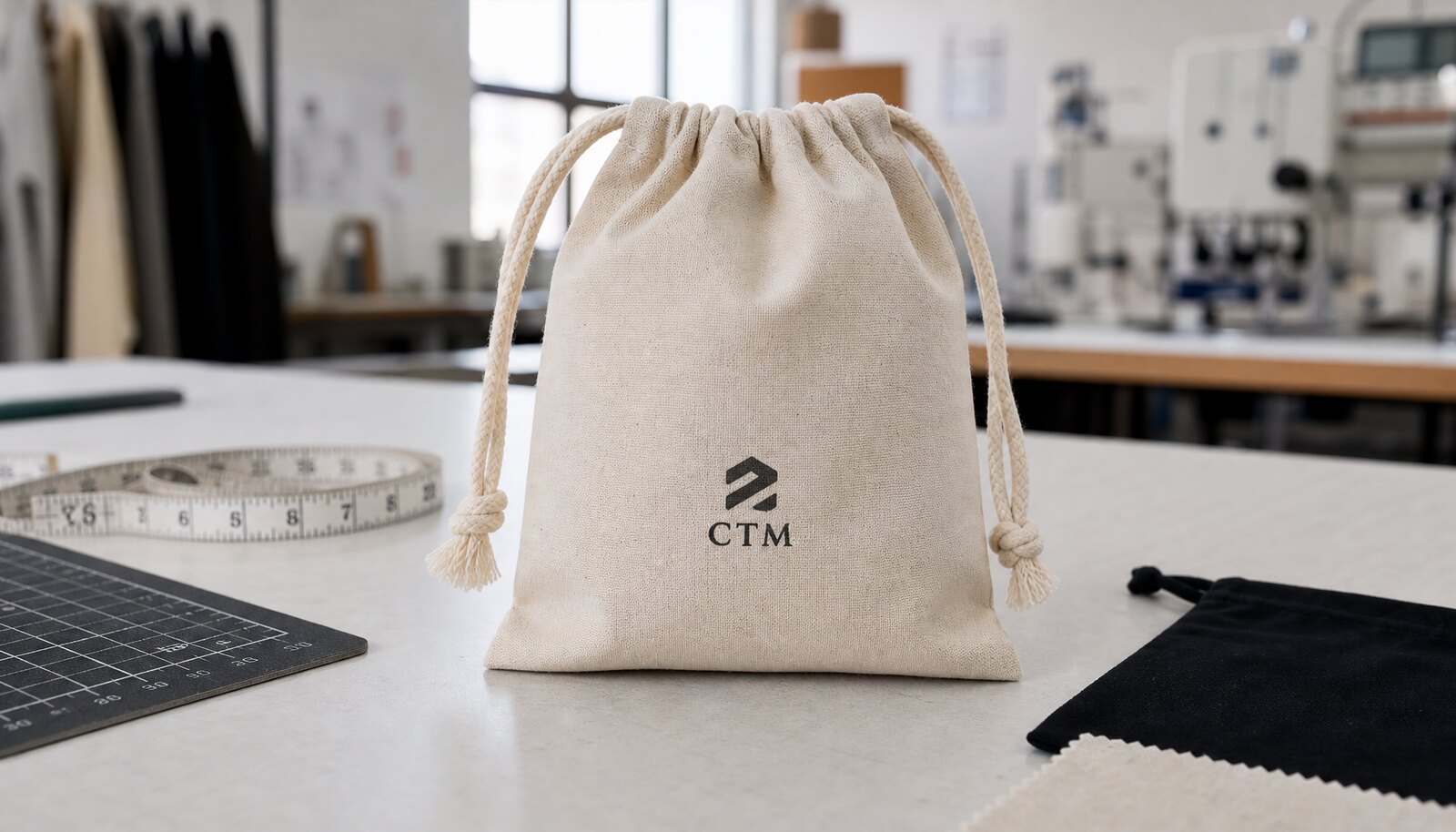
What a custom small drawstring pouch is really used for
A custom small drawstring pouch is usually bought for packaging, not just for carrying. That changes the sourcing logic. If the pouch will hold jewelry, sample kits, cosmetics, tea, candles, or premium inserts, the buyer cares about fabric hand feel, seam appearance, and how the logo looks when the string is pulled closed. If it is only a giveaway pouch, the focus shifts to cost, pack efficiency, and whether the print survives handling during stuffing and shipping.
The biggest mistake is treating all small pouches as the same product. A 10 x 15 cm pouch for accessories is not built the same way as a 14 x 20 cm pouch for gift sets or a 15 x 18 cm pouch used inside retail packaging. The right spec depends on what goes inside, how the pouch is displayed, and whether the buyer wants the pouch to look premium enough to be reused.
- Packaging use: prioritize print clarity, opening speed, and consistent sizing.
- Retail use: prioritize fabric weight, neat seams, and better cord finish.
- Gift-set use: prioritize color matching, carton efficiency, and low damage rate in transit.
- Repeat-use use: prioritize heavier fabric, stronger stitching, and cord reinforcement.
Choose fabric weight first, because it drives both appearance and quote
For a small pouch, fabric weight has a bigger effect than many buyers expect. A 120–150 GSM cotton or muslin works well when the pouch is mainly a light wrapper for a product or a low-cost promotional insert. It folds flat, keeps freight efficient, and usually prints cleanly with simple logos. But it will not hold a sharp shape, and if the product inside is heavy or sharp-edged, the pouch can feel flimsy fast.
Once the order needs better body, move toward 200–240 GSM cotton canvas or a dense cotton twill. This gives better opacity, less seam distortion, and a more premium finish when the pouch sits on retail shelves. The tradeoff is predictable: more fabric use, more sewing time, and a slightly higher reject risk if the cutting or hemming is sloppy. Buyers should not compare prices across suppliers unless they know the quoted GSM, weaving density, and whether the price is for washed or unwashed cloth.
- 120–150 GSM: good for light inserts, samples, and event packaging.
- 180–220 GSM: balanced option for retail packaging and mid-tier gifting.
- 220–240 GSM: better for premium feel, repeated opening, and stronger structure.
- Lined construction is usually unnecessary for small pouches unless the contents are delicate or the brand wants a higher-end interior finish.
Printing and decoration choices that hold up in production
For most custom small drawstring pouch orders, screen print is still the most practical method when the logo is one or two colors and the artwork is not overly detailed. It is cost-effective at volume and usually produces a more durable result on cotton than a cheap heat transfer. The key is to keep the design simple: solid fills, enough stroke width, and enough contrast against the base fabric. Thin fonts and small icons can disappear once the fabric texture is visible in mass production.
Heat transfer can work for short runs, complex artwork, or late-stage campaigns, but buyers should treat it as a tradeoff, not a default upgrade. Transfers can crack, peel, or look glossy in a way that does not suit natural-fiber pouches. Embroidery can be used for premium branding, but it adds cost and can distort small pouch panels if the stitch density is too high. Woven labels and side labels are useful when the pouch body needs to stay clean and the brand only wants a subtle mark.
- Screen print: best for stable logos, larger runs, and lower unit cost.
- Heat transfer: useful for short runs or multi-color graphics, but test durability.
- Embroidery: premium look, but avoid overly small logos or very dense fills.
- Woven/side labels: good when the pouch itself should stay minimal and clean.
MOQs and price tiers: where the real cost breaks happen
MOQ logic for a custom small drawstring pouch is often tied to fabric sourcing, cutting efficiency, and print setup. A factory may be willing to quote a low minimum, but the unit price can jump sharply if the order does not fit its cutting layout or if the artwork requires a separate screen for each color. For a simple cotton pouch, many factories prefer 1,000 to 5,000 pieces per style and color because that is where trimming, cutting, and printing all stay efficient. Below that, setup cost becomes a bigger share of the total.
Do not only compare the first price line. Ask where the next tier starts and what happens at 3,000, 5,000, and 10,000 pieces. Sometimes the best commercial decision is to move from a 2,000-piece order to a 5,000-piece order if the unit drop is enough to offset freight, holding cost, or multiple reorders. A quote that seems slightly higher per piece may still win if it includes better packing, more accurate print registration, or fewer carton-volume surprises.
- Low MOQ usually means higher setup share, not necessarily better value.
- Color changes often trigger separate material or print charges.
- Mixed-size or mixed-artwork orders can increase cutting waste and labor time.
- Ask for tier pricing before deciding whether to split or consolidate SKUs.
Comparison of sourcing routes for a small pouch order
There is more than one way to source a custom small drawstring pouch, and each route has a different control point. A specialist pouch factory usually gives the best production clarity because the team deals with drawcord channels, hem consistency, and print positioning every day. An integrated bag factory may offer a wider choice of fabrics or related products, which helps if the pouch is part of a bigger bag program. A trading company can be useful when the buyer needs to combine multiple products in one shipment, but the quote should be broken down to avoid losing visibility on the true factory cost.
The right route depends on order size, artwork complexity, and how much supplier transparency the buyer needs. For a simple repeated reorder, direct factory sourcing is usually the cleanest path. For a pilot run with many SKUs and mixed destinations, a sourcing partner may save time, but only if the buyer still gets the real specification sheet and does not lose control of the QC standard.
- Direct factory: best for repeat programs and strict spec control.
- Integrated bag factory: useful when fabric options or matching bags are also needed.
- Trading company: useful for mixed-category consolidation, but request factory-level data.
- Local stockholder: fastest for urgent replenishment, but limited on customization and consistency.
Supplier comparison table for buyer decision making
When buyers compare suppliers for a custom small drawstring pouch, the best comparison is not just price per piece. The useful comparison is how each route handles fabric control, print repeatability, sample quality, and packing accuracy. A lower quote means very little if the supplier cannot confirm the same fabric shade on the reorder or if carton counts come in short because packing was not standardized.
Use the table below to compare sourcing routes the way a procurement team actually buys: based on risk, lead time, and the amount of internal follow-up required after PO placement.
- Write decisions in measurable language, not only descriptive wording.
- Ask for sample photos plus one physical approval sample for important orders.
- Keep quotation, sample approval, and inspection notes tied to the same spec version.
Sample approval: what a real pre-production sample should prove
A production sample should be made from real fabric, with the actual cord, the actual print method, and the planned stitch construction. A digital mockup does not prove seam alignment, print density, or how the pouch closes when filled. For a small pouch, one of the most common sample misses is the print moving too close to the seam after sewing, which makes the logo look off-center once the bag is opened or tied shut.
Approval should be based on usable sample criteria, not general satisfaction. Measure the finished width and height, inspect the top hem for evenness, pull the cord several times, and compare the print against the approved artwork or strike-off under consistent light. If the pouch is intended for retail packaging, test it with the actual product inside so the buyer can see whether the opening size and body depth still work in real use.
- Approve size, seam finish, print placement, and cord function together.
- Test the sample with the actual product weight and shape.
- If color matters, use a physical reference, not only a PDF or screen image.
- Keep one signed sample for factory reference and one for internal procurement reference.
QC thresholds that prevent avoidable rejects
Small pouches are easy to underestimate in inspection because they are simple-looking items. In practice, the defects can be very visible: crooked hems, weak side seams, print drift, loose threads, or cords that slide unevenly. Buyers should set practical acceptance limits before mass production starts, especially on logo position, seam straightness, and carton count accuracy. If the pouch is a branded retail item, the inspection standard should be tighter than a generic promo pouch because the customer will see and touch every piece.
A sensible QC plan includes in-line checks on cutting and printing, final checks on seam integrity, and packing checks at the carton stage. For a sewn pouch, the most important measurable points are finished size, print alignment, stitch quality, and drawcord performance. If the factory does not track defect categories clearly, the buyer should ask for a photo report or a simple QC sheet before shipment.
- Size tolerance: set separate limits for width, height, and cord length.
- Print placement: define a safe distance from seams and top hem.
- Stitching: no skipped stitches, broken threads, or open corners.
- Packing count: carton quantities must match the packing list exactly.
Packing and carton planning for retail or distribution
Packing is often where a low-cost pouch quote loses value. If the pouches are going to retail, the buyer may need each one individually polybagged with a barcode label, warning label, or hangtag. That adds labor and material, but it also increases carton volume and may reduce loading efficiency. If the order is for internal distribution or packaging use, bulk packing is usually the cleaner option because it cuts unit cost and speeds up inbound handling.
Carton planning should be reviewed together with the pouch size, not after the PO is signed. A small change in folded size can affect how many pouches fit in one carton, and that changes freight cost. Request carton dimensions, gross weight, and pack count before comparing quotes. When a supplier cannot supply those numbers, the buyer is not comparing landed cost accurately.
- Bulk pack: best for distributors, repackers, and internal packaging use.
- Individual polybag: needed for retail presentation or barcode-controlled inventory.
- Carton dimensions affect freight efficiency more than many buyers expect.
- Add shipping marks and SKU labels before shipment to avoid receiving confusion.
Lead time planning and the schedule risks buyers usually miss
A realistic schedule for a custom small drawstring pouch includes artwork finalization, sample making, approval, material reservation, production, packing, and export booking. Even when the factory lead time looks short, delays often happen in the first week because the artwork is not final, the logo file needs cleanup, or the buyer changes the size after the sample. Small changes in pouch specs can force new cutting templates or new print screens, which resets the clock.
The cleanest way to protect the schedule is to freeze the core spec before quoting. Once the size, fabric weight, print method, and packing method are fixed, the supplier can book materials and give a meaningful lead time. For simple repeat orders, lead times are usually shorter; for new colors, complex print, or retail-ready packing, buyers should expect extra time for sample approval and packaging setup.
- Late artwork changes are a major cause of schedule slip.
- New fabric colors or special cords may require extra procurement time.
- Retail packing usually adds more lead time than bulk packing.
- Approve samples fast and with one internal owner to avoid stalled decisions.
Specification comparison for buyers
| Spec decision | Recommended option | When it fits | Buyer risk to check |
|---|---|---|---|
| Fabric choice | 120–150 GSM cotton for light retail use; 200–240 GSM cotton canvas for better shape and durability | Use lighter fabric for jewelry, cosmetics, gifts, and event kits; use heavier fabric for premium inserts or repeated handling | Thin fabric can show seam puckering and poor print opacity; heavy fabric raises unit cost and increases sewing time |
| Closure style | Single drawcord with reinforced top hem; optional double drawcord for wider opening control | Single cord works for small inserts and giveaway packaging; double cord is better when customers will open and close the pouch often | Weak cord channels cause fraying, uneven closure, or cord pull-out during transit |
| Print method | 1-color screen print for stable artwork; heat transfer only for short runs or variable graphics | Screen print fits most logo work and keeps unit cost predictable at volume | Fine lines, gradients, and tiny text may blur on textured fabric; transfer prints can crack if washed or folded often |
| Logo placement | Front center or lower-right corner with 12–15 mm safe margin from seams | Best when the pouch is used as packaging and the logo must stay visible when tied closed | Artwork too close to seams distorts after stitching and can be rejected in QC |
| MOQ route | Factory direct at 1,000–5,000 pcs per color/style; trading route for mixed items or lower risk pilot orders | Direct sourcing works when artwork is finalized and repeat replenishment is likely | Low MOQ quotes often hide smaller sizes, thinner fabric, or extra setup charges |
| Sample path | Pre-production sample from real fabric and real print, not just artwork proof | Use when color match, cord length, or print registration matters to the brand | Approved digital proofs do not reveal shrinkage, seam quality, or actual print density |
| Packing method | Bulk packed by carton with size label and poly liner; individual polybag only if retail-ready is required | Bulk pack suits distributors and internal repacking; individual pack suits direct retail and e-commerce | Retail-ready packing increases labor, material use, and carton volume, affecting landed cost |
| Supplier route | Specialist pouch factory for best control; integrated bag factory for wider fabric options; sourcing agent only when consolidating mixed SKUs | Choose based on order size, artwork complexity, and need for factory transparency | Agent quotes can hide actual millage, trimming, or labor details unless the factory data sheet is included |
| Landed-cost structure | Compare EXW, FOB, and DDP separately with carton dimensions and duty assumptions | Useful when comparing suppliers in different regions or when freight is a major share of total cost | A low unit price can be offset by oversized cartons, weak packing efficiency, or unexpected local clearance charges |
Buyer checklist before sampling
- Confirm final bag size, gusset, handle drop, and usable loading weight.
- Specify fabric type, GSM/oz weight, color tolerance, and shrinkage expectations.
- Send vector artwork and define logo size, print position, and Pantone references.
- Ask for sample photos plus one physical pre-production sample before bulk approval.
- Agree carton packing, barcode or hangtag needs, and shipment marks before production.
- Record inspection checkpoints for stitching, print adhesion, stains, and quantity count.
Factory quote questions to send
- What fabric type and GSM are you quoting, and is that the finished fabric weight before or after washing and cutting?
- What exact pouch size will you price, and does the quote include seam allowance, hemming, and cord channel construction?
- Which print method is included, how many colors are covered, and what is the setup charge per artwork or per color?
- What is the MOQ by color and by design, and how does the unit price change at the next quantity tier?
- Does the price include sample making, cartons, inner polybags, barcode labels, and export packing, or are those extra?
- What is the production lead time after sample approval, and how many days are needed for material booking and artwork confirmation?
- Can you share carton size, gross weight, and loading quantity for the quoted pack method?
- What QC standard do you use for stitch tolerance, print alignment, size tolerance, and defect allowance?
Quality-control points to confirm
- Finished size tolerance should be realistic for sewn pouch goods; set a separate tolerance for width, height, and cord length.
- Top hem should be even, with no visible skipped stitches, broken thread ends, or twisted cord channels.
- Print should stay clear after folding; small text and thin lines should not bridge or fill in on textured fabric.
- Cord ends must be secured so they do not fray or slip through the channel during pull testing.
- Color consistency should be judged against an approved strike-off or pre-production sample under daylight-equivalent light.
- Cartons should protect the pouch shape without crushing if retail presentation matters; bulk packs should still remain clean and dry.
- Polybag suffocation warnings, barcode placement, and carton marks should match buyer compliance requirements before shipment.