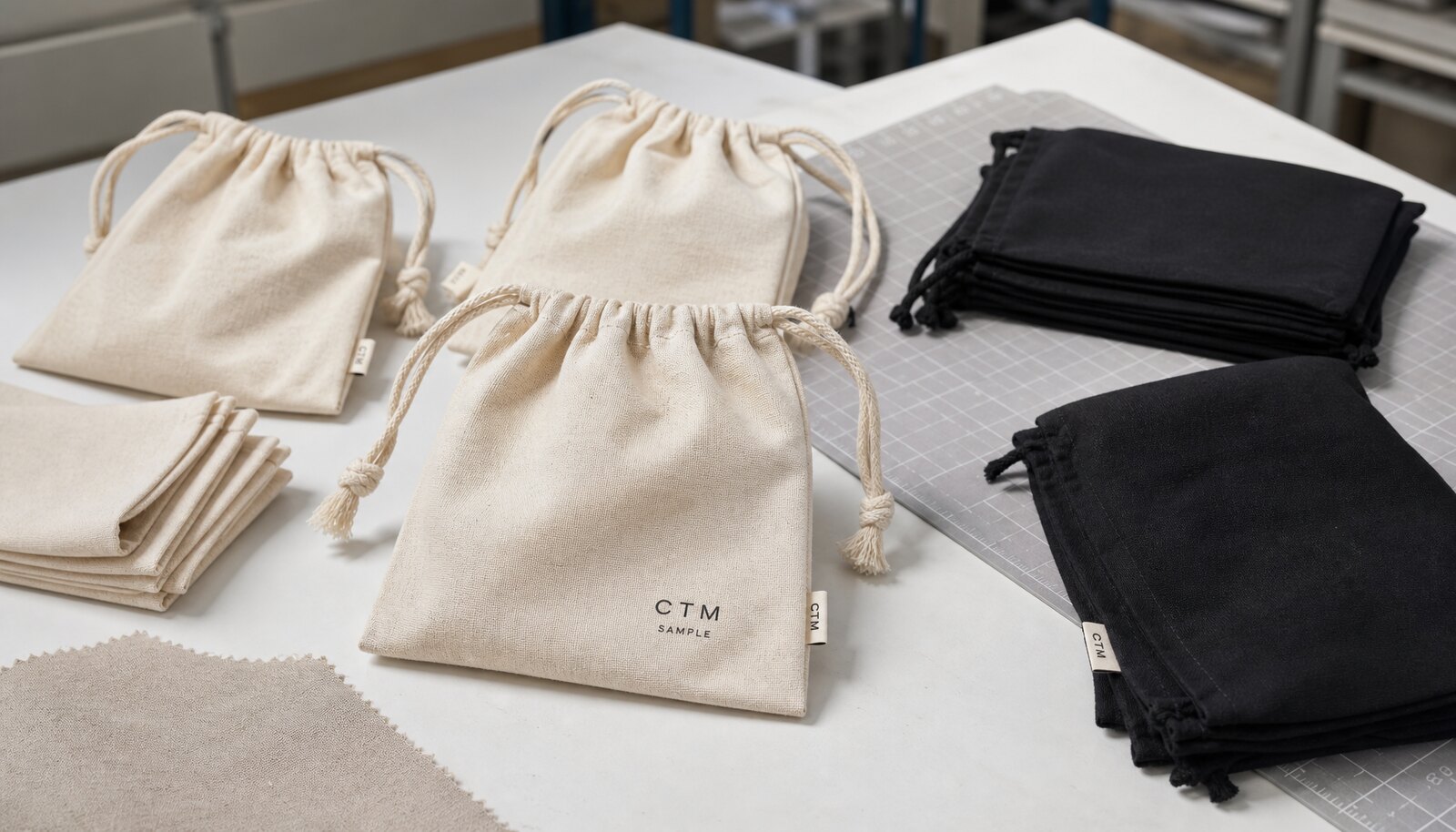
Why this pouch belongs in a procurement spec, not a casual accessory order
Custom small drawstring bags with logo look simple, but they behave like a real sourced product as soon as they are tied to a business use. A pouch for jewelry, cosmetics, samples, event inserts, or premium packaging has to do more than hold items. It has to fit the contents, close reliably, print cleanly, arrive in usable cartons, and repeat on reorder without surprise shade shifts or decoration failures. That is why this category should be treated as a mini manufacturing program rather than a generic accessory purchase.
The buyer’s risk is not usually a single catastrophic defect. It is a cluster of small misses that show up only when the bags are received in volume: a logo that is slightly off-center, fabric that varies too much from lot to lot, cords that knot unevenly, cartons that are packed in a way the warehouse does not want, or a sample that looks better than production because it was made differently. Each issue alone may seem minor. Together, they consume time, receiving labor, and budget.
A better sourcing process begins with use case. A giveaway pouch has different priorities from a retail insert bag. A luxury sample pouch needs more body and cleaner decoration than a back-of-house storage bag. Once the use case is clear, the team can define what matters most: structure, print clarity, dust protection, foldability, or freight density. That makes supplier quotes easier to compare and reduces the chance of approving a bag that looks fine in a photo but fails in distribution.
For procurement teams, the goal is not to over-specify every detail. It is to specify the details that affect repeatability, landed cost, and receiving acceptance. If the purchase order answers those points up front, the factory can quote cleanly, the sample can be judged fairly, and the production run is much less likely to drift.
- Start with the end use: retail insert, sample kit, cosmetic pouch, jewelry bag, travel item, or promotional giveaway.
- Decide whether the pouch must look premium, neutral, natural, or purely functional.
- Treat fabric, logo, closure, packing, and carton format as production inputs, not optional extras to sort out later.
Match size and fabric to the contents before you ask for pricing
The size of the bag and the fabric weight should be chosen together. A pouch that is physically large enough may still be unsuitable if the fabric is too soft, too translucent, or too thin for the item inside. Likewise, a small bag made from heavy canvas may look premium but cost more than the use case justifies. Procurement should begin with the contents: what the bag must hold, how often it will be handled, and whether the customer will see the contents through the fabric.
A light jewelry bag may work in a 100–120 GSM cotton body if the contents are soft and low-profile. A small cosmetics or product-sample pouch usually benefits from a denser 130–150 GSM fabric because it holds its shape better and reduces show-through. If the bag is meant for presentation or resale, 150–180 GSM cotton canvas often gives a more structured look and can improve logo edge clarity. These are practical ranges, not hard rules; the right choice depends on the exact object being packed, the finish of the cloth, and how much structure the buyer wants to pay for.
Do not let the supplier substitute a visually similar sample unless they clearly state the differences. Natural cotton, bleached cotton, dyed cotton, and canvas can all look acceptable in an approval photo while behaving differently in production. The same pattern can close differently, crease differently, or show print differently across fabric lots. For that reason, the approval sample should match the intended production fabric as closely as possible, including the finish and color basis.
A useful internal rule is to ask: if the logo were removed, would this fabric still be the right bag for the job? If the answer is no, the specification is probably too loose. The bag should still make sense on body, weight, and feel even before branding is added.
- 100–120 GSM cotton: best for lighter giveaway use, lower freight weight, and softer handfeel.
- 130–150 GSM cotton: balanced choice for sample kits, cosmetics, and general retail inserts.
- 150–180 GSM cotton canvas: better structure, stronger presentation, and improved logo definition.
- When the contents are sharp, dense, or frequently handled, prioritize seam strength and opacity over the lowest fabric cost.
Logo method affects not only appearance but also what artwork can be accepted
The decoration method should be chosen for the artwork and volume, not for convenience at the factory. A simple one-color logo on cotton is often a strong fit for screen printing because the process is repeatable and usually economical at scale. If the artwork has several colors, fine outlines, gradients, or photographic detail, the factory may suggest heat transfer or digital print. That may be valid, but the buyer should understand the tradeoff: more artwork flexibility usually brings more setup, more proofing, and more risk around feel or durability.
The most common procurement mistake is approving artwork without defining what the fabric can realistically carry. A design with tiny letters or tight line spacing may look crisp on a screen but soften once it lands on woven cotton. Ask the factory for the minimum printable line thickness and the smallest readable text size on the actual fabric. Also confirm whether the quoted logo area is measured in millimeters and whether the supplier allows one proof revision or multiple revisions before production.
For customer-facing programs, durability matters as much as appearance. Ask how the print will behave under rubbing, folding, and normal handling. If the bag is part of a retail bundle, a logo that smears easily can create a receiving rejection even when the pouch itself is sewn well. For the same reason, ask whether the quote includes a strike-off or production proof and whether that proof is the same process that will be used for bulk goods.
In short, the buyer should treat the logo as a manufacturing constraint, not a decoration afterthought. The more detailed the artwork, the more important it is to test the method on the approved fabric before release.
- Screen print: usually the most cost-effective choice for simple logos and repeat orders.
- Heat transfer: useful for shorter runs or more complex artwork, but confirm feel and durability.
- Digital print: better for detailed graphics, but quote should include proofing, setup, and artwork revision limits.
- Always ask for the exact print area and the minimum line thickness the factory will guarantee on the selected fabric.
Use MOQ to test production reality, not just supplier willingness
MOQ for small drawstring pouches is usually a summary of several constraints, not one magic number. Fabric sourcing, dye lot size, print setup, sewing efficiency, label application, and packing format all influence the minimum. That is why a supplier can quote a low MOQ for one configuration and a much higher MOQ for another. Buyers should ask for MOQ by specification so they can see where the threshold is coming from.
A low nominal MOQ can still be expensive if the setup cost is spread across a small run. A quote for 500 or 1,000 pieces may look easy to approve, but if the buyer later adds a woven label, a second print position, or retail polybag packing, the minimum may rise quickly. The opposite risk also exists: a supplier may accept a small order by using stock fabric that looks close enough on paper but is not stable enough for future reorders. The first order may arrive on time; the repeat order may not match.
A better buying question is: what exactly is driving the minimum? If the answer is unclear, the quote is incomplete. Ask the supplier to break MOQ into fabric, artwork, labels, and packing. That makes it easier to decide whether to simplify the spec, raise the volume, or move the order to a supplier who can support the full requirement from the start.
For pilot orders, it is also worth asking whether the supplier can price a lower quantity with a clear premium, rather than quietly shifting the specification. That is a cleaner commercial choice than discovering after sample approval that the production lot will be made from a different cloth or in a different packing format.
- Request MOQ by size, color, artwork, and packing type.
- Confirm whether the MOQ applies per SKU, per artwork, or across the total order.
- Ask whether labels, extra print colors, or custom dyeing increase the minimum.
- For a pilot order, confirm if the supplier can support a lower quantity at a transparent premium instead of changing the spec.
Comparison table: choose the right supply route and spec mix for the program
The best sourcing route depends on how much control the buyer needs and how often the pouch will be reordered. A direct factory usually gives the cleanest line of sight into fabric, printing, and sewing. A trading company can be useful when a buyer needs consolidated sourcing, mixed products, or a single communication channel. Stock-program suppliers are fast and often suitable for simple branded giveaways, but their customization limits can become visible once the buyer wants tighter carton control, a specific weave, or repeatable artwork placement.
The commercial choice also changes with the use case. A retailer buying pouches for packaging inserts may care more about consistency and carton efficiency than about absolute lowest unit price. A promotional team may care more about speed and a simple logo. The table below helps buyers think in practical terms rather than in generic “cheap versus premium” language.
Quote comparison should be line-by-line, not based on a single unit price
A useful quote for custom small drawstring bags with logo should read like a production recipe. The buyer needs to know what is included and what is excluded. The most common problem is not that the supplier is hiding something intentionally. It is that different suppliers include different things. One quote may include only the bag body and print, while another includes labels, inner bundles, carton marks, and special packing. If those are not normalized, the cheaper quote is not actually cheaper.
A clean RFQ asks the supplier to separate the price into material, sewing, decoration, label, packing, carton, and sample/tooling components. That makes it easier to compare suppliers on a like-for-like basis and to see which cost drivers really matter. It also helps the internal buyer explain price movement to finance or marketing when the final landed cost comes in above the initial target.
A practical way to evaluate the quote is to ask: if the order quantity stayed the same, what parts of the price would fall if we simplified the spec? If the answer is mostly the setup charge or packing labor, the quote is likely structured correctly. If the answer is unclear, the supplier may not have separated the real cost drivers. In that case, the buyer should push for a revised quotation before moving to sample approval.
- Ask for a quote broken into material, sewing, print, label, packing, and carton lines.
- Normalize packing style and carton count before comparing suppliers.
- Confirm whether the quote is based on stock fabric or custom-made fabric.
- Compare sample rounds and artwork revision limits, not only the bulk unit price.
A simple landed-cost model helps buyers defend the decision internally
Procurement teams often need to explain why the lowest ex-factory number is not always the best value. A simple landed-cost model is usually enough. Start with the quoted unit price, then add one-time fees such as print setup or tooling, divide those by the total order quantity, and add recurring packing costs. Then estimate freight using actual carton dimensions and carton count, not just the product weight. Finally, include any receiving labor if the destination warehouse has to repack, label, or count the bags again.
For example, a quote with a slightly higher unit price can still land cheaper if it uses denser carton packing and avoids individual polybags. The reverse can also happen: a quote that looks low at the factory can become expensive once the receiving team has to open, re-bundle, or relabel cartons. That is why landed cost is a more reliable comparison than ex-factory price alone.
This model is also useful in negotiation. When a supplier understands that the buyer is comparing total landed value, they are more likely to quote the real production structure up front. That reduces the chance of surprise charges after sample approval and makes reorders easier to forecast.
A fast internal check is to ask whether the bag will be shipped directly to end users, to a retailer, or to a warehouse that will do additional handling. The more handling that happens after import, the more important packing efficiency and carton clarity become.
- Amortize fixed setup fees across the full PO quantity.
- Add recurring packing materials and manual labor if the bags are not bulk-packed.
- Use carton dimensions to estimate freight, not only carton weight.
- Include receiving labor if the warehouse must repack or relabel goods.
Sample approval should confirm the production method, not just the appearance
A sample is only useful if it reflects the way the bulk order will actually be made. If the supplier sends a sample made from better fabric, a different print method, or a cleaner sewing line than the production plan, it can create false confidence. For custom small drawstring bags with logo, the sample should match the intended production fabric, print process, cord style, and packing approach as closely as possible. The buyer should ask whether the sample is a pre-production sample, a production reference, or only a visual mockup.
The approval process should be practical and measurable. Check the actual dimensions, not just the visual proportion. Pull the cord several times to see whether it binds or frays. Look at logo centering, print clarity, and whether small text remains readable at arm’s length. If the pouch includes a woven label, side label, care label, or barcode sticker, verify position and legibility. If the bag is intended for retail or customer gifting, inspect the handfeel and opacity under the type of lighting the end user is likely to see.
The best records are simple but complete: one signed reference sample, the final artwork file, the approved spec sheet, and any agreed tolerance notes. That package becomes the standard for production and reorder control. If a future batch drifts, you need that record to decide whether the issue is a true defect or a change that was never approved.
In procurement terms, the sample should remove ambiguity. If it does not, the approval is too weak.
- Approve size, fabric, print, cord, label, and packing together in one review.
- Do not accept a promise that bulk will be better unless the supplier can explain exactly what will change.
- Keep a signed reference sample and the final spec sheet together for reorder control.
- Where possible, approve under the same lighting and handling conditions as the final use case.
QC acceptance should use thresholds and reject criteria, not general impressions
Quality control becomes more effective when the buyer defines acceptance criteria before production starts. “Good quality” is too vague to hold a supplier accountable. For this category, the first checkpoint is size. For small pouches, a tolerance around ±0.5 cm is often workable, but the correct range depends on the final use. Retail presentation, insert kits, and machine-packed programs may need tighter control. The second checkpoint is fabric consistency: the cloth should match the approved reference, with no obvious thin spots, slubs, broken yarns, or shade variation that is visible in normal inspection conditions.
Logo quality needs its own standard. Check placement, centering, color, opacity, and line sharpness. If there is more than one color, confirm registration. If the bag has a large print area, look for ink pooling or edge distortion where the fabric weave is rougher. For fine logos, define what counts as an acceptable result before mass production begins. It is not enough to say the print should be “close” to the proof.
The closure deserves separate inspection because many pouches fail here after the visual checks are finished. The cord should move smoothly, exit evenly, and not snag on the channel. Pull-test a sample of bags for seam integrity around the top channel and the bottom seam. If the product will be handled repeatedly, this is more important than whether the bag looks attractive in the sample photo. A good-looking pouch that fails on opening and closing is a real commercial defect.
For shipment release, require a documented sampling method such as an AQL plan or an equivalent buyer-approved method. That gives the receiving team a clear basis for acceptance and reduces arguments based on a few isolated photos. The important point is not the name of the method; it is the discipline of defining major, minor, and critical defects before the goods leave the factory.
- Use a written size tolerance and check it against the approved sample.
- Classify defects as critical, major, and minor before production starts.
- Inspect seam strength, cord movement, print placement, and carton labeling.
- Tie release to a documented sampling method, not to a visual spot check only.
Packing and carton specs should be designed around receiving, freight, and shelf use
Packing is part of the product, not an afterthought. Bulk packing is usually the right choice when the pouches are going into a warehouse, kitting operation, or wholesale channel. It reduces handling, keeps the order simpler, and often improves carton density. Individual polybag packing makes more sense when the bags go to retail, need contamination protection, or must arrive ready for shelf display. If the program needs insert cards, barcode stickers, or customer-specific labels, those should be listed separately in the quote because they add labor and can alter the carton plan.
The carton specification matters because it affects both inbound handling and freight cost. Ask for carton dimensions, gross weight, and piece count per carton. If the carton is too loose, the bags can shift, crease, or arrive with folded edges that the receiving team dislikes. If the carton is too dense, it may be harder to handle and may increase compression risk. Mixed-style or mixed-size cartons should be avoided unless they are specifically approved, because they slow receiving and increase counting errors.
A smart carton plan also helps the freight team. Sometimes a slightly larger carton with better packing density ships more efficiently than many small cartons with empty air. Procurement should look at the full transport picture, not just the factory packing convenience. The goal is to protect the product while keeping count accuracy and landed cost under control.
- Use bulk pack for wholesale, kitting, and lower-cost inbound handling.
- Use individual polybag packing for retail display or contamination control.
- Request carton size, gross weight, and count per carton in the quote.
- Keep cartons single-style and single-color unless assortment packing is explicitly approved.
Specification comparison for buyers
| Sourcing/spec decision | What a competitive quote should spell out | Typical cost or lead-time effect | What procurement should verify before award |
|---|---|---|---|
| Fabric base | Exact composition, weave, GSM, finish, color basis, and mill reference or swatch photo | Moving from 100–120 GSM cotton to 150–180 GSM canvas usually increases material cost and can raise freight weight; dyed or bleached cloth can add lead time | Confirm the quoted fabric is the production fabric, not a look-alike sample, and ask for lot consistency or shade tolerance |
| Logo method | Print type, print area, number of colors, setup/plate cost, and proof or strike-off policy | Single-color screen print is usually the lowest-cost custom route; multi-color, transfer, or digital print adds setup and process cost | Check the minimum printable line thickness and whether fine type, small marks, or reverse-out logos are realistically supported |
| Cord and closure | Cord material, cord diameter, length, end finishing, channel construction, and reinforcement details | Double cords, longer cords, woven ends, or stitched reinforcements increase labor and can affect MOQ | Verify the cord slides cleanly and that the channel stitching holds under repeat opening and loaded use |
| Packing format | Bulk packing or retail pack, inner bundle count, carton count, carton marks, and any barcode or insert requirements | Retail packing adds labor, materials, and handling time; smaller carton counts can increase freight volume | Compare quotes only after normalizing packing, because a cheaper ex-factory price can become more expensive at receiving |
| Order structure | MOQ by size, color, artwork, packing type, and whether exact-count packing is available; sample fee and lead time | Lower volume usually raises setup amortization; custom dyeing, labels, or second print positions often increase MOQ | Ask whether MOQ applies to one SKU, one artwork, or total order volume across variants |
| Compliance and documents | Requested test reports, export paperwork, country-specific declarations, and any packaging or labeling requirements by market | Document handling, testing, or market-specific declarations can add indirect cost and schedule time | Confirm the supplier can support your destination market, not only a generic export shipment |
Buyer checklist before sampling
- Confirm finished bag size in both flat state and closed state; define acceptable tolerance for length, width, and seam allowance.
- State the fabric clearly: cotton, cotton canvas, or blended fabric; specify GSM, weave type, finish, and whether the cloth is natural, bleached, or dyed.
- Provide the logo file in vector format where possible, then specify print method, print size, print position, Pantone references, and minimum line thickness.
- Define cord construction: single cord or double cord, cord material, cord length, end finishing, and whether the cord is knotted, heat-sealed, or stitched.
- Specify whether you need a woven label, side label, care label, barcode sticker, insert card, or retail polybag, and confirm each item separately in the quote.
- Write the packing requirement in measurable terms: pieces per inner bundle, pieces per carton, carton dimensions, gross weight target, and carton mark content.
- Set acceptable overrun and underrun percentages in advance, and confirm whether exact-count packing is required.
- State sample approval rules: what must match the sample, what may vary slightly, and which defects are automatic reject conditions.
- List shipment terms, destination port or warehouse, target ship date, and whether partial shipment is allowed.
- Ask for pre-shipment photos, inspection evidence, or a third-party inspection window before goods are packed for export.
Factory quote questions to send
- What exact fabric composition, weave, GSM, and finish are you pricing, and can you send a swatch or close-up photo from the same mill batch?
- Is your quoted price for the bag only, or does it include logo printing, labels, cord finishing, packing, and carton marking?
- What is the MOQ by size, color, artwork, and packing type, and does the MOQ change if we add a woven label or a second print position?
- What print method are you proposing, what is the setup charge per color or artwork, and what minimum line thickness can you reliably print on this fabric?
- Can you separate the quote into material cost, sewing cost, print cost, label cost, packing cost, and carton cost?
- What is the sample fee, sample freight cost, and any tooling or plate charge, and are any of these credited back after bulk order placement?
- What is the standard lead time after sample approval, and which step usually causes delay: fabric sourcing, print approval, sewing, packing, or final inspection?
- What carton quantity, carton size, and gross weight are you planning, and can you confirm whether cartons are single-style and single-color only?
- What overrun or underrun percentage do you allow, and can you hold to exact quantity if our receiving rules require it?
- What QC checkpoints do you run before packing, and can you provide photo evidence, inline inspection notes, or a final inspection report?
Quality-control points to confirm
- Finished size should fall within the approved tolerance, commonly ±0.5 cm for small pouches; tighten the tolerance if the bag is used in retail presentation, kitting, or machine-assisted packing.
- Fabric weight should match the approved reference within the agreed range and should not show thin spots, broken yarns, obvious slubs, or inconsistent weave density.
- If you approved a specific mill sample, inspect production fabric against that reference, not against a generic showroom swatch.
- Logo placement should be centered or positioned within the stated tolerance; check for skew, rotation, blur, ink pooling, and registration drift if multiple colors are used.
- Print color should be judged against the approved strike-off or production proof under agreed lighting; any acceptable delta should be written into the spec before mass production.
- Drawcord should slide smoothly, exit evenly from both sides, and not snag at the channel; tug test the channel stitching on a sample basis before packing.
- Seam construction should be checked at the side seams, bottom seam, and channel top for stitch count, stitch uniformity, loose ends, and skipped stitches.
- Reject visible needle holes, broken threads, oil stains, dye marks, lint clumps, or contamination inside the bag or on outer cartons.
- If woven labels, care labels, or barcode labels are included, check position, readability, adhesion or stitch quality, and whether the label edges are clean.
- Cartons should be sealed, labeled, and counted correctly, with no mixed sizes or mixed artwork unless the purchase order explicitly allows assortment packing.