Why shoulder bag quotes are hard to compare
A custom shoulder bag quote often looks simple: size, fabric, logo, quantity, price. In practice, two factories can quote the same canvas messenger bag and still be pricing different products. One may assume 12 oz canvas, reinforced strap anchors, and a zipper under the flap. Another may assume lighter canvas, no lining, a shorter strap, and basic packing. The lower quote is not always cheaper once you correct the spec gap.
The buying problem is not only unit price. It is quote comparability. If procurement teams do not standardize construction, print, packing, and approval checkpoints, they end up negotiating against moving targets. That leads to delayed approvals, repeat samples, and cost claims after the purchase order is placed. A solid comparison process removes hidden assumptions early and gives you a cleaner basis for award decisions.
- Most quote gaps come from missing construction details, not from obvious price padding.
- Messenger bag quotes are especially sensitive to fabric weight, strap build, flap structure, and closure choice.
- A 5 to 10 percent quote gap can disappear once you normalize GSM, hardware grade, and carton packing.
Start with a quote sheet that fixes the main cost drivers
If you want comparable quotes, send one buyer-side quote sheet instead of asking factories to price from a loose visual reference. The quote sheet should lock size, fabric, logo method, and closure. Add a simple line drawing with finished dimensions, including flap drop and strap length range. For messenger bags, the side profile matters because gusset depth changes both fabric consumption and packing efficiency.
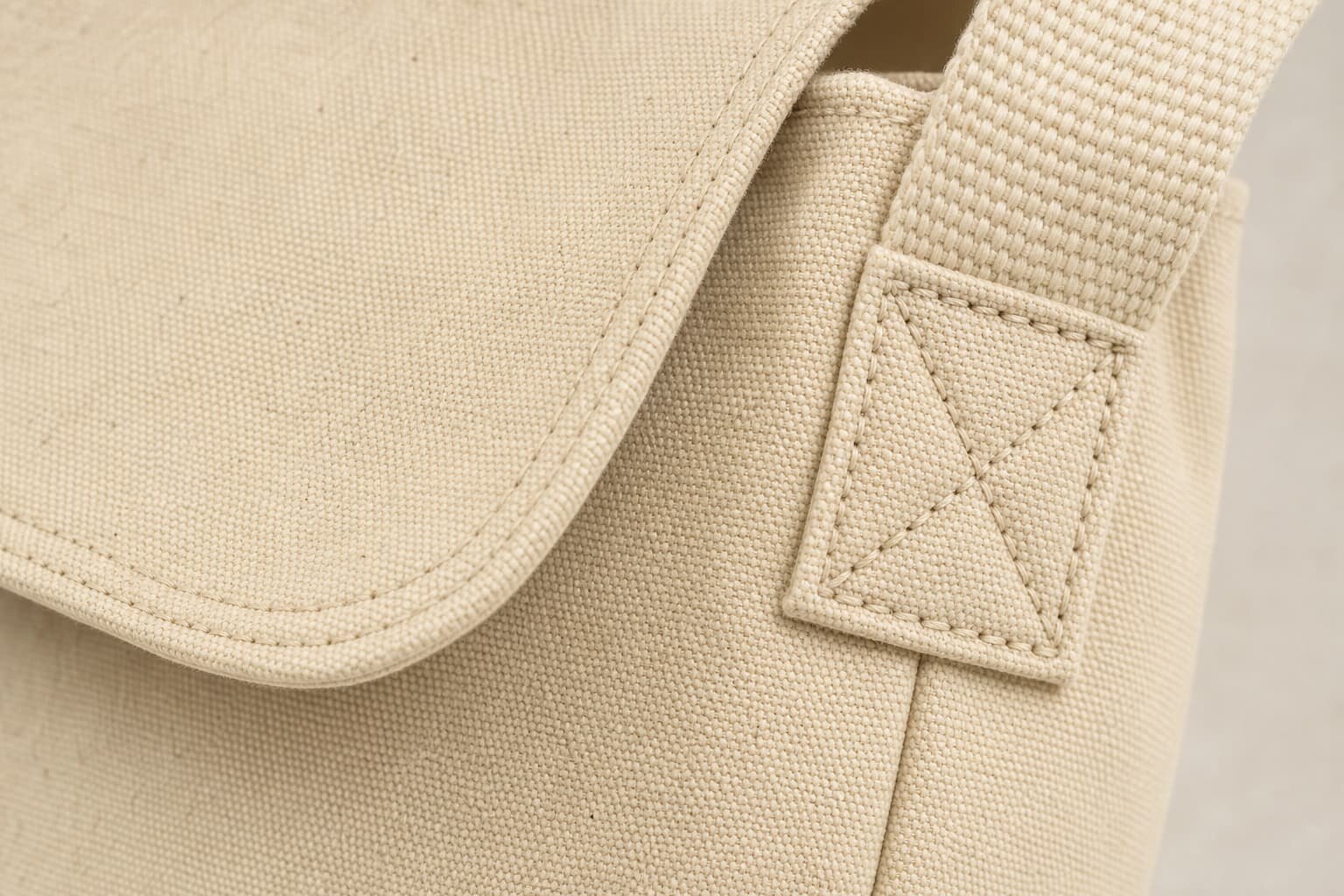
Use measurable language. Instead of writing heavy canvas, specify 340 GSM cotton canvas, natural or dyed, with fabric tolerance accepted at a stated range. Instead of saying adjustable strap, specify 38 mm cotton webbing, adjustable from 85 cm to 135 cm, with metal slider and X-box reinforcement. When buyers leave this open, factories fill the gap with whatever construction best suits their cost target.
- Minimum quote sheet items: bag size, gusset, fabric GSM, lining, strap spec, closure, pocket count, logo method, packing, MOQ, and required sample stages.
- Attach one artwork file and one dimensioned sketch so suppliers quote the same print area and same seam positions.
- State whether quote should include export carton, inner bag, barcode, and carton mark printing.
Fabric weight and body decide more of the price than buyers expect
For canvas messenger bags, the main fabric usually drives both cost and product feel. A shift from roughly 280 GSM to 340 GSM can materially change structure, print surface, and stitch stability. Heavier fabric increases material cost and carton weight, but it also reduces the need for hidden reinforcement in some builds. If your retail channel wants the bag to sit flatter on shelf or hold catalogs without collapsing, fabric choice matters more than cosmetic add-ons.
Ask suppliers how they calculate the quoted fabric. Some quote on greige canvas, some on dyed canvas, and some on pre-washed fabric. Washing or enzyme finishing can improve hand feel, but it changes shrinkage behavior and sometimes size yield. If your bag includes a front flap print, washed fabric may also affect print sharpness. Compare quotes only after confirming whether the GSM is before or after finishing, and whether shrinkage allowance is built into the cutting pattern.
- Typical commercial ranges: 10 oz canvas at about 280 GSM for lighter programs, 12 oz at about 340 GSM for balanced structure, 14 oz at about 400 GSM for heavier premium builds.
- Natural canvas usually prices differently from dyed or washed canvas; dyed black or deep navy often needs tighter shade control.
- Fabric substitutions show up later as softer body, higher wrinkle rate, or more see-through paneling on light colors.
Construction details that make one messenger bag quote look cheap
A shoulder bag can be visually similar and still be much cheaper to make if the internal construction is simplified. Common cost reductions include single-layer bottom panels, shorter seam allowances, no internal binding, fewer reinforcement stitches at strap anchors, or switching from cotton webbing to lighter polyester webbing. These changes rarely appear clearly in a one-line quote, but they affect return risk once the bag is loaded with books, sales folders, or a tablet.
For messenger styles, focus on the stress map. The highest-risk areas are strap end attachment, top corner seam junctions, zipper ends if the bag has a zip under the flap, and the side gusset where the front and back panels meet. If these points are under-built, the bag may pass a quick visual inspection but fail during retail use. Your RFQ should ask factories to describe the reinforcement pattern, not just confirm that the bag is durable.
- Ask whether strap anchors use X-box stitch, bartack, or both, and how many passes are used.
- Confirm seam allowance and whether raw inside edges are overlocked, bound, or left plain in unlined styles.
- If the bag includes a bottom insert, ask material type and thickness instead of accepting generic reinforced bottom wording.
Print method changes both appearance and quote logic
On custom shoulder bags, the print method should match the logo size, artwork detail, and order volume. For most canvas messenger bags, one-color or two-color screen printing is the practical baseline. It gives good opacity on natural canvas and stays cost-effective at bulk quantities. Heat transfer can work for detailed graphics or smaller runs, but buyers should verify wash and abrasion behavior because transfer films age differently from ink on textured canvas.
A common quoting problem is that the factory prices a small front logo, while the buyer expects a larger flap print. Print area affects screen size, setup cost, reject rate, and production speed. Dark dyed fabric may also require an underbase or different ink system. If you compare quotes without locking print dimensions and color count, you are comparing different decoration packages rather than different factories.
- For bulk quotes, specify exact print width and height, number of colors, artwork position, and Pantone references if needed.
- Woven labels are useful when many SKUs share one base bag because the label can replace repeated screen setup on small logos.
- Request a photo of the print on similar canvas texture if the logo includes fine lines or small reversed text.
MOQ, sample fees, and tooling charges need separate comparison
MOQ is not one number. A factory may advertise 500 pieces, but that could mean 500 pieces total only if all units share one fabric color, one logo, and one packing format. If your program has three colorways and two barcode versions, the real workable MOQ may be higher or the unit price may increase. Procurement teams should separate total MOQ, color MOQ, and logo MOQ before they compare suppliers.
Sample costs also distort quote comparisons. One supplier may offer a low unit price but charge separately for screen setup, pattern adjustment, and pre-production sample revision. Another may quote a slightly higher unit price but absorb these in the first order. When you compare only ex-works unit price, the cheaper supplier may not be cheaper by the time development is completed. Repeat-order economics matter too, especially if this bag will become a continuing line.
- Ask for first-order charges and repeat-order charges in separate lines.
- Clarify whether the sample fee includes revised sample after comments or only one attempt.
- If several SKUs share one construction, ask whether combined MOQ can be used for fabric booking.
Packing and carton assumptions can swing landed cost
Packing is often treated as a late-stage detail, but it changes freight cost and damage rate. A canvas messenger bag with a long strap, front flap, and hardware can be packed efficiently only if the folding method is planned. Folding the strap inward and flattening the flap can improve carton density, but over-compression may crease the print or distort a bottom insert. A supplier that quotes an aggressive unit price may be assuming a dense carton pack that raises presentation problems on arrival.
For import buyers, the right comparison point is not just factory price but bag cost in a usable delivered condition. If one quote assumes 50 pieces per carton and another assumes 24 pieces with cleaner folding, the freight math changes. So does warehouse handling. Carton weight limits also matter. Many buyers prefer cartons that stay within operational handling limits rather than pushing maximum density.
- Confirm pieces per carton, carton dimensions, and gross weight per carton in the quote.
- State whether each bag needs an individual polybag, recycled poly option, hangtag insertion, or barcode label attachment.
- If hardware can mark fabric during transit, ask for tissue, divider, or hardware wrapping in the packing standard.
Lead time should be broken into approval stages, not one headline number
Factories often give a simple lead time such as 30 to 40 days. That number is only useful if the assumptions are clear. Messenger bag lead time depends on fabric availability, print queue, hardware sourcing, sample approval speed, and production line loading. If dyed canvas or custom webbing is involved, the material path can be longer than sewing time. Buyers should request a milestone schedule rather than a single total.
Breaking lead time into stages also shows where delay risk sits. A factory with in-house cutting and sewing but outsourced printing may have a production lead time that looks fast until the print queue backs up. Likewise, a supplier may promise quick sample turnaround but still need extra days to source the exact webbing color. A cleaner quote comparison asks for development days, pre-production sample days, bulk production days, and readiness-after-approval days.
- Ask lead time from artwork approval to sample, from sample approval to bulk, and from bulk completion to shipment readiness.
- If your launch date is fixed, ask which trims are stock-supported and which are custom-sourced.
- Build time for approval comments, not just factory processing time, into your sourcing plan.
What to inspect on the pre-production sample before you compare final quotes
The pre-production sample is where a quote becomes real. Before placing the order, inspect whether the quoted construction matches the approved sample. Measure finished size, strap length, flap alignment, pocket opening, and print position. On messenger bags, even small changes such as a narrower strap or lighter interfacing can alter perceived quality. A supplier may claim the sample is representative while still planning bulk substitutions unless the approved details are locked in writing.
Use the sample review to convert visual approval into acceptance criteria. Buyers should not only comment on looks. Comment on hand feel, body, carrying balance, zipper run, and logo readability. If the bag is intended for documents or a light laptop sleeve, test the strap comfort under practical load. A quote that looked competitive may become unattractive once the sample reveals weak reinforcement or poor print consistency.
- Measure bag width, height, and gusset flat; compare against the approved drawing tolerance.
- Check logo location from fixed seams or edges so bulk inspection can repeat the same measurement method.
- Load the sample with realistic contents to assess strap comfort, seam strain, and flap closure behavior.
- Review smell, dust, loose threads, and panel shade consistency before approving for production.
How to normalize quote data into a real supplier comparison
Once you have quotes, do not rank them by unit price first. Normalize the data into a comparison sheet with line items for fabric, print, hardware, sample cost, packing, and lead time assumptions. Add a notes field for construction differences. If one quote includes 340 GSM canvas and another uses 300 GSM, estimate the cost of upgrading the lighter quote to the same spec before ranking. This is the only way to reach an apples-to-apples decision.
It also helps to create a risk-adjusted score. Give weight not only to price but to development clarity, sample quality, responsiveness, and consistency of assumptions. A supplier that answers questions clearly and documents its quote basis can save more money over the season than a supplier with the absolute lowest ex-works number. Procurement value comes from reducing correction cycles, claims, and avoidable delays.
- Normalize by spec first, then compare unit price, tooling, sample fees, repeat-order terms, and lead time.
- Flag any quote that uses vague terms such as heavy canvas, good zipper, or standard export packing.
- Add estimated freight impact if carton density or carton dimensions differ materially between suppliers.
Specification comparison for buyers
| Spec decision | Recommended option | When it fits | Buyer risk to check |
|---|---|---|---|
| Main fabric | 12 oz canvas, about 340 GSM, pre-washed if shrinkage matters | Daily retail messenger bags that need structure without adding heavy board | Some suppliers quote lighter 280-300 GSM fabric but keep the same bag size, which changes hand feel, print holdout, and perceived value |
| Lining | No lining or 210D RPET lining only if interior finish is part of the sales claim | Entry and mid-range bags where cost control matters | Adding lining changes sewing time, inside seam finish, and carton weight; quotes often hide this in a single line |
| Strap construction | 38 mm cotton webbing with adjustable slider and reinforced X-box stitch | Most shoulder and messenger formats carrying documents, tablets, and catalogs | Quoted strap length may vary by 10-20 cm; weak bartack count or thin webbing causes field failures |
| Closure | Resin zipper under flap or hidden magnetic snap for cleaner use case | Zipper for commuter protection; magnet for lighter promotional programs | Low-grade zipper head, mismatched tape color, or weak magnet position creates usability complaints after arrival |
| Logo method | 1-2 color screen print on canvas; woven label if many SKUs share the same base bag | Screen print for larger front branding; woven label for small repeat branding | Print area, Pantone tolerance, and logo placement are often not clearly stated in quotes |
| Bottom reinforcement | Self-fabric double layer or 2 mm foam insert only when shape retention is required | Corporate, bookstore, and laptop-adjacent bags that must sit flatter | Insert materials can warp in humid storage; if unspecified, different factories may use different fillers |
| Packing format | 1 pc per polybag, 20-40 pcs per export carton with strap folded inward | Standard import shipments where carton cube and presentation both matter | Carton count varies widely; over-packed cartons raise handling damage risk and under-packed cartons raise freight cost |
Buyer checklist before sampling
- Lock the finished bag size, gusset depth, and strap length before requesting quotes; size changes can make a low quote meaningless.
- Specify main fabric in GSM or oz, fabric composition, and whether washing, dyeing, or pre-shrinking is required.
- State if the bag is unlined, fully lined, or only has pocket lining; do not leave lining as supplier discretion.
- Define print method, print size, print colors, and artwork position with a simple measurement drawing.
- List all hardware: zipper brand level, slider finish, snap type, D-rings, adjusters, rivets, and whether nickel-free finishing is required.
- Ask for seam construction details on load points such as strap ends, side gussets, and handle anchors.
- Confirm MOQ by color, by logo, and by size, not only the total order MOQ.
- Request sample sequence in writing: digital mockup, pre-production sample, mass-production color dip if dyed fabric is used, and shipping sample if needed.
- Define packing: inner polybag requirement, silica gel if needed, barcode labeling, carton marks, carton dimensions, and carton weight limit.
- Compare lead time by development, sample approval, production, and booking windows instead of only the factory's headline production days.
Factory quote questions to send
- What exact fabric weight and weave are included in your quote, and what is the finished fabric tolerance in GSM?
- Is the quoted canvas greige, dyed, washed, or pre-shrunk, and how does that affect shrinkage and color tolerance?
- Does the quote include lining, inside pocket, zipper pocket, and base reinforcement, or are these optional add-ons?
- What strap material, width, thickness, adjustable length range, and reinforcement stitch pattern are included?
- Which print method is quoted, what is the maximum print size, and how many colors are included before extra charges apply?
- Are tooling, screen charges, mold costs, or Pantone matching charges included in the first order and in repeat orders?
- What MOQ applies per colorway, per logo design, and per packaging variant?
- What sample fee is charged for a pre-production sample, and is it refundable after bulk order placement?
- What carton pack quantity and carton dimensions were used to build the quote, and what is the estimated gross weight per carton?
- What lead time assumptions were used, including fabric booking, trims sourcing, printing queue, sewing, inspection, and shipping readiness?
Quality-control points to confirm
- Measure finished bag width, height, and gusset on a flat table against approved tolerance before packing.
- Check main fabric GSM against approved sample or test report so lighter substitutions are caught before shipment.
- Verify logo color, print registration, adhesion, and placement from top edge and side seam using a measured template.
- Inspect strap length, webbing width, slider movement, and X-box or bartack reinforcement at both strap anchor points.
- Run zipper opening and closing tests for alignment, smoothness, and end-stop security on a representative sample size.
- Check inside seam finish, thread trimming, skipped stitches, and needle damage around flap edges and stress points.
- Confirm odor, stains, shade variation, and panel-to-panel color consistency across the same carton and across the lot.
- Review folding method, polybag suffocation warning requirement, barcode labels, carton marks, and drop resistance of the master carton.