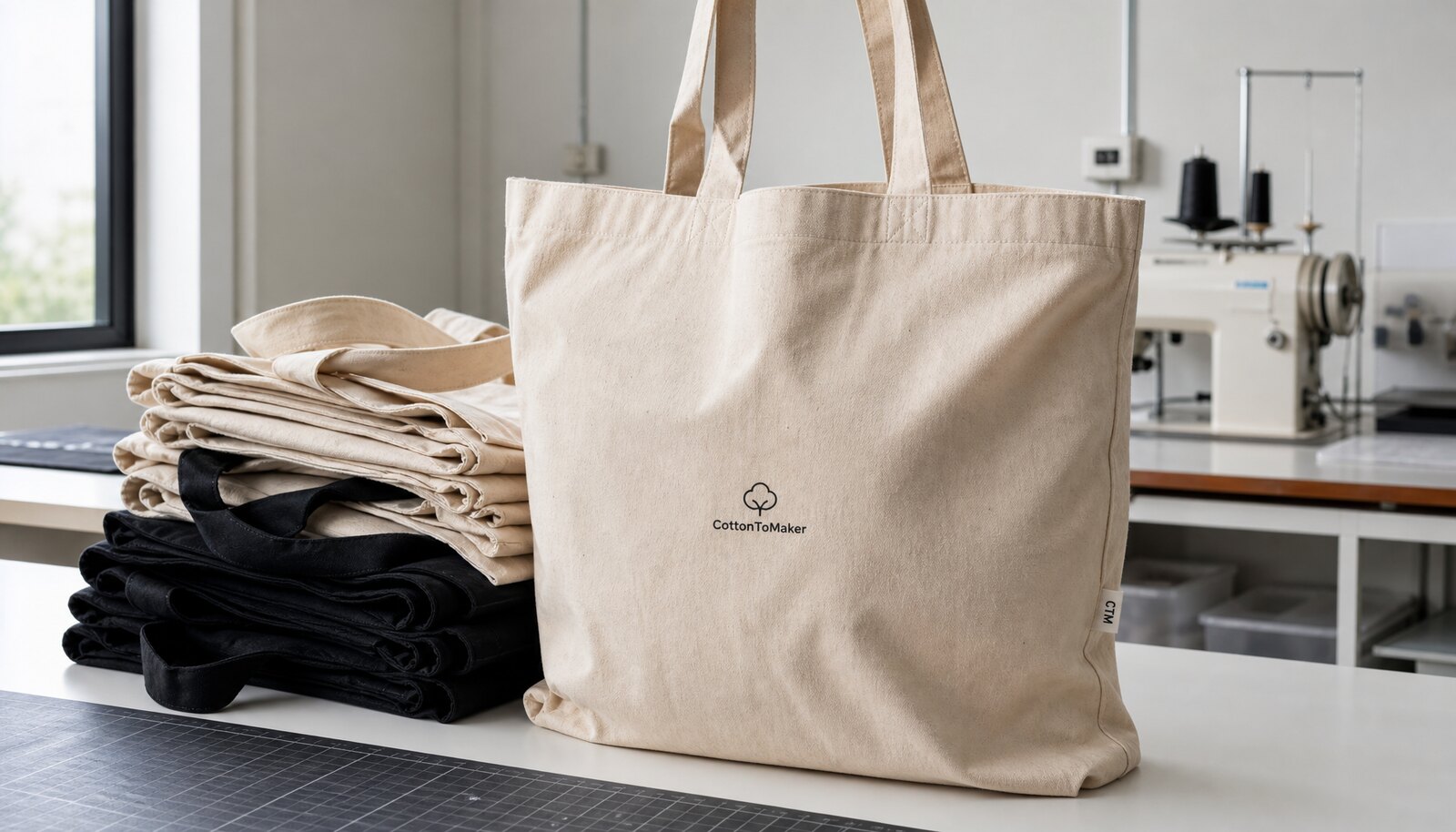
Why retail buyers get stuck on custom shopping bags
Most procurement teams start with price per piece and end up comparing bags that are not actually equivalent. One supplier quotes a 10 oz canvas tote with reinforced handles and one-color screen print; another quotes a lighter bag with shorter handles, thinner thread, and a cheaper print method. On paper the second quote looks better, but it may fail after a few uses, and the customer experience cost is higher than the savings.
For retail, the bag is part of the brand package, not just a carrier. It needs to survive store handling, fit the expected product mix, look clean on shelf, and arrive packed in a way that your DC can receive quickly. The buying problem is not finding a tote. It is writing a spec that lets suppliers quote the same thing and lets you see where the real cost sits.
- Focus the RFQ on the actual retail use: checkout, gift bag, promo giveaway, or premium reusable item.
- Do not compare a stock natural cotton bag with a custom-dyed canvas bag as if they were equal.
- Build the quote around measurable details: GSM, size, handle length, stitch type, print method, pack format.
Choose the bag structure around the retail load, not the catalog photo
The first buying decision is fabric and construction. For light retail carry, 120-140 GSM cotton works well if the load is mostly apparel, small accessories, or folded items. If the bag must carry boxed products, wine, hard goods, or repeated daily use, move into 6-10 oz canvas. That extra body improves appearance, reduces wrinkling, and gives the handles a stronger base to work with.
Handle design matters as much as the fabric. Self-fabric handles can be cost-effective, but they need enough width and reinforcement to avoid twisting. Cotton webbing handles cost more but often feel better in hand and carry weight more securely. If the bag is intended for premium retail, the handle finish can make the difference between a bag that feels disposable and one that feels worth keeping.
- 120-140 GSM cotton: suitable for lower-load retail, lighter handfeel, lower cost.
- 6 oz canvas: common middle ground for reusable retail bags with stronger body.
- 8-10 oz canvas: better for premium retail, heavier products, and longer reuse life.
- Box-stitch or cross-stitch reinforcement: preferred where handle load matters.
Set the dimensions from product mix and shelf behavior
A common mistake is ordering a standard tote size because it is easy for the supplier to quote. Retail buyers should size the bag to the actual product mix: folded apparel, boxed beauty, books, seasonal gifts, or mixed basket purchases. If the opening is too narrow, packing at store level becomes slow. If the bag is oversized, you pay for extra fabric, extra freight cube, and a bag that looks floppy on the customer’s shoulder.
The bag should also behave well in your retail environment. A bag for point-of-sale use needs to be easy for staff to stuff quickly, keep its shape on a display hook, and fold flat for storage. For e-commerce add-on sales or checkout upsells, a slightly more structured bag often justifies a small cost increase because the perceived value is higher.
- Match bag width and gusset to the real pack-out, not just the intended aesthetic.
- Confirm finished dimensions after sewing, not cut size on paper.
- If shelf display matters, ask for a flat fold sample and a packed sample, not only a single loose sample.
What actually drives the quote on custom shopping bags for retail
Retail bag pricing usually moves on six levers: fabric weight, fabric type, size, print complexity, handle construction, and packing. A simple one-color screen print on stock natural cotton may be economical, while the same bag with dyed fabric, a multi-color graphic, woven label, and branded carton can move the quote quickly. The quote often looks small on unit price but expands once you add set-up charges, color matching, and packaging upgrades.
MOQ logic also changes the economics. A supplier may offer a lower unit price at a higher volume tier, but that only helps if you can hold the stock or use the bags across multiple stores or seasons. For a pilot run, a higher unit price may be the better answer if it reduces overstock risk and lets you validate the bag in actual retail use.
- Fabric weight increases material cost and often thread usage.
- More print colors add screens, set-up labor, and registration risk.
- Custom-dyed fabric can add minimums and extra lead time.
- Special packing, hangtags, or barcode labels add labor and carton complexity.
How to compare supplier routes without getting trapped by the lowest price
The right sourcing route depends on your order pattern. A direct factory is usually the better route for repeat retail orders because you can control the spec, review samples directly, and avoid hidden markups. A trading company can make sense if you are buying multiple product categories together and want one shipment, but it often makes QC communication slower and less transparent. If a supplier cannot tell you who actually makes the bag and what machine or sewing line they use, you are not comparing real factory capability.
For brand owners and importers, the key question is not whether the supplier is large or small. It is whether they can hold fabric weight, print placement, stitch reinforcement, and pack count across repeats. A supplier that can quote low but cannot explain tolerance ranges is creating future claims. A supplier that asks good questions early is usually the safer commercial partner.
- Direct factory: best for repeat orders, custom construction, and consistent QC.
- Trading company: useful for mixed baskets, but confirm factory identity and inspection control.
- Local converter: can be good for fast turnaround, but unit cost may be higher and material choices narrower.
Comparison table: sourcing routes for retail shopping bags
The table below compares the most common sourcing routes buyers use for custom shopping bags for retail. The goal is to help you choose the route that fits your order size, lead time, and risk tolerance instead of treating all quotes as interchangeable.
Use this comparison before sending the RFQ. It will tell you whether you should prioritize cost, speed, communication, or consolidation.
- Direct factory works best when the spec is stable and repeatable.
- Trading companies can hide fabrication differences unless documentation is clear.
- Local sourcing is helpful when freight risk is higher than unit cost risk.
Sample approval is where most retail bag mistakes get caught
The sample stage should not be treated as a formality. It is the only time you can verify how the fabric feels, how the handles sit in the hand, whether the print lands cleanly, and whether the finished dimensions match the approved drawing. A good sample process usually includes a pre-production sample or strike-off, then a reference sample sealed against the purchase order before mass production starts.
For retail bags, the sample should be judged against practical use, not just appearance. Fill it with the actual product weight you expect to pack. Check whether the bag stands up, whether the handles are comfortable, and whether the print cracks or scratches when folded. If the bag is meant for premium retail, compare the sample under store lighting and in folded condition because that is how customers will see it.
- Measure width, height, and gusset after finishing.
- Test handle pull and seam stress with a realistic load, not just by hand.
- Inspect print clarity, edge sharpness, and color consistency on textured fabric.
- Approve one sealed golden sample for production reference.
QC thresholds that keep quotes honest
A clear QC standard protects both sides. If the supplier knows the allowed tolerance on size, thread breaks, print misalignment, and carton count, the quote becomes more accurate and the production team has a target. Without thresholds, buyers often receive bags that are technically similar but not commercially acceptable. That gap is where disputes start.
For most retail programs, the important thresholds are simple: consistent dimensions, neat seams, correct print placement, and cartons that match the packing list. If you require wash resistance or repeated folding performance, say so early. A bag that looks fine on arrival can still fail in-store if the print rubs off or the handle seam opens after use.
- Set size tolerance in finished dimensions, not only cut size.
- Define acceptable stitch quality and reinforcement pattern.
- State whether slight print variation is acceptable or not.
- Confirm carton count accuracy and SKU separation before shipment.
Packing and carton details affect your real landed cost
Packing is often treated as a minor line item, but it changes freight, warehouse labor, and receiving accuracy. Flat-packed bags in fixed carton counts are easier to receive and count, and they make it simpler to distribute across retail locations. If you need retail-ready packing with hangtags, barcode stickers, or individual polybags, build that into the RFQ from the start because it changes labor time and carton size.
For importers, carton dimensions matter almost as much as unit price. A slightly larger carton can push cube higher and make ocean or air freight less efficient. If your bag is lightweight but bulky, the freight cost may be a larger percentage of landed cost than the bag itself. That is why a quote should always include carton size, net weight, gross weight, and pack count.
- Ask for carton dimensions and packed weight in every quote.
- Keep pack counts simple and consistent by SKU and color.
- Avoid mixed-size cartons unless your DC process is built for them.
- If retail-ready labeling is needed, specify the exact label location and content.
A practical landed-cost view for retail buyers
A cheap ex-factory quote can still be the most expensive option once freight, duties, and receiving labor are added. If the bag is bulky, the cube drives freight cost. If the print or construction creates rework, the labor cost rises. If the supplier ships mixed cartons or mislabels sizes, your warehouse spends extra time sorting. Landed cost is not only import cost; it is also the cost to put the correct bag on the shelf with minimal handling.
The easiest way to compare quotes is to normalize them by total program cost per sellable bag. Start with ex-factory price, then add estimated freight per unit, duties, inland delivery, carton handling, and any packaging upgrades. That gives procurement a better basis for deciding whether a more expensive factory quote is actually the lower-risk option.
- Compare ex-factory price, not just sample-friendly verbal pricing.
- Add freight cube and carton count to the cost model.
- Factor in receiving labor if bags arrive in awkward pack formats.
- Use a single landed-cost sheet for every supplier so the comparison is fair.
Specification comparison for buyers
| Spec decision | Recommended option | When it fits | Buyer risk to check |
|---|---|---|---|
| Fabric base | 120-140 GSM cotton for light retail use; 6-10 oz canvas for heavier carry | Apparel, gift, and lifestyle retail where bag feel matters and repeat use is expected | Too-light fabric can sag, show print-through, or fail handle stress after short use |
| Handle construction | Self-fabric handles or reinforced cotton webbing handles with box-stitch or cross-stitch | When bag loads vary and retail customers may carry bottles, books, or boxed products | Short handle length or weak reinforcement leads to strap twist and seam failure |
| Print method | Screen print for 1-3 solid colors; heat transfer or digital print for short runs and artwork complexity | When artwork is simple and you need cost control, or when launch volumes are uncertain | Fine detail may blur on textured fabric; poor color matching causes brand inconsistency |
| Bag size | Sized to your actual SKU mix, not a generic tote template | When retail packing volume is known and shelf presentation matters | Overly large bags increase material cost and shipping cube; undersized bags trigger customer complaints |
| Supplier route | Direct factory for repeat orders; trading company only when you need multi-item consolidation | When you already know target spec and want best control on cost, timing, and QC | Trading layers can hide factory capability and make root-cause claims difficult |
| MOQ strategy | Start with a tiered MOQ tied to fabric color and print complexity | When you are testing a new retail chain, pilot season, or seasonal promotion | Low MOQ often raises unit cost sharply and may restrict custom fabric or PMS matching |
| Packing format | Flat packed 100-200 pcs/carton with master carton marks and size breakdown | When retail DCs need easy counting and efficient receiving | Loose folding or mixed carton counts create receiving discrepancies and labor cost |
| Lead time plan | Allow sample approval plus 25-35 days production for standard cotton bags | When artwork is confirmed and the order is not blocked by imported trims or special dyeing | Late artwork approvals, strike-off revisions, and carton changes can move ship dates by weeks |
| Quality standard | Pre-production sample plus in-line and final inspection based on agreed measurements and stitch tolerance | When the bag is branded and will sit on shelf or go into a customer-facing retail program | Without measurable tolerances, suppliers may substitute fabric handfeel, size, or print placement |
Buyer checklist before sampling
- Define the retail use case: checkout bag, gift-with-purchase, seasonal campaign, or premium reusable bag.
- Lock the fabric weight, bag size, handle length, and print area before RFQ release.
- State whether you need one factory color, dyed fabric, or stock natural cotton to control MOQ and lead time.
- Specify print method, artwork file format, color count, and Pantone target if color matching matters.
- Require sample approval against measurements, stitching, print registration, and handfeel before mass production.
- Confirm carton pack count, inner packing, barcode or SKU label needs, and destination warehouse requirements.
- Build a landed-cost model that includes freight cube, import duty, carton volume, and local receiving labor.
Factory quote questions to send
- What fabric GSM or oz weight are you quoting, and what tolerance do you allow on that weight?
- Is the quote based on stock fabric or custom-dyed fabric, and what changes if we request a different natural shade or Pantone match?
- Which print method is included, how many colors are covered, and what is the set-up charge per color or per screen?
- What handle construction, stitch pattern, and reinforcement are included in the quoted price?
- What is the MOQ per color and per artwork version, and how does the unit price change at the next volume tier?
- What is the sample process, sample fee, and whether the fee is refundable after order confirmation?
- What is the production lead time after sample approval, and what shipping terms are assumed in the quote?
- How are bags packed per carton, and can you provide carton dimensions, gross weight, and estimated cube?
- What QC standard do you follow for size tolerance, stitch defects, print defects, and carton count accuracy?
Quality-control points to confirm
- Fabric weight matches the agreed GSM or oz target within the supplier's stated tolerance.
- Bag dimensions are measured after finishing and match the approved sample, especially width, height, and gusset depth.
- Handles are centered, equal in length, and stitched with no skipped stitches, loose threads, or seam puckering.
- Print placement stays within agreed positioning tolerance and has no obvious registration shift, smearing, or pinholes.
- Stitch reinforcement at handle joins, side seams, and base stress points is consistent across the lot.
- Carton pack counts match the packing list, and cartons carry the correct SKU, size, and color marks.
- Sample approval includes wash or rub resistance expectations when the retail use requires repeated handling.