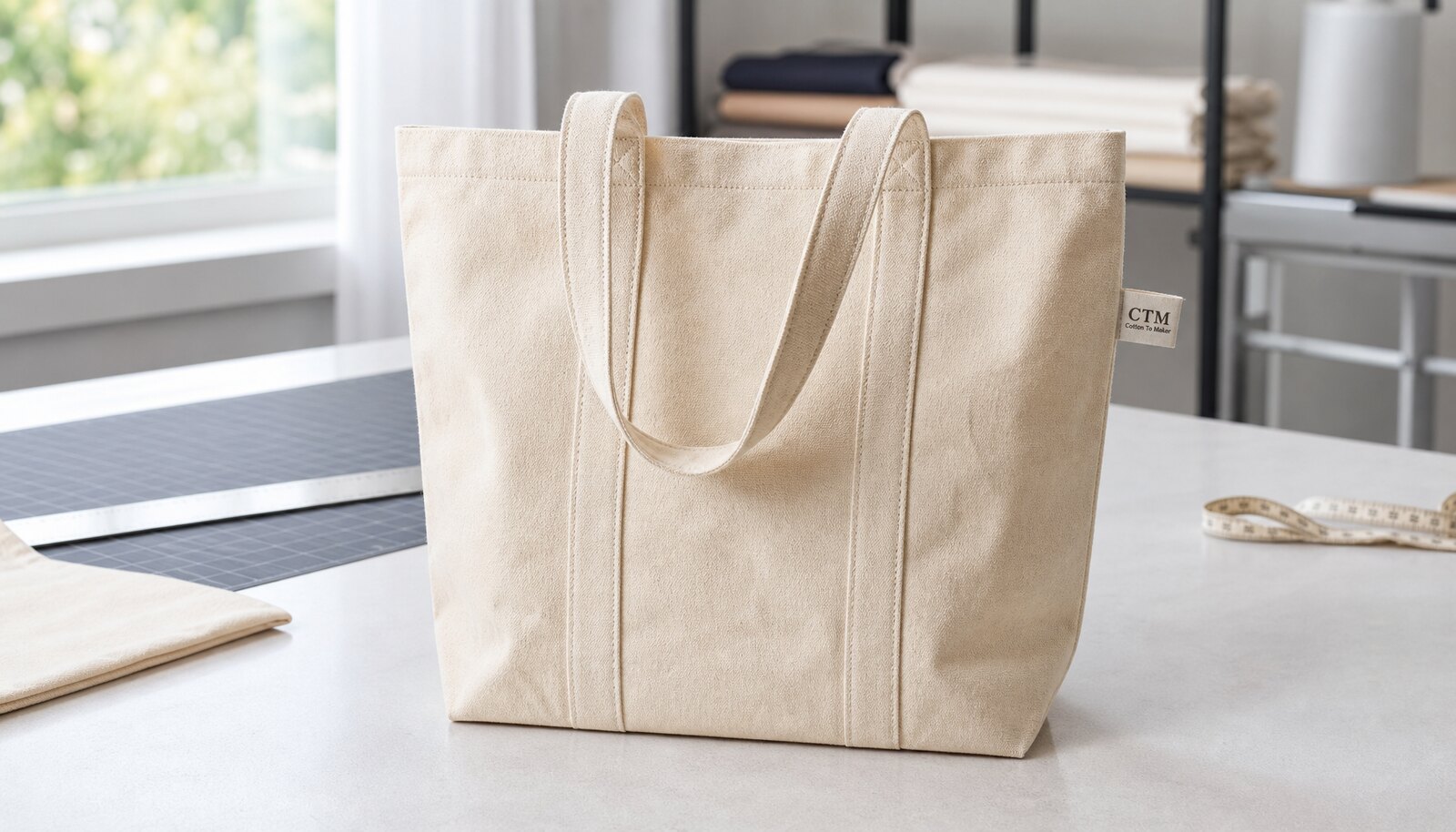
Start with the gift program, not the logo
Custom shopping bags for corporate gifts are procurement objects first and branding objects second. A tote for an onboarding kit, a client holiday box, a conference handoff, and a mailer insert all solve different problems even when the artwork is identical. The bag has to fit the contents, survive the handoff channel, and still look intentional when the recipient first opens it. If it fails any one of those jobs, the gift feels downgraded no matter how good the logo looks.
The cleanest way to avoid spec drift is to write the use case before you write the artwork brief. Define what goes inside, how the recipient receives it, whether the bag is expected to be reused, and whether presentation matters more than load capacity. A soft tote is fine for flat items like catalogs, apparel, or notebooks. A structured canvas bag is a better fit when the contents include a boxed gift, bottles, or anything that should arrive looking premium. The bag should be sized around the program, not around a template from a prior order.
- Write the contents and handoff method before asking for prices.
- Separate presentation requirements from carrying requirements.
- Treat reuse as a real spec item, not a marketing phrase.
- Do not pay for structure, lining, or hardware unless the gift needs them.
Translate the contents into size and load
Dimensions should come from the real gift set, not from a catalog example. Measure the longest, widest, and tallest item, then add practical clearance for tissue, inserts, packaging, and handling. If the contents include a rigid box, the tote needs enough base width and side clearance to slide in cleanly. If the contents are mostly flat, the bag can stay slimmer, which usually lowers material use, carton volume, and freight cost. A bag that fits on paper but fights the contents in the warehouse is a bad buy.
Carry load matters just as much as footprint. A gift bag that only needs to hold a notebook and a shirt has very different reinforcement needs from one expected to carry a boxed set, bottles, or multiple items at once. Wider handles, longer handle drop, and stronger bar-tacks matter more than decorative touches when the load increases. Ask the factory to state finished dimensions and tolerance in writing, then test the sample with the actual contents and the way the bag will be carried in real use.
- Use the largest content dimension plus clearance to size the bag.
- Match gusset depth to boxed or bulky items, not just to the logo layout.
- Set a target carry weight if the bag will be reused or given to retail-style recipients.
- Specify handle drop so the bag sits correctly in hand or over the shoulder.
- Ask for finished-size tolerance before approving the sample.
Choose material and build for the program outcome
For most corporate gift programs, cotton and canvas remain the safest choices because they print cleanly, feel familiar, and signal reuse. Ask for the measured fabric weight, not a vague label like premium cotton. A common light-to-mid range is about 240-270 gsm, which works well for folders, notebooks, apparel, and moderate gift kits. A heavier range around 320-360 gsm gives more structure and a more substantial feel, which is useful when the brand wants the bag to read as a real keepsake rather than a disposable carrier. These bands are useful starting points, but the supplier should confirm the actual bulk lot.
Construction details decide whether the bag feels deliberate or cheap. A straight top hem, consistent seam allowance, reinforced handle attachment, and trimmed threads are basic expectations, not upgrades. If the gift includes a bottle, a box, or sharp-edged merchandise, ask for gussets or boxed corners so the tote does not collapse around the load. Avoid adding lining, lamination, or decorative hardware unless they solve a real packaging problem, because each one adds labor, weight, and lead time. If sustainability claims matter, define the evidence required up front instead of assuming the factory can prove recycled, organic, or certified content later.
- Use lighter fabric for flat, low-weight kits and heavier canvas for premium handoffs.
- Ask whether the fabric is prewashed or raw if shrinkage will affect fit after use.
- Use gussets or boxed corners for boxed gifts, bottles, or dense merchandise.
- Treat sustainability claims as documentation requirements, not adjectives.
- Avoid construction details that only add cost and do not improve function.
Choose decoration based on the artwork and the fabric
Screen print is still the default for most corporate gift totes because it handles solid logos well, keeps unit cost stable, and is easy to repeat on reorders. Heat transfer or digital methods become more useful when the artwork has gradients, small text, photo detail, or multiple variations across the same program. Embroidery or a woven label can look more elevated, but only when the logo, budget, and production schedule can absorb the extra labor. The correct method is the one that survives the fabric, the freight, and the recipient's first touch.
The print file needs to be production-ready, not just presentation-ready. Send vector artwork, clear color references, and a defined placement that keeps the print away from seams, handles, and fold lines. Small legal text, reversed text, and thin strokes often disappear once they hit fabric. If the logo sits near a gusset or close to a handle stitch, require a strike-off on the final fabric before mass production starts. That is the cheapest time to catch a layout problem, and the least disruptive time to fix it.
- Use screen print for solid logos and repeat orders with limited color count.
- Use transfer or digital print when the artwork has gradients, small text, or many variants.
- Approve color on the actual fabric, not on a monitor or paper proof.
- Set a minimum line thickness and font size if the logo is detailed.
- Keep artwork away from seams and handle stitches unless the supplier has proven the placement.
Compare sourcing routes on price, speed, and control
The sourcing route changes the economics of the bag as much as the spec does. A direct cut-and-sew factory with in-house printing is usually the strongest fit when the order is repeatable, the dimensions are custom, and the buyer wants direct control over sewing quality. A trading company can be useful when the program includes multiple gift items, several SKUs, or export paperwork that the buying team does not want to manage. A local decorator or print shop can be the fastest option for urgent domestic delivery, but the buyer should assume narrower material choice and less control over cut-and-sew detail unless the supplier proves otherwise.
The comparison should be commercial, not just procedural. A quote with a lower ex-works price can still be more expensive once setup, packing, carton volume, freight, and repacking are added. The cheapest route on paper may also be the slowest if it adds extra handoffs or forces a second inspection after the goods arrive. Ask who actually owns sewing, printing, packing, and final QC. If the supplier cannot explain the workflow clearly, the risk usually shows up later in lead time or defect handling.
- Direct factory: best for repeat programs and custom dimensions.
- Trading company: best when several gift components need one point of contact.
- Local decorator: best for short runs and urgent domestic delivery.
- Ask who owns sewing, who owns printing, and who owns final inspection.
- Compare landed cost, not just factory price.
Build the RFQ so suppliers quote the same thing
A supplier quote is only useful when every supplier is pricing the same assumptions. Give them one spec sheet with the same dimensions, fabric weight, print method, quantity by SKU, packing format, and delivery term. Then ask for 500, 1,000, 3,000, and 5,000 pieces so the breakpoints are visible. Minimums are usually driven by setup cost, fabric color, cutting efficiency, or packing labor, so a single headline number does not tell you how the order will really be priced.
The quote should be broken out into bag body, decoration, packing, sample, and freight-related charges. If one supplier bundles everything into one clean number while another discloses every cost item, the cheaper line may not actually be cheaper. Compare landed cost per usable gift, not just unit price at the factory gate. A tote that arrives late, wrinkled, or packed in a way that forces warehouse rework is more expensive than a cleaner quote with transparent terms.
- Use one spec sheet for every supplier so hidden assumptions do not creep in.
- Request unit pricing at multiple quantities so price breaks are visible.
- Ask whether setup, screen, artwork, sample, packing, and freight are separate charges.
- Compare the same Incoterm and delivery destination across all quotes.
- Include repacking labor if your team will need to redistribute the goods.
Approve samples in stages and test the bag with real contents
Sampling should be staged, not compressed into a single approval step. The first sample should lock the size, handle length, gusset depth, seam appearance, and overall shape. The printed sample should use the final fabric and final artwork so you can see how the logo behaves on the actual material. For a larger or more visible program, a pre-production sample is worth the time because it reflects the real sewing path, print setup, and packing method that will be used on the production run. That sample is what the factory should be judged against later.
The sample needs to be tested under the conditions the finished bag will face. Put the actual gift contents inside, lift the bag by one handle, and carry it the way a recipient would. Fold and unfold it a few times to see how the print, seams, and handle attachments behave. Inspect it in daylight so crooked stitching, off-color ink, oil marks, or uneven trim are easy to see. The sample is not there to prove that the factory can make a tote. It is there to prove that the exact version you want can be repeated at scale without hidden compromises.
- Use a blank prototype to approve dimensions and build first.
- Use a printed strike-off on the final fabric before locking the order.
- Test the sample with the actual gift contents and the expected carry weight.
- Keep one signed master sample with the date, artwork, and packing note.
- Do not approve production until the sample, quote, and packing sheet all match.
Lock the QC standard before production starts
A procurement buyer needs acceptance criteria, not a general promise of quality. Define which defects are critical, major, and minor, or use your standard AQL if that is how incoming inspection is managed. The measurable items are straightforward: fabric weight, finished size, handle drop, stitching quality, print registration, handle reinforcement, stains, holes, and loose thread. If the bag is meant to be reused often, include a simple load or handling test on the approval sample so the supplier understands the performance expectation. A tote can look good in photos and still fail the moment it is loaded with actual contents.
Document control matters as much as the physical bag. The approved master sample, spec sheet, artwork file, and packing instructions should all be tied to the purchase order. If the supplier proposes a substitute fabric, a different print process, or a packing change, require written approval before production continues. If inspection finds a problem, the disposition rules should already be clear: rework, replacement, partial credit, or rejection. That keeps the conversation focused on the approved standard instead of on memory or interpretation.
- Define critical, major, and minor defects before production begins.
- Write down dimensional tolerances, not just nominal sizes.
- Specify the exact print position, color target, and acceptable registration range.
- Require written approval for any material, process, or packing substitution.
- Retain a dated master sample and signed inspection record for dispute control.
Treat packing, freight, and timing as part of the product
Packing changes both the commercial cost and the recipient experience. Bulk folded in master cartons is the lowest-cost option and makes sense when the buyer will warehouse, repack, or distribute the bags later. Individual folding or polybagging costs more, but it is appropriate when the bag goes straight into a gift kit or when the presentation itself is part of the product. The fold direction matters because it affects crease lines and which face of the bag is visible when the carton is opened. This is not a cosmetic detail; it affects first impression and warehouse efficiency.
Timing should be planned from the event date backward, not from the purchase order date forward. For straightforward cotton or canvas totes with final artwork and readily available material, factories may quote roughly 20 to 35 working days after sample approval, but that is only a planning baseline. Custom dyeing, multiple SKUs, holiday congestion, artwork changes, and overseas freight can all add time. Ask the supplier for a milestone schedule that covers material booking, cutting, printing, sewing, packing, inspection, and transit. That makes delays visible before they become a shipment problem.
- Specify fold direction, folded size, carton count, and carton marking in the RFQ.
- Use individual polybags only when presentation or contamination control justifies the cost.
- Ask for milestone dates for material booking, cutting, printing, sewing, packing, and inspection.
- Plan backward from the event date, not from the purchase order date.
- Keep a buffer for artwork changes, freight booking, and final approval cycles.
Specification comparison for buyers
| Commercial route | Indicative price band | Lead-time impact | Landed-cost tradeoff |
|---|---|---|---|
| Direct cut-and-sew factory with in-house printing | Low to mid ex-works at 1,000 to 5,000 pcs; best when the spec is stable and artwork is simple | Usually the shortest path once the sample is approved because sewing, print, and packing sit under one roof | Lowest friction for repeat programs, but only if the factory truly owns the line and does not outsource hidden steps |
| Trading company coordinating one or more factories | Mid ex-works, with margin built into the quote; often becomes less competitive as volume rises | Often moderate to long because approvals, relays, and handoffs add time | Useful for mixed gift kits, but compare the full landed cost because packing, freight, and rework risk can be buried in the margin |
| Local decorator or print shop | Mid to high unit cost on cut-and-sew bags, but can be efficient for very short runs | Fastest for urgent domestic delivery and short lead-time events | Good when time matters more than unit cost, but material choice and construction control are usually narrower |
| Light cotton tote, 240-270 gsm, one-color screen print | Low ex-works and efficient for higher quantities | Shorter than heavier builds because cutting and sewing are simpler | Best for folders, notebooks, and lightweight gift kits; risk rises if the contents are bulky or the bag must feel premium |
| Heavier canvas tote, 320-360 gsm, one- to three-color print | Mid ex-works because fabric, sewing time, and freight weight all increase | Slightly longer because heavier material takes more handling and may need more inspection | Better presentation and structure, but buyers should expect higher freight and more carton volume |
| Individual folding or polybagging | Higher unit cost because of labor and packaging materials | Adds packing time and usually adds one more QC checkpoint | Worth it for recipient-facing gift kits, but the real cost is often carton volume and warehouse handling, not just the bag itself |
Buyer checklist before sampling
- Define the contents first: size, shape, and maximum carry weight of the actual gift kit.
- State finished bag dimensions, gusset depth, handle drop, and acceptable tolerance before sampling.
- Choose the fabric basis in writing: cotton, canvas, recycled cotton, organic cotton, or an approved blend.
- Ask the supplier to quote the same measured gsm or oz basis for every SKU and sample.
- Provide vector artwork, color targets, and the minimum readable line or font size.
- Lock the print area, print position, and any seam or handle keep-out zones.
- Decide whether the bag must look premium at first handoff or survive repeated reuse.
- Specify whether the bag needs to be washable, crease-resistant, or gift-ready on arrival.
- Choose the packing method up front: bulk fold, individual fold, polybag, insert card, or full kit packing.
- Request pricing at 500, 1,000, 3,000, and 5,000 pieces so the quantity breakpoints are visible.
Factory quote questions to send
- What is the exact fabric composition, measured gsm or oz, and the tolerance you are quoting against?
- Is the fabric prewashed, pre-shrunk, or raw, and what shrinkage range should we plan for?
- What are the finished dimensions, gusset depth, handle drop, and allowable tolerance?
- How many bar-tacks or reinforcement stitches are used at each handle attachment?
- Which print method are you proposing, how many colors are included, and what setup fee applies per color?
- What is the minimum line thickness and smallest readable text size you will accept in production?
- Can you quote 500, 1,000, 3,000, and 5,000 pieces by SKU so the price curve is visible?
- Is the price ex-works, FOB, or delivered, and what exactly is excluded?
- Are sample fees, screen charges, plate charges, and artwork setup costs separate line items?
- What packing format is included, how many pieces per carton, and what are the carton dimensions and gross weight?
Quality-control points to confirm
- Fabric composition and measured weight match the approved specification and master sample.
- Finished body size, gusset depth, and handle drop stay within the agreed tolerance.
- Handle reinforcement matches the approved stitch pattern and does not pull under normal load.
- Seams are straight, trimmed, and free of skipped stitches, loose thread, or open ends.
- Print color, placement, opacity, and registration match the approved artwork and strike-off.
- No stains, oil marks, holes, broken yarns, cutting damage, or fabric distortion appear on finished bags.
- Bag opening, base shape, and overall structure remain usable when loaded with the intended contents.
- Fold direction and packed presentation match the approved packing sheet.
- Carton count, carton labeling, and outer marks match the purchase order and shipping documents.
- Master sample is retained, dated, and used as the reference for final inspection.