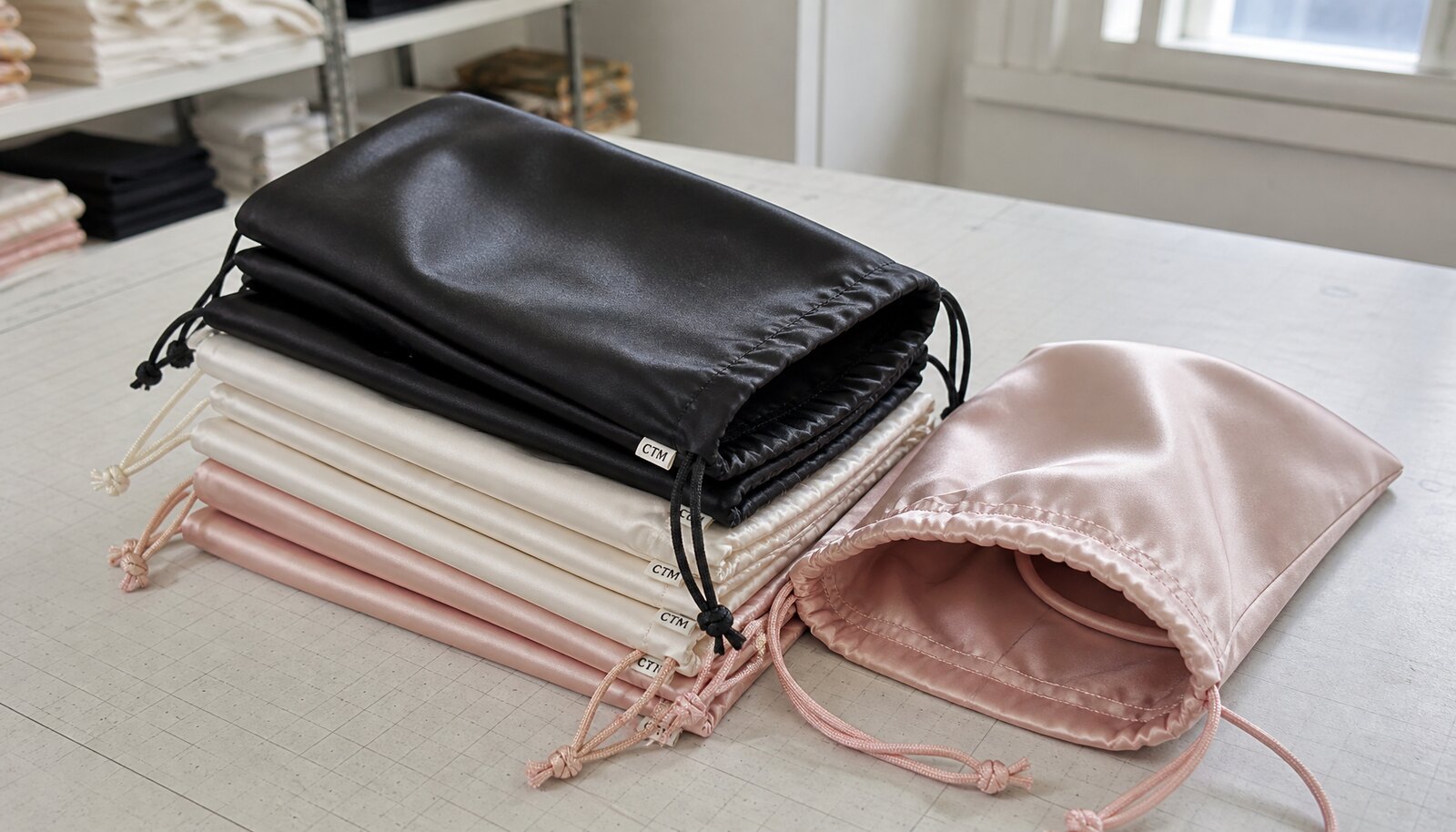
Why satin drawstring bags need a tighter RFQ than they first appear
Custom satin drawstring bags are a deceptively simple category. On paper, the product is just a pouch with a cord closure. In sourcing practice, however, small wording gaps can change the quote by a meaningful amount and change the final look even more. When a buyer writes only “satin bag,” the supplier has to guess at the fiber blend, fabric weight, finish level, lining, cord type, print method, and packing standard. Each guess creates a different commercial outcome. That is why a good RFQ is not just administrative work; it is the main tool that protects cost, timing, and consistency.
Procurement teams usually buy these bags for a brand-facing use case: retail packaging, cosmetics, jewelry, gifts, samples, premium inserts, or product protection. Those uses do not tolerate the same level of variation. A promotional pouch may accept a simpler finish, while a luxury gift pouch needs cleaner seams, more stable color, and better packing control. The right buying approach is to define what the pouch must do, what the end customer will notice first, and which details are flexible. When you do that, the supplier quote becomes much more useful because it compares the same product rather than three different versions of it.
The commercial risk is not limited to product appearance. Loose specifications also weaken negotiation. If one supplier assumes a lightweight single-layer bag and another assumes a lined bag with custom cord and barcode labels, the unit prices cannot be compared honestly. The buyer ends up evaluating quote noise instead of sourcing options. A tighter RFQ reduces the back-and-forth at the sample stage and makes later QC decisions much easier because the approved sample becomes the real reference, not an assumed understanding hidden in email threads.
- State the use case first so the supplier knows whether the pouch is decorative, protective, or both.
- Describe the visual target in practical terms: soft sheen, strong gloss, muted sheen, or a more premium drape.
- Separate required specs from optional extras so the supplier does not quote a different bag to stay competitive.
Start with the satin construction, not just the color
Color is usually the first thing buyers discuss, but fabric construction drives most of the commercial outcome. For satin drawstring pouches, the buyer should define the base material, finish, and weight range before any artwork is approved. In many market discussions, buyers ask for a GSM figure as shorthand for quality. That can be useful, but it should not be treated as a universal standard because fabric weight can vary by fiber type, weave density, finishing process, and the supplier’s testing method. The safer procurement approach is to specify a target range or reference sample and ask the supplier how they measured it.
For many standard retail and gifting programs, a medium-weight polyester satin is often a practical starting point because it balances sheen, hand feel, and handling durability. Lighter constructions may look elegant but can wrinkle quickly and show seam marks or the outline of the contents. Heavier constructions can feel more stable, but they may lose the soft drape buyers expect from satin. If the bag is intended to hold items with edges, weight, or repeated opening and closing, lining or reinforcement is worth discussing early. The extra layer adds cost, but it can also reduce internal abrasion and improve the opening experience.
Buyers should also ask how the factory handles finishing. The same fabric can look very different after cutting, hemming, pressing, and packing. A quote that looks attractive on a fabric-only basis may fail when the finished bag appears stiff or when the surface shows crease lines under warehouse lighting. Ask for the exact fabric reference, finishing method, and whether the factory will source from a standard stock base or dye to order. That tells you where the real cost and schedule risk sits.
- Use a fabric reference sample or target range instead of assuming one GSM number fits every satin pouch.
- Confirm whether the supplier is quoting stock satin, dyed-to-order satin, or a close substitute.
- Consider lining when the pouch will hold sharp edges, heavier contents, or premium presentation sets.
The main cost drivers that move the quote
A satin pouch quote is rarely driven by one number. The biggest price inputs are fabric consumption, seam and hem labor, print method, cord specification, and packing standard. Fabric consumption changes with bag dimensions, hem width, and whether the bag uses extra seam allowance. Labor rises when the design includes lining, a reinforced channel, careful center alignment for print, or a more exact closure finish. This is why the same-looking product can vary a lot from supplier to supplier: one factory may be quoting a simpler build, while another is including steps that are easy to overlook.
Printing is another major swing factor. A one-color logo is usually much easier to produce than artwork with multiple colors, gradients, or very fine text. Some suppliers will quote a low unit price but then add setup charges, screen fees, or color-change charges that only appear later. Buyers should ask for all one-time costs to be listed clearly. That matters especially for launch programs, because the first order may look expensive while the reorder becomes far more attractive if setup costs are already absorbed.
Packing often gets ignored until the warehouse says the cartons are too loose, the pouches are creased, or the labels do not match the purchase order. For low-touch distribution, bulk packing may be fine. For retail or fulfillment flows, inner counts and barcode-ready packing may be more important than a small unit-price saving. Procurement teams should ask suppliers to quote the same pack logic across alternatives so that carton cost, carton count, and warehouse handling can be compared on equal terms. If the supplier cannot explain how the quote changes when you adjust packing, that is a sign the quote may not be stable enough for sourcing decisions.
- Compare quotes on the same bag build: fabric, print, cord, packing, and label requirements.
- Ask for all setup or tooling fees to be listed separately from the recurring unit price.
- Check whether a lower unit price is offset by larger cartons, weaker packing, or higher reject risk.
How to compare supplier options without comparing the wrong thing
The sourcing route changes how much control the buyer has over the final product. A direct factory is usually the better fit when the program needs repeatability, strict color control, and the ability to revisit the same construction on a reorder. A trading company can be useful when the buyer is consolidating several packaging items, needs one commercial contact, or wants help coordinating across more than one factory. Neither route is automatically better; the right answer depends on how much the buyer values transparency, speed, and repeatable output.
The most important issue is traceability. If the supplier cannot tell you who controls fabric booking, who approves the print sample, and who signs off the final inspection, then the buying route is too opaque for a brand-sensitive order. That is especially true for custom satin drawstring bags because the product looks simple but can hide variation in sheen, stitching, cord finish, and packing compression. The buyer should ask who owns each step, not just who sends the quote. Otherwise the low quote may come from one party while the real production control sits elsewhere.
A practical way to compare suppliers is to assign each one a score against five questions: can they show a matching sample, can they explain the fabric source, can they quote setup costs cleanly, can they pack to your warehouse spec, and can they respond clearly to defect scenarios. The supplier that answers those questions in a structured way is often the safer choice, even if the unit price is not the absolute lowest. In procurement, the cheapest quote that cannot be controlled is usually not cheap for long.
- Ask who owns fabric sourcing, sample approval, production, inspection, and shipping documents.
- Prefer the source that can explain its process clearly rather than the one that only offers a low price.
- Use the same spec version for every supplier so route comparisons stay meaningful.
Supplier route comparison for custom satin drawstring bags
The table below is designed for a real sourcing decision, not just a generic channel summary. For each route, the key question is control versus coordination. If your program needs one factory to own fabric, sewing, print, and quality corrections, direct sourcing usually gives cleaner accountability. If your program needs mixed SKUs, faster cross-category coordination, or lower internal admin load, a trading company may be easier to manage. The tradeoff is that the buyer should be stricter about document requests and inspection evidence when the route is less direct.
As a rule, the more important the bag is to your brand presentation, the more you should care about sampling discipline, defect ownership, and the ability to reproduce the same result on reorders. A slightly higher quote from a more disciplined source can be cheaper than a low quote that creates inbound rejections or customer complaints.
- Use direct factories when repeatability and traceability matter most.
- Use trading companies when you need packaging consolidation or faster coordination across several items.
- Do not accept route claims without asking who controls the actual production and QC steps.
Print method choices that affect look, feel, and reject rate
Satin shows artwork differently from cotton or canvas, so the print method should be chosen for both visual result and process stability. For simple logos with one or two colors, silk screen printing is often the most straightforward route because it can offer clean edges and a practical cost structure on larger runs. The buyer should still ask about ink type and hand feel because a print that looks good in a photo may feel too rigid on a soft satin surface.
When the artwork includes fine text, multiple colors, gradients, or complex placement requirements, heat transfer or digital print may be more suitable. Those methods can reproduce more detail, but they also need better sample approval because the result can shift under different light, fabric tension, and pressing conditions. Buyers should not assume that a digital method automatically means better quality. It means different risks. On a glossy surface, small alignment errors or sheen differences can be more visible than on a matte pouch.
A strong RFQ should define the print area, the center point, the acceptable movement tolerance, and whether the brand will allow slight variation in shade or finish. It should also say whether the print must stay soft to the touch or may have a slightly raised feel. Those instructions help the supplier choose the right transfer or ink system and reduce the chance of receiving a visually acceptable bag that feels wrong in hand.
- Silk screen works well for simple logos and stable repeat orders.
- Heat transfer suits finer detail, but the buyer should insist on more careful sample approval.
- Digital print is useful for complex art, but the approval must cover shade, softness, and placement.
MOQ logic, sampling path, and how to avoid the wrong first order
MOQ is rarely one number for this product. It can change by size, color, fabric availability, print method, lining, and whether the supplier must dye or source a special satin shade. A standard black, ivory, or white pouch may be easier to buy at lower volume if the supplier already carries the fabric. Once you ask for a custom color, custom cord, woven label, or lined build, the MOQ usually rises because the factory must coordinate more inputs and absorb more setup cost. Buyers should ask where the MOQ comes from, not just what it is.
Sampling should move in stages because each sample answers a different question. A blank sample checks size, drape, opening width, seam appearance, and drawcord behavior. A decorated sample checks logo position, print quality, and how the artwork sits on satin. A pre-production sample is the most important approval point because it should reflect the actual fabric lot, the real print setup, and the final packing method. If the supplier wants to skip that step, the buyer should treat it as a red flag rather than a convenience.
The wrong first order usually happens when the buyer approves a sample that is not close enough to bulk reality. The sample may be made with different fabric, looser stitching, or a hand-finished print that the line cannot repeat at scale. To avoid that problem, ask the supplier to label which sample stage you are approving and require a photo or document record that links the approved sample to the bulk spec. That keeps later disputes from turning into opinions about what was “understood.”
- Use blank samples to test structure and opening behavior before you discuss decoration.
- Use decorated samples to check artwork clarity and placement on satin.
- Approve only a pre-production sample made from the actual planned fabric, cord, and packing method.
Packing, carton marks, and warehouse handling are part of the spec
Packing is a quality issue, not just a logistics issue. Satin can show crease marks and compression lines if it is packed too tightly or folded inconsistently. That means the buyer needs to define how the bag should be folded, whether it should be tissue-wrapped or polybagged, and how many units go into each inner pack. The right packing method depends on the destination: retail stores, e-commerce fulfillment, contract kitting, and export warehousing all have different handling expectations.
The carton spec matters because it affects both receiving efficiency and freight cost. Ask for the packed carton size, carton gross weight, units per carton, and whether the supplier can adjust pack count to improve cube efficiency without damaging the product. For export shipments, carton marks should be detailed enough for warehouse teams to identify the PO, size, color, and quantity without opening cartons unnecessarily. If barcode labels are required, specify their location and format before production starts.
A common failure point is mismatch between the purchase order and the packing logic. The product may be correct, but if the carton count or label text is wrong, the warehouse can reject the shipment or delay receiving. Procurement should insist that packing be shown on the quote and the pre-production sample approval. That makes the supplier accountable for the finished delivery format, not only the bag itself.
- Specify fold method, inner pack count, and whether each pouch must be polybagged or tissue-wrapped.
- Ask for packed carton dimensions and gross weight before accepting freight assumptions.
- Define carton marks, barcode placement, and receiving labels in the RFQ instead of after production starts.
QC thresholds that matter more than generic AQL language
AQL can be part of the inspection plan, but it is not enough for a satin pouch. This product needs visible, product-specific acceptance rules because the buyer is usually judging retail appearance as much as function. The QC standard should say what defects are unacceptable to the end customer, not only what falls outside a general sampling table. For example, a slight stitch variation may be acceptable if it is hidden, but a snag near the logo, an off-center print, or a crushed sheen line in the front panel can be a customer-facing rejection.
Defect control should start with the most visible areas first: front panel, logo position, top hem, opening line, and cord symmetry. Then move to the less visible but still important issues such as loose threads, seam reinforcement, and internal finish. Buyers should ask the supplier to separate repairable defects from reject-level defects before bulk shipment. That makes source inspection more practical because both sides are working from the same severity logic. If the order is for premium packaging, a cosmetic defect that would be visible from normal shelf distance should be treated as a major issue even if the bag still functions.
It also helps to define a few numeric examples where precision matters. For instance, the buyer can set a measured tolerance for finished size, logo placement, and cord length rather than leaving the supplier to interpret “close enough.” Even a simple tolerance note can reduce disputes. Ask the factory what it normally uses, then decide whether that matches your brand’s retail standard. If the supplier cannot explain how it measures dimensions or shade consistency, that is a warning sign that inspection may become subjective after production is finished.
- Inspect the front panel under normal retail lighting for snags, oil marks, streaks, and crushed sheen.
- Set measured tolerances for bag size, print position, and cord length instead of using vague wording.
- Separate repairable, minor, and reject-level defects so inspection results lead to action.
Landed-cost comparison: what changes when the order is not just FOB
Factory price is only one piece of the landed-cost picture. For custom satin drawstring bags, the final cost is affected by carton volume, packing density, print complexity, inspection needs, and how often the order fails first-pass approval. A supplier with a lower unit price can still be more expensive if the cartons are larger, the bags are packed loosely, or the goods require rework before they are accepted into the warehouse. Procurement teams should therefore compare not just unit pricing but also cube efficiency and likely follow-up costs.
A simple landed-cost model should include the ex-works or FOB unit price, setup or tooling charges, packing materials, carton size, freight impact by volume, and any outside inspection cost. If the buyer expects retail distribution, add a risk allowance for relabeling, rework, or partial rejection. This is not about overcomplicating the purchase. It is about avoiding quote decisions that look good only before logistics and QC are added.
The most useful comparison method is to normalize the quotes. Put all suppliers on the same basis: same bag size, same construction, same print method, same pack count, same carton spec, same delivery term, and same approval milestone. Then compare the real difference. If one quote is still cheaper after those controls, it is a meaningful saving. If the difference disappears when the specs are aligned, the cheaper quote was probably incomplete rather than truly better. For a buyer managing a launch schedule, certainty is often more valuable than a small unit discount.
- Compare suppliers on the same bag build, the same pack count, and the same delivery term.
- Include carton volume and not only carton weight when estimating freight impact.
- Add a rework or relabeling allowance if the bags must pass a strict receiving process.
Specification comparison for buyers
| Decision area | Factory-direct sourcing | Trading-company sourcing | What procurement should verify |
|---|---|---|---|
| Best fit | Best for repeat programs, stable specs, and tighter control over fabric, stitching, and print approval. | Best for mixed product programs, urgent consolidation, or when the buyer needs one contact to coordinate multiple items. | Ask who owns fabric booking, print approval, and final QC sign-off. |
| Quote transparency | Usually clearer on fabric source, sewing process, and machine setup charges. | May bundle costs into a single line, which can be convenient but less transparent. | Request a cost breakdown for fabric, print, labor, packing, and any tooling or plate fees. |
| Sampling control | Often stronger if the factory has a real sampling room and can produce blank, printed, and pre-production samples in-house. | Can be fast if the trading company already has sample access, but sample revisions may take longer if they rely on a third-party factory. | Ask for sample lead time by sample type, not just a generic sample promise. |
| MOQ flexibility | May be less flexible on special colors, woven labels, or custom trims unless the order size justifies setup. | Sometimes can combine volumes across orders or factories, but the tradeoff may be less consistency. | Confirm whether MOQ applies per size, per color, per print version, or per order. |
| Change management | Easier to track if one factory handles the same fabric lot, print setup, and sewing line. | Can be slower to trace when the quote comes from one team and production happens elsewhere. | Ask who will approve artwork revisions, spec changes, and post-sample corrections. |
| Risk on color and hand feel | Lower risk when the factory controls the same material source each time. | Higher risk if the trading company sources from different factories over time. | Request fabric swatches, shade bands, and a signed approval sample. |
| Inspection accountability | Factory can often respond directly to defects, rework, and replacement requirements. | Trading company may mediate issues, which can be useful for the buyer but slower in urgent cases. | Clarify who handles corrective action if defects appear in bulk. |
| Logistics coordination | Usually straightforward for direct shipment and factory cartons. | Can be helpful if the supplier consolidates accessories, inserts, or mixed SKUs. | Verify carton counts, packed dimensions, and shipping marks before dispatch. |
| Best buying scenario | Repeatable retail packaging, brand gift pouches, and orders that need stable quality over several seasons. | Small programs, broad sourcing baskets, or buyers who prefer one commercial contact for multiple items. | Match the route to the buying problem instead of chasing the lowest unit price alone. |
Buyer checklist before sampling
- Lock the pouch use case before quoting: retail packaging, gifting, cosmetics, jewelry, promotional inserts, or product protection.
- Define the satin base as clearly as possible: fiber type, finish level, target GSM or fabric weight range, and whether the supplier may offer an equivalent substitution.
- State whether the pouch is single-layer, lined, or reinforced, and specify any internal construction that must not change without approval.
- Provide final artwork in vector format and list the number of print colors, print area, placement, and acceptable color variation.
- Specify drawcord material, cord diameter, knot or heat-seal preference, and whether the finish must match the bag body or may contrast.
- Include finished size, measurement method, and tolerance by dimension so suppliers do not quote different interpretations of the same bag.
- Ask for a sample sequence: blank sample, decorated sample, and pre-production sample made from the actual bulk materials.
- Request a quote breakdown covering fabric, sewing, print, trim, packing, setup/tooling, and domestic or export freight terms if included.
- Define packaging acceptance: inner pack count, polybag or tissue use, carton count, carton marks, barcode labels, and master carton dimensions.
- Ask the supplier to identify the top two production risks in their own process and how they control them.
Factory quote questions to send
- What exact satin construction are you quoting, and what is the finished fabric weight or GSM after processing, not just the nominal base fabric weight?
- Is the pouch single-layer or lined, and what seam allowance is used to achieve the quoted finished dimensions?
- Which print method is included, how many colors are covered, and are screens, plates, or setup charges separate from unit pricing?
- What is the exact MOQ by size, color, and print version, and does the MOQ change if we combine multiple sizes in one fabric run?
- Can you provide a blank sample, a decorated sample, and a pre-production sample before bulk production starts?
- What tolerance do you use for finished size, logo placement, cord length, and shade variation, and how do you measure each one?
- What is the cord specification, including material, diameter, end finishing, and whether the channel is reinforced to prevent tearing?
- How are the bags packed for shipment, how many units per inner pack and carton, and are carton labels and barcodes included in the quote?
- What is the lead time after sample approval, and what steps in your process are most likely to affect the schedule?
- What defects would you classify as repairable versus reject-level for this product, and who makes that decision before shipment?
Quality-control points to confirm
- Verify the approved fabric swatch or reference sample against the bulk lot before cutting begins, and note the acceptable shade range in writing.
- Check for visible satin defects such as pulls, snags, oil spots, weave streaks, pressure marks, or uneven sheen in the retail-facing surface.
- Inspect the top hem and drawcord channel for straight stitching, secure reinforcement, and no skipped stitches, puckering, or loose thread ends.
- Measure finished dimensions on a flat bag and confirm the buyer’s specified tolerance for width, height, and opening width.
- Count stitches only where it matters to construction integrity: use a sample-based check for seam density rather than asking for an industry-wide universal number.
- Confirm that the left and right cord ends are equal within the agreed tolerance, pull smoothly, and do not twist or jam during opening and closure.
- Check print alignment against the approved sample, including center position, angle, logo scale, and whether small text remains legible on satin.
- Review color consistency across multiple cartons and across the same carton top-to-bottom if the order is large enough to reveal shade drift.
- Classify defects by severity: critical issues that affect function or safety, major issues that affect saleability, and minor issues that do not change retail acceptance.
- Inspect trim quality, including knots, heat-sealed ends, woven labels, or side seam labels, for loose attachment or visible damage.