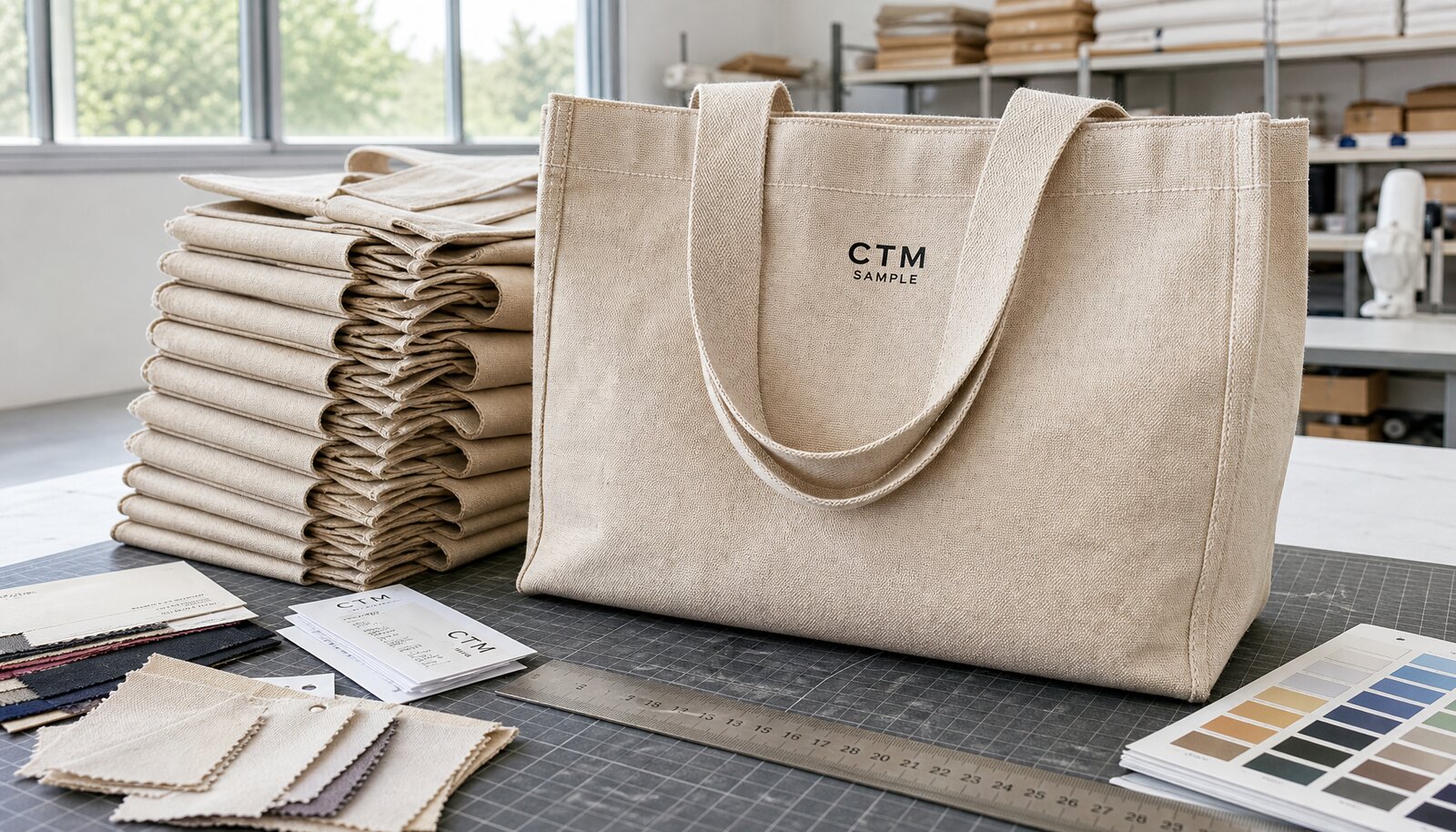
Start With the Use Case, Not the Logo
When buyers source custom reusable bags bulk, the fastest way to create a bad quote is to start with artwork instead of use case. A logo can be printed on almost any tote. The hard part is deciding what the bag must carry, how often it will be reused, and whether the order is meant to function as a promo item, a retail bag, or a durable merch piece. Those three use cases can look similar in a catalog and still require very different fabric weights, handle builds, and carton plans.
The procurement team should define the end use in plain language before any RFQ goes out. If the bag is for grocery carry, weight and seam strength matter more than print complexity. If it is for retail resale, finish quality, shade consistency, and folding presentation matter more. If it is for event giveaways, packed size and unit cost may matter more than long-cycle durability. The supplier can only quote well when the commercial goal is explicit.
- Write the intended load in the brief, not just the bag type.
- State whether the bag is for one-time distribution or repeat consumer reuse.
- Tie the spec to the channel: retail, grocery, conference, or promotional pack.
Use a Spec Table to Choose the Tote Build
The most useful comparison is not supplier A versus supplier B. It is one tote construction versus another. A flat tote is cheaper and easier to pack, but it has less volume and a more casual shape. A gusseted tote adds usable depth and usually presents better in retail. A boxed-base tote is the most structured of the common canvas formats and is often the better fit when the buyer wants the bag to stand upright or carry heavier goods without sagging.
The comparison table at the top of this article is meant to sharpen that decision. In bulk sourcing, many complaints are traceable to the wrong body shape rather than the wrong print. A bag that looks adequate on a sample card may collapse in use if the base is too narrow or the fabric too light. If the bag is expected to hold books, bottles, boxed goods, or repeated shopping loads, a reinforced gusset and a more substantial canvas usually pay back in fewer complaints and less damage risk.
- Use flat totes for lighter promotional programs and compact packing.
- Use gusseted totes when capacity and shelf presence matter.
- Use boxed-base constructions when shape retention and heavier carry loads matter.
Fabric Weight, Finish, and Sewing Details That Change Durability
For canvas tote bags, the fabric weight is only one piece of the durability story. A 6 oz to 8 oz canvas can work for giveaways and lighter retail tasks, but buyers should not expect it to feel or behave like a premium retail tote. An 8 oz to 10 oz canvas is a common middle ground for custom reusable bags bulk orders because it balances cost, drape, and body. A 10 oz to 12 oz build gives more structure and generally better wear resistance, but it also raises cloth cost and can make sewing slower if the factory is not used to heavier fabric.
The sewing spec matters just as much. Ask for seam allowance, top hem width, stitch density, and reinforcement detail in writing. A visible seam target of 8 to 10 stitches per inch is a reasonable procurement benchmark for many canvas totes, while bartacks or cross-stitches should appear at each handle attachment point. Handle width should match the load. A narrow handle may look tidy but become uncomfortable or fail earlier under repeated use. For shoulder carry, a longer drop and wider webbing or reinforced self-fabric handle is often the safer commercial choice.
- Specify finished fabric weight and ask the factory to confirm the unit system they are using.
- Request handle width, handle drop, seam allowance, and top hem width in the quote.
- Require bartacks or cross-stitch reinforcement at the load points, not only a visual stitch line.
Print Method Should Follow Artwork, Not Habit
Decoration choice has a direct impact on quote quality and complaint rate. Screen printing remains the standard for simple logos, spot colors, and larger runs because it is predictable and cost-efficient. It also gives better opacity on natural canvas than many quick-print methods, which matters when the fabric base is not pure white. For a stable brand mark or one to three color logo, screen print is usually the first method buyers should ask the supplier to price.
For more complex artwork, smaller runs, or designs that change frequently, heat transfer or digital print can be appropriate. Those methods reduce setup friction, but they can create other issues if the buyer does not ask the right questions. Ask how the print feels after folding, whether it cracks when the bag is compressed, and whether the edge stays clean after rubbing. If the bag is being sold at retail, ask for a finished sample on the actual fabric and approve the result on the real substrate, not on a white reference sheet.
Natural canvas is not a neutral surface. Unbleached cloth absorbs ink differently than a coated or bleached fabric, so the same artwork can look darker, softer, or less crisp depending on the base. The buyer should provide artwork in vector form where possible, confirm the intended color standard, and ask the supplier to call out any color shift risk before production begins. That reduces argument later and forces a better approval process up front.
- Use screen print for stable logos and repeat programs.
- Use transfer or digital methods only when the artwork or order size justifies the tradeoff.
- Approve the print on the actual fabric base and check folding durability before release.
Read Quotes as a Specification Document, Not a Price Sheet
A quote for custom reusable bags bulk should be broken into clear components. Product price, print setup, sample cost, packaging, carton spec, and freight should not all be bundled into one unexplained number. If the supplier gives only a single line price, ask for the scope to be split. Otherwise, you may compare a bag-only quote against another quote that quietly includes cartons, polybags, or decoration setup. That is not a fair comparison and it usually leads to false savings.
The landed cost is what procurement needs, not the factory gate price. Add decoration setup, packaging, local charges, freight, duty, and receiving costs to get the real number. Then compare the same bag spec across all suppliers. If one vendor is cheaper only because the fabric is lighter, the handle is shorter, or the print area is reduced, that is not a real savings. It is a spec downgrade. The best quote is the one that gives you the right tote at the lowest all-in cost with the least execution risk.
- Require separate lines for bag body, decoration, packaging, and freight.
- Compare all suppliers against the same finished size and fabric basis.
- Treat a blended quote as incomplete until the scope is broken apart.
MOQ Is a Production Constraint, Not a Sales Opinion
Minimum order quantity is often driven by cutting efficiency, print setup, and packing labor. A blank tote can sometimes be produced at a lower MOQ than a decorated tote because the factory avoids screen setup, extra checks, and artwork handling. A multi-color print, special hangtag, or custom retail fold can push MOQ higher. That is not a red flag by itself. It only becomes a problem when the supplier cannot explain why the number exists or cannot separate volume logic from pricing logic.
For a first order, avoid committing to a large run until the sample is approved and the print result is confirmed. A smaller pilot order can reveal problems that are hard to see in the quote stage: the handle drop is wrong, the gusset is narrower than expected, the canvas wrinkles more than planned, or the print sits differently on natural cloth. If the bag is a new SKU, the first run should buy learning as well as inventory. Paying a slightly higher per-unit price for a controlled pilot is often cheaper than scaling a bad spec into a seasonal program.
- Expect MOQ to change when print colors, labels, or special packing are added.
- Use a pilot order to validate size, finish, and transit performance.
- Ask the supplier to explain which setup step is driving the MOQ.
Sample Approval Should Test Fit, Load, and Presentation
A sample is not approved until it proves the full product, not just the artwork. For a proper pre-production sample, the buyer should see the actual fabric, thread color, print method, handle build, and packing method that will be used in bulk. A blank fabric swatch may help confirm color or texture, but it does not replace a finished sample. If the order includes a woven label, side tag, or hangtag attachment, those details should be on the sample before production starts.
The review should be closer to a functional test than a visual glance. Put weight in the bag, lift it by the handles, fold it, and reopen it several times. Measure the opening, base depth, and handle drop. Check whether the fabric recovers shape or stays creased. On natural canvas, color and print density can shift because of weave and absorbency, so the approval standard should include an acceptable range rather than a promise of exact visual equality to a digital mockup. That is especially important for brands that care about shelf presentation or retail resale.
- Approve a finished sample, not only a blank cloth swatch.
- Test the bag under realistic weight before authorizing bulk production.
- Keep a measured sample or signed photo record as the production reference.
Build a QC Plan Around Real Manufacturing Defects
Quality control for canvas totes should be specific enough that a factory can execute it without guessing. The most common defects are simple but costly: wrong size, weak handle attachment, bad print registration, uneven folding, poor thread trimming, and carton count errors. A good inspection plan checks those items in a way that is repeatable. If possible, define the defect list in major and minor categories and align the inspection target to the retail risk of the program. Many procurement teams use AQL 2.5 for major defects and 4.0 for minor defects, but tighter programs can justify stricter limits.
Manufacturing details matter here. Ask for seam strength evidence, stitch density targets, and test methods that the supplier or lab can actually run. Fabric tensile testing can be referenced to ASTM D5034, ASTM D5035, or the equivalent ISO method. If the bag has sewn handles, ask for a pull test on the handle attachment and a seam slippage check on the body seam. If the print will be handled often, ask for dry and wet rub testing and inspect the result after repeated folding. QC should reflect how the bag is used, not just how it looks in a photo.
- Use an inspection plan that separates major defects from minor defects.
- Ask for tensile, seam, pull, and rub testing when the program needs real durability.
- Check printed and structural defects on sampled bags from multiple cartons, not only the first carton opened.
Packing, Cartons, and Freight Need Their Own Spec
Packing is a cost and quality lever, not an afterthought. Flat-folded canvas bags packed into polybags and then master cartons are common because they protect the fabric and reduce shipping cube. But the folding method affects the final look, and the carton count affects freight density. If the tote is retail-facing, the fold has to look consistent when cartons are opened. If the program is warehouse-distributed, the carton size and barcode placement may matter more than presentation. Ask for both the bag pack and the export pack as part of the quote.
Carton spec also affects damage risk. Request carton dimensions, gross weight, count per carton, and any moisture protection if the bags will travel by sea or be stored in humid conditions. If the bags are printed on natural canvas, the outer surface can scuff or transfer if the packing is loose or wet. For larger bulk orders, ask whether cartons are palletized, whether pallet height is fixed, and whether carton labels follow your warehouse standard. That keeps receiving clean and reduces chargeback risk from mislabeled shipments.
- Request fold style, polybag spec, and carton count as part of the RFQ.
- Confirm carton dimensions and gross weight before freight is booked.
- Ask for moisture protection and pallet rules when the route includes ocean or long storage.
Evaluate the Factory on Process Control, Not Just Price
A reliable supplier should be able to explain how the order moves from sample to bulk. That includes who approves artwork, who checks the first cut, who signs off the print proof, and who performs the final carton audit. If the supplier cannot name the person responsible for each step, the risk is usually higher than the quote suggests. You do not need a long factory story. You need a repeatable process and a responsible owner at each checkpoint.
For repeat programs, ask for production photos, a sample archive, and evidence that the factory can reproduce the same bag consistently across batches. If the tote has a special finish, ask how they control shrinkage, fabric shade variation, and handle alignment over time. A factory with poor process control may still make an acceptable sample, but bulk consistency will suffer. That is the exact point where procurement teams get surprised, and where a slightly higher-priced, better-controlled factory often saves money in claims and rework.
- Ask who owns artwork approval, first article review, and final inspection.
- Request evidence of repeatability if the tote will be reordered seasonally.
- Favor suppliers who can explain process control, not only pricing.
Specification comparison for buyers
| Tote spec | Best fit | Performance notes | Buyer risk to check |
|---|---|---|---|
| 6 oz to 8 oz flat tote | Light promotional use, inserts, events, and giveaway packs | Lowest material cost and easiest to pack, but the bag drapes more and shows wear sooner | Ask whether the handles are reinforced enough for the expected contents and whether the fabric is too thin for print opacity |
| 8 oz to 10 oz gusseted tote | General-purpose bulk orders, retail support bags, and branded programs | Better volume and shelf presence than a flat tote, with a practical balance of cost and durability | Confirm gusset depth, seam allowance, and whether the side seams stay square after loading |
| 10 oz to 12 oz boxed-base tote | Retail carry, grocery use, and premium merchandise | Stronger body, better shape retention, and more premium hand feel | Check fabric shrinkage, stitch density, and handle attachment because heavier cloth increases stress at the seams |
| Self-fabric handles | Budget-sensitive orders and simple promo bags | Works well when the same canvas is available in sufficient width and weight | Verify handle width, folded edge finish, and pull strength; thin self-fabric handles are a common failure point |
| Cotton webbing handles | Higher-traffic retail bags and shoulder carry | More comfortable to carry, cleaner edge finish, and often better load handling | Confirm webbing width, color consistency, and whether stitch lines are neat enough for retail presentation |
| Open-top tote | Fast packing, lower cost, and general retail use | Simpler construction and fewer failure points than closures | Check whether the opening is too wide for the use case or if a top hem is needed for stiffness |
| Top-zip or snap closure | Travel kits, premium retail packs, and higher-value contents | Adds security and a more finished feel but increases labor and component cost | Ask for zipper grade, snap pull strength, and how the closure affects packed carton density |
Buyer checklist before sampling
- Define the end use first: retail carry, grocery, event giveaway, conference kit, or merchandise pack.
- Lock finished size, gusset depth, handle drop, and top hem width before asking for quotes.
- Specify fabric basis in one system only, either finished oz or GSM, and ask the supplier to confirm the conversion.
- Choose the decoration method, print locations, number of colors, and whether the artwork needs Pantone or CMYK matching.
- State whether the canvas is natural, bleached, dyed, or washed, because the base shade changes print appearance.
- Set the packing format: flat-folded or rolled, polybag or no polybag, and carton count per size.
- Ask for the sample path: blank sample, pre-production sample, and strike-off or print proof if decoration is involved.
- Define acceptance criteria for stitch quality, thread trimming, color shift, and handle reinforcement.
- Request quote separation for bag body, decoration, packaging, sample charges, and freight or destination charges.
- Confirm import and labeling needs, including carton marks, barcodes, country-of-origin marking, and warehouse labels.
Factory quote questions to send
- What exact finished size, gusset depth, handle length, and fabric weight are you pricing against?
- Is your fabric quote based on raw cloth, finished cloth, or finished bag weight, and what is the conversion basis?
- Which construction are you quoting: flat tote, gusset tote, boxed-base tote, or a reinforced retail version?
- What stitch density, seam allowance, and reinforcement method are included in the price?
- What print method do you recommend for this artwork, and what setup charges apply per color or location?
- What sample is included in the offer, what is the approval sequence, and who pays courier charges?
- What is the production lead time after sample approval, and which steps can extend it?
- Can you quote unit price, decoration, packaging, cartons, and freight as separate line items?
- What tolerance do you accept for size, color placement, seam alignment, and print registration?
- Can you confirm your carton count, carton dimensions, gross weight, and pallet or export packing method?
Quality-control points to confirm
- Measure finished width, height, and gusset depth against the approved sample and ask for a target tolerance of plus or minus 0.5 cm on sampled pieces and plus or minus 1 cm in bulk unless the program needs tighter limits.
- Inspect fabric weight, weave consistency, and visible defects such as slubs, thin spots, oil marks, dye streaks, or contamination on the outer panels.
- Request a fabric test report or lab evidence for tensile strength using a recognized method such as ASTM D5034 or ASTM D5035, or the equivalent ISO fabric tensile standard.
- Check seam strength and seam slippage on load-bearing panels, especially where the handles meet the body or where the side gusset turns into the base.
- Use a handle pull test that reflects the end use; many buyers set a minimum target of 10 kg for light promotional totes and 15 to 20 kg for heavier retail bags, then validate against the planned load.
- Verify stitch quality with a visible seam count target such as 8 to 10 stitches per inch on exposed seams and neat bartacks or cross-stitches at stress points.
- Inspect print registration, ink opacity, edge sharpness, and rub resistance on the actual canvas base, not only on a white proof sheet.
- For programs that will be washed or reused often, ask for dry rub and wet rub testing and check whether the print cracks or transfers when the bag is folded and reopened.
- Apply an AQL inspection plan on bulk orders, with many buyers using 2.5 for major defects and 4.0 for minor defects, or a tighter standard for retail programs.
- Randomize carton sampling from the top, middle, and bottom of cartons, then verify count, folding consistency, barcode accuracy, and label placement before release.