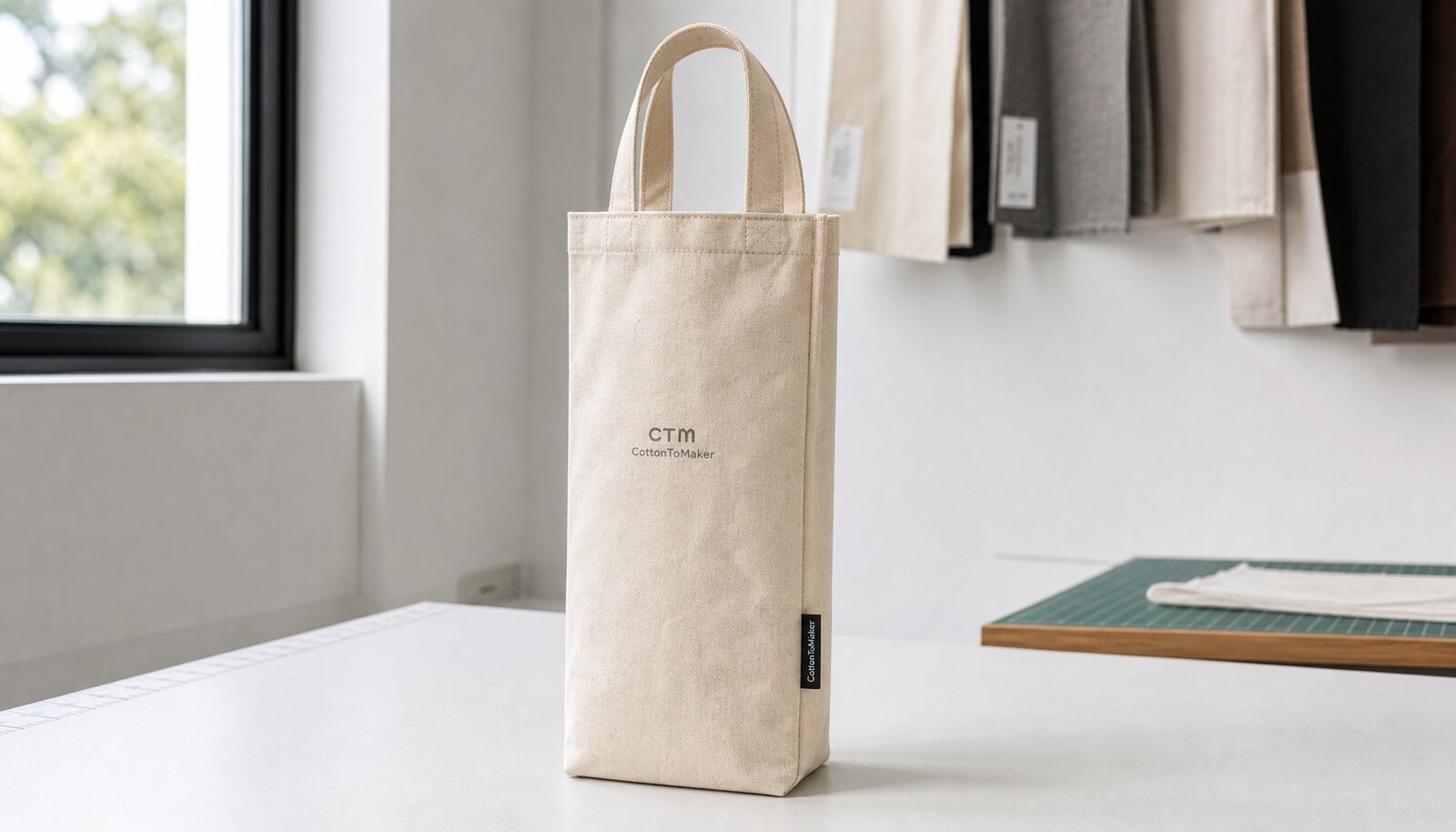
Start With the Bottle, Then Choose the Bag
The fastest way to get a bad quote on custom printed wine bags is to start with the logo and leave the bottle for later. A bag that works for a slim Bordeaux bottle may look loose around a wider Burgundy bottle or fail completely on a sparkling bottle with a taller shoulder and foil capsule. Procurement needs the real bottle profile first, because that one decision affects finished size, opening allowance, seam placement, and the way the printed panel lands after stitching.
The sales channel matters as much as the bottle. Retail bags need cleaner finishing, tighter size control, and repeatable color. Promotional bags can accept a simpler structure, but they still need to look deliberate and protect the bottle. If the bag will sit inside a gift set or pass through a reseller network, decide whether the wine bag is a primary branded item or a functional insert. That changes what the factory should optimize for.
- Use the widest point of the actual bottle as the basis for internal width.
- If the program includes multiple bottle shapes, spec the bag to the hardest-fit bottle, not the easiest one.
- Ask for a sample insert test with the real bottle before you approve the size.
Choose Material by Channel, Not by Catalog Name
Cotton, canvas, and jute are the three most common routes, but the right answer depends on how the buyer wants the bag to feel in hand. Lighter cotton works for campaign volume and fast turn programs. Heavier canvas gives more structure and a better shelf presence. Jute brings a rustic look, but it is rougher to print, more variable in texture, and less forgiving when the artwork needs fine detail. Treat the material as part of the commercial spec, not just a style choice.
Fabric weight changes both perception and performance. A 140-160 gsm cotton bag may be fine for a giveaway, but a retail buyer often expects more body and a cleaner fold line. For a more premium look, 240-300 gsm canvas usually gives better structure without needing an elaborate construction. If the bag will be reused or carried repeatedly, choose the heavier body early. It is cheaper to upgrade the fabric than to recover from a bag that feels thin on shelf.
- Use lighter cotton when speed and volume are more important than body.
- Use canvas when the bag needs to hold shape around the bottle.
- Ask for real photos of the weave and print result on the actual material, not a stylized catalog rendering.
Print Method and Artwork Control Decide Whether the Bag Looks Bought or Made
Decoration is where custom printed wine bags either become a branded product or stay a generic pouch with a logo. Screen print is still the most efficient choice for simple logos and one to three spot colors. Digital print is better when the artwork has gradients, fine detail, or a short-run variation, but the unit cost and hand feel need to be checked carefully. Embroidery and woven labels work best when the brand wants a quieter premium signal rather than a large graphic panel.
The artwork file should be built around the print process, not the other way around. Thin lines, small type, and tight detail may disappear once the bag is sewn, folded, and tensioned on the bottle. Keep the print area practical and centered. If the design needs to run close to a seam, ask the factory to show where the art will shift in production. A good supplier should be able to mark the final print box on the pattern before sampling starts.
- Provide vector art and a Pantone target when color match matters.
- Define the print area in millimeters so every supplier quotes the same coverage.
- If the logo has small type or more than three colors, ask which process gives the lowest risk at your quantity.
Construction Details Are What Separate a Functional Bag From a Cheap One
The sewing spec matters as much as the fabric. Wine bags fail at the top hem, bottom seam, and handle anchor because those are the points that carry weight and absorb repeated handling. A serious quote should identify the seam type, stitch density, reinforcement method, and whether the handle is sewn into the side seam or fixed with a bar-tack. If those details are missing, you are probably pricing a generic bag shell rather than the construction you actually want.
Fit is another commercial issue, not just an aesthetic one. The bag should support the bottle without forcing it. A single-bottle bag needs enough height for the neck and enough width at the widest point for insertion without wrinkling the seams. For a double-bottle or premium gift version, the internal divider and base reinforcement should be tested with actual bottles, because a dummy insert will not show how the seams behave under real glass weight.
- Require reinforcement at every load-bearing point, especially the top edge and base corners.
- Approve the closure style with a real bottle inside the bag, not as a flat sample.
- If the bag will be reused, ask the factory to show repeated load-and-remove behavior on the sample.
MOQ and Unit Price Make Sense Only When You Separate Setup From Product Cost
MOQ in this category is usually driven by several factors at once: fabric roll availability, print setup, thread color, packing format, and whether the factory is cutting a standard size or a custom pattern. A one-color screen-printed cotton bag may start in the low hundreds per design. Once you move to custom dyeing, embroidery, special inserts, or unusual packing, the practical MOQ rises quickly. If you change the bag color, artwork, and packaging in the same order, the factory may treat it as a new program rather than a variant.
When comparing quotes, split the number into base bag cost, decoration cost, packing cost, and one-time setup cost. That is the only way to compare suppliers honestly. A quote can look cheap until the buyer adds screens, digitizing, hang tags, inner polybags, carton changes, or a special ship mark. Procurement should ask for a landed-cost view early, especially when the order is being benchmarked across a factory, a trading company, and a local decorator.
- Ask whether MOQ is tied to the fabric color, artwork, or finished style.
- Confirm whether a second logo color or second print location triggers a new setup fee.
- Request a price break at the first reorder quantity so you can plan replenishment.
Sampling Should Prove the Real Build, Not Just the Look
A sample is only useful if it reflects the actual production route. A hand-built development sample can be misleading if it uses substitute fabric, different thread tension, or a decoration method that is easier to control at a small scale than in bulk. The approval sample should use the same fabric, the same thread, the same closure parts, and the same print process planned for production. If the supplier cannot say exactly what changed between the sample room and the production line, the sample is not good enough to freeze the order.
Approval should happen in stages. First check the blank bag for size, seam line, and fit. Then approve the printed bag for artwork position and color. Finally approve the packed version, because folding, inner packing, and carton load can change how the bag looks on arrival. Keep one sealed reference sample with the PO file and one measured spec sheet that records the approved dimensions, artwork position, and packing method.
- Approve blank sample, printed sample, and packed sample separately.
- Use the actual bottle during the final fit check.
- Ask the supplier to mark what changed between the sample and the intended bulk route.
QC Needs Numbers: AQL, Measurement Tolerances, and Simple Test Methods
This is the point where many buyer guides stay too general. Procurement teams need tolerances and test methods. If you use ANSI/ASQ Z1.4, set the acceptance plan before production starts. A common setup is zero critical defects, AQL 2.5 for major defects, and AQL 4.0 for minor defects. The factory should know exactly what counts as a major defect before it packs a single carton. Missing print, wrong size, open seams, or mixed artwork are not the same as loose threads or tiny stains, and they should not be treated as the same risk.
Use simple, repeatable checks that the factory can actually run. Measure finished size on a flat table, inspect print position against a marked template, and run a basic load test on the sample or first article. For a standard single-bottle cotton bag, many buyers set a static load target around 3 kg. For heavier canvas styles, 5 kg is a practical starting point. If your bottle is heavier or your channel is more demanding, raise the target. The important part is to write the target into the spec instead of guessing at final inspection.
- Set print registration tolerance, commonly around 1.5 mm on small logos and about 2 mm on larger panels.
- Use a dry-rub check where the artwork must not smear or transfer visibly on clean white cloth.
- Agree the load test and pass criterion before bulk starts, then repeat it on first production output.
- Check for no skipped stitches, no open seams, and no loose thread tails longer than the buyer allows.
Packing and Cartons Can Make a Good Bag Arrive Looking Wrong
Packing is not a minor line item in wine bag sourcing. A soft cotton bag packed too tightly can hold a permanent crease. A structured canvas bag can lose its shape if the carton is too shallow, while a flat jute bag can pick up pressure marks if it is over-compressed. The buyer should decide whether the product needs retail-ready presentation or shipment density. Those are different packing goals, and the supplier should not guess between them.
Freight decisions start with carton size, not just unit price. Ask for the carton dimensions, gross weight, net weight, and units per carton on every quote. A cheaper unit price can become more expensive once carton cube, pallet pattern, and handling costs are added. If the bags are going into a gift set or multi-SKU pack, confirm that the outer pack will not distort the bag body or damage the print. The final carton should protect the product without crushing it into a shape that looks used on arrival.
- Specify whether the bag should be folded, stuffed, or kept flat before boxing.
- Request the carton cube early so landed cost can be compared properly.
- If the order is retail-facing, confirm barcode, size label, and inner pack format before production.
Comparing Suppliers Without Letting the Quote Hide the Real Spec
A clean sourcing decision depends on comparing like with like. In custom printed wine bags, quote differences often come from hidden assumptions: one supplier prices a lighter fabric, another omits carton cost, and a third includes a decoration method that looks similar on paper but behaves differently in production. The buyer should force all suppliers onto one spec sheet, one artwork version, one packing instruction, and one inspection plan. Otherwise the cheapest quote is just the least complete quote.
The best supplier is not always the one with the lowest ex-factory number. For repeat retail programs, the better choice is often the maker who can hold a tighter tolerance, document the sample route, and pack consistently. For promotional work, speed and price may matter more than perfect structure. The procurement decision should reflect the use case. If the bag is a branded retail item, small defects in print position or seam line matter more than they do for a one-time event giveaway.
- Use one master spec for every supplier so artwork, size, and packing are comparable.
- Ask for recent production photos of the actual build, not only studio images.
- Treat any supplier who cannot identify the real production route as a higher-risk option.
Put the Order on One Spec Sheet Before You Release the PO
The easiest way to reduce rework is to make the purchase order boring. One spec sheet should carry the bottle profile, fabric, GSM, print method, print area, tolerance, closure, packing, carton count, inspection standard, and delivery terms. When that information is split across email threads, the factory will fill gaps with its own assumptions. That is how a buyer ends up with a usable bag that still fails the internal standard.
Procurement teams do better when they write the order like a production document instead of a marketing brief. The spec does not need to be long, but it must be exact. If the bag is for a retail chain, keep the approved sample, the measured spec sheet, the print file, and the carton instruction together. That package gives the factory one version to follow, gives QA one version to inspect against, and gives the buyer one version to reorder from without reopening the whole project.
- Keep one reference sample and one signed spec sheet with the PO.
- Archive the approved artwork version and print position drawing.
- Reorder from the same measured spec rather than rebuilding the brief from scratch.
Specification comparison for buyers
| Procurement route | Best fit | Commercial upside | Control point |
|---|---|---|---|
| Direct factory with in-house sewing and print | Repeat programs with stable artwork and clear specs | Fewer handoffs, better process control, easier reorders | Verify that printing, sewing, and packing are not being subcontracted without disclosure |
| Factory plus separate packaging or kitting partner | Gift sets, retail bundles, and multi-part programs | Useful when cartons, inserts, and outer packs must be coordinated | Confirm who owns final pack-out quality and carton labeling |
| Trading company with access to several plants | Mixed materials or multiple bag styles in one order | Can consolidate sourcing when the program is broad | Ask for the real producing factory before sample approval |
| Stock-bag converter with custom print | Short lead times and lower artwork complexity | Fastest route when the body shape is standard | Check blank bag consistency by lot, not by catalog photo |
| Premium embellishment supplier | Embroidery, woven labels, and gift-driven retail programs | Higher perceived value and a cleaner brand finish | Expect higher MOQ and more approval steps |
| Custom-dyed cut-and-sew factory | Chain retailers or brands with fixed color standards | Best when brand color consistency outweighs speed | Control dye lot variation and fabric booking windows |
| Dual-source program with one master spec | Seasonal demand or continuity planning | Gives fallback capacity and pricing leverage | Keep tolerances and test methods identical across suppliers |
| Local decorator using imported blanks | Emergency replenishment or very small trial runs | Can reduce lead time when bag body is standardized | Do not assume imported blanks match the approved production lot |
Buyer checklist before sampling
- Measure the actual bottle, not just the nominal size. Capture height, widest diameter, shoulder shape, closure type, and whether the bag must fit 750 ml, 375 ml, magnum, or a mixed bottle profile.
- Set the finished-size tolerance in the RFQ. For many standard single-bottle bags, buyers use +/-5 mm on length and width; tighten to +/-3 mm if the bag is for premium retail display.
- Lock the fabric weight, weave, and finish before you ask for pricing. Typical working ranges are 140-180 gsm cotton for lighter promotional bags and 240-300 gsm canvas for firmer retail styles.
- Specify the decoration method, print area in millimeters, Pantone references, and the number of print colors so suppliers do not quote different levels of finish under the same item name.
- State the required construction: drawstring, rope handle, stitched flap, open top, window panel, insert board, woven label, or gift-tag attachment.
- Request a pre-production sample made with the same fabric, thread, and print process that will be used in bulk production.
- Ask for a packing plan with carton dimensions, units per carton, gross weight, and whether the bag ships folded, stuffed, or flat.
- Define the inspection standard before the PO. If your team uses ANSI/ASQ Z1.4, state the AQL plan up front, commonly AQL 2.5 for major defects and 4.0 for minor defects.
- Ask for the quote to separate base bag price, decoration setup, packing, inner polybag, carton charge, and any inland freight or documentation cost.
- Request one sealed approved sample and one measured spec sheet for the order file so production, inspection, and reorders use the same reference.
Factory quote questions to send
- What is the exact fabric composition, finished GSM, weave, and roll width you are pricing for this wine bag?
- Is the print done in-house or subcontracted, and which print method is included in the unit price?
- What finished-size tolerance do you normally hold on this construction, and can you build to a tighter buyer tolerance if needed?
- What seam allowance, stitch density, and reinforcement method do you use at the handle, top hem, and bottom seam?
- What is the MOQ per size, per artwork, per print color, and per fabric color if I change only one element?
- Can you make a pre-production sample from bulk material rather than a development sample from substitute fabric?
- What are your sample fee, setup charge, and whether either one is refundable or deductible on bulk order?
- What is the full production lead time by step, from approved artwork to packed cartons ready for dispatch?
- Which inspection standard do you work to, and can you support an agreed AQL plan such as AQL 2.5 major and 4.0 minor?
- What load or seam-strength test do you normally perform on a single-bottle bag, and what is the pass criterion?
Quality-control points to confirm
- Finished dimensions should match the approved sample within the agreed tolerance. For standard single-bottle styles, many buyers use +/-5 mm; for premium retail work, tighten to +/-3 mm where the construction allows it.
- Fabric weight should stay within a practical tolerance band around the approved spec, and color should not shift noticeably from the reference under daylight or D65 viewing conditions.
- Print registration should be centered and aligned to the agreed art board. A useful buyer target is no visible misalignment beyond about 1.5 mm on small logos and about 2 mm on larger panels.
- Color should match the approved reference rather than a generic catalog color. If the artwork is brand-critical, define a Pantone target or an agreed visual standard before bulk starts.
- Print should pass a simple rub check where appropriate. A common acceptance test is 10 back-and-forth dry rub strokes on clean white cloth with no obvious transfer or smearing.
- Seams should be clean, even, and reinforced at every load-bearing point. Look for no skipped stitches, no puckering, no split seam allowances, and loose thread tails trimmed to a short, consistent length.
- Handle anchors and top hems should survive a load test without tearing or noticeable distortion. Many buyers use a static load equal to at least 1.5x the intended filled weight, with 3 kg as a practical minimum for standard single-bottle cotton styles and 5 kg for heavier canvas styles.
- Bottle fit should be checked with the real bottle inside the approved bag. The bottle should insert and remove smoothly, and the neck or shoulder should not force the opening open permanently.
- Closure performance should be repeatable if the bag uses a drawstring, flap, or tie. The closure should close cleanly, stay aligned, and not snag on raw edges or loose threads.
- If you are using ANSI/ASQ Z1.4, set the lot acceptance standard before production. A typical buyer setup is zero critical defects, AQL 2.5 for major defects, and AQL 4.0 for minor defects.