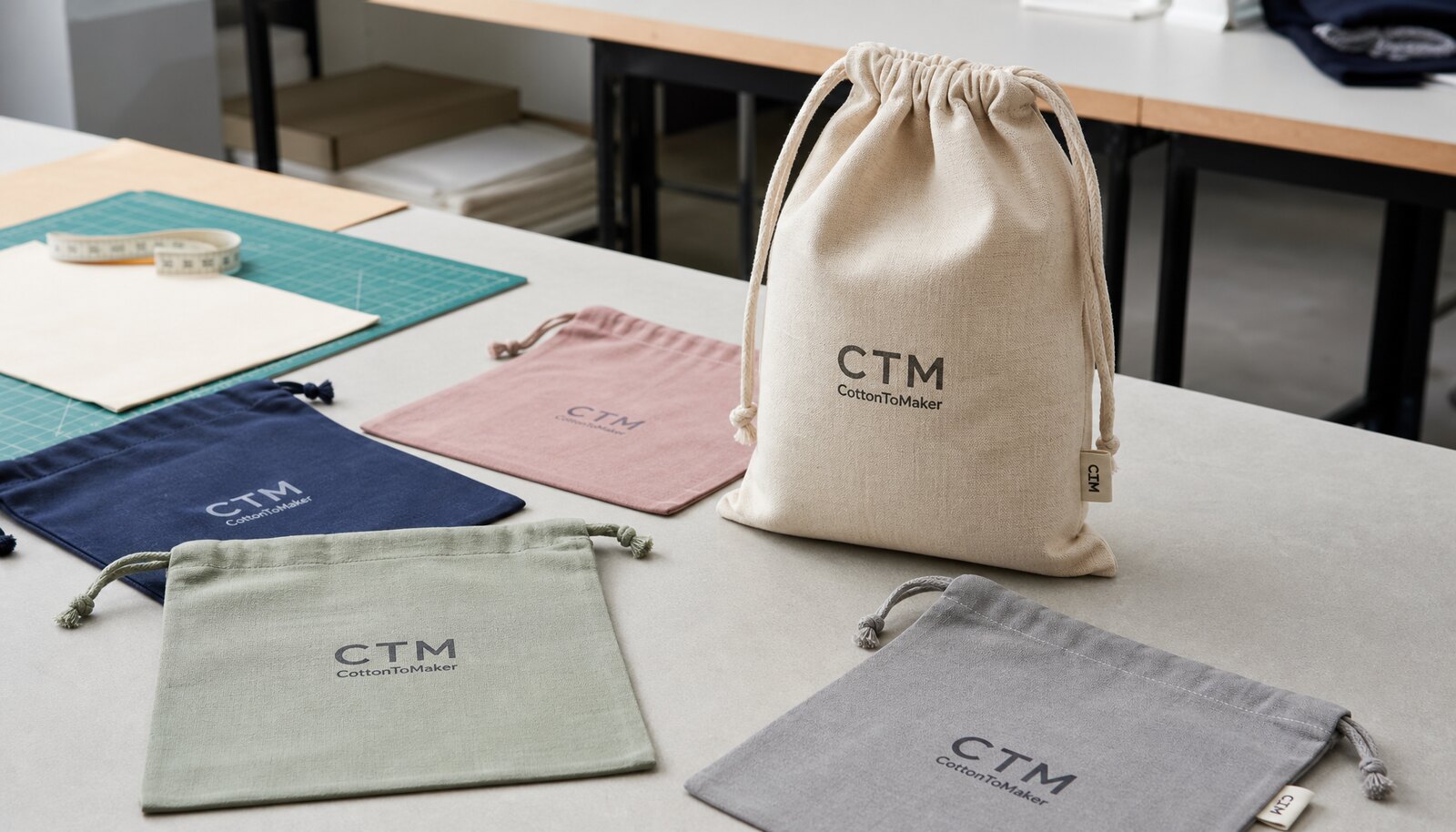
What buyers usually get wrong when sourcing drawstring bags
Most sourcing problems start before the first quote is compared. Buyers often send a bag size and a logo, then ask suppliers to “quote the same thing.” That phrasing leaves too much room for the factory to choose the fabric weight, print method, stitch detail, packing format, and sample route. Those differences can move the unit price, but they also change how the bag performs once it is filled, folded, shipped, and handled at the warehouse or retail shelf.
For procurement teams, custom printed drawstring bags are usually not just a promotional item. They may be a packaging component for apparel, cosmetics, gift sets, or product samples. In that setting, the bag has a functional role: protect the item, present the brand cleanly, and survive a measurable amount of handling. A low unit price only matters if the bag still meets the program’s fill, print, and transit requirements.
The most common mistake is treating the bag like a generic commodity. In reality, the quote is a bundle of decisions. A heavier fabric can reduce transparency and improve handfeel, but it can also increase freight cost. A better print method may improve artwork fidelity, but setup time or MOQ may rise. Good procurement practice is to define the use case first, then ask suppliers to quote to that use case rather than to a vague product name.
- A low GSM bag may look economical but fail presentation or strength expectations after filling.
- A print method that works on paper or smooth synthetic fabric may not perform the same way on woven cotton.
- A supplier can keep unit price down by reducing stitch density, cord quality, or carton protection, which pushes risk into QC and claims later.
Choose fabric first: weight, weave, and how the bag will actually be used
For custom printed drawstring bags, fabric is the first decision that affects both procurement cost and product performance. Cotton remains the most common base because it prints well, folds neatly, and usually gives a better perceived value than a very thin synthetic bag. But “cotton” is not enough detail for a sourcing brief. A buyer should specify the fabric family, weave or finish, and an approximate GSM target so the supplier is not free to quote the cheapest possible cloth.
A practical cotton range for many retail or gift applications is around 100–150 gsm. At that level, the bag usually feels substantial enough for branded presentation and can tolerate repeated packing and handling without looking flimsy. If the bag is only a promotional insert or event giveaway, 80–100 gsm can be workable, but the buyer should expect a lighter handfeel, more visible wrinkling, and greater sensitivity to print show-through and seam distortion. For buyers who need moisture resistance or a lighter freight profile, polyester or cotton-poly blends can be sensible. Those materials are often worth a separate comparison because they may change print behavior, seam handling, and perceived value in the customer’s hand.
Weave matters almost as much as GSM. A coarse weave can make small text and fine line work look soft or uneven, while a tighter weave gives the print a cleaner face. If the logo includes small type, thin rules, or a QR code, the buyer should request a pre-production sample on the actual fabric rather than assuming the artwork will transfer cleanly across all substrates. This is especially important when the bag will be seen at retail distance or used in branded presentation kits.
- 100–150 gsm cotton: common range for retail, gifting, and better perceived value.
- 80–100 gsm cotton: acceptable for promo use if the program tolerates a lighter bag and less body.
- 100–120 gsm polyester or blends: useful when moisture resistance, lower weight, or a smoother print face matters.
- Ask for a swatch or production-like sample; do not approve fabric from a catalog photo alone.
Print method should be matched to artwork, fabric, and handling requirements
Screen printing is still the default starting point for many custom printed drawstring bags because it offers strong opacity and predictable cost on simple artwork. It works especially well for one- or two-color logos on woven fabric when the buyer wants a bold brand mark and a controlled unit price. That said, it is not a universal answer. Each screen, color, and placement can add setup time, so a quote that looks attractive for one version can become less competitive once the order splits across multiple SKUs or artwork variants.
Heat transfer and digital printing are usually worth quoting when the artwork includes gradients, small text, or more than two colors. These methods can support shorter runs and more complex branding, but the buyer should ask what durability claims are realistic for the chosen fabric and curing process. On drawstring bags, the key question is not simply whether the logo appears sharp on day one. It is whether the print stays readable after folding, storage, and normal handling.
A procurement-safe way to compare methods is to ask the supplier to show the artwork size, print placement, and a simple durability reference. If the bag will be laundered, rubbed against other items, or repeatedly folded in transit, the buyer should ask for any in-house wash, rub, or crease test data the factory can legitimately provide. If no formal test standard is used, that should be stated clearly so expectations do not overrun the actual process.
- Screen print: best for opacity, simple logos, and lower per-unit cost at scale.
- Heat transfer: useful for short runs and sharper detail, but check edge lift and crease behavior.
- Digital print: better for multi-color artwork, but compare rub resistance and color consistency carefully.
- Request a real-size proof on the bag shape if the logo is near a seam, fold, or drawcord channel.
MOQ is not one number: it changes with fabric, setup, and SKU structure
The minimum order quantity for custom printed drawstring bags is rarely a single fixed rule. It usually depends on fabric availability, cutting efficiency, print setup, labor flow, and packing format. A factory may quote a low MOQ on paper, but that minimum can assume one fabric, one size, one print position, and one packaging method. Once the buyer adds mixed sizes, multiple colors, or several artwork versions, the real minimum often rises or the setup fee structure changes.
For procurement, the useful question is not “What is your MOQ?” but “What is your MOQ by variant?” A proper RFQ should break the order into size, color, fabric, and artwork version. If the supplier says the MOQ can be shared across variants, ask how that share works in production: can one screen be reused, can the same fabric roll be used across all sizes, and will packing be consolidated or separated by SKU? Those details determine whether the order is commercially workable or just technically possible.
A lower MOQ quote may still be the right choice if you are testing a new market, but the buyer should know the tradeoff. Lower minimums often bring higher unit price, limited print colors, fewer packing options, or stricter file requirements. In other words, MOQ is a commercial lever, not a free benefit. It should be negotiated with the program’s risk profile in mind.
- Treat MOQ separately by size, color, fabric, and artwork version.
- Ask whether setup charges are one-time, per color, or per reorder.
- For test launches, one fabric and one print position generally produce the cleanest and cheapest pilot run.
- If the supplier offers a split MOQ across variants, confirm the exact method in writing to avoid a surprise surcharge later.
How to compare quotes on a landed-cost basis, not a headline unit price
A useful quote for custom printed drawstring bags should show more than a single price per piece. At minimum, it should identify the fabric, size, print method, color count, packing format, sample costs, and lead time. Without those details, a buyer cannot tell whether two offers are truly comparable. One supplier may quote only the bag; another may include print setup, carton labeling, inner packing, and a pre-production sample. Those are not equivalent offers even if the line item price looks similar.
Procurement teams should build landed cost before deciding. That means adding the unit price, screen or plate setup, sample charges, freight assumptions, import duties if applicable, and warehouse receiving cost. If the bag is lightweight, buyers sometimes assume freight will be trivial, but carton dimensions can still have a meaningful impact on air or ocean rates once volume scales up. A slightly higher unit price with a flatter, more efficient pack can be cheaper overall than a low unit price in bulky packaging.
It also helps to ask suppliers to quote in a line-item format. A structured quote makes hidden differences visible and helps internal approvers see why one offer may be safer. If a supplier cannot separate bag cost, print cost, packing cost, and sample cost, the buyer is taking on avoidable estimation risk. That is especially important for retail private label programs, where repeated reorders depend on the original commercial baseline being clear.
- Separate unit price from setup fee, sample fee, and packaging fee.
- Ask for carton dimensions and gross weight because they affect freight planning and warehouse handling.
- Compare freight assumptions under the same packing style; retail-ready polybagging and bulk packing are not cost equivalent.
- If a quote is unusually low, check what is excluded before comparing it to a fuller offer.
A practical sourcing comparison: which supplier route fits which program
The best supplier route depends on order size, artwork complexity, and how much technical control you need. Direct factory buying usually gives the strongest visibility into production steps and is the best fit for repeat programs where the spec needs to stay stable. It is often easier to lock in a fabric, keep the same screen or file, and manage quality deviations when you are speaking directly to the production source. That said, direct buying also requires the buyer to manage the brief carefully, because the factory will work from whatever spec is written.
Trading companies can be useful when the program includes multiple categories, a mixed assortment, or a need for consolidated shipping and communication. They can reduce coordination burden, but they may also add margin and may not always expose the full technical details of the actual manufacturer. That matters when the buyer needs precise accountability for print quality or packaging accuracy. Local decorators or small shops can work for very short runs or urgent domestic programs, but they often have weaker fabric options and less efficient freight economics at larger volumes.
The key procurement issue is not whether one route is “better” in general, but which route best matches the order stage. Pilot programs may need flexibility more than scale. Reorder programs need traceability, repeat consistency, and clean approval records. Buyers should choose the sourcing route that matches that stage rather than forcing every order through the same channel.
- Direct factory: best for repeat orders, spec control, and clearer responsibility for production defects.
- Trading company: useful for mixed-category sourcing or where one contact simplifies purchasing.
- Local decorator: fast and convenient for short runs, but often limited on fabric choice and freight efficiency.
- Marketplace seller: easy to start, but usually too shallow for robust QC or repeat-order control.
Use a deeper RFQ comparison table: what to ask, what to benchmark, and what to reject
Many procurement teams already use a comparison table, but the useful version needs more than a yes/no column. When buyers source custom printed drawstring bags, they should benchmark not only price and MOQ but also tolerances, inspection approach, and defect handling. A quote that does not state those items is incomplete, even if the supplier is responsive. The table below is meant to expose the commercial differences that often get missed in a simple spreadsheet.
For higher-risk programs, ask each supplier to map their offer against the same reference sample and defect rules. That way the comparison is not based on marketing language such as “high quality” or “best price.” Instead, it is based on measurable items like stitch density, placement tolerance, and acceptable defect count. That is the level of detail that helps a buyer decide whether a lower quote is actually lower risk or just less complete.
- Use the same sample reference when comparing multiple suppliers.
- Keep the quotation version, artwork version, and inspection standard linked together.
- Ask suppliers to state what they will reject internally before shipping, not just what they promise after delivery.
Sample approval: what must be signed off before bulk production starts
A pre-production sample should confirm the full bag, not just the print. For custom printed drawstring bags, the sample must prove finished size, fabric feel, cord movement, seam quality, print placement, and how the bag closes when filled. If the logo sits near the channel or seam line, the sample should be checked in both open and closed positions. Many production mistakes only appear when the bag is pulled taut, folded, or packed with product.
The sample process should also cover packaging. If the bags will ship bulk packed, the buyer should see how the bundles are arranged, whether the cartoning compresses the print face, and whether the outer cartons are marked correctly. For retail programs, the buyer may want to approve one unit in final retail presentation and one unit in shipping pack format, because the same bag can look very different in those two conditions.
Buyers should keep a sealed approved sample with the date, quote number, and artwork version on the label. That sample becomes the visual standard for bulk inspection. It is also useful when the procurement team changes later and needs to verify whether a reprint or reorder still matches the original approval.
- Approve size, fabric, color, print position, cord behavior, and packaging together.
- Measure both the flat lay size and the closed state if the bag is printed near the opening.
- Keep one signed sample as the reference standard for bulk inspection.
- Do not approve from a photo only when print placement or seam interaction matters.
Packing, carton marks, and freight decisions change the real cost
Packing is part of the product, not an afterthought. Drawstring bags are often light enough that a weak packing plan creates unnecessary freight cost or warehouse friction. Bulk packed cartons usually give the best efficiency for B2B shipments, especially when the buyer is receiving cartons into a distribution center rather than putting the bags directly on shelf. If individual polybags are required, the buyer should expect extra labor and material cost and should confirm whether the retail presentation justifies that expense.
Carton counts and marks are equally important. A quote should state the number of pieces per inner pack, inners per master carton, carton dimensions, and gross weight. Those details affect freight estimates, pallet design, and receiving speed. If the supplier uses mixed-size cartons or vague markings, the warehouse will spend time sorting and counting. That hidden cost often exceeds the savings from a slightly lower unit price.
For import programs, ask whether the supplier can keep cartons dry, legible, and clean through transit. A simple carton mark with PO number, SKU, size, quantity, and country of origin can prevent receiving confusion. If the outer carton is part of your compliance or retail flow, the procurement brief should say so explicitly rather than assuming the factory knows the requirement.
- Ask for carton dimensions before you compare freight or pallet fit.
- Confirm whether cartons are single-SKU or mixed-SKU.
- Use individual polybags only if shelf presentation, moisture protection, or customer-facing presentation requires them.
- Make carton marks part of the PO requirements so receiving does not become a manual reconciliation exercise.
Quality control: define acceptance criteria before the order moves into production
Quality control for custom printed drawstring bags should be written as acceptance criteria, not vague expectations. The buyer should define which defects are critical, major, and minor, and how those categories affect shipment release. In most B2B programs, critical defects include open seams, wrong size, wrong artwork, severe print misregistration, or contamination that makes the bag unusable. Major defects usually cover visible stains, broken stitches, off-center artwork beyond tolerance, and damaged cords or channels. Minor defects might include light thread tails or slight cosmetic variation that does not affect function or brand presentation.
The QC plan should also state the inspection method. Some buyers use a formal AQL plan; others use a simple pre-shipment checklist with defined pass/fail rules. Either can work if it is written clearly and tied to the approved sample. The important part is that the supplier knows what will be checked and how strict the standard is. If that is not defined, the factory may ship according to its own internal tolerance, which may not match the buyer’s retail or brand requirement.
It is also worth asking the supplier how they handle rework before shipment. If the factory has a process for trimming threads, rechecking print position, and separating rejected pieces from accepted ones, that reduces the risk of hidden defect lots. Buyers should not rely on visual inspection alone; they should tie the acceptance standard to measurable dimensions, defect types, and packaging condition.
- State critical, major, and minor defect rules before bulk starts.
- Tie acceptance to the approved sample and the written spec version.
- Require visible control for stains, holes, open seams, and print misregistration.
- Confirm whether the supplier will rework defects or only sort them before packing.
Specification comparison for buyers
| Spec decision | Practical buyer benchmark | When it fits | Buyer risk to check |
|---|---|---|---|
| Fabric base | Cotton: 100–150 gsm for retail/gift programs; 80–100 gsm only for promo use; polyester or blends when moisture resistance matters | Retail packaging, premium inserts, events, light product packaging | Too-light fabric can show print bleed, see-through seams, and shape distortion after filling |
| Weave / finish | Plain weave for economy and broad print compatibility; twill or tighter weave for a cleaner print face and better perceived value | Branding programs where logo clarity and handfeel matter | A coarse weave can blur small text, while very soft finishes may hide print detail or allow slippage in sewing |
| Print method | 1–2 color screen print for opacity and unit economics; heat transfer for short runs or complex artwork; digital print for multi-color graphics | Simple logos, gradients, small type, or short promotional runs | Ink cracking, edge lift, rub-off, or registration drift if the method is not matched to fabric and artwork |
| Artwork tolerance | Placement tolerance commonly ±3–5 mm on a production spec; more critical logos may need tighter control and a signed sample reference | Artwork close to seams, folds, or drawcord channels | A bag can be technically “printed” but still unusable if the logo shifts into the fold line or channel |
| Stitching standard | Double-needle or reinforced side seams where load and presentation matter; bartack or extra reinforcement at stress points | Gift sets, cosmetics, footwear, apparel packs, sample kits | Loose threads, seam puckering, and weak channel stitching can cause returns even when print looks acceptable |
| Drawcord / closure | Self-draw cord with reinforced eyelets or stitched openings; cord lock only if reclosure control is required | Products that are frequently opened and closed | Cord fray, eyelet cutting, or uneven channel width can create premature failure under normal handling |
| MOQ route | Single-SKU orders usually quote cleanest; mixed sizes/colors should be priced separately by variant and setup | Test launches, distributor programs, and multi-channel retail | Low MOQ quotes may hide higher setup fees or limited color-count pricing |
| Packing format | Bulk pack with agreed inner count and carton marks for most B2B programs; retail polybag only when shelf presentation requires it | Warehouse receiving, export shipments, and private label distribution | Missing carton count, label detail, or moisture protection adds receiving risk and freight inefficiency |
| Inspection route | AQL-based inspection plan with written critical/major/minor defect limits before production or shipment | Import programs and repeat orders with measurable QC needs | If defect limits are not written, supplier and buyer may disagree at the claim stage |
Buyer checklist before sampling
- The spec sheet defines finished size, fabric GSM, weave/fabric type, color reference, and tolerance band in writing.
- Artwork is supplied as vector artwork with Pantone or clearly defined CMYK/RGB references and approved text size minimums.
- The print method is selected based on artwork complexity, target durability, and the fabric face—not on habit or lowest quote only.
- MOQ is quoted by size, color, and print version, with setup fees and repeat-order terms separated clearly.
- A pre-production sample is approved against a physical reference, not only a digital image.
- Stitching, cord length, channel reinforcement, and seam construction are shown in photos or a technical sheet before bulk.
- Quote includes carton count, inner pack, carton dimensions, and gross weight for freight and warehouse planning.
- Lead time is broken into sample time, bulk time, and shipping assumptions so the schedule can be tracked realistically.
- QC acceptance criteria are written for print registration, color consistency, stitching, stains, holes, and packaging accuracy.
- Inspection method is defined in advance, including AQL level or a comparable pass/fail standard for major and minor defects.
Factory quote questions to send
- What exact fabric type, weave, and GSM are you quoting, and what changes if I step up or down one GSM band?
- Which print method is included, how many colors are covered in the base price, and what are the surcharges for extra colors, oversized artwork, or multiple print positions?
- What is the MOQ by size, color, and artwork version, and is the MOQ tied to fabric dye lot, screen setup, or packaging run length?
- Can you confirm seam type, stitch density, cord material, cord thickness, cord length, and whether the eyelet or channel area is reinforced?
- What are the carton pack details, inner quantity, carton dimensions, net/gross weight, and palletizing assumptions?
- Which sample stages are available before bulk, and what does each sample stage confirm: fabric, color, print placement, size, or packing?
- How is lead time split between sample approval, material procurement, bulk production, and packing, and what events can cause delay?
- Which defects are treated as rejectable in bulk inspection, especially for print misregistration, staining, broken stitches, open seams, and damaged cords?
- If I reorder, what changes in price or setup charges should I expect, and do you keep the same screen, file, or tool record for repeat runs?
Quality-control points to confirm
- Finished dimensions are within the approved tolerance, typically tightened for high-visibility retail programs.
- Fabric GSM and weave match the approved sample or written spec; any acceptable deviation is explicitly stated before production.
- Print position stays within the agreed placement tolerance and does not clip into the seam, fold, or drawcord channel.
- Print density is even, with no pinholes, smearing, color cast, or visible cracking after agreed handling checks.
- Stitching is straight and secure at seams, channel, and reinforcement points; no skipped stitches, seam puckering, or loose thread bundles.
- Cord moves smoothly through the channel without fray, snagging, or edge cutting at the eyelet or opening.
- Carton counts are exact, packaging is dry and clean, and carton marks match the PO, SKU, size, and quantity.
- No oil stains, broken needles, holes, mixed shade lots, or untrimmed thread tails remain in the accepted lot.
- If an AQL plan is used, critical defects should be zero tolerance, major defects should be clearly capped, and minor defects should be limited by written agreement before shipment.